Homepage Blank Baker Act Form
Outline

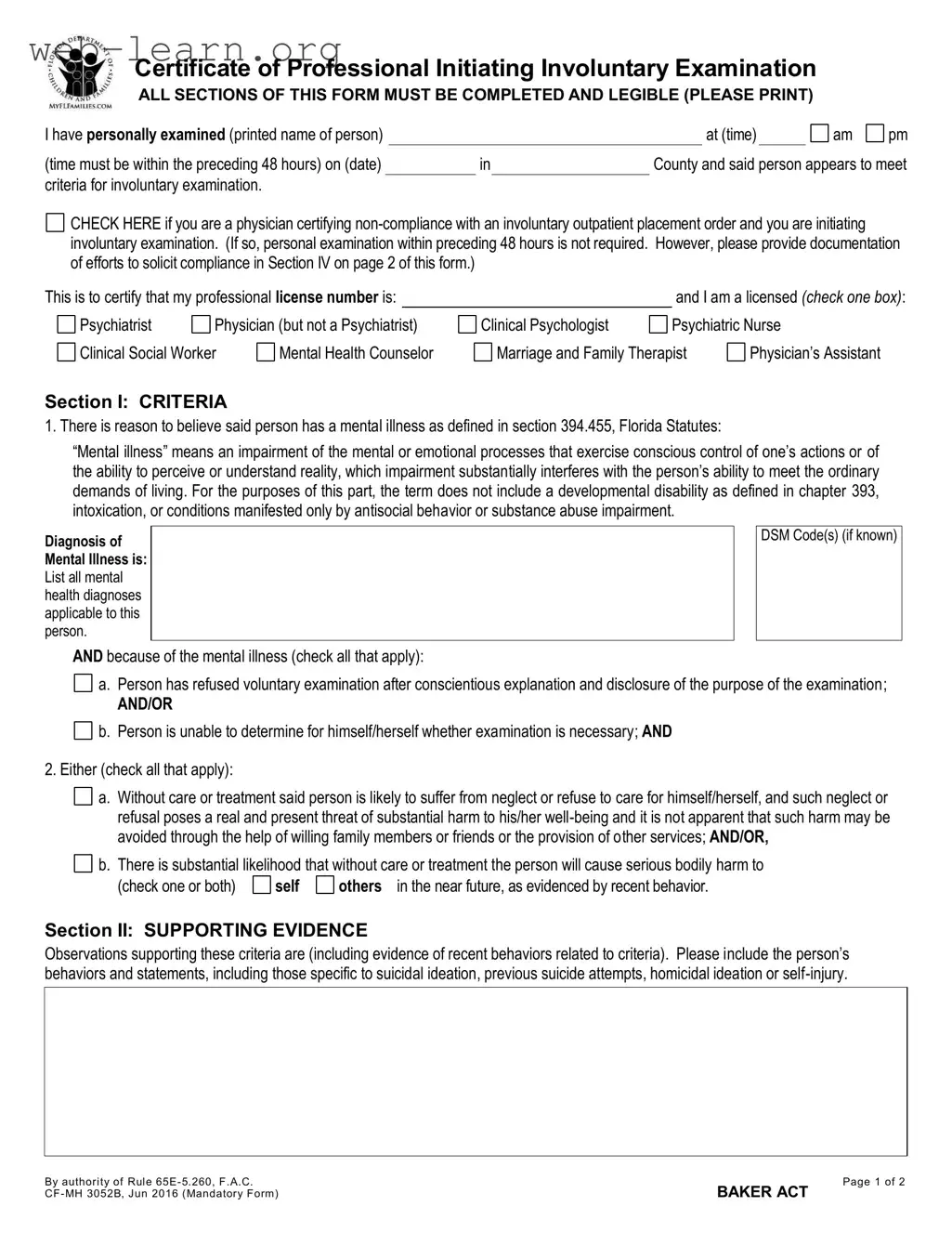
The Baker Act form serves as a crucial tool in the mental health care system, facilitating the involuntary examination of individuals who may be experiencing a mental health crisis. This form must be completed in its entirety and legibly, ensuring that all necessary information is readily available for review. It begins with a certification from a qualified professional who has personally examined the individual within the last 48 hours. The form outlines specific criteria that must be met, including evidence of mental illness as defined by Florida law, and the individual’s refusal or inability to seek voluntary examination. Additionally, it requires documentation of behaviors that indicate a potential risk of harm to themselves or others. Supporting evidence must be provided, detailing observations and any relevant statements made by the individual. In cases where a person is non-compliant with an involuntary outpatient placement order, the form includes a section dedicated to documenting the physician's efforts to encourage adherence to treatment. Finally, the form collects identifying information to assist law enforcement in locating the individual if necessary. This comprehensive approach ensures that the needs of individuals in crisis are addressed with care and precision.


Sample - Baker Act Form

By authority of Rule 65E-5.260, F.A.C. Page 1 of 2
CF-MH 3052B, Jun 2016 (Mandatory Form) BAKER ACT
Certificate of Professional Initiating Involuntary Examination
ALL SECTIONS OF THIS FORM MUST BE COMPLETED AND LEGIBLE (PLEASE PRINT)
I have personally examined (printed name of person)
at (time)
am pm
(time must be within the preceding 48 hours) on (date)
County and said person appears to meet
criteria for involuntary examination.
CHECK HERE if you are a physician certifying non-compliance with an involuntary outpatient placement order and you are initiating
involuntary examination. (If so, personal examination within preceding 48 hours is not required. However, please provide documentation
of efforts to solicit compliance in Section IV on page 2 of this form.)
This is to certify that my professional license number is:
and I am a licensed (check one box):
Psychiatrist Physician (but not a Psychiatrist) Clinical Psychologist Psychiatric Nurse
Clinical Social Worker Mental Health Counselor Marriage and Family Therapist Physician’s Assistant
Section I: CRITERIA
1. There is reason to believe said person has a mental illness as defined in section 394.455, Florida Statutes:
“Mental illness means an impairment of the mental or emotional processes that exercise conscious control of one’s actions or of
the ability to perceive or understand reality, which impairment substantially interferes with the person’s ability to meet the ordinary
demands of living. For the purposes of this part, the term does not include a developmental disability as defined in chapter 393,
intoxication, or conditions manifested only by antisocial behavior or substance abuse impairment.
Diagnosis of
Mental Illness is:
List all mental
health diagnoses
applicable to this
person.
DSM Code(s) (if known)
AND because of the mental illness (check all that apply):
a. Person has refused voluntary examination after conscientious explanation and disclosure of the purpose of the examination;
AND/OR
b. Person is unable to determine for himself/herself whether examination is necessary; AND
2. Either (check all that apply):
a. Without care or treatment said person is likely to suffer from neglect or refuse to care for himself/herself, and such neglect or
refusal poses a real and present threat of substantial harm to his/her well-being and it is not apparent that such harm may be
avoided through the help of willing family members or friends or the provision of other services; AND/OR,
b. There is substantial likelihood that without care or treatment the person will cause serious bodily harm to
(check one or both)
self others in the near future, as evidenced by recent behavior.
Section II: SUPPORTING EVIDENCE
Observations supporting these criteria are (including evidence of recent behaviors related to criteria). Please include the person’s
behaviors and statements, including those specific to suicidal ideation, previous suicide attempts, homicidal ideation or self-injury.
Certificate of Professional Initiating Involuntary Examination
By authority of Rule 65E-5.260, F.A.C. Page 2 of 2
CF-MH 3052B, Jun 2016 (Mandatory Form) BAKER ACT
Section III: OTHER INFORMATION
Other information, including source relied upon to reach this conclusion is as follows. If information is obtained from other persons,
describe these sources (e.g., reports of family, friends, other mental health professionals or law enforcement officers, as well as medical or
mental health records, etc.).
Section IV: NON-COMPLIANCE WITH INVOLUNTARY OUTPATIENT PLACEMENT ORDER
Complete this section if you are a physician who is documenting non-compliance with an involuntary outpatient placement
order: This is to certify that I am a physician, as defined in Florida Statutes 394.455, F.S. and in my clinical judgment, the person has
failed or has refused to comply with the treatment ordered by the court, and the following efforts have been made to solicit compliance
with the treatment plan:
Section V: INFORMATION FOR LAW ENFORCEMENT
Provide identifying information (if known) if requested by law enforcement to find the person so he/she may be taken into custody for
examination:
Age:
Male Female Race/ethnicity:
Other details (such as height, weight, hair color, what wearing when last seen, where last seen):
If relevant, information such as access to weapon, recent violence or pending criminal charges:
This form must be transported with the person to the receiving facility to be retained in the clinical record. Copies may be
retained by the initiating professional and by the law enforcement agency transporting the person to the receiving facility.
Section VI: SIGNATURE
am pm
Signature of Professional
Date Signed
Time
Printed Name of Professional Phone Number (including area code))

Form Information

Fact Name Description
Purpose The Baker Act form is used to initiate involuntary examination for individuals who may have a mental illness and are unable to seek help voluntarily.
Criteria for Examination Individuals must meet specific criteria, including a refusal of voluntary examination or an inability to determine the necessity of an examination due to their mental state.
Governing Law This form is governed by Florida Statutes, specifically section 394.455, which defines mental illness and outlines the criteria for involuntary examination.
Documentation Requirements All sections of the form must be completed and legible. Observations and supporting evidence must be documented to justify the need for involuntary examination.

Detailed Guide for Filling Out Baker Act

After completing the Baker Act form, it will be necessary to submit it to the appropriate authorities for further processing. This form serves as a critical document in the involuntary examination process, providing essential information about the individual in question.

  1. Begin by filling in your printed name in the designated space for the person examined.
  2. Record the time of your examination in the format of am or pm. Ensure that this time is within the preceding 48 hours.
  3. Indicate the date of the examination and the county where it took place.
  4. If applicable, check the box indicating that you are a physician certifying non-compliance with an involuntary outpatient placement order.
  5. Provide your professional license number and select your professional title from the options provided (e.g., Psychiatrist, Clinical Psychologist, etc.).
  6. In Section I, specify the mental illness diagnosis, including any relevant DSM codes.
  7. Check all applicable boxes that describe the individual's refusal of voluntary examination or inability to determine the necessity of examination.
  8. In the next part of Section I, check all boxes that apply regarding the potential harm or neglect the individual may face without care or treatment.
  9. Proceed to Section II and describe your observations that support the criteria listed in Section I. Include specific behaviors and statements related to suicidal or homicidal ideation.
  10. In Section III, provide any additional information that supports your conclusions, including sources of information.
  11. If you are a physician documenting non-compliance with an involuntary outpatient placement order, complete Section IV with relevant details about the individual’s refusal to comply with the treatment ordered by the court.
  12. In Section V, fill in identifying information about the individual, including age, gender, race/ethnicity, and any other relevant details that may assist law enforcement.
  13. Finally, sign and date the form in Section VI, ensuring your printed name and phone number are also included.

Obtain Answers on Baker Act

  1. What is the Baker Act?

    The Baker Act is a Florida law that allows for the involuntary examination and treatment of individuals who may be experiencing a mental health crisis. It is designed to protect individuals who are unable to make decisions about their care due to mental illness.

  2. Who can initiate a Baker Act examination?

    A Baker Act examination can be initiated by a qualified professional, such as a physician, clinical social worker, or mental health counselor. The professional must personally examine the individual within 48 hours prior to completing the Baker Act form.

  3. What criteria must be met for a Baker Act examination?

    To qualify for a Baker Act examination, the individual must:

    • Have a mental illness as defined by Florida law.
    • Refuse voluntary examination after being informed of its purpose.
    • Be unable to determine the necessity of an examination.
    • Pose a real and present threat of substantial harm to themselves or others.
  4. What information is required on the Baker Act form?

    The Baker Act form must include:

    • The professional's name and license number.
    • The individual's mental health diagnoses and DSM codes.
    • Supporting observations and evidence related to the individual's behavior.
    • Any other relevant information, including sources of information.
  5. What happens after the Baker Act form is completed?

    Once the form is completed, it must be transported with the individual to the receiving facility. The facility will retain the form in the clinical record. Copies may also be kept by the initiating professional and law enforcement.

  6. Can a person be held under the Baker Act without their consent?

    Yes, individuals can be held under the Baker Act if they meet the criteria for involuntary examination. This is done to ensure their safety and the safety of others when they are unable to make informed decisions regarding their mental health.

  7. What if the individual complies with treatment after being placed under the Baker Act?

    If the individual begins to comply with treatment, the professional overseeing their care can reassess their condition. If they no longer meet the criteria for involuntary examination, they may be discharged from the facility.

  8. How can family members or friends help during the Baker Act process?

    Family members or friends can provide information about the individual’s behavior and history to the professional initiating the examination. They can also support the individual emotionally during this difficult time, but their involvement in the decision-making process is limited by the law.

Common mistakes

Filling out the Baker Act form correctly is crucial. Mistakes can lead to delays or even denial of necessary care. Here are eight common errors to avoid when completing this form.

First, many professionals fail to complete all sections of the form. Each part is essential for ensuring a comprehensive understanding of the individual’s situation. Leaving sections blank can result in confusion and hinder the process of involuntary examination.

Second, legibility is often overlooked. Handwriting that is difficult to read can create significant issues. Ensure that all information is printed clearly to avoid misinterpretation of critical details.

Another frequent mistake is not providing a diagnosis of mental illness. The form requires specific DSM codes and descriptions. Omitting this information can lead to questions about the validity of the examination request.

Additionally, professionals sometimes neglect to check all applicable boxes regarding the individual’s condition and behavior. Each checkbox is a vital indicator of the individual’s need for examination. Incomplete responses may suggest a lack of urgency or understanding of the situation.

Moreover, some professionals fail to include supporting evidence in Section II. This section is critical for justifying the need for involuntary examination. Detailed observations and statements about the individual’s behavior are necessary to support the claims made in the form.

Another common error is not documenting the source of information in Section III. If insights come from family, friends, or other professionals, these sources must be noted. This adds credibility to the assessment and provides a fuller picture of the individual’s circumstances.

Section IV often sees mistakes, particularly with physicians documenting non-compliance. It’s vital to clearly outline the efforts made to encourage compliance with the treatment plan. Without this information, the request for involuntary examination may lack the necessary foundation.

Finally, failing to provide accurate identifying information for law enforcement can create significant delays. This includes age, gender, and physical description. Providing thorough details ensures law enforcement can locate the individual quickly and efficiently.

In summary, attention to detail is paramount when completing the Baker Act form. Avoiding these common mistakes can expedite the process and ensure that individuals receive the necessary care they require.

Documents used along the form

The Baker Act is a crucial document used in Florida for initiating involuntary examinations of individuals who may be experiencing a mental health crisis. Along with the Baker Act form, several other documents are commonly utilized to support the process and ensure that all legal requirements are met. Here’s a list of related forms and documents you might encounter.

  • Involuntary Examination Petition: This document is filed by a petitioner, often a family member or mental health professional, requesting an involuntary examination of an individual. It outlines the reasons for the request and the individual’s behavior that warrants examination.
  • Notice of Rights: This form informs the individual subject to the Baker Act of their rights during the involuntary examination process. It includes information about the right to an attorney and the right to a hearing.
  • Clinical Assessment Report: This report is completed by a mental health professional after evaluating the individual. It summarizes the findings of the assessment and provides recommendations for treatment or further action.
  • Consent for Treatment: If the individual is deemed to need treatment following the examination, this document is used to obtain consent for any proposed treatment plan. It ensures that the individual understands and agrees to the treatment process.
  • Discharge Summary: Once the individual is discharged from the receiving facility, this document provides a summary of the treatment received, recommendations for follow-up care, and any necessary referrals to outpatient services.
  • Emergency Restraining Order: In some cases, an emergency restraining order may be necessary to protect the individual or others from potential harm. This document outlines the terms of the order and the duration of its enforcement.
  • Law Enforcement Transport Form: This form is completed by law enforcement when transporting an individual for examination. It includes details about the individual and any incidents that occurred during transport.

Each of these documents plays a vital role in the process surrounding the Baker Act. Understanding their purpose can help ensure that individuals receive the appropriate care and legal protections during a mental health crisis.

Similar forms

The Baker Act form is crucial for initiating involuntary examinations for individuals suspected of having a mental illness. Several other documents serve similar purposes in various contexts. Below are seven documents that share similarities with the Baker Act form:

  • Involuntary Commitment Petition: This document is filed in court to request the involuntary commitment of an individual who poses a danger to themselves or others due to mental illness. Like the Baker Act form, it requires evidence of the person's mental state and potential risks.
  • Emergency Detention Order: This order allows law enforcement to detain an individual for a short period when they are a danger to themselves or others. Similar to the Baker Act, it emphasizes immediate risk and the need for evaluation.
  • Mental Health Evaluation Report: This report is generated by mental health professionals following an assessment. It outlines the individual's mental health status, much like the supporting evidence section in the Baker Act form.
  • Physician's Certificate for Involuntary Treatment: This certificate is used to certify that a patient requires involuntary treatment due to mental illness. It parallels the Baker Act's requirement for professional certification and examination.
  • Consent for Treatment Form: While this form is used to obtain consent from patients for treatment, it shares the need for a thorough understanding of the individual's mental health status, akin to the Baker Act's criteria for examination.
  • Risk Assessment Tool: This tool evaluates the likelihood of an individual harming themselves or others. It is similar to the Baker Act form's criteria for assessing danger and mental health needs.
  • Advance Directive for Mental Health Treatment: This document outlines a person's preferences for mental health treatment during crises. Like the Baker Act, it addresses the individual's mental health needs but focuses on their wishes rather than involuntary measures.

Each of these documents plays a vital role in addressing mental health crises, emphasizing the importance of timely and appropriate intervention.

Dos and Don'ts

When filling out the Baker Act form, there are important dos and don’ts to keep in mind. This ensures the process goes smoothly and all necessary information is accurately provided.

  • Do print clearly and legibly in all sections of the form.
  • Do provide a complete and accurate description of the person’s mental health condition.
  • Don't leave any sections blank; all sections must be completed.
  • Don't use abbreviations or shorthand that may confuse the reader.

Misconceptions

  • Misconception 1: The Baker Act can be initiated by anyone.
  • This is incorrect. Only licensed professionals, such as psychiatrists or mental health counselors, can initiate the Baker Act process after a personal examination.

  • Misconception 2: A person can be held indefinitely under the Baker Act.
  • The Baker Act allows for a maximum of 72 hours of involuntary examination. After this period, a further legal process is required for continued detention.

  • Misconception 3: The Baker Act is only for individuals with severe mental illnesses.
  • The act is designed to address a range of mental health issues. It is applicable when a person poses a danger to themselves or others, regardless of the severity of the condition.

  • Misconception 4: Individuals are always aware of their need for examination.
  • Misconception 5: Family members can override the Baker Act.
  • Family members cannot prevent the initiation of the Baker Act if a licensed professional believes it is necessary for the individual’s safety.

  • Misconception 6: The Baker Act is a criminal charge.
  • The Baker Act is a mental health law, not a criminal statute. It is intended to provide care and treatment, not punishment.

  • Misconception 7: The person being examined has no rights during the process.
  • Individuals under the Baker Act retain certain rights, including the right to be informed of their situation and to receive appropriate care.

  • Misconception 8: The Baker Act is only applicable in Florida.
  • While the Baker Act is specific to Florida, other states have similar laws and procedures for involuntary examination and treatment.

  • Misconception 9: Once the Baker Act is initiated, the person will be hospitalized.
  • Not all individuals who undergo examination will be hospitalized. The outcome depends on the assessment made during the examination.

  • Misconception 10: The Baker Act process is quick and straightforward.
  • The process can be complex and may involve multiple steps, including assessments, documentation, and potential legal proceedings.

Key takeaways

Filling out and using the Baker Act form is a critical process that requires attention to detail and compassion for the individual involved. Here are some key takeaways to consider:

  • Complete All Sections: Ensure that every section of the form is filled out completely and legibly. This is essential for the form to be valid and effective.
  • Timeliness Matters: The personal examination must occur within 48 hours prior to filling out the form. This timeframe is crucial for accurately assessing the individual’s mental health status.
  • Documenting Non-Compliance: If the individual is non-compliant with an involuntary outpatient placement order, provide thorough documentation of efforts made to encourage compliance. This is important for legal and clinical purposes.
  • Observations Are Key: Include specific observations and behaviors that support the criteria for involuntary examination. This may involve detailing any suicidal or homicidal ideation, as well as self-injurious behavior.
  • Provide Context: When citing sources of information, include reports from family, friends, or other professionals. This context can be vital for understanding the individual’s situation.
  • Transport Requirements: The completed form must accompany the individual to the receiving facility. Retain copies for the initiating professional and law enforcement to ensure continuity of care.

By following these guidelines, the process can be navigated with care and professionalism, ensuring that the needs of the individual are prioritized.