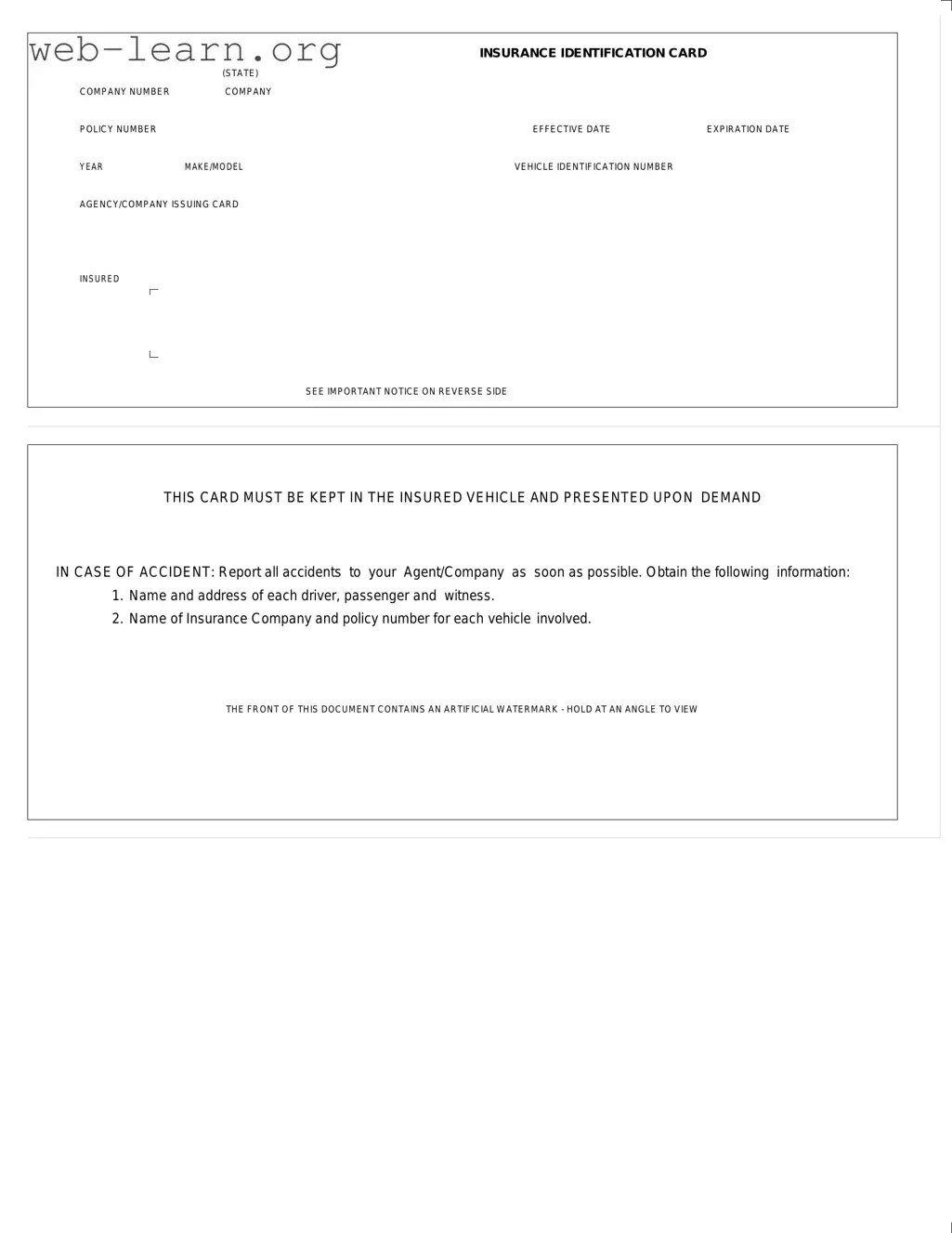
When it comes to driving legally and safely, having an Auto Insurance Card is essential. This important document serves as proof of your insurance coverage and contains key information that you may need in case of an accident. On the front of the card, you will find details such as the insurance company’s name, policy number, and the effective and expiration dates of your coverage. Additionally, the card lists the vehicle's make, model, and identification number, which helps identify the specific car covered under the policy. It is important to keep this card in your vehicle at all times, as you may be required to present it upon request during a traffic stop or after an accident. Furthermore, the card includes a reminder to report any accidents to your insurance agent as soon as possible, along with instructions on what information to gather from other parties involved. Lastly, a security feature, an artificial watermark, is included on the card to help prevent fraud, and it can be viewed by holding the card at an angle. Understanding the Auto Insurance Card not only helps you comply with legal requirements but also ensures that you are prepared in the event of an unexpected incident.

| Fact Name | Description |
|---|---|
| Insurance Identification Card | This card serves as proof of auto insurance coverage for the insured vehicle. |
| Company Number | The unique identifier assigned to the insurance company providing the policy. |
| Policy Number | This number identifies the specific insurance policy associated with the vehicle. |
| Effective and Expiration Dates | The effective date indicates when the coverage begins, while the expiration date shows when it ends. |
| Vehicle Information | Details such as the year, make, model, and vehicle identification number (VIN) are included. |
| Legal Requirement | Most states require drivers to keep this card in their vehicle and present it upon demand, as per state laws. |
Filling out the Auto Insurance Card form is a straightforward process. This card is essential for drivers, as it provides proof of insurance coverage. To ensure that you complete the form accurately, follow these steps carefully.
Once you have completed the form, keep it in your vehicle at all times. Remember, you must present it if requested during an accident. It's also crucial to report any accidents to your insurance agent as soon as possible.
What is an Auto Insurance Card?
An Auto Insurance Card serves as proof of insurance coverage for your vehicle. It includes essential information such as your insurance company, policy number, and the effective dates of your coverage. Keeping this card in your vehicle is a legal requirement in many states.
What information is included on the Auto Insurance Card?
The card typically contains the following details:
Why is it important to keep the Auto Insurance Card in my vehicle?
It is crucial to keep your Auto Insurance Card in your vehicle because you may need to present it during traffic stops or in the event of an accident. Law enforcement and other parties involved may require proof of insurance, and having the card readily available can help avoid potential legal issues.
What should I do if I lose my Auto Insurance Card?
If you lose your Auto Insurance Card, contact your insurance company or agent immediately. They can provide you with a replacement card or a digital version that you can keep on your phone. It’s important to have proof of insurance at all times.
What happens if I get into an accident?
In the event of an accident, you must report it to your insurance agent or company as soon as possible. Gather the following information:
This information will help your insurance company process your claim effectively.
What is the significance of the watermark on the card?
The front of the Auto Insurance Card contains an artificial watermark. This feature is designed to prevent fraud. You can view the watermark by holding the card at an angle. It serves as an additional security measure to ensure the card's authenticity.
Can I use a digital version of the Auto Insurance Card?
Many states allow the use of digital insurance cards displayed on your smartphone. However, check your state’s regulations to ensure that a digital version is acceptable. If permitted, having a digital card can be a convenient alternative to carrying a physical card.
What should I do if my policy is about to expire?
Before your policy expires, contact your insurance company to discuss renewal options. They can help you understand your coverage and any changes in premiums. Once renewed, you will receive a new Auto Insurance Card reflecting the updated policy information.
Is there a penalty for not having my Auto Insurance Card?
Yes, driving without proof of insurance can lead to penalties, including fines and possible legal repercussions. In some states, failing to present your Auto Insurance Card when required may result in additional points on your driving record or even suspension of your driver's license. Always keep your card in your vehicle to avoid these issues.
Filling out the Auto Insurance Card form can be straightforward, but mistakes often occur. One common error is failing to include the effective date and expiration date. These dates are crucial as they indicate when the coverage begins and ends. Without them, the form may be considered incomplete, leading to complications when presenting it in case of an accident.
Another frequent mistake is incorrect vehicle information. Many people overlook the year, make, and model of their vehicle. Providing accurate details is essential, as insurance companies need this information to verify coverage. Errors in this section can result in delays or issues with claims.
People also often forget to include the vehicle identification number (VIN). This unique number helps identify the specific vehicle covered by the insurance policy. Omitting the VIN can create confusion and may complicate the process of verifying coverage during an accident.
Some individuals mistakenly use the wrong company number or policy number. These numbers are unique to your insurance policy and must be entered accurately. A simple typo can lead to significant problems when trying to access your policy information.
In addition, many fail to keep the card in the insured vehicle. The instructions clearly state that this card must be kept in the vehicle and presented upon demand. Not having it available can lead to fines or complications during an accident.
Another mistake is not reviewing the important notice on the reverse side of the card. This notice often contains vital information regarding what to do in case of an accident. Ignoring this can lead to confusion and unnecessary stress when an accident occurs.
People sometimes neglect to report all accidents to their agent or company promptly. The instructions emphasize the importance of reporting accidents as soon as possible. Delays in reporting can hinder the claims process and may result in denied claims.
Lastly, many individuals do not keep a copy of the completed form for their records. Having a copy can be beneficial in case of disputes or questions about coverage. It serves as a reference point and can simplify communication with the insurance company.
When it comes to auto insurance, several important documents accompany the Auto Insurance Card. Each of these documents serves a specific purpose and can be crucial in various situations, such as accidents or policy inquiries. Below is a list of commonly used forms and documents.
Understanding these documents can help you navigate the complexities of auto insurance more effectively. Keeping them organized and accessible will ensure that you are prepared for any situation that may arise on the road.
The Auto Insurance Card form serves as a crucial document for vehicle owners, primarily for proof of insurance. Several other documents share similarities with the Auto Insurance Card, either in purpose or content. Below is a list of seven such documents:
When filling out the Auto Insurance Card form, it is essential to follow certain guidelines to ensure accuracy and compliance. Below is a list of things you should and shouldn't do:
Following these guidelines will help ensure that your Auto Insurance Card is filled out correctly and serves its purpose effectively.
Many people have misconceptions about the Auto Insurance Card form. Here are eight common misunderstandings and clarifications about them:
When it comes to filling out and using the Auto Insurance Card form, there are several important points to keep in mind. Understanding these can help ensure that you are adequately prepared in case of an accident.
Being diligent about these steps can help protect you and streamline the process if you find yourself in an accident situation. Stay informed and prepared.