Homepage Blank Australia 54 Form
Outline

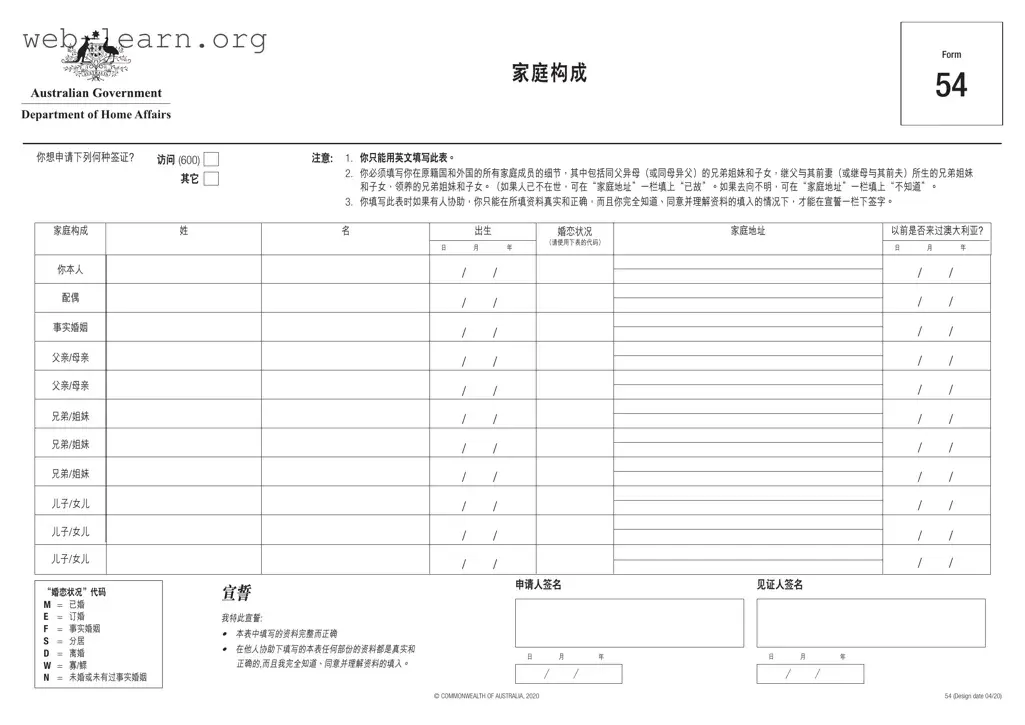
The Australia 54 form is an essential document for individuals applying for certain types of visas, including the Visitor visa (subclass 600). This form requires applicants to provide detailed information about their family composition, ensuring that all family members, whether residing in the home country or abroad, are accounted for. It includes sections for listing names, dates of birth, relationship statuses, and home addresses of family members, which encompass half-siblings, step-siblings, and adopted children. If any family members are deceased or their whereabouts are unknown, applicants can indicate this directly on the form. Completing the Australia 54 form must be done in English, and it is crucial that the information provided is accurate and complete. If assistance is used in filling out the form, the applicant must affirm that they fully understand and agree with the information submitted. The declaration at the end of the form serves as a confirmation of the truthfulness of the provided details, reinforcing the importance of accuracy in the visa application process.
Sample - Australia 54 Form

家庭構成
54
Form
你想申請下列何種簽証﹖
1.
你只能用英文填寫此表。
2.
你必須填寫你在原籍國和外國的所有家庭成員的細節,其中包括同父異母(或同母異父)的兄弟姐妹和子女,繼父與其前妻(或繼母與其前夫)所生的兄弟姐妹
和子女,領養的兄弟姐妹和子女。(如果人已不在世,可在“家庭地址”一欄填上“已故”。如果去向不明,可在“家庭地址”一欄填上“不知道”。
3.
你填寫此表時如果有人協助,你只能在所填資料真實和正確,而且你完全知道﹑同意並理解資料的填入的情況下,才能在宣誓一欄下籤字。
訪問
(600)
其它
/ /
/ /
/ /
/ /
/ /
/ /
/ /
/ /
/ /
/ /
/ /
/ /
/ /
/ /
/ /
/ /
/ /
/ /
/ /
/ /
你本人
配偶
父親/母親
父親/母親
兄弟
/
姐妹
兄弟
/
姐妹
兄弟
/
姐妹
兒子
/
女兒
兒子
/
女兒
兒子
/
女兒
54 (Design date 04/20)© COMMONWEALTH OF AUSTRALIA, 2020
注意﹕
家庭構成
/ /
/ /
事實婚姻
出生
婚戀狀況
(請使用下表的代碼)
家庭地址 以前是否來過澳大利亞﹖
“婚戀狀況”代碼
M =
已婚
E =
訂婚
F =
事實婚姻
S =
分居
D =
離婚
W =
寡/鰥
N =
未婚或未有過事實婚姻
申請人簽名
見證人簽名
我特此宣誓﹕
本表中填寫的資料完整而正確
在他人協助下填寫的本表任何部份的資料都是真實和
正確的﹐而且我完全知道﹑同意並理解資料的填入。
宣誓
Department of Home Affairs
Family composition
54
Form
Are you applying for a:
1. You must complete this form in English only.
2. You must give details of all your family members living in your home country and abroad including half, step and adopted brothers, sisters and children (if not living, write
‘Deceased’ in Home address column. If whereabouts unknown, write ‘Unknown’ in Home address column).
3. If you have been assisted in completing this form, you should only sign the Declaration if the information is true and correct and has been included with your full knowledge,
consent and understanding.
Visitor visa (600)
Other
Home address Previous visits to Australia
Given names Date of birth
DAY MONTH YEAR
/ /
/ /
/ /
/ /
/ /
/ /
/ /
/ /
/ /
/ /
/ /
/ /
/ /
/ /
/ /
/ /
/ /
/ /
/ /
/ /
Family name
Yourself
Spouse
Father/Mother
Father/Mother
Brother/sister
Brother/sister
Brother/sister
Son/daughter
Son/daughter
Son/daughter
Relationship status
(use codes below)
54 (Design date 04/20)© COMMONWEALTH OF AUSTRALIA, 2020
DAY MONTH YEAR
Note:
Family
composition
/ /
/ /
De facto
‘Relationship status’ codes
M = Married
E = Engaged
F = De facto
S = Separated
D = Divorced
W = Widowed
N = Never married or been in
a de facto relationship
DAY MONTH YEAR
Signature of applicant
DAY MONTH YEAR
Signature of witness
Declaration
I declare that:
the information I have given on this form is complete and correct.
in any section of this form which has been completed with the
assistance of another person, the information as set down is
true and correct and has been included with my full knowledge,
consent and understanding.
Department of Home Affairs

Form Information

Fact Name Description
Form Purpose The Australia 54 form is used for individuals applying for a Visitor visa (600) or other visa types.
Language Requirement This form must be completed in English only, ensuring clarity and consistency in communication.
Family Member Details Applicants must provide information about all family members, including half-siblings, step-siblings, and adopted children.
Deceased or Unknown Status If a family member is deceased, write "Deceased" in the home address column. For unknown whereabouts, write "Unknown."
Declaration Requirement Applicants must sign a declaration confirming the truthfulness and accuracy of the information provided, particularly if assisted by another person.
Governing Law This form is governed by Australian immigration law, specifically under the Migration Act 1958.

Detailed Guide for Filling Out Australia 54

After gathering the necessary information, the next step involves completing the Australia 54 form accurately. This form collects details about family composition, which is essential for visa applications. Properly filling out the form ensures that all relevant family members are accounted for, and it helps to provide a clear picture of the applicant's familial ties.

  1. Obtain the Australia 54 form and ensure it is the most recent version.
  2. Fill out the form in English only, as other languages are not accepted.
  3. Indicate the type of visa you are applying for by selecting either “Visitor visa (600)” or “Other.”
  4. Complete the section on family composition by providing the following details for each family member:
    • Family name
    • Given names
    • Date of birth (day, month, year)
    • Relationship status (use the provided codes)
    • Home address (if deceased, write ‘Deceased’; if unknown, write ‘Unknown’)
    • Previous visits to Australia (if applicable)
  5. Use the relationship status codes provided in the form to indicate each family member's status accurately.
  6. After completing the family composition section, review the information for accuracy and completeness.
  7. If someone assisted you in filling out the form, ensure you understand and agree with the information provided before signing.
  8. Sign the Declaration section, confirming the accuracy of the information.
  9. Have a witness sign the form as required.

Obtain Answers on Australia 54

  1. What is the purpose of the Australia 54 form?

    The Australia 54 form, also known as the Family Composition Form, is primarily used to gather detailed information about your family members when applying for a Visitor visa (600) or other types of visas. It ensures that the Australian immigration authorities have a complete understanding of your family structure.

  2. Who needs to be included in the form?

    You must provide details for all family members living in your home country and abroad. This includes:

    • Half-siblings
    • Step-siblings
    • Adopted siblings
    • Children, including adopted children

    If any family member is deceased, you should indicate this by writing "Deceased" in the Home Address column. If their whereabouts are unknown, write "Unknown."

  3. In what language should the form be completed?

    The form must be filled out in English only. This requirement is essential for processing your application accurately.

  4. What should I do if someone assists me in completing the form?

    If you receive assistance while filling out the form, you must ensure that the information provided is true and correct. You can only sign the Declaration section if you fully understand and agree with the information entered.

  5. What information is required about each family member?

    For each family member, you need to provide:

    • Full name
    • Date of birth
    • Relationship status (e.g., spouse, sibling)
    • Home address
    • Details of any previous visits to Australia
  6. What are the relationship status codes, and what do they mean?

    The form includes specific codes to indicate the relationship status of each family member. These codes are:

    • M = Married
    • E = Engaged
    • F = De facto
    • S = Separated
    • D = Divorced
    • W = Widowed
    • N = Never married or been in a de facto relationship
  7. Is it necessary to provide previous visit details?

    Yes, you must indicate whether you or any family member has previously visited Australia. This information helps immigration authorities assess your application more effectively.

  8. What happens if I provide false information?

    Providing false information on the Australia 54 form can lead to serious consequences, including the denial of your visa application or future applications. It is crucial to ensure that all information is accurate and truthful.

  9. How do I submit the completed form?

    Once you have completed the Australia 54 form, you will need to submit it along with your visa application. Ensure that all required documents are included to avoid delays in processing.

Common mistakes

Filling out the Australia 54 form can be a straightforward process, but there are common mistakes that applicants often make. One major error is failing to complete the form in English. Since the instructions clearly state that the form must be filled out in English only, using another language can lead to delays or even rejection of the application.

Another frequent mistake involves not including all family members. The form requires details of every family member living both in the home country and abroad. This includes half-siblings, step-siblings, and adopted children. Omitting any family member can result in incomplete information, which may negatively impact the application.

Some applicants also struggle with the relationship status codes. It is essential to use the correct codes provided in the form. Mislabeling one’s relationship status can create confusion and may lead to complications in the visa application process. For example, marking “M” for married when the applicant is actually separated can cause significant issues.

Additionally, many people overlook the importance of providing accurate home addresses for family members. If a family member is deceased, the applicant should write “Deceased” in the home address column. Similarly, if a family member's whereabouts are unknown, it is necessary to indicate “Unknown.” Failure to do so can result in questions about the integrity of the information provided.

Moreover, applicants often forget to sign the declaration section of the form. This signature confirms that the information provided is true and correct. Without a signature, the application may be considered incomplete, leading to further delays in processing.

Lastly, individuals sometimes fail to understand the implications of having assistance in completing the form. If someone else helps fill out the form, the applicant must ensure that they fully understand and agree with all the information provided. Signing the declaration without this understanding can lead to complications later on.

Documents used along the form

When applying for a visa, several forms and documents may accompany the Australia 54 form. Each of these documents plays a crucial role in ensuring that your application is complete and accurate. Here’s a brief overview of some of the most common forms used alongside the Australia 54 form.

  • Form 80 - Personal Particulars for Character Assessment: This form gathers detailed personal information about the applicant, including their background, travel history, and any criminal records. It helps assess the applicant's character and suitability for a visa.
  • Form 47P - Application for a Partner Visa: Used by individuals applying for a partner visa, this form requires information about the relationship between the applicant and their partner, including details about their life together.
  • Form 48R - Assurance of Support: This document is used to provide assurance that the applicant will have financial support in Australia. It typically requires a sponsor to sign and provide their financial details.
  • Form 1419 - Application for a Visitor Visa: If you are applying for a visitor visa, this form is essential. It collects information about the purpose of your visit, travel plans, and financial means.
  • Form 956 - Appointment of an Authorised Recipient: This form allows applicants to appoint someone to act on their behalf regarding their visa application. It can be particularly useful if you are working with an immigration agent.
  • Form 1194 - Statutory Declaration: This document is often required to provide additional information or clarification about your application. It must be signed in front of a witness and can be critical in supporting your case.
  • Form 1442 - Medical Examination Referral: If a medical examination is required as part of your visa application, this form will be issued to you. It directs you to a panel doctor for the necessary health assessments.
  • Form 1345 - Application for a Child Visa: For those applying for a visa on behalf of a child, this form is necessary. It includes details about the child's background, family situation, and reasons for the visa application.
  • Form 1470 - Request for a Refund: If you need to withdraw your application or request a refund of your visa application fee, this form is used to formally request that refund.

Each of these forms and documents serves a specific purpose in the visa application process. By understanding their roles and ensuring you have them ready, you can help facilitate a smoother application experience. Always remember to double-check your forms for accuracy and completeness before submission.

Similar forms

The Australia 54 form, which is used to detail family composition for visa applications, shares similarities with several other important documents. Here are four such documents:

  • Form I-130 (Petition for Alien Relative): This form is utilized in the United States for U.S. citizens or lawful permanent residents to establish a qualifying relationship with a foreign relative. Like the Australia 54 form, it requires detailed information about family members, including their names, relationships, and addresses.
  • Form DS-260 (Immigrant Visa and Alien Registration Application): This application is necessary for individuals seeking an immigrant visa to enter the U.S. It also demands comprehensive family information, similar to the Australia 54 form, ensuring that all relevant relationships are documented for immigration purposes.
  • Form N-400 (Application for Naturalization): Those applying for U.S. citizenship must complete this form, which includes questions about family members. It parallels the Australia 54 form in that it seeks to clarify the applicant's family structure and history, aiding in the evaluation of the application.
  • Form G-325A (Biographic Information): This form is often required for various immigration applications in the U.S. It collects personal and family information, similar to the Australia 54 form, ensuring a thorough understanding of the applicant's background and familial connections.

Dos and Don'ts

When filling out the Australia 54 form, it's important to follow specific guidelines to ensure accuracy and compliance. Here are seven things you should and shouldn't do:

  • Do complete the form in English only.
  • Do provide details for all family members, including half, step, and adopted relatives.
  • Do write 'Deceased' for family members who are no longer living.
  • Do ensure that all information is accurate and complete before signing.
  • Don't leave any required fields blank.
  • Don't sign the Declaration unless you fully understand the information provided.
  • Don't use abbreviations or codes that are not specified in the instructions.

Misconceptions

Misconceptions about the Australia 54 form can lead to confusion and errors in the application process. Here are ten common misconceptions clarified:

  1. Only immediate family needs to be listed. Many believe that only parents and siblings must be included. In fact, all family members, including half-siblings, step-siblings, and adopted children, must be listed.
  2. The form can be filled out in any language. Some applicants think they can submit the form in their native language. However, it must be completed in English only.
  3. Deceased family members do not need to be mentioned. There is a misconception that deceased relatives can be omitted. Instead, applicants should indicate 'Deceased' in the home address column for those who have passed away.
  4. It is acceptable to leave sections blank. Some individuals think they can skip questions. All sections must be filled out, even if the answer is 'unknown' for certain family members.
  5. Assistance in completing the form is not allowed. Many believe they must fill out the form entirely on their own. In reality, assistance is permitted, but the applicant must ensure the information is accurate and truthful.
  6. Only current family members need to be listed. Some applicants think only living family members should be included. However, the form requires details of all family members, regardless of their current status.
  7. Previous visits to Australia are optional to report. There is a belief that applicants can choose not to disclose past visits. In fact, all previous visits to Australia must be documented.
  8. Signatures can be provided without a witness. Some individuals think they can sign the form without a witness. However, a witness signature is mandatory for the declaration section.
  9. Filling out the form correctly guarantees visa approval. Many assume that a correctly filled form ensures visa approval. While accuracy is crucial, it does not guarantee that the visa will be granted.
  10. Once submitted, the form cannot be amended. Some applicants believe that they cannot make changes after submission. In fact, corrections can be made if the application is still under review.

Understanding these misconceptions can help applicants navigate the process more effectively and avoid potential pitfalls.

Key takeaways

When filling out and using the Australia 54 form, it is essential to understand the following key points:

  • Language Requirement: The form must be completed in English only. This ensures that all information is clear and understandable for processing.
  • Family Details: You are required to provide information about all family members, including half-siblings, step-siblings, and adopted children. If any family member is deceased or their whereabouts are unknown, you should indicate this in the home address section.
  • Declaration of Truth: If someone assists you in completing the form, you must only sign the declaration if you are fully aware of the information provided and can confirm its accuracy. This is a critical step in the application process.
  • Relationship Status Codes: Familiarize yourself with the relationship status codes (e.g., M for Married, E for Engaged). These codes must be used correctly to avoid confusion during processing.