Homepage Blank Ata 106 Form
Outline

The ATA 106 form serves as a crucial document in the aviation and aerospace industries, particularly for the certification of parts and materials. This form is designed to ensure that sellers and buyers maintain transparency regarding the origin and condition of components used in aircraft maintenance and repairs. Key elements of the form include the seller's information, including name, address, and contact details, as well as the specific details of the item being certified, such as the manufacturer, part number, and quantity. The form also requires verification of whether the parts are new or have undergone repair or overhaul. Signatures from authorized representatives are mandatory, attesting to the accuracy of the information provided and binding the parties to its contents. The form emphasizes the importance of compliance with FAA regulations and industry standards, thereby holding both the seller and signer accountable for any inaccuracies that may arise. In essence, the ATA 106 form not only facilitates the flow of information between parties but also plays a pivotal role in maintaining safety and regulatory compliance in aviation operations.
Sample - Ata 106 Form

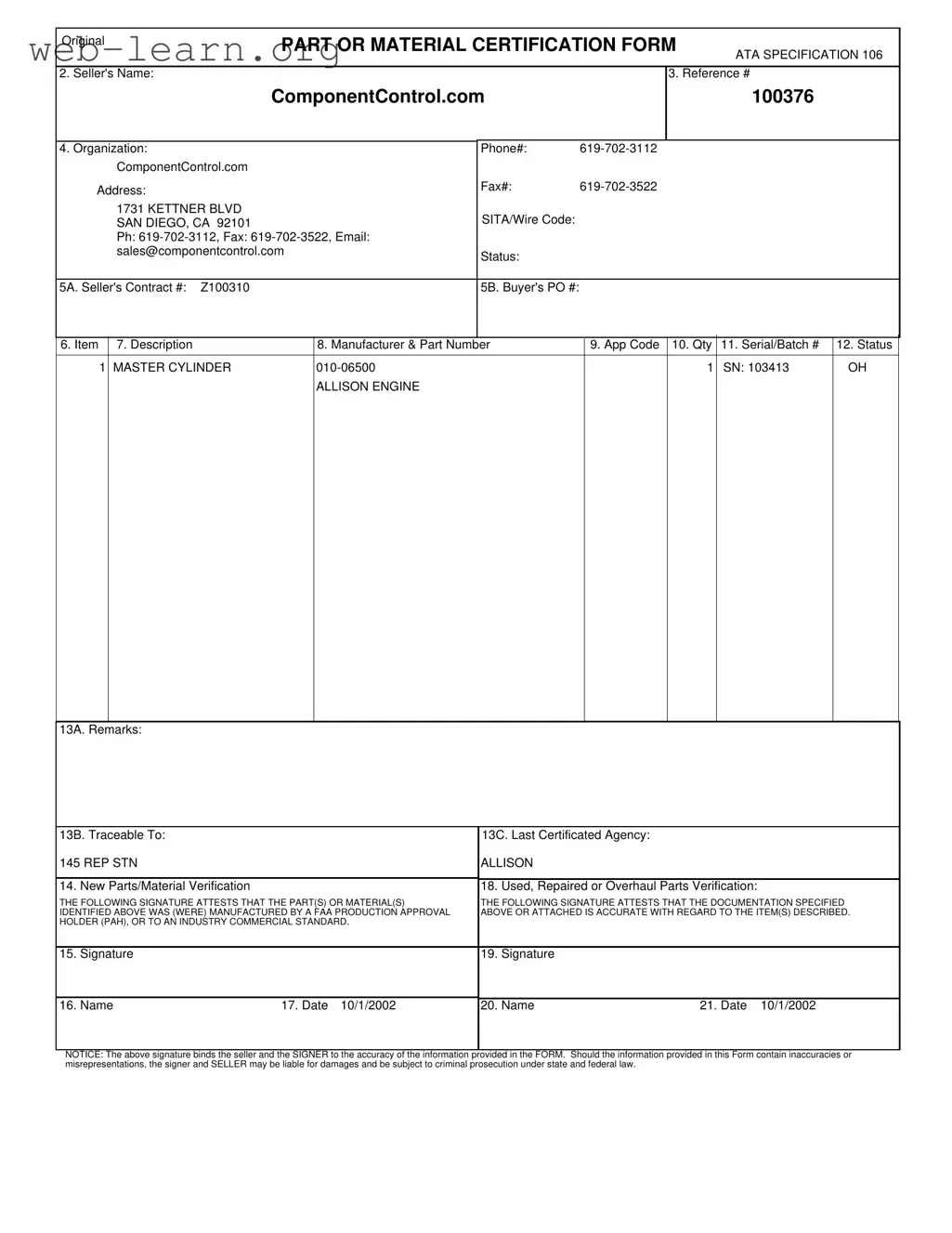
1731 KETTNER BLVD
SAN DIEGO, CA 92101
Ph: 619-702-3112, Fax: 619-702-3522, Email:
PART OR MATERIAL CERTIFICATION FORM
2. Seller's Name:
ATA SPECIFICATION 106
3. Reference #
ComponentControl.com
100376
4. Organization:
Phone#:
ComponentControl.com
Address:
Fax#:
SITA/Wire Code:
Status:
5A. Seller's Contract #:
Z100310
5B. Buyer's PO #:
6. Item
7. Description
8. Manufacturer & Part Number
9. App Code
10. Qty
11. Serial/Batch #
12. Status
Original
1
010-06500
1
SN:
OH
ALLISON ENGINE
103413
MASTER CYLINDER
13A. Remarks:
13B. Traceable To:
145 REP STN
ALLISON
14. New Parts/Material Verification
18. Used, Repaired or Overhaul Parts Verification:
THE FOLLOWING SIGNATURE ATTESTS THAT THE PART(S) OR MATERIAL(S)
IDENTIFIED ABOVE WAS (WERE) MANUFACTURED BY A FAA PRODUCTION APPROVAL
HOLDER (PAH), OR TO AN INDUSTRY COMMERCIAL STANDARD.
THE FOLLOWING SIGNATURE ATTESTS THAT THE DOCUMENTATION SPECIFIED
ABOVE OR ATTACHED IS ACCURATE WITH REGARD TO THE ITEM(S) DESCRIBED.
19. Signature
20. Name
16. Name
17. Date
10/1/2002
21. Date
10/1/2002
15. Signature
NOTICE: The above signature binds the seller and the SIGNER to the accuracy of the information provided in the FORM. Should the information provided in this Form contain inaccuracies or
misrepresentations, the signer and SELLER may be liable for damages and be subject to criminal prosecution under state and federal law.

Form Information

Fact Name Details
Form Purpose The ATA 106 form certifies the authenticity and compliance of parts or materials used in aviation.
Seller Information Seller's name is ComponentControl.com, located at 1731 Kettner Blvd, San Diego, CA 92101.
Contact Details Phone: 619-702-3112, Fax: 619-702-3522, Email: [email protected].
Contract and PO Numbers Seller's Contract #: Z100310; Buyer's PO #: Not specified.
Item Description The form includes details about a master cylinder with part number 010-06500.
Manufacturer Verification Parts must be verified as manufactured by an FAA Production Approval Holder or to an industry commercial standard.
Signature Requirement The form requires signatures from both the seller and the buyer, attesting to the accuracy of the information provided.
Legal Implications Inaccuracies in the form may lead to liability for damages and possible criminal prosecution under state and federal law.
Governing Laws This form is governed by FAA regulations and relevant state laws concerning aviation safety and compliance.

Detailed Guide for Filling Out Ata 106

Filling out the ATA 106 form is a straightforward process that requires attention to detail. This form is essential for certifying parts or materials and ensuring compliance with industry standards. Follow these steps carefully to complete the form accurately.

  1. Begin by entering the seller's name in the designated field. In this case, it is ComponentControl.com.
  2. Next, input the reference number, which is 100376.
  3. Provide the organization name, again ComponentControl.com, followed by the complete address: 1731 KETTNER BLVD SAN DIEGO, CA 92101.
  4. Fill in the contact details, including phone number: 619-702-3112, fax number: 619-702-3522, and email: [email protected].
  5. Enter the SITA/Wire Code if applicable, followed by the status field.
  6. For section 5A, provide the seller's contract number: Z100310.
  7. In section 5B, input the buyer's purchase order number.
  8. Proceed to section 6 and list the item, which in this case is MASTER CYLINDER.
  9. In section 7, describe the item, followed by the manufacturer and part number in section 8: 010-06500.
  10. Fill in the app code in section 9, followed by the quantity in section 10.
  11. In section 11, provide the serial or batch number: SN: 103413.
  12. Indicate the status of the item in section 12.
  13. In section 13A, add any remarks, and for section 13B, indicate what the item is traceable to.
  14. For section 13C, specify the last certificated agency: 145 REP STN ALLISON.
  15. Complete section 14 by verifying if the parts or materials are new.
  16. In section 18, verify if the parts have been used, repaired, or overhauled.
  17. Sign the form in section 15, followed by printing your name in section 16.
  18. Enter the date in section 17: 10/1/2002.
  19. Another signature is required in section 19, along with the name in section 20 and date in section 21, also 10/1/2002.

Obtain Answers on Ata 106

  1. What is the ATA 106 form?

    The ATA 106 form is an Original Part or Material Certification form used to verify the authenticity and compliance of aviation parts. It ensures that the parts meet the required standards set by the FAA or industry commercial standards.

  2. Who needs to use the ATA 106 form?

    This form is primarily used by sellers and buyers in the aviation industry. Sellers of aircraft parts must complete the form to certify that their parts are genuine and meet safety regulations. Buyers can request this form to ensure they are purchasing compliant parts.

  3. What information is required on the ATA 106 form?

    The form requires various details, including:

    • Seller's name and contact information
    • Buyer's purchase order number
    • Description of the item
    • Manufacturer and part number
    • Quantity and serial or batch number
    • Verification signatures and dates
  4. What does the signature on the ATA 106 form signify?

    The signature on the form attests to the accuracy of the information provided. By signing, the seller and the signer confirm that the parts were manufactured by an FAA Production Approval Holder or meet industry standards. This signature also carries legal responsibilities.

  5. What are the consequences of inaccuracies on the ATA 106 form?

    If the information on the form is found to be inaccurate or misleading, both the signer and the seller may face legal liabilities. This could include damages or even criminal prosecution under state and federal laws.

  6. How can I obtain an ATA 106 form?

    You can typically obtain the ATA 106 form from your supplier or directly from aviation regulatory websites. Many companies also provide templates for the form that can be filled out electronically or printed for manual completion.

  7. Is the ATA 106 form required for all aviation parts?

    While not every aviation part requires an ATA 106 form, it is essential for parts that need certification for safety and compliance. Always check with your regulatory authority or industry standards to determine if the form is necessary for specific parts.

  8. What should I do if I have questions about filling out the ATA 106 form?

    If you have questions, consider reaching out to your supplier or a legal expert in aviation compliance. They can provide guidance on how to accurately complete the form and ensure you meet all necessary requirements.

Common mistakes

Filling out the ATA 106 form can be a straightforward process, but there are common mistakes that people often make. One frequent error is leaving out essential information. For example, if the seller's name or the buyer's purchase order number is missing, it can lead to delays and complications in processing. Always ensure that all required fields are filled out completely and accurately.

Another mistake occurs when individuals fail to double-check the accuracy of the part numbers and descriptions. Inaccurate details can result in the wrong parts being delivered, which may cause significant disruptions. It is crucial to verify that the manufacturer and part number match the items being certified. Taking a moment to cross-check this information can save a lot of trouble down the line.

People also sometimes overlook the importance of signatures and dates. Both the seller and buyer must sign the form, and their names and dates must be included. If any of these elements are missing, the form may be considered incomplete. This oversight can lead to legal issues and liability for both parties. Always ensure that all signatures are present and that dates are filled in correctly.

Finally, failing to understand the implications of the certification can lead to serious consequences. The form states that the signer attests to the accuracy of the information provided. Misrepresentations can result in legal repercussions. Therefore, it is essential to comprehend the responsibilities that come with signing this document. Taking the time to read and understand the form can prevent potential issues and ensure compliance with regulations.

Documents used along the form

The ATA 106 form is essential for certifying parts or materials in the aviation industry. Alongside this form, several other documents are commonly used to ensure compliance and maintain proper records. Below is a list of these documents, each serving a specific purpose.

  • Bill of Lading: This document serves as a receipt for the shipment of goods. It outlines the details of the cargo, including the type, quantity, and destination. It is crucial for tracking shipments and confirming delivery.
  • Certificate of Conformance: This document verifies that the supplied parts meet the required specifications and standards. It is often required to ensure that products are compliant with industry regulations.
  • Purchase Order (PO): A purchase order is issued by the buyer to the seller, detailing the items being purchased, prices, and delivery terms. It serves as a formal agreement and helps in tracking orders and payments.
  • Inspection Report: This report documents the findings from inspections conducted on parts or materials. It includes details about the condition of the items and any discrepancies that may need addressing.

Each of these documents plays a vital role in the procurement and certification process within the aviation industry. Proper handling and management of these forms help maintain safety and compliance standards.

Similar forms

The ATA 106 form is a crucial document in the aviation industry, primarily used for certifying parts or materials. It shares similarities with several other documents that also serve to verify the authenticity and compliance of aviation components. Below is a list of seven documents that are similar to the ATA 106 form, along with a brief explanation of how they are alike:

  • FAA Form 8130-3: This form is used for the airworthiness approval of aircraft parts. Like the ATA 106, it certifies that the part meets specific regulatory standards and is safe for use.
  • Certificate of Conformance (C of C): This document confirms that the supplied parts conform to the specifications and requirements. Similar to the ATA 106, it ensures that the parts are compliant with industry standards.
  • Part Manufacturer Approval (PMA) Documentation: PMA documentation certifies that a manufacturer has been approved by the FAA to produce specific parts. This is akin to the ATA 106 in that both confirm the legitimacy of the parts being sold.
  • Maintenance Release or Logbook Entry: This document provides a record of maintenance performed on an aircraft. It parallels the ATA 106 by ensuring that all work done meets regulatory requirements and is properly documented.
  • Service Bulletins (SB): These are issued by manufacturers to inform operators of necessary actions regarding parts. Like the ATA 106, they provide critical information for maintaining safety and compliance.
  • Airworthiness Directive (AD): An AD is a legally enforceable rule issued by the FAA to correct an unsafe condition. It shares the goal of ensuring safety, much like the ATA 106 form does for parts certification.
  • Quality Assurance (QA) Certificates: These certificates verify that a product meets quality standards. They are similar to the ATA 106 in that both documents assure the buyer of the quality and compliance of the parts being purchased.

Each of these documents plays a vital role in maintaining safety and compliance within the aviation industry, highlighting the importance of accurate and trustworthy certification processes.

Dos and Don'ts

When filling out the ATA 106 form, it's essential to be thorough and accurate. Here are four important dos and don'ts to keep in mind:

  • Do ensure all required fields are completed. Missing information can lead to delays or complications.
  • Do double-check the accuracy of the seller's and buyer's information. This includes names, addresses, and contact details.
  • Don't use abbreviations or shorthand that may confuse the reader. Clarity is key.
  • Don't overlook the signature section. Both the seller and buyer must sign to validate the form.

Following these guidelines can help streamline the process and ensure that your form is processed without unnecessary issues.

Misconceptions

Understanding the ATA 106 form is crucial for anyone involved in the aviation parts industry. Unfortunately, several misconceptions can lead to confusion. Here are nine common misconceptions, along with clarifications:

  • The ATA 106 form is only for new parts. This form can be used for both new and used parts, including those that have been repaired or overhauled.
  • Only manufacturers can complete the ATA 106 form. While manufacturers often fill out this form, authorized representatives or sellers can also provide the necessary information.
  • The form guarantees the quality of the parts. While the ATA 106 form certifies that the information provided is accurate, it does not guarantee the actual quality or condition of the parts.
  • All parts must have a unique serial number. While many parts do have serial numbers, not all items require them. The form allows for batch numbers as well.
  • The signatures on the form are just formalities. The signatures carry significant weight. They bind the signer and the seller to the accuracy of the information, making them liable for any misrepresentations.
  • Once submitted, the form cannot be corrected. If inaccuracies are discovered, it is possible to amend the form, but it should be done promptly to avoid potential liability.
  • The ATA 106 form is only relevant for domestic transactions. This form is widely recognized and used internationally, making it important for both domestic and international sales.
  • Compliance with the ATA 106 form is optional. For many transactions, especially those involving regulated parts, completing this form is a necessary requirement.
  • The ATA 106 form is a one-size-fits-all document. The form may vary in format or requirements based on the specific transaction or the parties involved, so it is essential to understand the context of its use.

By addressing these misconceptions, individuals and organizations can better navigate the complexities of the aviation parts industry and ensure compliance with necessary regulations.

Key takeaways

Here are key takeaways about filling out and using the ATA 106 form:

  1. Ensure Accuracy: Double-check all entries for correctness. Inaccuracies can lead to serious consequences.
  2. Complete Seller Information: Include the seller's name, address, and contact details. This information is crucial for communication.
  3. Reference Numbers: Always fill in the reference number. This helps in tracking and managing the transaction.
  4. Item Details: Provide a detailed description of the item, including the manufacturer and part number. Clarity is key.
  5. Serial or Batch Number: Record the serial or batch number. This is essential for traceability.
  6. Verification Sections: Complete the new parts/material verification and used, repaired, or overhaul parts verification sections accurately.
  7. Signatures Required: Ensure that both the seller and buyer sign the form. Their signatures confirm the accuracy of the information.
  8. Date Entries: Include the date next to each signature. This provides a timeline for the transaction.
  9. Understand Liability: Be aware that inaccuracies can result in liability for damages and potential legal consequences.

By following these guidelines, you can effectively fill out and utilize the ATA 106 form, ensuring compliance and accuracy in your transactions.