The Articles of Incorporation form serves as a crucial document for anyone looking to establish a corporation in the United States. This form outlines essential information about the business, including its name, purpose, and the location of its registered office. Additionally, it specifies the number of shares the corporation is authorized to issue and the names and addresses of the initial directors. By filing this form with the appropriate state authorities, entrepreneurs can officially create a legal entity that is separate from its owners, providing liability protection and potential tax benefits. Understanding the key components and requirements of the Articles of Incorporation is vital for anyone embarking on the journey of forming a corporation, as it lays the foundation for future operations and compliance with state regulations.
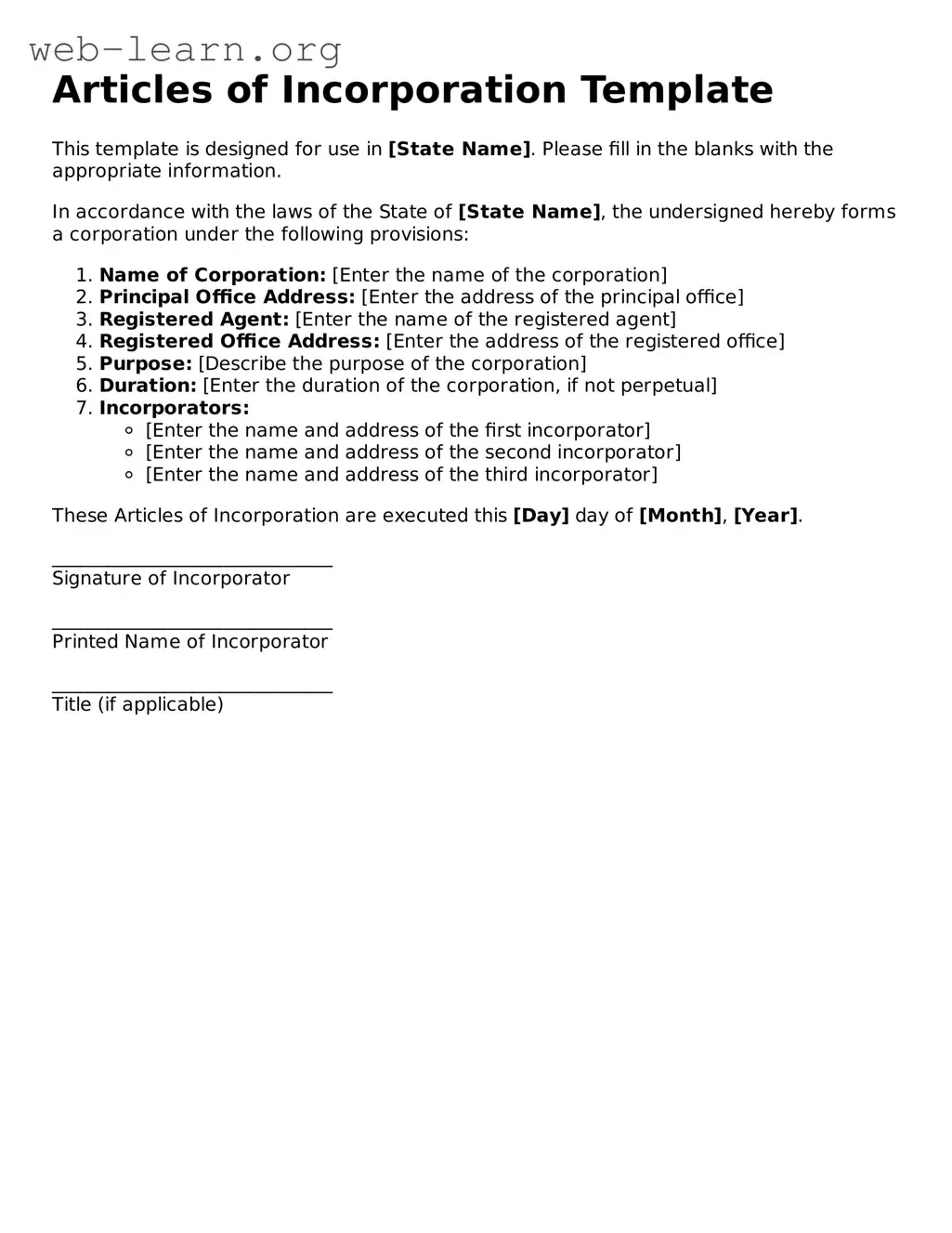
Articles of Incorporation Template
This template is designed for use in [State Name]. Please fill in the blanks with the appropriate information.
In accordance with the laws of the State of [State Name], the undersigned hereby forms a corporation under the following provisions:
These Articles of Incorporation are executed this [Day] day of [Month], [Year].
______________________________
Signature of Incorporator
______________________________
Printed Name of Incorporator
______________________________
Title (if applicable)
| Fact Name | Description |
|---|---|
| Definition | The Articles of Incorporation is a legal document that establishes a corporation in the U.S. |
| Purpose | This document outlines the basic information about the corporation, such as its name and purpose. |
| State-Specific Forms | Each state has its own specific form for Articles of Incorporation, which must be filed with the state government. |
| Governing Laws | The formation of a corporation is governed by state laws, which vary by jurisdiction. |
| Required Information | Typically, the form requires the corporation's name, address, registered agent, and the number of shares authorized. |
| Filing Fee | A filing fee is usually required when submitting the Articles of Incorporation, and this fee varies by state. |
| Approval Process | Once filed, the state reviews the document for compliance before granting approval. |
| Public Record | After approval, the Articles of Incorporation become a public record, accessible to anyone. |
| Amendments | Changes to the Articles of Incorporation can be made by filing an amendment with the state. |
After completing the Articles of Incorporation form, you will submit it to the appropriate state agency. This process is essential for officially establishing your corporation. Once submitted, you will receive confirmation and further instructions on the next steps.
What are Articles of Incorporation?
Articles of Incorporation are legal documents that establish a corporation in the United States. They outline the basic details of the corporation, such as its name, purpose, and structure. Filing these documents is a crucial step in the process of forming a corporation.
Why do I need to file Articles of Incorporation?
Filing Articles of Incorporation is necessary to legally create a corporation. This document provides legal recognition, which is essential for conducting business, opening bank accounts, and protecting personal assets from business liabilities.
What information is required in the Articles of Incorporation?
Typically, the following information is required:
Where do I file the Articles of Incorporation?
Articles of Incorporation must be filed with the Secretary of State or the appropriate state agency in the state where you plan to incorporate. Each state has its own filing requirements and fees, so it’s important to check local regulations.
How much does it cost to file Articles of Incorporation?
The filing fee varies by state. Generally, it can range from $50 to several hundred dollars. Additional fees may apply for expedited processing or other services. Always verify the current fees with your state’s Secretary of State office.
How long does it take to process Articles of Incorporation?
Processing times can vary significantly by state. Some states offer same-day processing, while others may take several weeks. It is advisable to check with your state’s office for specific timelines.
Can I amend my Articles of Incorporation after filing?
Yes, you can amend your Articles of Incorporation after they have been filed. This process typically requires submitting an amendment form and paying a fee. Common reasons for amendments include changes in the corporation’s name or structure.
Do I need a lawyer to file Articles of Incorporation?
While it is not required to have a lawyer, consulting one can be beneficial, especially if your corporation has complex needs. Many individuals successfully file Articles of Incorporation on their own using resources available through state agencies.
When filling out the Articles of Incorporation form, individuals often overlook important details that can lead to delays or complications in the incorporation process. One common mistake is failing to provide accurate information about the corporation's name. The name must be unique and not too similar to existing businesses in the state. If this step is neglected, it could result in the rejection of the application. Taking the time to conduct a thorough name search can save a lot of trouble down the line.
Another frequent error involves misidentifying the purpose of the corporation. While some may think a brief description suffices, it is essential to be clear and specific. The purpose should reflect the activities the corporation intends to engage in. A vague or overly broad description can raise questions during the review process, potentially leading to additional requests for clarification.
People also tend to overlook the importance of including all necessary information about the directors and officers. Omitting details such as their names and addresses can lead to delays. Each state has specific requirements regarding the number of directors, so it's crucial to check those regulations. Providing complete and accurate information helps ensure a smoother approval process.
Finally, many individuals forget to review the form for errors before submission. Simple mistakes, such as typos or incorrect information, can cause significant setbacks. Taking a moment to double-check the form can prevent unnecessary complications. It’s always a good idea to have someone else review the document as well, as a fresh set of eyes can catch mistakes that might have been missed.
When forming a corporation, several important documents accompany the Articles of Incorporation. Each of these documents plays a crucial role in establishing and maintaining the corporation's legal standing. Below is a list of commonly used forms and documents that often accompany the Articles of Incorporation.
Each of these documents is vital for the successful establishment and operation of a corporation. By ensuring that all necessary forms are completed and filed, business owners can lay a solid foundation for their new venture.
The Articles of Incorporation form is a crucial document for establishing a corporation. It shares similarities with several other legal documents. Here are four documents that are comparable to the Articles of Incorporation:
When filling out the Articles of Incorporation form, it is crucial to get it right. Here are five things you should and shouldn't do:
The Articles of Incorporation is a crucial document for establishing a corporation, yet several misconceptions surround it. Understanding these misconceptions can help individuals navigate the incorporation process more effectively.
While a business plan outlines a company's strategy and goals, the Articles of Incorporation serve as a formal declaration of the corporation's existence. They include essential details such as the corporation's name, purpose, and structure.
This is not true. Any business, regardless of size, that seeks to operate as a corporation must file Articles of Incorporation. This applies to small startups as well as large enterprises.
While there is some flexibility, it is essential to file Articles of Incorporation before commencing business operations. Failure to do so can lead to legal complications and potential fines.
Each state has its own requirements and procedures for filing Articles of Incorporation. It is crucial to consult the specific regulations in the state where the corporation will be established.
In reality, amendments can be made to the Articles of Incorporation after they have been filed. However, the process for making amendments varies by state and must be followed carefully.
While filing this document is an important step in starting a corporation, it does not ensure success. Effective management, a solid business model, and market demand play significant roles in a business's success.
This is incorrect. Nonprofit organizations also need to file Articles of Incorporation to establish their legal status and operate effectively.
Changes in the corporation, such as changes in leadership or business purpose, may necessitate updates to the Articles of Incorporation. Regular reviews are advisable to ensure compliance with current laws.
When filling out and using the Articles of Incorporation form, several key points should be kept in mind to ensure compliance and effectiveness.