The Arkansas Transfer-on-Death Deed form serves as an essential tool for individuals seeking to streamline the transfer of real property upon their passing. This legal document allows property owners to designate beneficiaries who will automatically receive ownership of the property without the need for probate. By completing this form, individuals can maintain control over their property during their lifetime while ensuring a smooth transition for their loved ones after death. The form requires specific information, including the names of the beneficiaries and a clear description of the property involved. Additionally, it must be signed in the presence of a notary public to ensure its validity. This deed not only simplifies the transfer process but also provides peace of mind, knowing that the property will be passed on according to the owner's wishes. Understanding the nuances of this form is crucial for anyone considering estate planning in Arkansas.
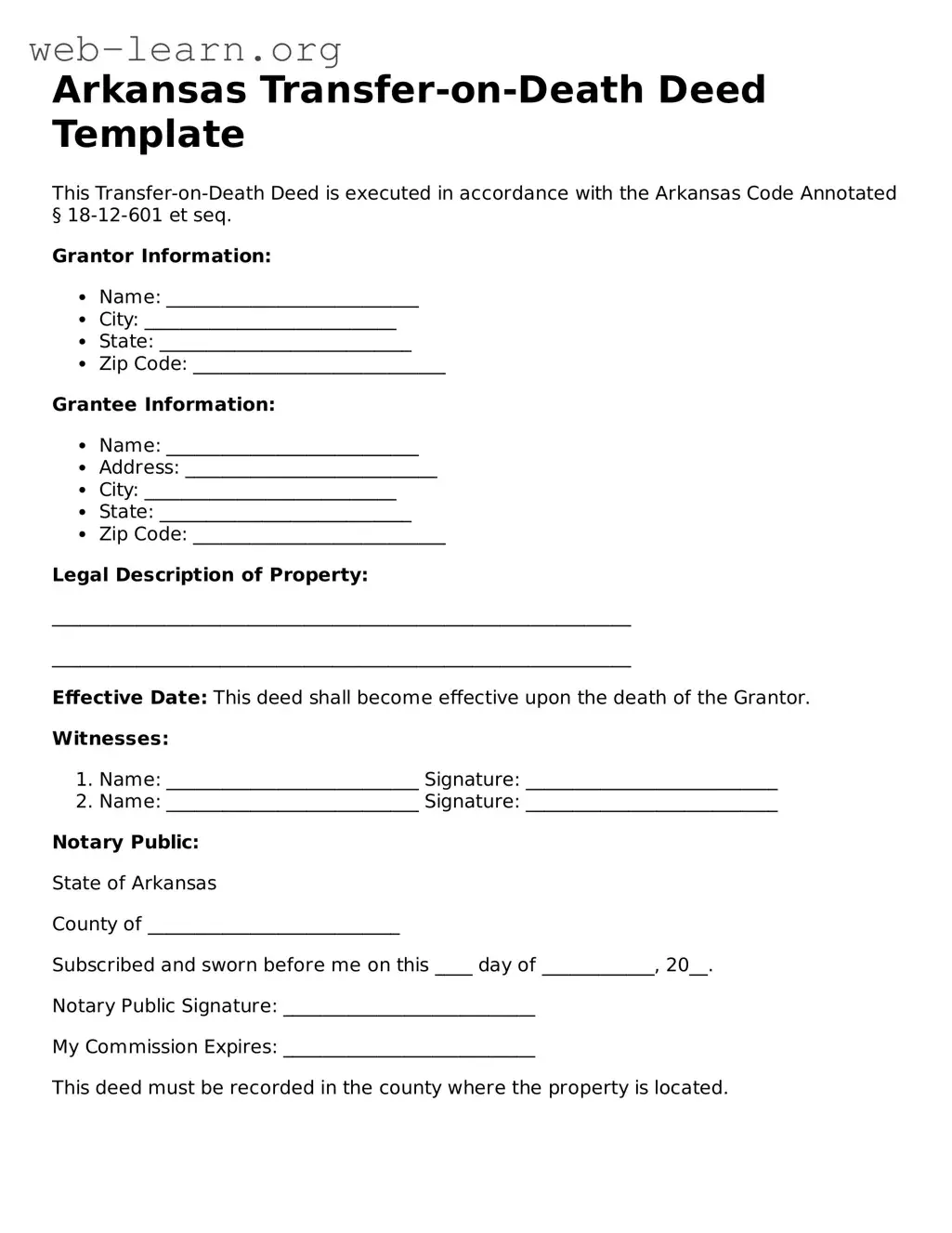
Arkansas Transfer-on-Death Deed Template
This Transfer-on-Death Deed is executed in accordance with the Arkansas Code Annotated § 18-12-601 et seq.
Grantor Information:
Grantee Information:
Legal Description of Property:
______________________________________________________________
______________________________________________________________
Effective Date: This deed shall become effective upon the death of the Grantor.
Witnesses:
Notary Public:
State of Arkansas
County of ___________________________
Subscribed and sworn before me on this ____ day of ____________, 20__.
Notary Public Signature: ___________________________
My Commission Expires: ___________________________
This deed must be recorded in the county where the property is located.
| Fact Name | Description |
|---|---|
| Definition | An Arkansas Transfer-on-Death Deed allows property owners to transfer real estate to beneficiaries upon their death without going through probate. |
| Governing Law | The Transfer-on-Death Deed in Arkansas is governed by Arkansas Code Annotated § 18-12-601 to § 18-12-608. |
| Revocability | This deed can be revoked by the property owner at any time before their death, allowing flexibility in estate planning. |
| Beneficiary Designation | Property owners can designate one or more beneficiaries in the deed, providing options for distribution. |
| Execution Requirements | The deed must be signed by the property owner and notarized to be valid, ensuring authenticity. |
| Filing | The deed must be filed with the county clerk's office where the property is located to take effect. |
| Tax Implications | Transfer-on-Death Deeds do not trigger gift taxes, as the transfer occurs after the owner's death. |
Filling out the Arkansas Transfer-on-Death Deed form is a straightforward process that allows you to designate beneficiaries for your property. Once you have completed the form, it will need to be signed and notarized before being filed with the appropriate county office. This ensures that your wishes are honored and that your property is transferred smoothly upon your passing.
What is a Transfer-on-Death (TOD) Deed in Arkansas?
A Transfer-on-Death Deed is a legal document that allows an individual to transfer ownership of real property to a designated beneficiary upon the individual's death. This type of deed enables the property owner to retain full control of the property during their lifetime while providing a straightforward way to pass the property to heirs without going through probate.
Who can create a Transfer-on-Death Deed?
In Arkansas, any individual who is at least 18 years old and legally owns real property can create a Transfer-on-Death Deed. The property owner must be of sound mind and capable of understanding the implications of the deed.
How do I complete a Transfer-on-Death Deed?
To complete a Transfer-on-Death Deed, the property owner must fill out the appropriate form, which typically includes the owner's name, the beneficiary's name, and a description of the property. It is essential to sign the deed in the presence of a notary public. Once completed, the deed must be filed with the county clerk's office where the property is located.
Can I change the beneficiary after the deed is executed?
Yes, the property owner can revoke or change the beneficiary at any time before their death. To do this, the owner must execute a new Transfer-on-Death Deed or a revocation form, which should also be filed with the county clerk's office. It is important to ensure that the changes are properly documented to avoid confusion later.
What happens if the beneficiary predeceases the property owner?
If the designated beneficiary passes away before the property owner, the Transfer-on-Death Deed becomes void concerning that beneficiary. The property owner may choose to name a new beneficiary or allow the property to pass according to their will or Arkansas intestacy laws if no will exists.
Is a Transfer-on-Death Deed subject to estate taxes?
Generally, a Transfer-on-Death Deed does not avoid estate taxes. The value of the property transferred via the deed may still be included in the property owner's estate for tax purposes. It is advisable to consult with a tax professional to understand any potential tax implications.
Can a Transfer-on-Death Deed be contested?
Yes, a Transfer-on-Death Deed can be contested in court. If someone believes that the deed was created under duress, fraud, or that the property owner lacked the mental capacity to execute the deed, they may challenge its validity. Such disputes can lead to legal proceedings, which may require evidence to support the claims.
What are the benefits of using a Transfer-on-Death Deed?
There are several benefits to using a Transfer-on-Death Deed, including:
Are there any drawbacks to a Transfer-on-Death Deed?
While there are advantages, there are also potential drawbacks. For instance, if the property owner has outstanding debts, creditors may still claim the property before it is transferred to the beneficiary. Additionally, a Transfer-on-Death Deed does not provide any tax benefits or protections against Medicaid claims.
Where can I obtain a Transfer-on-Death Deed form in Arkansas?
Transfer-on-Death Deed forms can typically be obtained from the Arkansas Secretary of State's website, local county clerk's offices, or through legal document preparation services. It is essential to ensure that the form used complies with Arkansas state law.
Filling out the Arkansas Transfer-on-Death Deed form can be a straightforward process, but mistakes can lead to complications down the line. One common error is failing to provide complete and accurate property descriptions. It’s essential to ensure that the property is clearly identified, including the address and legal description. Missing this information can create confusion about which property is being transferred.
Another frequent mistake is neglecting to include all necessary signatures. The form requires the signatures of the property owner(s) and, in some cases, witnesses. If any required signatures are missing, the deed may be deemed invalid. Always double-check to confirm that everyone involved has signed the document appropriately.
People often overlook the importance of notarization. In Arkansas, a Transfer-on-Death Deed must be notarized to be legally binding. Skipping this step can invalidate the deed, leaving the property in limbo and potentially causing disputes among heirs.
Some individuals mistakenly assume that a Transfer-on-Death Deed is the same as a will. While both documents serve to transfer property, they function differently. A Transfer-on-Death Deed takes effect immediately upon the owner’s death, bypassing probate. Misunderstanding this distinction can lead to unnecessary legal complications.
Another common error is not recording the deed with the county clerk’s office. After completing the form, it must be filed in the appropriate county where the property is located. Failing to do so means that the transfer may not be recognized, leaving the property subject to probate proceedings.
Many people also forget to inform their beneficiaries about the Transfer-on-Death Deed. It’s crucial to communicate with those named in the deed to ensure they understand their rights and responsibilities. Lack of communication can lead to confusion and potential disputes among family members.
Lastly, individuals sometimes neglect to review the deed periodically. Life circumstances can change, and it may be necessary to update the deed to reflect new beneficiaries or changes in property ownership. Regularly reviewing the document can help avoid complications in the future.
When considering the Arkansas Transfer-on-Death Deed, it is important to understand that this document often works in conjunction with several other forms and documents. Each of these plays a vital role in ensuring that property is transferred smoothly and in accordance with the wishes of the property owner.
Understanding these related documents can help ensure that your estate planning is comprehensive and effective. Each plays a unique role in the process, contributing to a well-organized plan that reflects your intentions and protects your loved ones.
When filling out the Arkansas Transfer-on-Death Deed form, it is important to follow specific guidelines to ensure that your intentions are clearly expressed and legally valid. Here are seven essential do's and don'ts:
Following these guidelines will help ensure that your Transfer-on-Death Deed is properly executed and that your wishes are respected.
There are several misconceptions about the Arkansas Transfer-on-Death Deed form that can lead to confusion. Here are four common misunderstandings:
Many people believe that the deed transfers ownership immediately upon death. In reality, the transfer only occurs when the owner passes away, and the deed must be properly recorded beforehand.
This form can be used for various types of real estate, not just homes. This includes vacant land and commercial properties, as long as they are in Arkansas.
Some think that all heirs must consent to the transfer for it to be valid. However, the owner has the right to designate beneficiaries without needing approval from other family members.
This is not true. The owner can revoke or change the Transfer-on-Death Deed at any time before their death, as long as they follow the proper legal procedures.
Filling out and using the Arkansas Transfer-on-Death Deed form can be a straightforward process if you keep a few key points in mind. Here are some essential takeaways:
By keeping these points in mind, you can navigate the process of using a Transfer-on-Death Deed in Arkansas with confidence. It’s a valuable tool for estate planning that can simplify the transfer of your property to loved ones.
Where Can I Get a Tod Form - It is important to review the deed periodically to ensure it reflects your current wishes.
Petition for Possession Louisiana - Consulting with an estate planning professional can help clarify any questions about the deed.