When it comes to transferring property in Arkansas, the Quitclaim Deed form plays a crucial role. This simple yet effective document allows one party, known as the grantor, to transfer their interest in a property to another party, called the grantee. Unlike other types of deeds, a Quitclaim Deed does not guarantee that the grantor holds clear title to the property. Instead, it conveys whatever interest the grantor has, if any. This makes it a popular choice for situations such as transferring property between family members or settling estate matters. Understanding the specific requirements for completing and filing this form is essential to ensure a smooth transfer. Additionally, knowing the potential risks involved is equally important. This article will delve into the various components of the Arkansas Quitclaim Deed form, guiding you through the process and helping you make informed decisions.
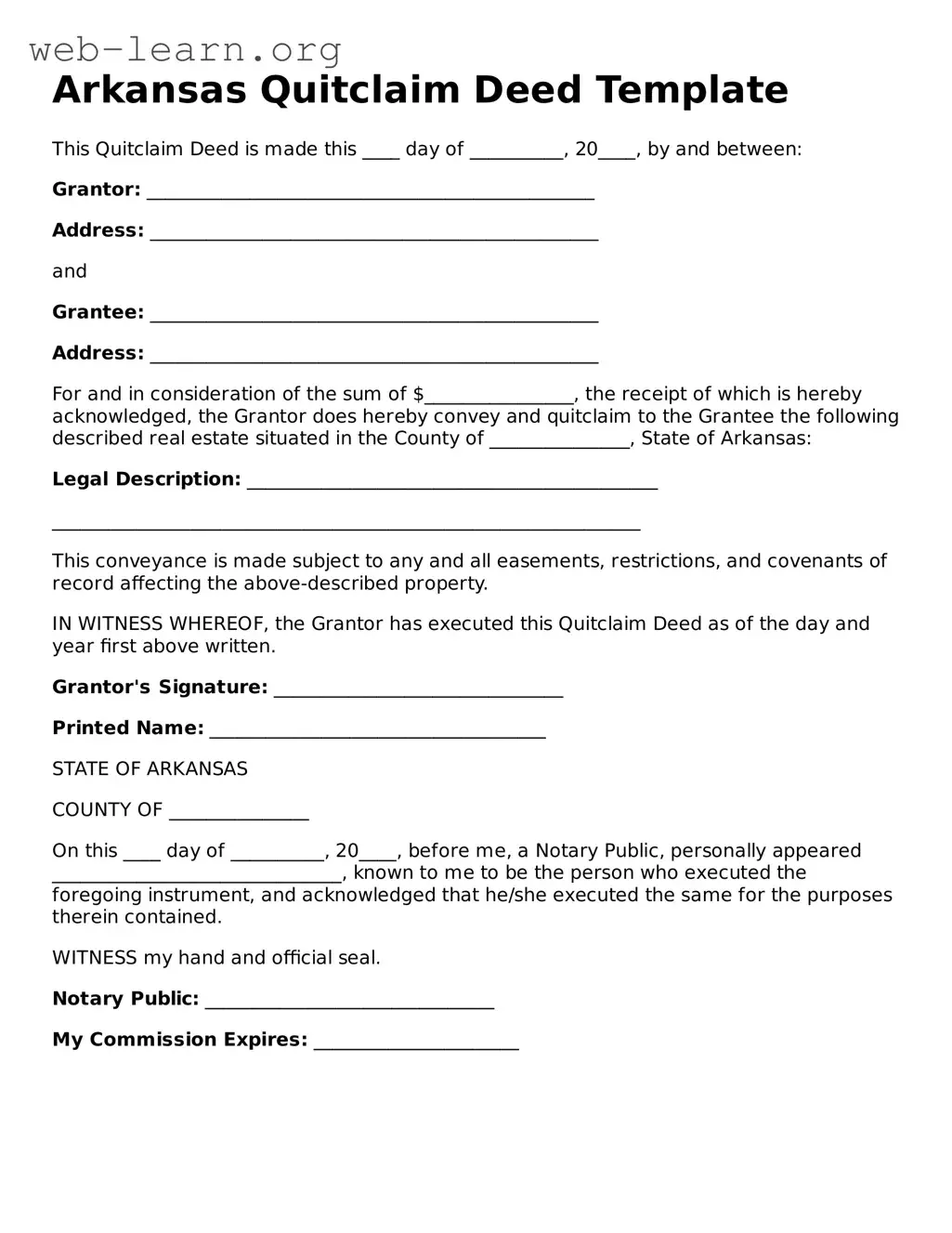
Arkansas Quitclaim Deed Template
This Quitclaim Deed is made this ____ day of __________, 20____, by and between:
Grantor: ________________________________________________
Address: ________________________________________________
and
Grantee: ________________________________________________
Address: ________________________________________________
For and in consideration of the sum of $________________, the receipt of which is hereby acknowledged, the Grantor does hereby convey and quitclaim to the Grantee the following described real estate situated in the County of _______________, State of Arkansas:
Legal Description: ____________________________________________
_______________________________________________________________
This conveyance is made subject to any and all easements, restrictions, and covenants of record affecting the above-described property.
IN WITNESS WHEREOF, the Grantor has executed this Quitclaim Deed as of the day and year first above written.
Grantor's Signature: _______________________________
Printed Name: ____________________________________
STATE OF ARKANSAS
COUNTY OF _______________
On this ____ day of __________, 20____, before me, a Notary Public, personally appeared _______________________________, known to me to be the person who executed the foregoing instrument, and acknowledged that he/she executed the same for the purposes therein contained.
WITNESS my hand and official seal.
Notary Public: _______________________________
My Commission Expires: ______________________
| Fact Name | Details |
|---|---|
| Definition | A quitclaim deed is a legal document that transfers ownership interest in a property from one party to another without any warranties. |
| Governing Law | The Arkansas Quitclaim Deed is governed by Arkansas Code Annotated § 18-12-101 et seq. |
| Usage | Commonly used among family members or in situations where the parties know each other well. |
| Warranties | Unlike warranty deeds, quitclaim deeds do not guarantee that the grantor has clear title to the property. |
| Filing Requirements | To be effective, the quitclaim deed must be signed by the grantor and notarized before being filed with the county clerk. |
| Consideration | While a monetary consideration is not required, it is common to include a nominal amount, such as $10. |
| Property Description | The deed must include a legal description of the property being transferred. |
| Tax Implications | There may be tax implications for both the grantor and grantee, including potential gift tax considerations. |
| Revocation | A quitclaim deed cannot be revoked once it is executed and recorded, unless a new deed is created. |
| Common Mistakes | Failing to properly describe the property or not having the deed notarized are common errors that can invalidate the deed. |
After you have gathered all necessary information, you are ready to fill out the Arkansas Quitclaim Deed form. This document will need to be completed accurately to ensure a smooth transfer of property ownership.
What is a Quitclaim Deed?
A Quitclaim Deed is a legal document used to transfer ownership of real estate from one party to another. It does not guarantee that the property is free of liens or other encumbrances. Instead, it simply conveys whatever interest the grantor has in the property at the time of the transfer. This type of deed is often used among family members or in situations where the parties know each other well.
When should I use a Quitclaim Deed in Arkansas?
Quitclaim Deeds are commonly used in various scenarios, including:
However, because a Quitclaim Deed does not provide any warranties, it is crucial to understand the risks involved.
What information is required on an Arkansas Quitclaim Deed?
An Arkansas Quitclaim Deed must include specific information to be valid. This includes:
It is important to ensure all information is accurate to avoid complications later.
Do I need to file the Quitclaim Deed with the county?
Yes, in Arkansas, it is necessary to file the Quitclaim Deed with the county clerk's office in the county where the property is located. Filing provides public notice of the transfer and helps establish a clear chain of title. Failure to file could lead to disputes regarding ownership in the future.
What are the potential risks of using a Quitclaim Deed?
Using a Quitclaim Deed carries certain risks, primarily because it offers no guarantees about the property. The grantee may inherit any existing liens, mortgages, or other encumbrances. Additionally, if the grantor does not actually own the property, the grantee receives nothing. Therefore, it is advisable to conduct a title search before proceeding with a Quitclaim Deed.
Can I revoke a Quitclaim Deed in Arkansas?
Once a Quitclaim Deed is executed and recorded, it cannot be revoked unilaterally. However, the grantor and grantee can agree to execute another deed to reverse the transaction if both parties consent. It is essential to consult with a legal professional for guidance on the best course of action if a reversal is desired.
Filling out a Quitclaim Deed form in Arkansas can seem straightforward, but many people make common mistakes that can lead to complications. One frequent error is failing to include the correct legal description of the property. The legal description should be precise and detailed, often including lot numbers or metes and bounds. Omitting this information can create confusion about the property being transferred.
Another common mistake is not properly identifying the grantor and grantee. The grantor is the person transferring the property, while the grantee is the recipient. If names are misspelled or if the relationship between the parties is unclear, it may cause issues later. Always ensure that full legal names are used, and if applicable, include any relevant titles or designations.
Many people also overlook the need for signatures. Both the grantor and any necessary witnesses must sign the Quitclaim Deed for it to be valid. Failing to obtain the required signatures can invalidate the deed. It's important to check that all parties have signed before submitting the document.
Finally, not filing the Quitclaim Deed with the appropriate county office is a significant mistake. After completing the form, it must be recorded to provide public notice of the property transfer. If this step is skipped, the transfer may not be recognized legally, which can lead to disputes down the line. Always ensure that the deed is filed promptly with the correct office.
When transferring property ownership in Arkansas, the Quitclaim Deed is a vital document. However, several other forms and documents are commonly used in conjunction with it to ensure a smooth and legally sound transaction. Below is a list of these essential documents, each playing a specific role in the property transfer process.
Utilizing these documents alongside the Quitclaim Deed can help ensure a clear and legally sound property transfer. Understanding each form's purpose is essential for both buyers and sellers to navigate the complexities of real estate transactions in Arkansas.
A Quitclaim Deed is a unique legal document used to transfer property rights. However, several other documents serve similar purposes in real estate transactions. Here are four documents that share similarities with the Quitclaim Deed:
Understanding these documents can help clarify the nuances of property transactions and ensure that all parties are aware of their rights and obligations.
When filling out the Arkansas Quitclaim Deed form, it's important to follow specific guidelines to ensure accuracy and legality. Here’s a list of things you should and shouldn't do:
When dealing with the Arkansas Quitclaim Deed form, several misconceptions often arise. Understanding these can help clarify the purpose and implications of this document.
This is incorrect. A quitclaim deed transfers whatever interest the grantor has in the property, but it does not guarantee that the grantor actually owns the property or that there are no liens against it.
While quitclaim deeds are commonly used in family transactions, they can also be used in other situations, such as transferring property between business partners or in divorce settlements.
This is a misunderstanding. A warranty deed provides a guarantee of clear title and protects the grantee against any future claims, while a quitclaim deed offers no such assurances.
This is not entirely accurate. While a quitclaim deed is generally considered final, there may be circumstances under which it can be contested or revoked, such as fraud or lack of capacity at the time of signing.
When dealing with the Arkansas Quitclaim Deed form, there are several important points to consider. Understanding these can help ensure a smooth process for transferring property ownership.
Understanding these key points can facilitate the effective use of the Arkansas Quitclaim Deed form and help avoid potential issues during the property transfer process.
Quick Claim Deed Form Connecticut - It can be used to transfer property without a lengthy process.
Quick Deed Process - It is not advisable for high-value transactions without proper title checks.
New York Quitclaim Deed - A Quitclaim Deed is often used when the property has no mortgage.
How Long Does a Quit Claim Deed Take to Process - Ideal for transferring property between family members.