When couples decide to tie the knot, they often face the important decision of whether to create a prenuptial agreement, especially in Arkansas. This legal document serves as a proactive measure to outline the financial and property rights of each partner in the event of a divorce or separation. A well-crafted Arkansas Prenuptial Agreement can address various aspects, such as the division of assets, debt responsibilities, and even spousal support. It can also clarify how future earnings and properties acquired during the marriage will be handled. By discussing these matters before saying "I do," couples can foster open communication and reduce potential conflicts down the line. Understanding the requirements and key elements of the Arkansas Prenuptial Agreement form is essential for ensuring that both parties are protected and that their wishes are honored. This article will delve into the specific components of the form, including what information needs to be included, how to properly execute it, and the legal considerations that come into play.
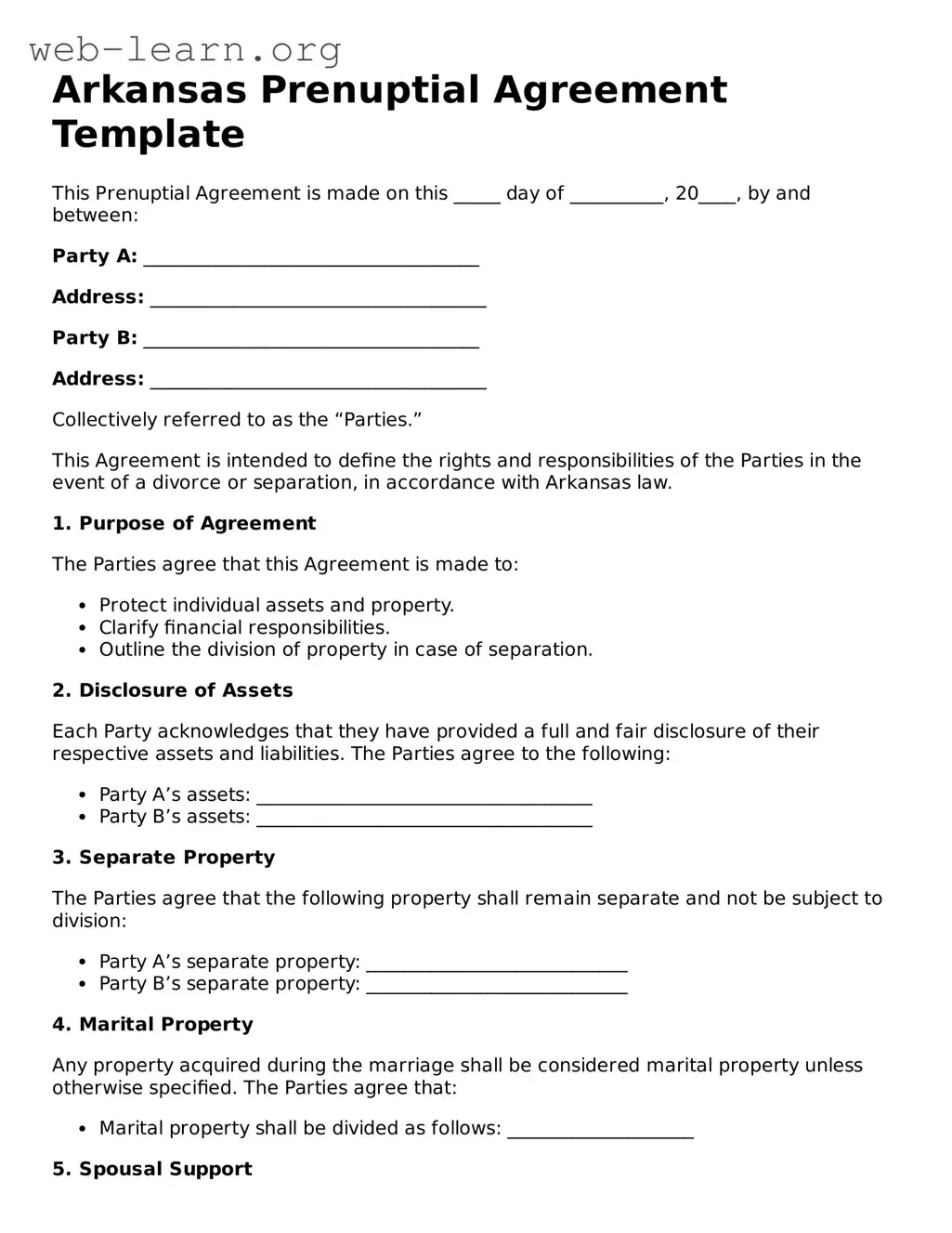
Arkansas Prenuptial Agreement Template
This Prenuptial Agreement is made on this _____ day of __________, 20____, by and between:
Party A: ____________________________________
Address: ____________________________________
Party B: ____________________________________
Address: ____________________________________
Collectively referred to as the “Parties.”
This Agreement is intended to define the rights and responsibilities of the Parties in the event of a divorce or separation, in accordance with Arkansas law.
1. Purpose of Agreement
The Parties agree that this Agreement is made to:
2. Disclosure of Assets
Each Party acknowledges that they have provided a full and fair disclosure of their respective assets and liabilities. The Parties agree to the following:
3. Separate Property
The Parties agree that the following property shall remain separate and not be subject to division:
4. Marital Property
Any property acquired during the marriage shall be considered marital property unless otherwise specified. The Parties agree that:
5. Spousal Support
In the event of a divorce, the Parties agree to the following regarding spousal support:
6. Governing Law
This Agreement shall be governed by and construed in accordance with the laws of the State of Arkansas.
7. Amendments
This Agreement may only be amended or modified by a written document signed by both Parties.
8. Severability
If any provision of this Agreement is found to be unenforceable, the remaining provisions shall continue to be valid and enforceable.
IN WITNESS WHEREOF, the Parties have executed this Prenuptial Agreement as of the day and year first above written.
_____________________________
Party A Signature
_____________________________
Party B Signature
_____________________________
Witness Signature
_____________________________
Witness Signature
| Fact Name | Description |
|---|---|
| Definition | An Arkansas prenuptial agreement is a contract between two individuals before marriage that outlines the distribution of assets and responsibilities in the event of divorce or separation. |
| Governing Law | Arkansas prenuptial agreements are governed by the Arkansas Uniform Premarital Agreement Act. |
| Requirements | The agreement must be in writing and signed by both parties to be enforceable. |
| Disclosure | Full financial disclosure by both parties is recommended to ensure fairness and validity. |
| Modification | Prenuptial agreements can be modified or revoked after marriage, but changes must be made in writing and signed by both parties. |
| Enforceability | A prenuptial agreement may be challenged in court if it is found to be unconscionable or if one party did not have adequate legal representation. |
Filling out the Arkansas Prenuptial Agreement form is an important step in planning for your future together. Once you have completed the form, both parties will need to review it carefully before signing. This ensures that all information is accurate and that both individuals understand the terms laid out in the agreement.
A prenuptial agreement, often called a prenup, is a legal document that a couple signs before getting married. It outlines how assets and debts will be divided in the event of a divorce or separation. This agreement can help clarify financial responsibilities and protect individual interests.
Yes, prenuptial agreements are generally enforceable in Arkansas, provided they meet certain legal requirements. The agreement must be in writing and signed by both parties. Additionally, both individuals should fully disclose their assets and liabilities at the time of signing. This transparency helps ensure that the agreement is fair and valid.
A well-crafted prenuptial agreement typically includes:
Including these elements can help prevent misunderstandings and disputes in the future.
Yes, a prenuptial agreement can be modified after marriage. Both parties must agree to any changes, and the modifications should be documented in writing and signed by both individuals. It’s advisable to consult a legal professional when making changes to ensure that the new agreement is enforceable.
While it is not legally required to have a lawyer, it is highly recommended. A legal professional can help ensure that the agreement is fair, complies with state laws, and protects both parties' interests. Having independent legal advice can also help prevent claims of coercion or undue influence.
When preparing a prenuptial agreement in Arkansas, it is essential to approach the process with care and attention to detail. Many individuals make common mistakes that can lead to complications down the line. Understanding these pitfalls can help ensure that the agreement is valid and effective.
One frequent mistake is failing to fully disclose assets and liabilities. Both parties should provide a complete picture of their financial situation. Omitting important information can lead to disputes later on and may even render the agreement unenforceable.
Another common error is using vague or ambiguous language. Clarity is crucial in legal documents. If terms are not clearly defined, it may create confusion and lead to differing interpretations of the agreement’s provisions.
People often overlook the importance of having the agreement reviewed by legal professionals. While it may seem tempting to draft the document independently or use generic templates, consulting with an attorney can help ensure that the agreement complies with Arkansas law and addresses both parties' needs.
Timing can also be an issue. Some couples wait until just before the wedding to finalize their prenuptial agreement. This rushed approach can lead to mistakes and may raise questions about whether both parties entered into the agreement voluntarily.
Additionally, failing to consider changes in circumstances is a mistake that can impact the agreement's relevance. Life events such as the birth of children or significant changes in income should prompt a review and potential modification of the prenuptial agreement.
People sometimes neglect to include a dispute resolution clause. This clause can outline how any disagreements regarding the agreement will be resolved, whether through mediation, arbitration, or court. Without this provision, parties may find themselves facing lengthy and costly legal battles.
Lastly, some individuals mistakenly believe that a prenuptial agreement is only necessary for the wealthy. Regardless of financial status, anyone entering a marriage should consider a prenuptial agreement. It serves to protect both parties and clarify expectations, making it a wise choice for couples of all backgrounds.
When preparing a prenuptial agreement in Arkansas, several other forms and documents can complement the process. Each of these documents serves a specific purpose and can help clarify intentions and expectations between partners. Here’s a brief overview of five important forms often used alongside a prenuptial agreement.
Using these documents in conjunction with a prenuptial agreement can provide a comprehensive framework for financial and personal arrangements. It’s always wise to consult with a legal professional to ensure that all documents are properly prepared and tailored to your unique situation.
The Prenuptial Agreement form shares similarities with several other legal documents. Each document serves a specific purpose in outlining agreements and expectations. Below is a list of documents that are similar to a Prenuptial Agreement:
When filling out the Arkansas Prenuptial Agreement form, there are key actions to take and pitfalls to avoid. Here’s a straightforward list to guide you:
Understanding prenuptial agreements can be challenging, and several misconceptions often arise. Here are four common misconceptions about the Arkansas Prenuptial Agreement form:
This is a widespread belief, but prenuptial agreements can benefit individuals of all financial backgrounds. They provide clarity and security regarding asset division, regardless of the couple's wealth.
Many people think that discussing a prenuptial agreement implies a lack of trust or an expectation of divorce. In reality, these agreements can help couples establish financial boundaries and expectations, promoting transparency and communication.
This misconception is not accurate. When properly drafted and executed according to state laws, prenuptial agreements are generally enforceable in Arkansas. However, they must meet specific legal requirements to be upheld in court.
While prenuptial agreements can address many financial matters, they cannot include provisions that are illegal or violate public policy. For example, they cannot dictate terms related to child custody or support, as these issues are determined based on the best interests of the child.
When considering a prenuptial agreement in Arkansas, it is important to understand the key aspects involved in filling out and using the form. Here are some essential takeaways:
Understanding these key points can help ensure that the prenuptial agreement is properly executed and serves its intended purpose.
Illinois Prenup - This document can help couples avoid potential conflicts over money matters.
Louisiana Prenup - This document helps couples clarify their financial expectations and responsibilities.