In Arkansas, the Power of Attorney for a Child form serves as a vital legal tool for parents and guardians who need to delegate authority over their child's care and decisions to another trusted adult. This form can be particularly useful in various situations, such as when parents are traveling, facing temporary hardships, or simply need assistance with their child's daily activities. By completing this document, parents can grant specific powers, which may include making medical decisions, enrolling the child in school, or managing finances on behalf of the child. It is essential to clearly outline the scope of authority, as well as the duration of the power granted, to ensure that the arrangement meets the family's needs while protecting the child's best interests. Understanding the nuances of this form can help prevent misunderstandings and legal complications down the road.
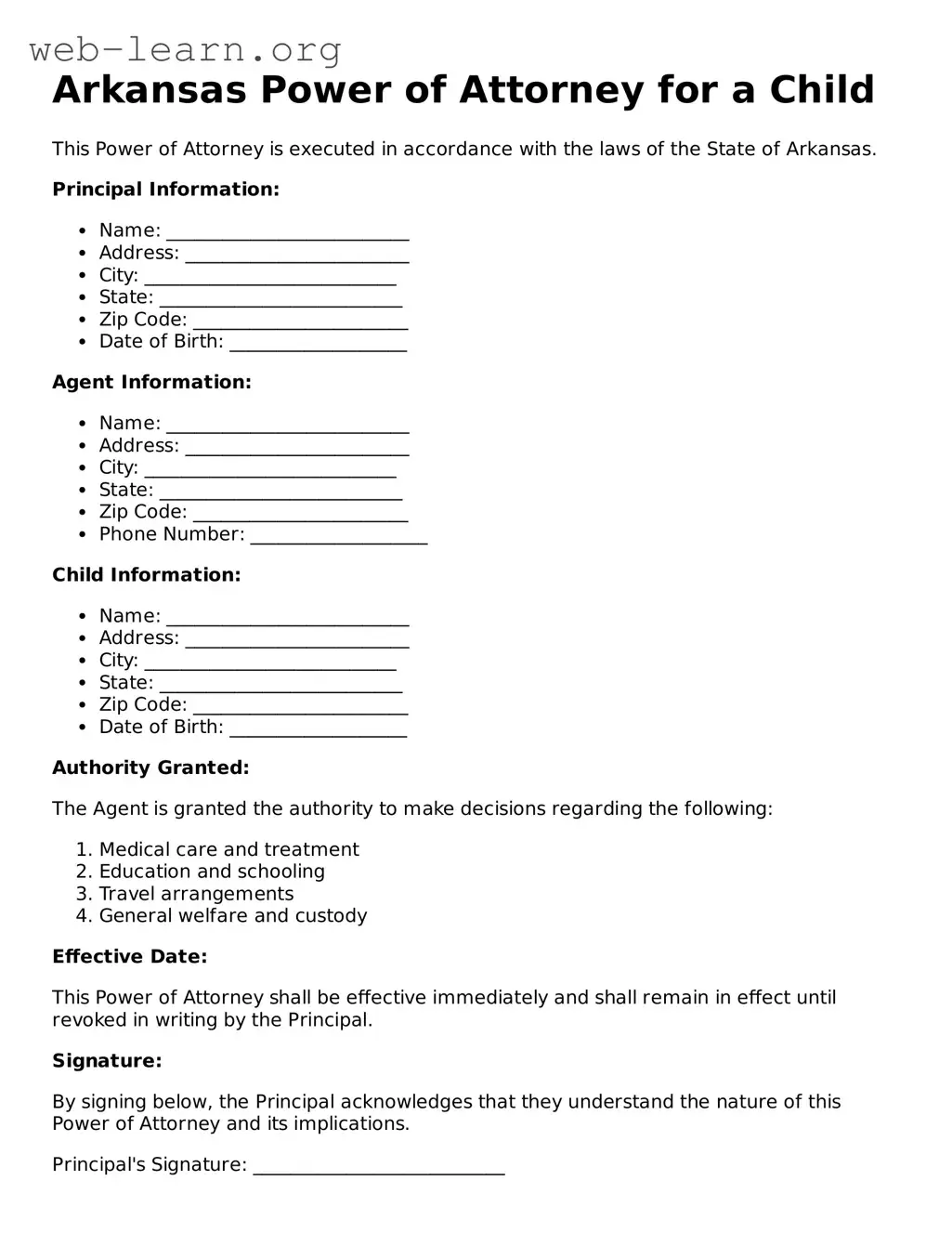
Arkansas Power of Attorney for a Child
This Power of Attorney is executed in accordance with the laws of the State of Arkansas.
Principal Information:
Agent Information:
Child Information:
Authority Granted:
The Agent is granted the authority to make decisions regarding the following:
Effective Date:
This Power of Attorney shall be effective immediately and shall remain in effect until revoked in writing by the Principal.
Signature:
By signing below, the Principal acknowledges that they understand the nature of this Power of Attorney and its implications.
Principal's Signature: ___________________________
Date: ___________________________
Witness Signature: ___________________________
Date: ___________________________
Notary Public:
State of Arkansas, County of ________________
Subscribed and sworn before me this _____ day of ______________, 20____.
Notary Public Signature: ___________________________
My Commission Expires: ___________________________
| Fact Name | Details |
|---|---|
| Purpose | The Arkansas Power of Attorney for a Child form allows a parent or legal guardian to designate another individual to make decisions on behalf of their child. |
| Governing Law | This form is governed by Arkansas Code Annotated § 9-26-101 et seq., which outlines the legal framework for powers of attorney for minors. |
| Duration | The authority granted through this form can be temporary or indefinite, depending on the specifications outlined by the parent or guardian. |
| Eligibility | Any adult can be appointed as an agent, provided they are willing to accept the responsibilities involved. |
| Limitations | The agent's powers can be limited to specific areas, such as medical decisions, education, or travel, as specified in the document. |
| Revocation | The parent or guardian can revoke the power of attorney at any time, as long as it is done in writing. |
| Signatures Required | The form must be signed by the parent or guardian and may require notarization to be legally binding. |
After obtaining the Arkansas Power of Attorney for a Child form, you will need to complete it carefully to ensure all necessary information is accurately provided. Once filled out, the form will need to be signed and possibly notarized, depending on your specific situation.
What is a Power of Attorney for a Child in Arkansas?
A Power of Attorney for a Child is a legal document that allows a parent or guardian to grant another person the authority to make decisions on behalf of their child. This can include decisions related to education, healthcare, and general welfare. It is particularly useful when parents are unavailable due to work, travel, or other commitments.
Who can be designated as an agent in the Power of Attorney for a Child?
The agent can be any responsible adult, such as a relative, family friend, or neighbor. It is essential to choose someone trustworthy who can act in the best interest of the child. The agent must be at least 18 years old and capable of understanding the responsibilities associated with the role.
What powers can be granted to the agent?
The powers granted can vary based on the needs of the child and the preferences of the parent. Common powers include:
It is important to specify which powers are being granted to avoid any confusion later.
How long does the Power of Attorney for a Child remain in effect?
The duration of the Power of Attorney can be specified in the document. It can be set for a specific period, such as a few months, or it can remain in effect until revoked by the parent or guardian. If the parent wishes to terminate the authority, they must do so in writing.
Do I need to have the Power of Attorney for a Child notarized?
Yes, in Arkansas, the Power of Attorney for a Child must be signed in the presence of a notary public to be legally valid. This helps ensure that the document is authentic and that the parent or guardian understands what they are signing.
Can the Power of Attorney for a Child be used for travel purposes?
Yes, this document can be particularly useful for travel. If a child is traveling with someone other than their parent or guardian, having a Power of Attorney can help clarify that the accompanying adult has the authority to make decisions on behalf of the child, especially in emergencies.
What should I do if I need to revoke the Power of Attorney for a Child?
If you need to revoke the Power of Attorney, you should do so in writing. Notify the agent and any relevant parties, such as schools or healthcare providers, about the revocation. It is advisable to keep a copy of the revocation document for your records.
When completing the Arkansas Power of Attorney for a Child form, individuals sometimes overlook important details that can lead to complications. One common mistake is failing to clearly identify the child. It is essential to provide the child's full name, date of birth, and any other identifying information. Without this, there could be confusion about which child the document pertains to.
Another frequent error involves not specifying the powers granted to the agent. The form allows for a range of responsibilities, from making medical decisions to handling educational matters. If these powers are not clearly defined, the agent may not be able to act in the best interest of the child when necessary.
Additionally, some individuals forget to include the signatures of both the parent and the agent. This step is crucial, as both parties must agree to the terms laid out in the document. Without proper signatures, the form may not be considered valid, leading to potential legal issues.
People also sometimes neglect to date the form. A missing date can create uncertainty about when the Power of Attorney takes effect. This can be particularly problematic in urgent situations where timely decisions are needed.
Lastly, failing to have the document notarized is a mistake that can invalidate the Power of Attorney. Notarization adds an extra layer of verification, ensuring that the signatures are authentic and that the form has been completed correctly. Taking the time to have the document notarized can prevent future complications.
The Arkansas Power of Attorney for a Child form allows a parent or legal guardian to designate another adult to make decisions on behalf of their child. This form is often used in conjunction with other documents to ensure that all legal aspects of guardianship and care are covered. Below is a list of other forms and documents that may be relevant.
These documents help clarify roles and responsibilities, ensuring that the child's needs are met in various situations. It is advisable to consider each form's relevance based on individual circumstances.
When filling out the Arkansas Power of Attorney for a Child form, it's important to follow specific guidelines to ensure the document is valid and effective. Below are some essential dos and don'ts to consider.
Understanding the Arkansas Power of Attorney for a Child form is crucial for parents and guardians. However, several misconceptions can lead to confusion. Here are five common misunderstandings:
Many believe that this form is only necessary in urgent situations. In reality, it can be used for various circumstances, such as temporary relocation or when parents are unavailable due to work or travel.
Some people think that signing this document transfers permanent custody. This is not the case; the Power of Attorney is temporary and can be revoked at any time by the parent or guardian.
While one parent can grant power, if both parents share legal custody, it is advisable for both to sign. This helps avoid potential disputes later on.
This form is specifically designed for child care decisions, such as medical treatment and educational needs. It does not grant authority for all legal matters involving the child.
Although consulting a lawyer can be beneficial, it is not mandatory. Parents can fill out the form themselves as long as they understand the implications and requirements.
Addressing these misconceptions can empower parents and guardians to use the Arkansas Power of Attorney for a Child form effectively and responsibly.
Filling out and using the Arkansas Power of Attorney for a Child form can be straightforward if you keep a few key points in mind. Here are some important takeaways:
By following these key points, you can effectively use the Power of Attorney for a Child form in Arkansas, ensuring that your child's needs are met when you are not available.
Power of Attorney Illinois Cost - This document can be a vital part of your family's planning and preparedness efforts.
Power of Attorney Georgia - Enables a caregiver to make decisions regarding a child’s health and safety.
How to Get Power of Attorney in Hawaii - Having a Power of Attorney for a Child form can streamline processes in schools and healthcare settings.