In the state of Arkansas, a Living Will serves as a crucial document for individuals wishing to outline their healthcare preferences in the event they become unable to communicate their wishes. This form allows you to specify the types of medical treatments you want or do not want, particularly in situations involving terminal illness or irreversible conditions. By completing the Arkansas Living Will, you empower your loved ones and healthcare providers to make informed decisions that align with your values and desires. Key aspects of this form include the ability to designate a healthcare proxy, clarify your preferences regarding life-sustaining treatments, and express your wishes about organ donation. Understanding the significance of this document can provide peace of mind, ensuring that your healthcare choices are respected even when you cannot voice them yourself.
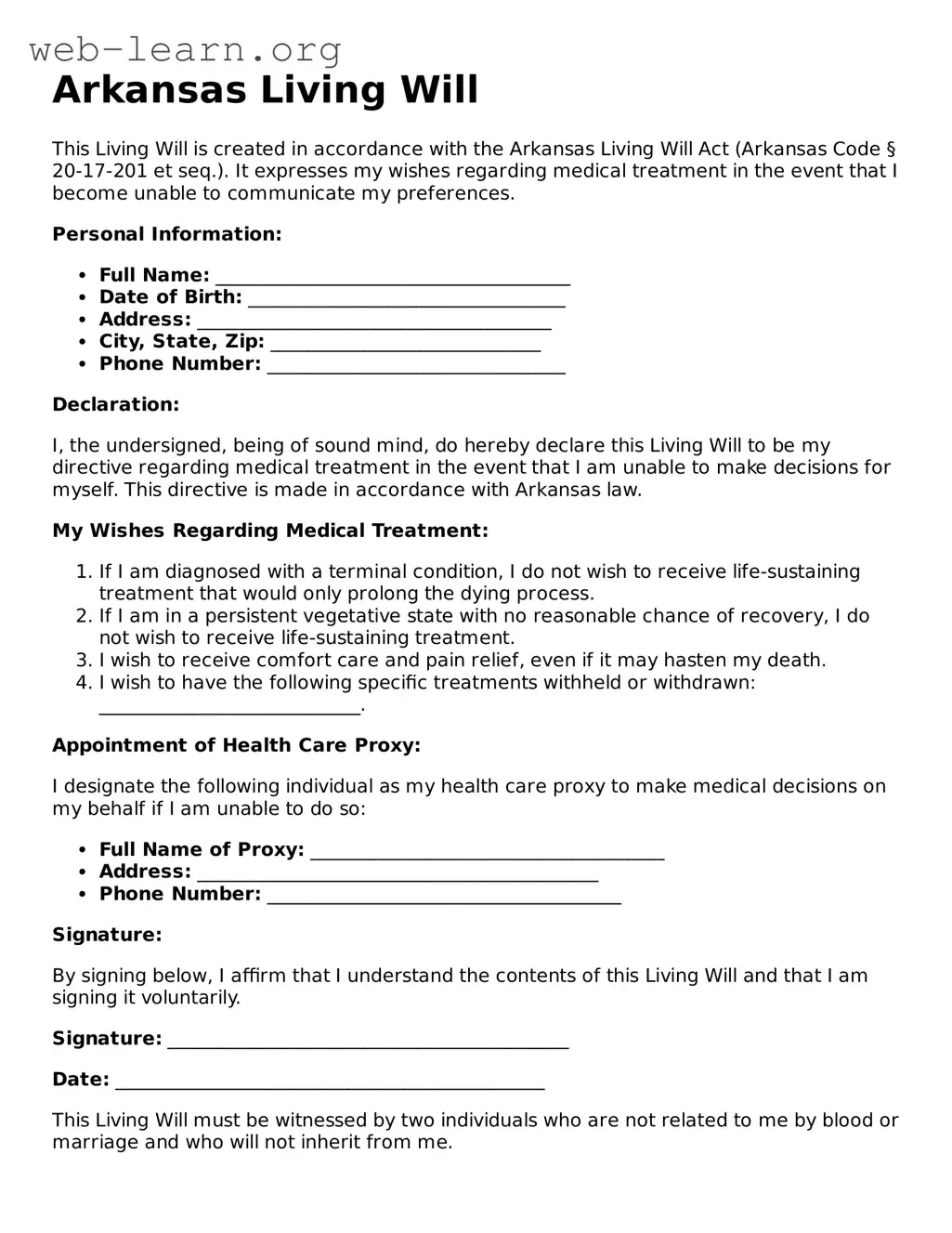
Arkansas Living Will
This Living Will is created in accordance with the Arkansas Living Will Act (Arkansas Code § 20-17-201 et seq.). It expresses my wishes regarding medical treatment in the event that I become unable to communicate my preferences.
Personal Information:
Declaration:
I, the undersigned, being of sound mind, do hereby declare this Living Will to be my directive regarding medical treatment in the event that I am unable to make decisions for myself. This directive is made in accordance with Arkansas law.
My Wishes Regarding Medical Treatment:
Appointment of Health Care Proxy:
I designate the following individual as my health care proxy to make medical decisions on my behalf if I am unable to do so:
Signature:
By signing below, I affirm that I understand the contents of this Living Will and that I am signing it voluntarily.
Signature: ___________________________________________
Date: ______________________________________________
This Living Will must be witnessed by two individuals who are not related to me by blood or marriage and who will not inherit from me.
| Fact Name | Details |
|---|---|
| Definition | An Arkansas Living Will is a legal document that outlines a person's wishes regarding medical treatment in the event they become incapacitated. |
| Governing Law | The Arkansas Living Will is governed by the Arkansas Code Annotated, Title 20, Chapter 17. |
| Eligibility | Any adult, 18 years or older, can create a Living Will in Arkansas. |
| Witness Requirements | The form must be signed in the presence of two witnesses, who cannot be relatives or beneficiaries. |
| Revocation | A Living Will can be revoked at any time by the individual, either verbally or in writing. |
| Durability | The Arkansas Living Will remains effective even if the individual becomes incapacitated. |
| Medical Decisions | This document allows individuals to refuse or accept specific medical treatments, including life-sustaining measures. |
| Notarization | Notarization is not required for the Living Will to be valid in Arkansas. |
| Availability | Arkansas Living Will forms are readily available online and through legal service providers. |
Completing the Arkansas Living Will form is an important step in ensuring your healthcare preferences are respected. Once you have filled out the form, you will need to sign it and ensure that it is stored in a safe place where it can be easily accessed by your healthcare providers and loved ones.
What is a Living Will?
A Living Will is a legal document that allows you to outline your preferences for medical treatment in case you become unable to communicate your wishes. It specifically addresses the types of medical care you want or do not want at the end of life. This document helps ensure that your healthcare decisions align with your values and desires.
Why should I have a Living Will?
Having a Living Will can provide peace of mind for you and your loved ones. It clearly communicates your healthcare preferences, reducing the burden on family members during difficult times. Without a Living Will, your family may face tough decisions without knowing your wishes, which can lead to confusion and conflict.
How do I create a Living Will in Arkansas?
Creating a Living Will in Arkansas involves a few straightforward steps:
Once completed, keep the document in a safe place and share copies with your family, healthcare providers, and anyone who may be involved in your care.
Can I change or revoke my Living Will?
Yes, you can change or revoke your Living Will at any time, as long as you are mentally competent. To make changes, simply create a new Living Will and ensure that it is signed and witnessed properly. If you wish to revoke the existing document, you can do so verbally or in writing, but it's best to inform your healthcare providers and family to avoid any confusion.
Is a Living Will the same as a Durable Power of Attorney for Healthcare?
No, a Living Will and a Durable Power of Attorney for Healthcare are different documents. A Living Will focuses specifically on your wishes regarding medical treatment, while a Durable Power of Attorney for Healthcare allows you to appoint someone to make healthcare decisions on your behalf if you are unable to do so. Many people choose to have both documents to ensure comprehensive coverage of their healthcare wishes.
Filling out the Arkansas Living Will form is an important step in ensuring that your healthcare preferences are respected. However, many individuals make common mistakes that can undermine the effectiveness of their wishes. Understanding these pitfalls can help ensure that the document accurately reflects your intentions.
One frequent error is failing to provide clear and specific instructions. Vague language can lead to confusion among healthcare providers and family members. It is crucial to articulate your preferences regarding life-sustaining treatments and end-of-life care in a straightforward manner.
Another mistake is neglecting to date the document. A living will should always include the date it was signed to establish its validity. Without a date, it may be difficult to determine whether the document is current or superseded by a later version.
Many individuals also overlook the importance of signatures. Both the principal (the person creating the living will) and the witnesses must sign the document. In Arkansas, the law requires at least two witnesses, and failing to include their signatures can invalidate the living will.
Additionally, some people forget to review and update their living wills regularly. Life circumstances change, and so can your healthcare preferences. It is advisable to revisit the document periodically to ensure it still aligns with your wishes.
Another common mistake is not discussing the living will with family members or healthcare proxies. Open communication can prevent misunderstandings and ensure that your loved ones are aware of your preferences. This conversation can also provide peace of mind for both you and your family.
People sometimes also make the error of assuming that a living will is the same as a power of attorney for healthcare. While both documents are important, they serve different purposes. A living will outlines your wishes regarding medical treatment, while a power of attorney designates someone to make healthcare decisions on your behalf.
Some individuals may also fail to consider the implications of their choices. For instance, opting for aggressive treatment in certain situations may lead to prolonged suffering. It is essential to reflect on the potential outcomes of your decisions and how they align with your values.
Finally, a lack of understanding of the legal requirements specific to Arkansas can lead to mistakes. Each state has its own regulations regarding living wills, and being unaware of these can result in an invalid document. It is advisable to consult with a knowledgeable source or use official resources to ensure compliance with state laws.
When considering end-of-life decisions, it’s essential to have a comprehensive understanding of various documents that can work in conjunction with the Arkansas Living Will form. These documents help clarify your wishes and ensure that your healthcare preferences are honored. Below is a list of common forms and documents that are often used alongside a Living Will.
Understanding these documents can empower individuals to make informed decisions about their healthcare and end-of-life preferences. By utilizing these forms alongside the Arkansas Living Will, you can ensure that your wishes are clearly communicated and respected, providing peace of mind for both you and your loved ones.
When filling out the Arkansas Living Will form, it's essential to approach the process with care. Here are five important guidelines to follow, along with some common pitfalls to avoid.
Misconception 1: A Living Will is the same as a Last Will and Testament.
While both documents address end-of-life decisions, they serve different purposes. A Last Will and Testament outlines how a person's assets will be distributed after death, whereas a Living Will specifically details medical preferences in the event of incapacitation.
Misconception 2: A Living Will only applies to terminal illnesses.
This is not accurate. A Living Will can guide medical decisions in various situations, including severe injuries or illnesses that may not be terminal but still leave a person unable to communicate their wishes.
Misconception 3: You need a lawyer to create a Living Will in Arkansas.
Although having legal assistance can be beneficial, it is not a requirement. Arkansas allows individuals to create a Living Will using standard forms available online or through healthcare providers, as long as they meet state regulations.
Misconception 4: A Living Will is permanent and cannot be changed.
In reality, individuals can modify or revoke their Living Will at any time, as long as they are of sound mind. This flexibility allows for adjustments as circumstances or preferences change.
Misconception 5: A Living Will is only for older adults.
This belief overlooks the fact that anyone, regardless of age, can face unexpected medical emergencies. Young adults should also consider having a Living Will to ensure their healthcare preferences are respected.
Filling out and using the Arkansas Living Will form is an important step in expressing personal healthcare preferences. Here are some key takeaways to consider:
Living Will Indiana - A Living Will can help you avoid unwanted medical interventions that do not align with your wishes.
Living Will Vs Health Care Directive - A Living Will is particularly important for individuals with chronic illnesses or those facing terminal conditions.