Creating a Last Will and Testament is an essential step in ensuring that your wishes are honored after your passing. In Arkansas, this legal document outlines how your assets will be distributed, who will serve as the executor of your estate, and guardianship arrangements for any minor children. The form provides a clear framework for expressing your intentions regarding property and financial matters. It also allows you to specify any particular bequests, ensuring that cherished items are passed on to the intended recipients. Additionally, the Arkansas Last Will and Testament form requires certain formalities, such as signatures and witnesses, to be considered valid. Understanding these aspects is crucial for anyone looking to secure their legacy and provide peace of mind for their loved ones.
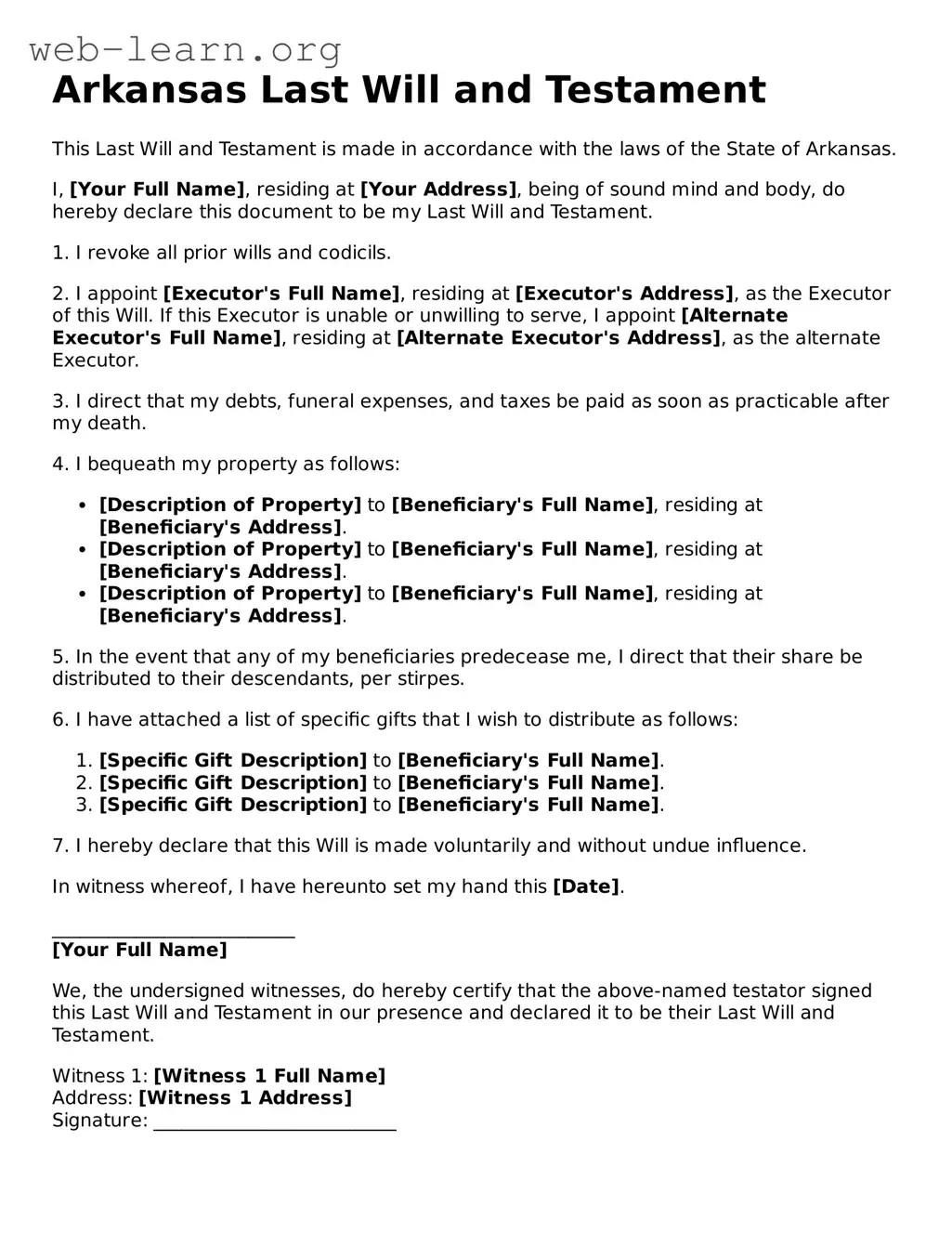
Arkansas Last Will and Testament
This Last Will and Testament is made in accordance with the laws of the State of Arkansas.
I, [Your Full Name], residing at [Your Address], being of sound mind and body, do hereby declare this document to be my Last Will and Testament.
1. I revoke all prior wills and codicils.
2. I appoint [Executor's Full Name], residing at [Executor's Address], as the Executor of this Will. If this Executor is unable or unwilling to serve, I appoint [Alternate Executor's Full Name], residing at [Alternate Executor's Address], as the alternate Executor.
3. I direct that my debts, funeral expenses, and taxes be paid as soon as practicable after my death.
4. I bequeath my property as follows:
5. In the event that any of my beneficiaries predecease me, I direct that their share be distributed to their descendants, per stirpes.
6. I have attached a list of specific gifts that I wish to distribute as follows:
7. I hereby declare that this Will is made voluntarily and without undue influence.
In witness whereof, I have hereunto set my hand this [Date].
__________________________
[Your Full Name]
We, the undersigned witnesses, do hereby certify that the above-named testator signed this Last Will and Testament in our presence and declared it to be their Last Will and Testament.
Witness 1: [Witness 1 Full Name]
Address: [Witness 1 Address]
Signature: __________________________
Witness 2: [Witness 2 Full Name]
Address: [Witness 2 Address]
Signature: __________________________
| Fact Name | Description |
|---|---|
| Governing Law | The Arkansas Last Will and Testament is governed by the Arkansas Code Annotated, Title 28, Chapter 40. |
| Requirements | To be valid, the will must be in writing, signed by the testator, and witnessed by at least two individuals. |
| Age Requirement | The testator must be at least 18 years old to create a valid will in Arkansas. |
| Revocation | A will can be revoked by creating a new will or by physically destroying the original document. |
| Self-Proving Wills | Arkansas allows for self-proving wills, which can simplify the probate process by eliminating the need for witnesses to testify. |
Filling out the Arkansas Last Will and Testament form is an important step in ensuring that your wishes are respected after your passing. Once you have completed the form, it will be necessary to sign it in the presence of witnesses to make it legally binding. Here are the steps to guide you through the process of filling out the form.
What is a Last Will and Testament in Arkansas?
A Last Will and Testament is a legal document that outlines how a person's assets and affairs will be handled after their death. In Arkansas, this document allows you to specify who will inherit your property, appoint guardians for minor children, and name an executor to manage your estate.
Who can create a Last Will and Testament in Arkansas?
Any person who is at least 18 years old and of sound mind can create a Last Will and Testament in Arkansas. This means you should understand the nature of your actions and the consequences of creating a will.
Do I need a lawyer to create a Last Will and Testament?
While it is not required to hire a lawyer to create a will in Arkansas, it is often advisable. A lawyer can ensure that the will meets all legal requirements and accurately reflects your wishes. However, you can also use a template or online service if you feel confident in your understanding of the process.
What are the requirements for a valid will in Arkansas?
For a will to be valid in Arkansas, it must meet several criteria:
Can I change my will after it has been created?
Yes, you can change your will at any time while you are alive. This can be done by creating a new will or by making a codicil, which is an amendment to your existing will. Just remember that any changes must also meet the legal requirements to be valid.
What happens if I die without a will in Arkansas?
If you die without a will, your assets will be distributed according to Arkansas intestacy laws. This means the state will determine how your property is divided, which may not align with your wishes. It is always best to have a will to ensure your preferences are honored.
How can I ensure my will is legally recognized?
To ensure your will is legally recognized, follow these steps:
Is it necessary to have my will notarized in Arkansas?
No, notarization is not required for a will to be valid in Arkansas. However, having a notarized will can help simplify the probate process. It can serve as evidence that you signed the will voluntarily and that you were of sound mind at the time.
Creating a Last Will and Testament in Arkansas is a significant step in planning for the future. However, many individuals make common mistakes that can lead to confusion or legal issues down the line. One of the most frequent errors is failing to sign the document properly. In Arkansas, a will must be signed by the testator, the person making the will, in the presence of two witnesses. If this step is overlooked, the will may not be considered valid.
Another mistake is not including all necessary information about the beneficiaries. It’s important to clearly identify each person or entity that will inherit assets. This includes providing full names and, if possible, addresses. Vague descriptions can lead to disputes among family members, which can be avoided with clear and precise language.
People often forget to update their wills after significant life events, such as marriage, divorce, or the birth of a child. Failing to revise the document can result in outdated information that may not reflect current wishes. Regularly reviewing and updating the will ensures that it remains relevant and accurate.
Some individuals mistakenly assume that a handwritten will is automatically valid. While Arkansas does recognize holographic wills, they must still meet specific criteria. If the will is not properly written and signed, it could be challenged in court. Therefore, it’s advisable to use a standard form or consult with a professional when drafting a will.
Additionally, people sometimes neglect to consider the appointment of an executor. The executor is responsible for carrying out the terms of the will. Without naming someone, the court may have to appoint an administrator, which can delay the process and lead to additional complications.
Another common error is failing to account for debts and taxes. When creating a will, it’s crucial to consider how debts will be paid and how taxes will be handled after death. Ignoring these aspects can leave beneficiaries with unexpected financial burdens.
Some may also overlook the importance of including a residuary clause. This clause specifies what happens to any remaining assets not explicitly mentioned in the will. Without it, those assets may be distributed according to state law rather than the deceased’s wishes.
Finally, individuals might not seek legal advice when needed. While it’s possible to complete a will without professional help, consulting with an attorney can provide valuable guidance. An expert can help ensure that the will meets all legal requirements and accurately reflects the individual’s intentions.
When creating a Last Will and Testament in Arkansas, several other documents can be essential for ensuring that your estate plan is comprehensive and effective. Each document serves a specific purpose and can help clarify your intentions regarding your assets and healthcare decisions.
In summary, these documents complement your Last Will and Testament, helping to create a more robust and clear estate plan. Each serves a unique purpose and can significantly impact how your wishes are carried out. It is essential to consider these forms when planning for the future.
When filling out the Arkansas Last Will and Testament form, it is essential to follow specific guidelines to ensure that the document is valid and reflects your wishes accurately. Below is a list of things you should and shouldn't do.
Misconception 1: A handwritten will is not valid in Arkansas.
This is incorrect. Arkansas recognizes handwritten wills, known as holographic wills, as valid as long as they are signed by the testator and the material provisions are in the testator's handwriting. However, it is advisable to follow formal requirements for clarity and to avoid disputes.
Misconception 2: You cannot change your will once it is created.
This is false. Individuals can amend or revoke their wills at any time, provided they follow the legal requirements for doing so. This can be done through a codicil or by creating a new will that explicitly revokes the previous one.
Misconception 3: A will can distribute property that is jointly owned.
This is misleading. Jointly owned property typically passes directly to the surviving owner upon death, bypassing the will. Therefore, a will does not control the distribution of such property.
Misconception 4: All wills must be notarized in Arkansas.
This is not true. While notarization can add an extra layer of validity, it is not a requirement for a will to be valid in Arkansas. What is essential is that the will is signed by the testator and witnessed by at least two individuals.
Misconception 5: You must have a lawyer to create a valid will.
This is incorrect. While legal assistance can be beneficial, it is not mandatory to have a lawyer draft a will in Arkansas. Individuals can create their own wills, but they should ensure that all legal requirements are met to avoid complications.
When preparing to fill out the Arkansas Last Will and Testament form, there are several important points to keep in mind. These key takeaways can help ensure that the document is valid and meets your wishes.
Taking the time to understand these aspects of the Arkansas Last Will and Testament form can help you create a document that accurately reflects your wishes and stands up to legal scrutiny.
Free Will Forms to Print - Can include a list of personal items and their intended recipients.
Will Template Indiana - Allows for the appointment of a trusted individual to handle your estate.
Free Ny Will Template - Helps to clarify the testator's intentions regarding joint assets.