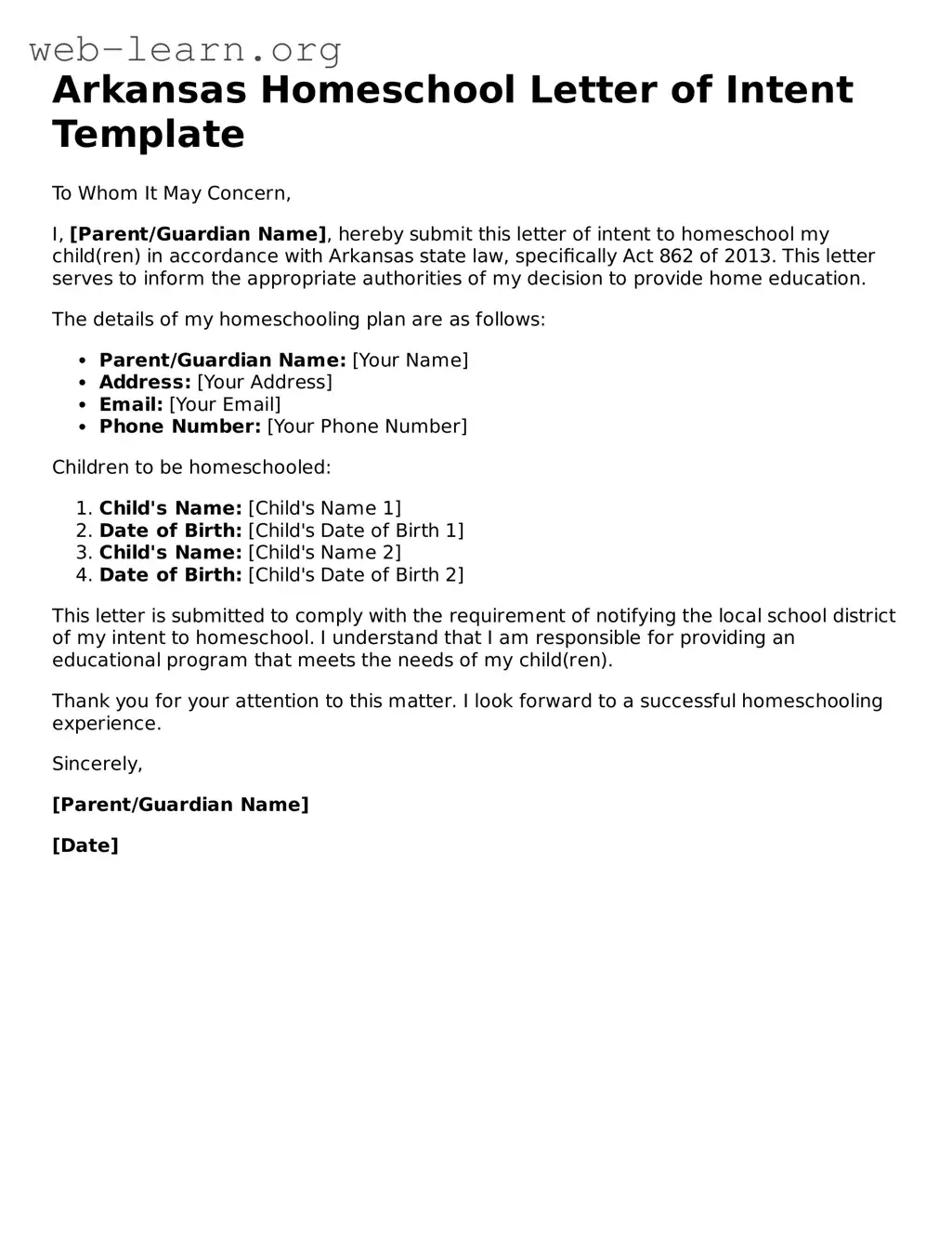
The Arkansas Homeschool Letter of Intent form serves as a crucial document for families choosing to educate their children at home. This form must be submitted to the local school district to officially notify authorities of the intent to homeschool. It typically includes essential information such as the names and ages of the children being homeschooled, the address of the residence, and the signature of the parent or guardian. By completing this form, parents demonstrate their commitment to providing an educational experience outside the traditional school setting. Additionally, this document helps ensure compliance with state regulations governing homeschooling, allowing families to establish their educational plans while maintaining transparency with local education officials. Understanding the requirements and process for submitting this letter is vital for any parent considering homeschooling in Arkansas.
Arkansas Homeschool Letter of Intent Template
To Whom It May Concern,
I, [Parent/Guardian Name], hereby submit this letter of intent to homeschool my child(ren) in accordance with Arkansas state law, specifically Act 862 of 2013. This letter serves to inform the appropriate authorities of my decision to provide home education.
The details of my homeschooling plan are as follows:
Children to be homeschooled:
This letter is submitted to comply with the requirement of notifying the local school district of my intent to homeschool. I understand that I am responsible for providing an educational program that meets the needs of my child(ren).
Thank you for your attention to this matter. I look forward to a successful homeschooling experience.
Sincerely,
[Parent/Guardian Name]
[Date]
| Fact Name | Details |
|---|---|
| Governing Law | The Arkansas Homeschool Letter of Intent is governed by Arkansas Code Annotated § 6-15-501. |
| Purpose of the Form | This form notifies the local school district of a parent’s intent to homeschool their child. |
| Who Must File | Parents or guardians of children aged 5 to 17 must file this form to homeschool legally. |
| Filing Deadline | The form should be submitted at least 30 days before the start of the homeschooling year. |
| Information Required | Parents need to provide their names, addresses, and the names and ages of the children being homeschooled. |
| Submission Method | The completed form can be mailed or delivered in person to the local school district office. |
| Record Keeping | Parents should keep a copy of the submitted form for their records. |
| Annual Updates | Parents must submit a new Letter of Intent each year to continue homeschooling. |
After completing the Arkansas Homeschool Letter of Intent form, you will need to submit it to the appropriate local school district. This is an important step in ensuring your homeschooling plans are recognized by the state. Make sure to keep a copy for your records.
The Arkansas Homeschool Letter of Intent is a formal document that parents or guardians must submit to the local school district to notify them of their intent to homeschool their child or children. This letter serves as an official declaration that you are opting out of the traditional school system to provide education at home.
Any parent or guardian who wishes to homeschool a child aged 5 to 17 in Arkansas is required to submit this letter. It applies to all children who are not enrolled in a public or private school. If you have multiple children, a separate letter must be submitted for each child.
The Letter of Intent should be submitted at least 14 days before the start of your homeschooling program. If you are pulling your child from a public school, it is advisable to submit the letter as soon as you make the decision to homeschool, to ensure a smooth transition.
The letter should include:
While the state does not require additional details, providing your contact information can help facilitate communication with the school district.
No specific format is mandated by the state. However, it is recommended to keep the letter clear and concise. A simple, straightforward format that includes all required information will suffice. You may choose to send it via mail or email, depending on your local school district's preferences.
Once you submit the Letter of Intent, the school district will acknowledge receipt. It is important to keep a copy of the letter for your records. After that, you can begin your homeschooling journey. The state does not require you to submit any further documentation or curriculum plans, but you should maintain educational records in case they are requested later.
Filling out the Arkansas Homeschool Letter of Intent form is an essential step for families wishing to educate their children at home. However, many individuals make common mistakes that can lead to delays or complications. Understanding these pitfalls can help ensure a smooth submission process.
One frequent error is incomplete information. The form requires specific details about the child, such as their full name, date of birth, and address. Omitting any of this information can result in the form being rejected or returned for correction.
Another mistake involves the failure to sign the form. While it may seem simple, neglecting to sign can invalidate the submission. Parents must remember that their signature indicates their commitment to homeschooling and compliance with state laws.
Some individuals also overlook the deadline for submission. In Arkansas, the Letter of Intent must be filed by August 15 for the upcoming school year. Missing this deadline can lead to complications in starting the homeschooling process on time.
Additionally, people sometimes forget to include additional children who may be homeschooled. Each child must be listed on the form, and failing to do so can create confusion regarding the family's educational plans.
Many applicants also misinterpret the requirements for curriculum disclosure. While the form does not require a detailed curriculum plan, some families mistakenly believe they need to provide extensive information about their educational approach. This misconception can lead to unnecessary stress during the application process.
Moreover, individuals often neglect to keep a copy of the submitted form. Retaining a copy is crucial for personal records and can serve as proof of intent should any questions arise later.
Some parents may also fail to update their information if there are changes in their homeschooling plans. For instance, if a family moves or decides to add another child, they must notify the state by submitting an updated Letter of Intent.
Another common oversight is the inaccurate reporting of educational history. While the form does not delve deeply into past schooling, providing incorrect information can lead to misunderstandings about a child's educational background.
Lastly, some individuals might not seek guidance or clarification when needed. If there are uncertainties about how to fill out the form correctly, reaching out to local homeschooling groups or educational resources can provide valuable assistance.
When you decide to homeschool in Arkansas, submitting the Homeschool Letter of Intent is just the first step. Several other documents may be required or beneficial as you navigate the homeschooling process. Here’s a list of forms and documents that often accompany the Letter of Intent.
These documents collectively support your homeschooling journey and help maintain compliance with Arkansas regulations. Being organized and prepared will make the process smoother for you and your child.
Notice of Intent to Homeschool: This document serves as a formal declaration to the local school district that a parent intends to educate their child at home. Similar to the Homeschool Letter of Intent, it outlines the parent's commitment and provides essential information about the child and the educational plan.
Curriculum Plan: A curriculum plan details the educational materials and resources a parent plans to use for homeschooling. Like the Homeschool Letter of Intent, it is often submitted to the school district to demonstrate the educational framework that will be followed.
Educational Assessment Report: This report assesses a child’s educational progress and is usually required by some states. It shares similarities with the Homeschool Letter of Intent in that it provides the school district with insights into the child’s learning outcomes and the effectiveness of the homeschooling approach.
Withdrawal Form from Public School: When parents decide to homeschool, they often need to submit a withdrawal form to the public school. This form, like the Homeschool Letter of Intent, serves to notify the school that the child will no longer attend, ensuring that the district updates its records accordingly.
When filling out the Arkansas Homeschool Letter of Intent form, it's important to follow certain guidelines. Here are six things you should and shouldn't do:
Following these simple steps can help ensure a smooth process as you begin your homeschooling journey in Arkansas. Take your time, and don't hesitate to ask for help if you need it.
Many families considering homeschooling in Arkansas may have some misunderstandings about the Homeschool Letter of Intent form. Below are some common misconceptions and clarifications regarding this important document.
In reality, the Homeschool Letter of Intent form is straightforward. It requires basic information about the student and the parent or guardian. Most families find it manageable.
This is not true. Submitting the Letter of Intent is a requirement for families who choose to homeschool in Arkansas. It officially notifies the state of your intent to educate your child at home.
The form does not require a detailed curriculum. While you should have a plan for your child's education, the Letter of Intent simply states your intention to homeschool.
You can submit the form at any time. However, it is advisable to do so before the school year begins to ensure compliance with state regulations.
While it is best to submit the form on time, there are no specific penalties for late submissions. However, it is crucial to ensure that you are following the state's guidelines.
Returning homeschoolers must also submit a new Letter of Intent each year. This keeps the state informed about your educational plans.
If circumstances change, you can withdraw your Letter of Intent. It's important to keep the state updated on your educational choices.
Understanding these misconceptions can help families navigate the homeschooling process more effectively. It's essential to stay informed and ensure compliance with state requirements.
Filling out and using the Arkansas Homeschool Letter of Intent form is an important step for parents who wish to homeschool their children. Here are key takeaways to keep in mind:
Home Schooling in Idaho - Can help parents to stay informed about local homeschooling laws and regulations.
Do You Get Paid to Home School - Provides a clear record of the family's educational choices for future reference.
Best Homeschool Programs in Hawaii - It can be an important part of your homeschooling portfolio.
Oregon Home-schooling - Parents should verify if there are any associated fees for filing the Letter of Intent.