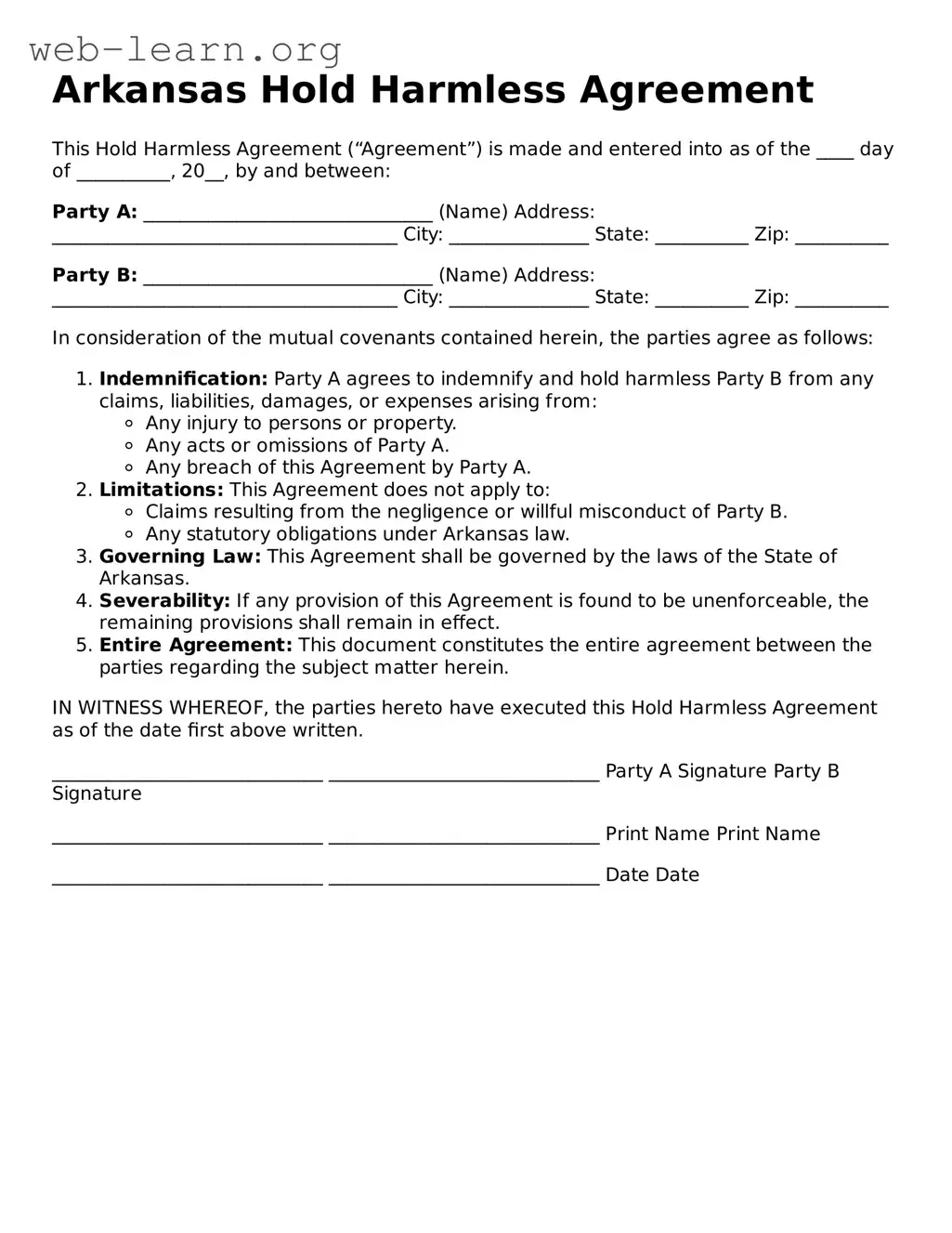
The Arkansas Hold Harmless Agreement form is a crucial legal document designed to protect one party from liability for certain risks associated with specific activities or events. This agreement is commonly used in various contexts, such as rental agreements, event planning, and service contracts, where one party may be exposed to potential claims or damages. By signing this form, the parties involved acknowledge and accept the inherent risks, thereby agreeing to release the other party from any legal responsibility for injuries or damages that may occur. Key elements of the form typically include a clear description of the activities covered, the identification of the parties involved, and the specific liabilities being waived. This document not only serves to clarify the responsibilities of each party but also aims to foster a safer environment by ensuring that all participants understand the risks they are undertaking. As such, the Hold Harmless Agreement is an essential tool for anyone engaging in activities that could lead to unforeseen accidents or legal disputes.
Arkansas Hold Harmless Agreement
This Hold Harmless Agreement (“Agreement”) is made and entered into as of the ____ day of __________, 20__, by and between:
Party A: _______________________________ (Name) Address: _____________________________________ City: _______________ State: __________ Zip: __________
Party B: _______________________________ (Name) Address: _____________________________________ City: _______________ State: __________ Zip: __________
In consideration of the mutual covenants contained herein, the parties agree as follows:
IN WITNESS WHEREOF, the parties hereto have executed this Hold Harmless Agreement as of the date first above written.
_____________________________ _____________________________ Party A Signature Party B Signature
_____________________________ _____________________________ Print Name Print Name
_____________________________ _____________________________ Date Date
| Fact Name | Details |
|---|---|
| Purpose | The Arkansas Hold Harmless Agreement is designed to protect one party from legal liability for damages or injuries incurred by another party during a specified activity or event. |
| Governing Law | This agreement is governed by the laws of the State of Arkansas, specifically under the principles of contract law and liability waivers. |
| Key Components | Typically, the agreement includes a clear statement of the parties involved, the activity in question, and an explicit waiver of liability for the party being held harmless. |
| Enforceability | For the agreement to be enforceable, it must be signed voluntarily by all parties involved, and the language should be clear and understandable. |
After obtaining the Arkansas Hold Harmless Agreement form, you will need to fill it out carefully to ensure that all necessary information is provided. This process involves gathering relevant details and entering them accurately. Follow the steps below to complete the form effectively.
Once the form is filled out, you may need to submit it to the relevant party or organization as per their instructions. Ensure that you keep a copy for your records and follow up if necessary.
An Arkansas Hold Harmless Agreement is a legal document that protects one party from liability for any damages or injuries that may occur during a specific activity or event. By signing this agreement, the other party agrees not to hold the first party responsible for any claims that may arise.
Various individuals and organizations may use a Hold Harmless Agreement. Common users include event organizers, property owners, contractors, and businesses. It is particularly prevalent in situations where there is a risk of injury or damage, such as sports events, construction projects, or rental agreements.
A typical Hold Harmless Agreement includes:
Yes, a Hold Harmless Agreement can be legally binding if it meets certain criteria. It must be clear, voluntary, and entered into by competent parties. Courts generally uphold such agreements, provided they do not violate public policy or involve gross negligence.
Yes, a Hold Harmless Agreement can be modified. Both parties must agree to any changes, and it is advisable to document these modifications in writing. This ensures clarity and helps prevent disputes in the future.
Before signing, consider the following:
While a Hold Harmless Agreement provides protection, it does not grant absolute immunity. If negligence or willful misconduct occurs, a party may still be held liable. It is important to understand the limitations of the agreement.
Hold Harmless Agreement forms can often be obtained online through legal document websites, local government offices, or legal professionals. It is essential to ensure that the form complies with Arkansas laws and is tailored to your specific needs.
Filling out the Arkansas Hold Harmless Agreement form can be a straightforward process, but many individuals make common mistakes that can lead to complications. One frequent error is failing to read the entire document before signing. This oversight can result in misunderstandings about the terms and conditions, potentially leaving individuals unprotected.
Another mistake is not providing accurate personal information. The form requires specific details such as names, addresses, and contact information. Inaccuracies can create issues if the agreement needs to be enforced or referenced later.
Many people also overlook the importance of understanding the scope of the agreement. They might sign without fully grasping what liabilities they are agreeing to hold harmless. This lack of comprehension can have serious consequences if a dispute arises.
Additionally, individuals sometimes forget to date the form. A missing date can lead to questions about the validity of the agreement. It is essential to include the date to establish when the agreement was made.
Another common error involves not having witnesses or notarization when required. Some situations may necessitate additional verification to ensure the agreement is legally binding. Skipping this step can weaken the enforceability of the document.
People often fail to keep a copy of the signed agreement. Without a personal record, individuals may find themselves in difficult situations where they cannot prove the terms they agreed to. Keeping a copy is a simple yet crucial step.
Misunderstanding the legal implications of the agreement is also a significant mistake. Some individuals may believe that signing a Hold Harmless Agreement absolves them of all liability, which is not always the case. It is important to recognize that certain situations may still hold individuals accountable.
Lastly, rushing through the process can lead to errors. Taking the time to carefully review and complete the form ensures that all necessary information is included and accurately presented. A rushed approach can result in mistakes that could have been easily avoided.
A Hold Harmless Agreement is often used in various situations to protect parties from liability. Along with this agreement, several other forms and documents may be necessary to ensure clarity and legal protection. Here are some commonly associated documents:
Using these documents in conjunction with the Hold Harmless Agreement can help ensure that all parties are aware of their responsibilities and liabilities. It is important to review each document carefully to understand its implications.
When filling out the Arkansas Hold Harmless Agreement form, it is essential to approach the task with care. Here are some important dos and don'ts to consider:
The Arkansas Hold Harmless Agreement form is often misunderstood. Here are six common misconceptions about this legal document:
Understanding these misconceptions can help individuals make informed decisions when considering the use of an Arkansas Hold Harmless Agreement.
The Arkansas Hold Harmless Agreement is a crucial document that protects parties from liability. Understanding its key components can help ensure its effective use. Here are some essential takeaways:
Utilizing the Hold Harmless Agreement effectively can provide peace of mind and clarity in various situations. Understanding its components and implications is vital for all parties involved.
Indemnity Hold Harmless Agreement - This agreement can be a simple way to address liability concerns.
What Is a Hold Harmless Letter - This document can help clarify insurance responsibilities.