In Arkansas, the Do Not Resuscitate (DNR) Order form serves as a crucial tool for individuals who wish to express their preferences regarding medical treatment in the event of a life-threatening situation. This legally binding document allows patients to indicate their desire not to receive cardiopulmonary resuscitation (CPR) or other life-saving measures if their heart stops or they stop breathing. The form must be completed and signed by a physician, ensuring that it reflects the patient’s informed decision. It is essential for individuals to discuss their wishes with family members and healthcare providers to ensure that everyone understands and respects their choices. The DNR Order is typically placed in a visible location, such as a patient's medical record or on their person, to ensure that emergency responders can quickly access this important information. Understanding how to complete and utilize this form can provide peace of mind for both patients and their loved ones during difficult times.
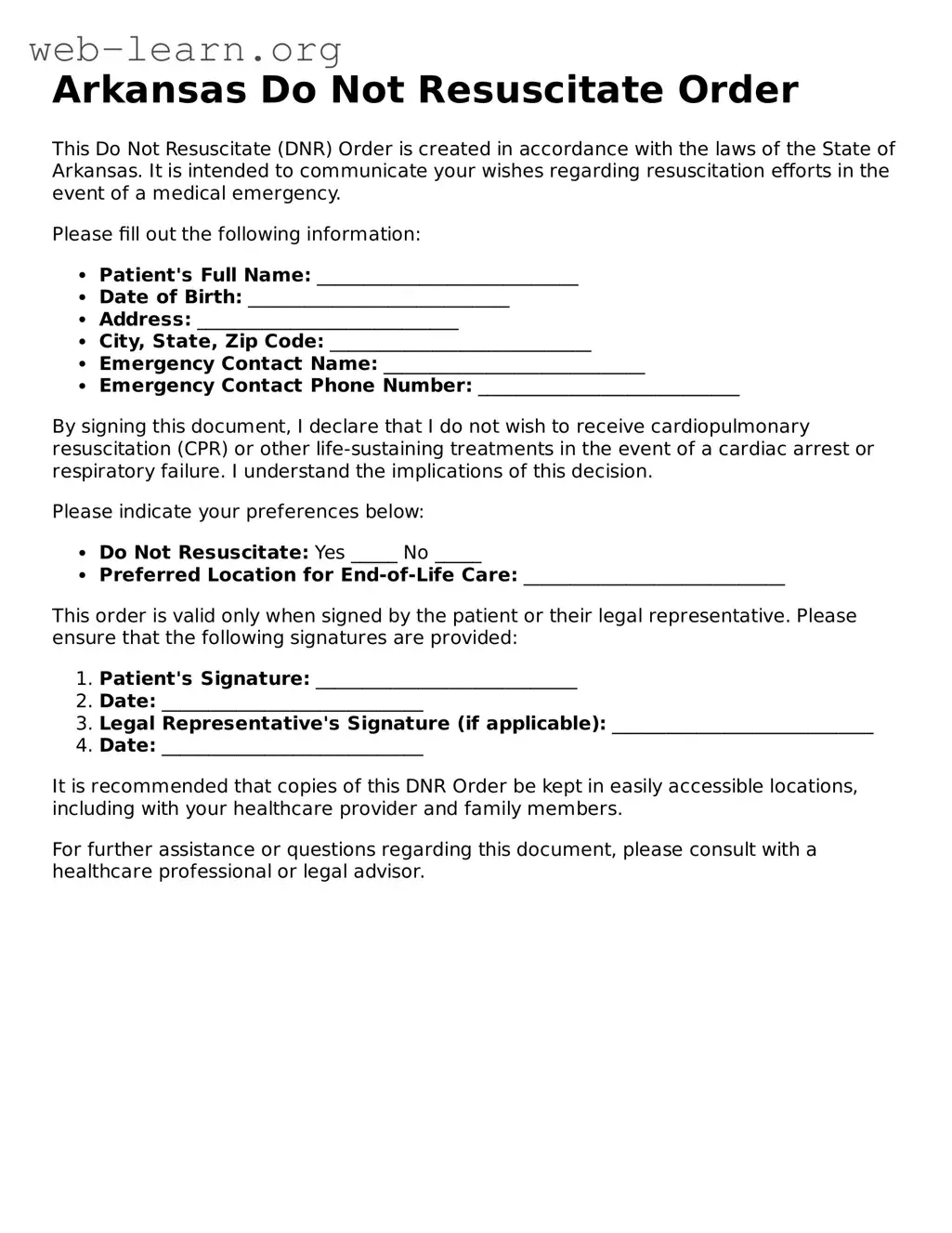
Arkansas Do Not Resuscitate Order
This Do Not Resuscitate (DNR) Order is created in accordance with the laws of the State of Arkansas. It is intended to communicate your wishes regarding resuscitation efforts in the event of a medical emergency.
Please fill out the following information:
By signing this document, I declare that I do not wish to receive cardiopulmonary resuscitation (CPR) or other life-sustaining treatments in the event of a cardiac arrest or respiratory failure. I understand the implications of this decision.
Please indicate your preferences below:
This order is valid only when signed by the patient or their legal representative. Please ensure that the following signatures are provided:
It is recommended that copies of this DNR Order be kept in easily accessible locations, including with your healthcare provider and family members.
For further assistance or questions regarding this document, please consult with a healthcare professional or legal advisor.
| Fact Name | Description |
|---|---|
| Definition | An Arkansas Do Not Resuscitate (DNR) Order is a legal document that instructs medical personnel not to perform cardiopulmonary resuscitation (CPR) in the event of cardiac arrest. |
| Governing Law | The Arkansas DNR Order is governed by Arkansas Code Annotated § 20-13-2201 et seq. |
| Eligibility | Any adult may complete a DNR Order, or a parent or legal guardian may complete it on behalf of a minor. |
| Signature Requirement | The DNR Order must be signed by the patient or their authorized representative, as well as a physician. |
| Form Availability | The DNR Order form is available through healthcare providers, hospitals, and state health departments. |
| Revocation | A DNR Order can be revoked at any time by the patient or their authorized representative, verbally or in writing. |
| Emergency Medical Services | Emergency medical services (EMS) personnel are required to honor the DNR Order when it is presented at the scene of an emergency. |
Filling out the Arkansas Do Not Resuscitate Order form is an important step in expressing your medical care preferences. After completing the form, you will need to ensure that it is properly signed and witnessed, then keep it in a safe place where it can be easily accessed by healthcare providers when needed.
What is a Do Not Resuscitate (DNR) Order?
A Do Not Resuscitate Order is a legal document that allows individuals to refuse resuscitation efforts in the event of a medical emergency. This means that if your heart stops beating or you stop breathing, medical personnel will not perform CPR or other life-saving measures. The DNR order reflects your wishes regarding end-of-life care.
Who can request a DNR Order in Arkansas?
In Arkansas, a DNR order can be requested by a patient who is at least 18 years old and has the capacity to make medical decisions. If the patient is unable to make decisions, a legally authorized representative, such as a family member or guardian, may request the order on their behalf.
How do I obtain a DNR Order form in Arkansas?
You can obtain a DNR Order form from various sources, including hospitals, healthcare providers, and online resources. It is important to ensure that the form you use complies with Arkansas state laws. After filling out the form, it must be signed by a physician and the patient or their representative.
What should I do after completing the DNR Order?
Once the DNR Order is completed and signed, make multiple copies. Keep one copy in a visible location at home, such as on the refrigerator, and provide copies to your healthcare providers. It is also advisable to inform family members and caregivers about your wishes to ensure they are respected in an emergency.
Can I change or revoke my DNR Order?
Yes, you can change or revoke your DNR Order at any time. To do this, simply complete a new DNR Order form and ensure it is signed and distributed as needed. You can also verbally communicate your wishes to your healthcare provider, but it is best to have a written document for clarity.
Will a DNR Order affect my overall medical care?
A DNR Order specifically pertains to resuscitation efforts and does not limit other types of medical care. You will continue to receive all other necessary treatments, including pain management and comfort care. It is crucial to discuss your overall healthcare goals with your medical team to ensure that your wishes are fully understood.
When filling out the Arkansas Do Not Resuscitate (DNR) Order form, people often make several common mistakes. These errors can lead to confusion or even unwanted medical interventions. Understanding these pitfalls can help ensure that your wishes are clearly communicated.
One frequent mistake is not providing a signature. The DNR form requires the signature of the patient or their legal representative. Without this signature, the document may not be valid. Always double-check that all necessary signatures are present before submitting the form.
Another common error is failing to date the form. A DNR Order must include the date it was completed. This date is essential because it indicates when the order was made. Without it, medical personnel may question the validity of the document.
Some individuals overlook the importance of clear and specific language. Using vague terms can lead to misunderstandings about what the DNR Order entails. Be explicit about your wishes to ensure that healthcare providers understand your preferences.
Additionally, people sometimes forget to communicate their DNR status to family members and healthcare providers. It’s crucial to discuss your wishes with loved ones and ensure that your medical team is aware of the DNR Order. This communication helps avoid confusion during critical moments.
Lastly, individuals may not keep a copy of the DNR Order for themselves. Having a personal copy is important for quick reference and to ensure that your wishes are honored. Store it in a safe but accessible place, and consider providing copies to your healthcare providers.
When considering end-of-life care options in Arkansas, several important documents accompany the Do Not Resuscitate (DNR) Order form. Each of these documents plays a crucial role in ensuring that a person's healthcare preferences are respected. Below is a list of commonly used forms that work in conjunction with the DNR Order.
Understanding these documents can help individuals make informed decisions about their healthcare preferences. Each form serves a specific purpose and together they create a comprehensive plan that reflects a person's wishes during critical health situations.
When filling out the Arkansas Do Not Resuscitate (DNR) Order form, it's essential to approach the task with care and consideration. Here are some important things to keep in mind.
By following these guidelines, you can help ensure that your DNR order reflects your wishes and is properly respected in a medical setting.
Understanding the Arkansas Do Not Resuscitate (DNR) Order form is essential for patients and their families. However, several misconceptions often cloud its purpose and function. Here are nine common misconceptions:
By addressing these misconceptions, individuals can make informed decisions about their healthcare preferences and ensure that their wishes are respected.
When filling out and using the Arkansas Do Not Resuscitate Order form, consider the following key takeaways:
Is a Dnr an Advance Directive - A DNR order can be a compassionate choice for those who prioritize quality of life over prolonging life at all costs.
Ky Dnr Form - Healthcare teams are trained to honor a patient's DNR order while providing supportive care.
Hawaii Do Not Resuscitate - A DNR order can be a compassionate choice for those facing terminal illnesses.