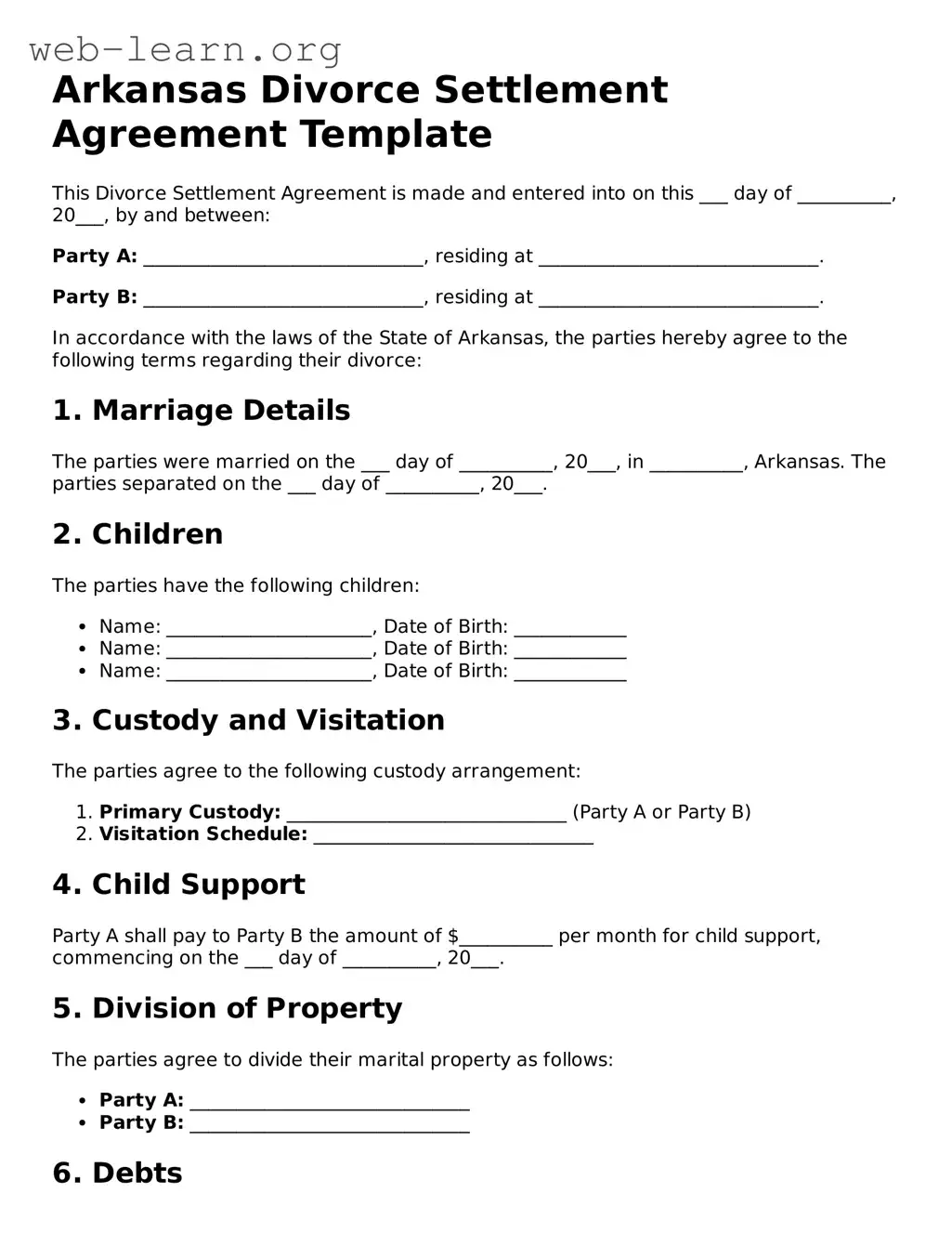
In the state of Arkansas, couples seeking a divorce must navigate various legal requirements to finalize their separation. A crucial component of this process is the Divorce Settlement Agreement form, which outlines the terms of the divorce. This form addresses significant issues such as the division of marital property, child custody arrangements, and spousal support obligations. It serves as a comprehensive document that reflects the mutual agreements reached by both parties, ensuring that their rights and responsibilities are clearly defined. Additionally, the form may include provisions for child support, visitation schedules, and any other relevant matters that impact the family dynamic post-divorce. Completing this form accurately is essential, as it not only facilitates a smoother legal process but also helps to prevent future disputes between the parties involved.
Arkansas Divorce Settlement Agreement Template
This Divorce Settlement Agreement is made and entered into on this ___ day of __________, 20___, by and between:
Party A: ______________________________, residing at ______________________________.
Party B: ______________________________, residing at ______________________________.
In accordance with the laws of the State of Arkansas, the parties hereby agree to the following terms regarding their divorce:
1. Marriage Details
The parties were married on the ___ day of __________, 20___, in __________, Arkansas. The parties separated on the ___ day of __________, 20___.
2. Children
The parties have the following children:
3. Custody and Visitation
The parties agree to the following custody arrangement:
4. Child Support
Party A shall pay to Party B the amount of $__________ per month for child support, commencing on the ___ day of __________, 20___.
5. Division of Property
The parties agree to divide their marital property as follows:
6. Debts
The parties agree to be responsible for the following debts:
7. Spousal Support
Party A shall pay Party B the amount of $__________ per month for spousal support, commencing on the ___ day of __________, 20___.
8. Miscellaneous
This agreement constitutes the entire understanding between the parties. Any amendments must be made in writing and signed by both parties.
IN WITNESS WHEREOF, the parties have executed this Divorce Settlement Agreement as of the date first above written.
Party A Signature: ______________________________ Date: ____________
Party B Signature: ______________________________ Date: ____________
Witness Signature: ______________________________ Date: ____________
| Fact Name | Details |
|---|---|
| Purpose | The Arkansas Divorce Settlement Agreement form outlines the terms agreed upon by both parties regarding the division of assets, debts, and custody arrangements. |
| Governing Law | The form is governed by the Arkansas Code Annotated, Title 9, Chapter 12, which pertains to divorce and family law. |
| Filing Requirement | This form must be filed with the court as part of the divorce proceedings to finalize the settlement. |
| Mutual Agreement | Both spouses must sign the form, indicating their mutual agreement to the terms specified within. |
| Modification | Once approved by the court, the agreement can only be modified through a subsequent court order. |
| Child Support Provisions | If children are involved, the form must include provisions for child support, which are subject to state guidelines. |
| Legal Advice | It is advisable for both parties to seek independent legal advice before signing the agreement to ensure fairness and compliance with the law. |
After obtaining the Arkansas Divorce Settlement Agreement form, it’s important to fill it out accurately. This document will help outline the terms of your divorce, including property division, child custody, and support arrangements. Follow the steps below to complete the form effectively.
Once the form is filled out and signed, it will be ready for submission to the appropriate court. Ensure you keep a copy for your records before filing.
What is a Divorce Settlement Agreement in Arkansas?
A Divorce Settlement Agreement is a legal document that outlines the terms agreed upon by both spouses during a divorce. It typically covers important aspects such as property division, child custody, visitation rights, and spousal support. This agreement serves as a roadmap for how the couple will handle their affairs post-divorce.
Why is a Divorce Settlement Agreement important?
This agreement is crucial because it helps prevent future disputes between the parties. By clearly defining the rights and responsibilities of each spouse, it can facilitate a smoother transition into post-divorce life. Additionally, a well-drafted agreement can be enforced by the court, providing legal protection for both parties.
What should be included in the Divorce Settlement Agreement?
Essential elements of the agreement often include:
Including these details helps ensure that both parties have a clear understanding of their obligations and rights.
Do I need a lawyer to create a Divorce Settlement Agreement?
While it is not legally required to have a lawyer draft the agreement, it is highly recommended. A legal professional can provide valuable insights, ensure that the document complies with Arkansas laws, and help protect your interests. If both parties agree, they may also choose to work collaboratively with a mediator.
How is the Divorce Settlement Agreement enforced?
Once the agreement is signed by both parties and approved by the court, it becomes a legally binding contract. If one party fails to adhere to the terms, the other party can seek enforcement through the court system. This may involve filing a motion for contempt or seeking modification of the agreement if circumstances change.
Can the Divorce Settlement Agreement be modified?
Yes, modifications are possible, especially regarding child custody and support. If circumstances change significantly—such as a job loss or relocation—either party can petition the court to modify the agreement. However, both parties must agree to the changes, and the court must approve them.
What happens if we cannot agree on the terms?
If spouses cannot reach an agreement, they may need to consider mediation or, in some cases, litigation. Mediation involves a neutral third party who helps facilitate discussions and negotiations. If mediation fails, the case may proceed to court, where a judge will make decisions regarding the contested issues.
Is the Divorce Settlement Agreement confidential?
Generally, the Divorce Settlement Agreement is part of the public record once filed with the court. However, certain sensitive information may be sealed or kept private, depending on the circumstances. Parties concerned about privacy should discuss this with their attorney to explore options for confidentiality.
How long does it take to finalize a Divorce Settlement Agreement?
The time required to finalize an agreement varies widely based on the complexity of the issues and the level of cooperation between the parties. Some couples may reach an agreement in a matter of weeks, while others may take months. Once an agreement is reached, it still needs to be approved by the court, which can add additional time.
What should I do after the Divorce Settlement Agreement is finalized?
After finalizing the agreement, it is important to keep a copy for your records. Ensure that you understand your rights and obligations under the agreement. If you have children, maintaining open communication with your ex-spouse can help facilitate a positive co-parenting relationship. Additionally, consider consulting with a financial advisor to understand the implications of your new financial situation.
Filling out the Arkansas Divorce Settlement Agreement form can be a daunting task. Many individuals overlook crucial details that can lead to complications down the road. One common mistake is failing to provide accurate personal information. This includes names, addresses, and other identifying details. Inaccuracies can delay the process and create unnecessary confusion.
Another frequent error is neglecting to specify the division of assets and debts. It’s essential to clearly outline how property will be divided. Without this clarity, disputes may arise later, causing additional stress for both parties. Make sure to list all assets, from the family home to bank accounts, and agree on how debts will be handled.
Many people also forget to consider future financial obligations. Child support and alimony are critical components of a divorce settlement. If these are not properly addressed in the agreement, it can lead to misunderstandings and potential legal issues later. Be thorough in discussing and documenting these obligations.
Another mistake involves failing to include a parenting plan when children are involved. This plan should detail custody arrangements, visitation schedules, and decision-making responsibilities. Without a clear parenting plan, co-parenting can become chaotic, and the best interests of the children may not be prioritized.
Some individuals rush through the form, thinking that a quick completion is sufficient. However, taking the time to review each section carefully is crucial. Rushing can lead to overlooked details or incomplete sections, which could invalidate the agreement.
Moreover, people often forget to sign and date the document. An unsigned agreement is not legally binding. Ensure that both parties have signed the form in the appropriate places to avoid any future disputes regarding its validity.
Another common oversight is not consulting with a legal professional. While it may seem tempting to handle everything independently, having an expert review the agreement can help identify potential pitfalls. This step can provide peace of mind and ensure that all legal requirements are met.
Additionally, some individuals fail to keep copies of the completed agreement. After submitting the form, it’s vital to retain a copy for personal records. This documentation can be useful for future reference, especially if any disputes arise.
People may also underestimate the importance of detailing tax implications related to asset division. Understanding how assets will be taxed can influence decisions made during the settlement. Consulting a financial advisor can provide clarity on this matter.
Lastly, many overlook the importance of being honest and transparent throughout the process. Concealing information or assets can lead to serious legal consequences and strain relationships. Open communication fosters trust and helps ensure a smoother transition for everyone involved.
When navigating the process of divorce in Arkansas, several key documents accompany the Divorce Settlement Agreement. Each of these forms serves a specific purpose, helping to clarify the terms of the divorce and ensuring that both parties understand their rights and obligations. Below are some commonly used forms that work in conjunction with the Divorce Settlement Agreement.
Understanding these documents is crucial for anyone going through a divorce in Arkansas. Each plays a vital role in ensuring that the process is as smooth and fair as possible, protecting the rights of both parties and any children involved.
Filling out the Arkansas Divorce Settlement Agreement form can feel overwhelming, but it doesn’t have to be. Here’s a helpful list of what you should and shouldn’t do to make the process smoother.
By following these tips, you can navigate the form with confidence and ease. Remember, this is an important step in moving forward, so take it seriously but don’t let it stress you out!
When it comes to the Arkansas Divorce Settlement Agreement form, several misconceptions can lead to confusion and frustration. Understanding these common misunderstandings can help you navigate the divorce process more smoothly. Here are five prevalent misconceptions:
This is not true. The Divorce Settlement Agreement form can vary based on individual circumstances. Each couple's situation is unique, and the form should reflect the specific agreements made between the parties involved.
While signing the form signifies an agreement, it does not mean that changes cannot be made later. If both parties agree, modifications can be made, but it may require additional paperwork and court approval.
This misconception overlooks the fact that the Divorce Settlement Agreement can also cover child custody, visitation rights, and support obligations. It is a comprehensive document that can address various aspects of the divorce.
While some individuals may choose to represent themselves, having legal assistance can be invaluable. An attorney can help ensure that all necessary terms are included and that your rights are protected throughout the process.
Filing the Divorce Settlement Agreement is an important step, but it is not the end. The court must review and approve the agreement before it becomes legally binding. This process may involve a hearing or additional documentation.
By dispelling these misconceptions, individuals can approach the Divorce Settlement Agreement form with greater clarity and confidence. Always consider seeking guidance from a legal professional to ensure that your interests are adequately represented.
Filling out the Arkansas Divorce Settlement Agreement form can be a significant step in the divorce process. Here are some key takeaways to keep in mind:
By keeping these points in mind, you can navigate the process more smoothly and ensure that your agreement reflects your intentions and needs.
Mutual Divorce Agreement Sample - The agreement can be used as evidence in court if disputes arise later.
Divorce Templates - This document serves as a mutual agreement between spouses to settle their divorce amicably.