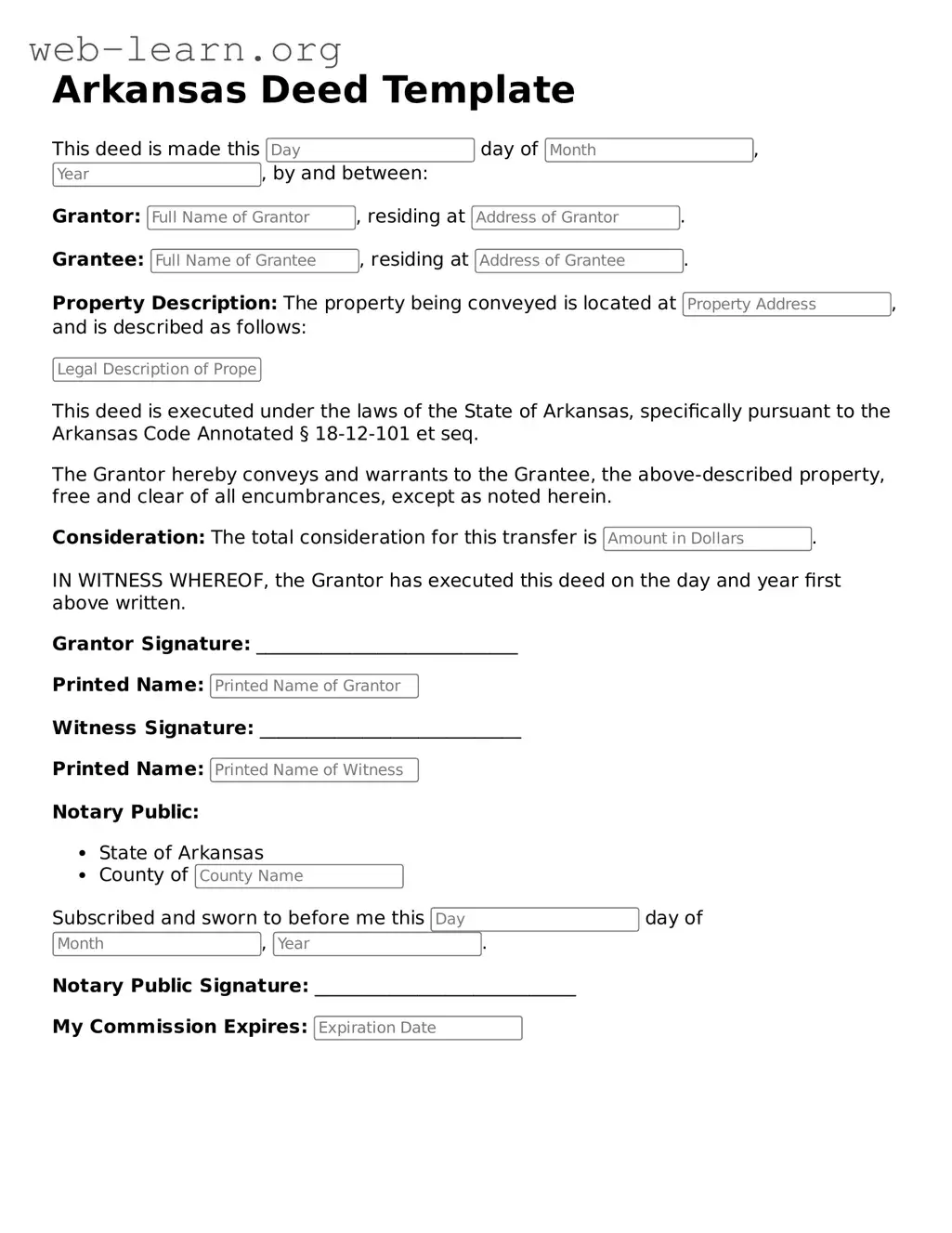
The Arkansas Deed form is a crucial document in real estate transactions, serving as the official record of property ownership transfer. This form outlines essential details such as the names of the parties involved, the legal description of the property, and the consideration amount, which is the price paid for the property. It also specifies the type of deed being used, whether it's a warranty deed, quitclaim deed, or another variation, each offering different levels of protection for the buyer. Signatures of both the grantor and grantee are required, along with notarization to validate the transaction. Additionally, the form must be filed with the county clerk's office to ensure public record and enforceability. Understanding these key components is vital for anyone looking to buy or sell property in Arkansas, as they help safeguard rights and clarify ownership in future dealings.
Arkansas Deed Template
This deed is made this day of , , by and between:
Grantor: , residing at .
Grantee: , residing at .
Property Description: The property being conveyed is located at , and is described as follows:
This deed is executed under the laws of the State of Arkansas, specifically pursuant to the Arkansas Code Annotated § 18-12-101 et seq.
The Grantor hereby conveys and warrants to the Grantee, the above-described property, free and clear of all encumbrances, except as noted herein.
Consideration: The total consideration for this transfer is .
IN WITNESS WHEREOF, the Grantor has executed this deed on the day and year first above written.
Grantor Signature: ____________________________
Printed Name:
Witness Signature: ____________________________
Printed Name:
Notary Public:
Subscribed and sworn to before me this day of , .
Notary Public Signature: ____________________________
My Commission Expires:
| Fact Name | Description |
|---|---|
| Governing Law | The Arkansas Deed form is governed by the Arkansas Code Annotated, Title 18, Chapter 12. |
| Types of Deeds | Arkansas recognizes several types of deeds, including warranty deeds, quitclaim deeds, and special warranty deeds. |
| Required Signatures | Both the grantor and the grantee must sign the deed for it to be valid. |
| Notarization | A notary public must witness the signing of the deed to ensure its authenticity. |
| Recording | Deeds must be recorded in the county where the property is located to provide public notice of ownership. |
| Consideration | The deed must specify the consideration, or payment, exchanged for the property. |
| Legal Description | A legal description of the property must be included to clearly identify the parcel being transferred. |
| Property Taxes | Transfer of property through a deed may affect property tax assessments, so it's important to check local regulations. |
After you have gathered the necessary information, you can begin filling out the Arkansas Deed form. Make sure you have all relevant details on hand, such as the names of the parties involved, property description, and any other required information. Following these steps will help ensure that the form is completed accurately.
What is an Arkansas Deed form?
An Arkansas Deed form is a legal document used to transfer ownership of real estate property from one party to another in the state of Arkansas. This form outlines the details of the transaction, including the names of the parties involved, a description of the property, and the terms of the transfer.
What types of deeds are available in Arkansas?
In Arkansas, several types of deeds can be used, including:
Who needs to sign the deed?
Typically, the seller (grantor) must sign the deed. If the property is owned by multiple individuals or entities, all owners must sign. The buyer (grantee) does not need to sign the deed for it to be valid.
Is notarization required for an Arkansas Deed?
Yes, in Arkansas, a deed must be notarized to be legally effective. The notary public verifies the identities of the signers and their willingness to sign the document.
How is a deed recorded in Arkansas?
To record a deed, the completed and notarized document must be submitted to the county clerk's office in the county where the property is located. There may be a recording fee, and it is advisable to keep a copy of the recorded deed for personal records.
What information is typically included in an Arkansas Deed?
An Arkansas Deed usually includes:
Can I create my own Arkansas Deed form?
While it is possible to create your own deed, it is advisable to use a standard form or consult with a legal professional to ensure that all necessary elements are included and comply with Arkansas law.
What happens if a deed is not recorded?
If a deed is not recorded, the transfer of ownership may not be legally recognized against third parties. This means that if someone else claims an interest in the property, they may prevail over an unrecorded deed, potentially causing complications for the new owner.
Are there any tax implications when transferring property in Arkansas?
Yes, transferring property may have tax implications, such as transfer taxes or capital gains taxes. It is recommended to consult with a tax professional to understand the specific tax responsibilities associated with the property transfer.
Where can I find an Arkansas Deed form?
Arkansas Deed forms can be obtained from various sources, including:
Filling out a deed form in Arkansas can seem straightforward, but there are several common mistakes that individuals often make. One significant error is failing to include the correct legal description of the property. This description must be precise and should match the information found in the county assessor's office. Omitting or inaccurately describing the property can lead to complications in the transfer process.
Another frequent mistake is neglecting to include all necessary parties involved in the transaction. The deed must clearly identify both the grantor (the person transferring the property) and the grantee (the person receiving the property). If either party is missing or incorrectly named, the deed may not be legally valid.
People often forget to sign the deed in the appropriate places. In Arkansas, the grantor must sign the deed for it to be effective. Additionally, some individuals overlook the requirement for witnesses or a notary public. Without these signatures, the deed may not be accepted for recording.
Additionally, many individuals do not check for proper notarization. In Arkansas, a deed must be notarized to be legally binding. If the notary does not sign or stamp the document correctly, it may be rejected by the county clerk’s office, causing delays in the property transfer.
Another common mistake is miscalculating the transfer tax. Arkansas requires a transfer tax based on the property's sale price. Failing to include this tax or calculating it incorrectly can lead to additional fees or complications during the recording process.
Lastly, people sometimes ignore the importance of checking for existing liens or encumbrances on the property. Before completing the deed, it is crucial to ensure that there are no outstanding debts or claims against the property. Failing to address these issues can lead to disputes and legal challenges after the transfer is complete.
When completing a property transaction in Arkansas, several forms and documents often accompany the Deed form to ensure all legal requirements are met. These documents help facilitate the transfer of property ownership and protect the interests of both the buyer and the seller.
These documents play a crucial role in the property transfer process, ensuring that both parties are protected and that the transaction proceeds smoothly. Properly completing and reviewing these forms can help avoid potential legal issues in the future.
The Deed form is a crucial document in property transactions, but it shares similarities with several other important documents. Here are five documents that are similar to the Deed form:
When filling out the Arkansas Deed form, it’s important to be careful and precise. Here are five things you should and shouldn't do:
By following these guidelines, you can help ensure that your Arkansas Deed form is filled out correctly and efficiently.
Misconceptions about the Arkansas Deed form can lead to confusion among property owners and buyers. Understanding these misconceptions is important for making informed decisions. Below are five common misconceptions:
All deeds are the same. Many people believe that all deeds serve the same purpose and have the same legal effect. In reality, there are different types of deeds, such as warranty deeds and quitclaim deeds, each with distinct implications for ownership and liability.
A deed must be notarized to be valid. While notarization is a common practice that adds a layer of authenticity, it is not always required for a deed to be legally effective in Arkansas. However, notarization is often necessary for recording the deed with the county clerk.
Once a deed is signed, it cannot be changed. Some individuals believe that a deed is final and unchangeable once it is executed. In fact, deeds can be modified or revoked through various legal processes, depending on the circumstances and the type of deed involved.
Deeds do not need to be recorded. There is a misconception that recording a deed is optional. However, recording a deed with the appropriate local authority is crucial for establishing public notice of ownership and protecting rights against future claims.
All property transfers require a lawyer. While having legal representation can be beneficial, it is not a legal requirement for all property transfers in Arkansas. Individuals can complete the process independently, though they should ensure compliance with all legal requirements.
When filling out and using the Arkansas Deed form, it is essential to keep several key points in mind to ensure the process goes smoothly. Below are important takeaways:
By following these guidelines, individuals can navigate the process of completing and utilizing the Arkansas Deed form effectively.
What Does a House Deed Look Like in Michigan - Helps in documenting property improvements or changes.
Indiana Quit Claim Deed Form - Understanding deeds is crucial for anyone involved in real estate.
Hawaii Quick Claim Deed - A legal document that transfers ownership of property.