Homepage Blank Arkansas Border City Form
Outline

Navigating the intricacies of state taxes can be daunting, especially for residents of border cities like Texarkana, which straddles Arkansas and Texas. The Arkansas Border City form addresses a unique tax exemption that can significantly impact your financial situation if you live or work in this area. Essentially, if you reside in Texarkana, Arkansas, your income earned there is exempt from Arkansas income tax. Conversely, residents of Texarkana, Texas, can also enjoy this exemption for income earned while working in the Arkansas portion of the city. However, it's important to note that any other income sourced from Arkansas remains taxable. To take advantage of this exemption, certain conditions must be met. For instance, you must file your tax return using your street address in either Texarkana, Arkansas, or Texarkana, Texas—using a Post Office Box or Rural Route will disqualify you from the exemption. Additionally, if you're claiming an exemption based on income reported on a W-2 form, you must attach that form along with the AR-TX form provided by your employer. Non-wage income, such as interest or dividends, does not require the AR-TX form, but you may need to provide extra information for verification if adjustments are claimed. Finally, filing an Arkansas tax return is mandatory, where you will report all your income and can claim the exemption as an adjustment on Form AR1000ADJ.

Sample - Arkansas Border City Form

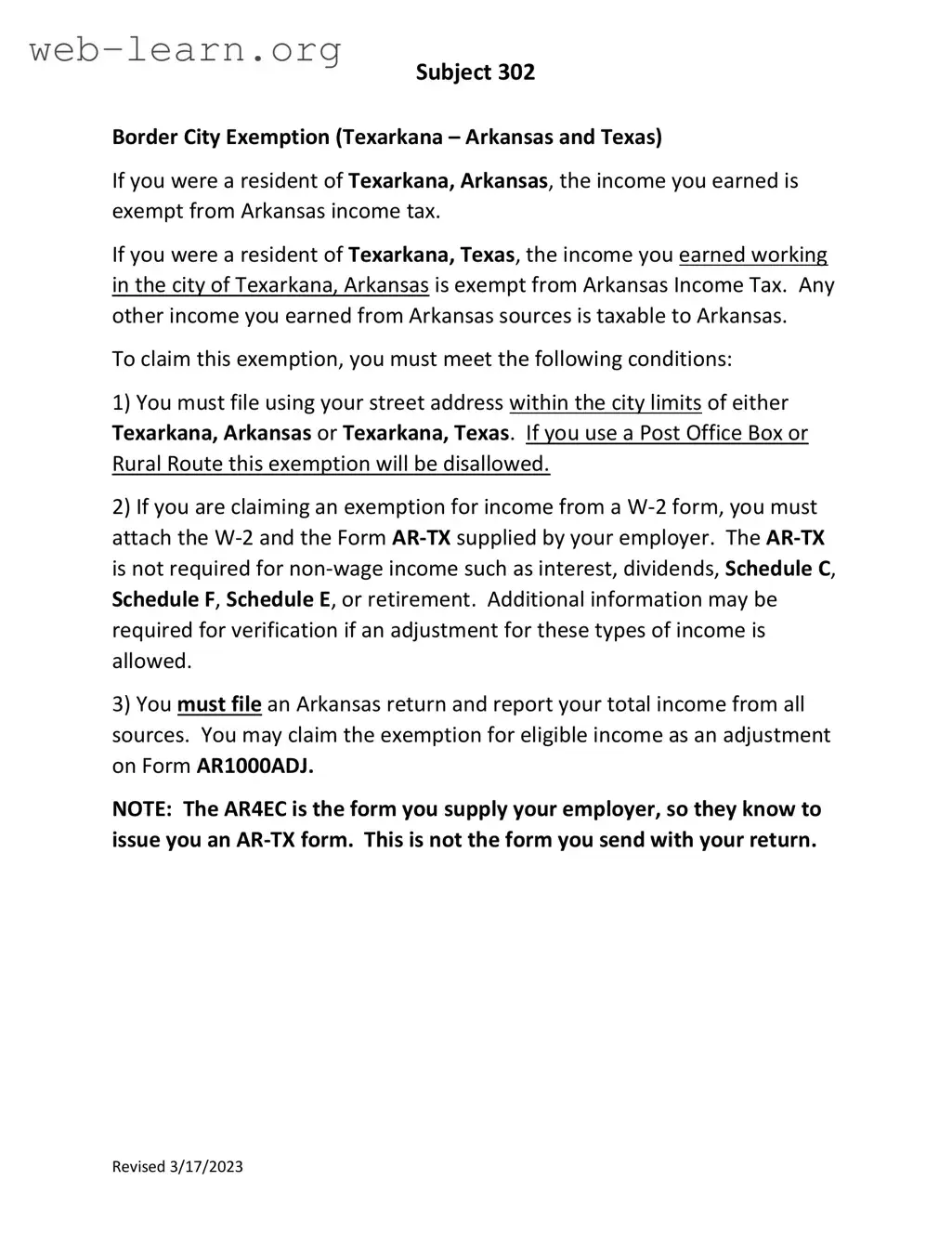
Subject 302
Revised 3/17/2023
Border City Exemption (Texarkana Arkansas and Texas)
If you were a resident of Texarkana, Arkansas, the income you earned is
exempt from Arkansas income tax.
If you were a resident of Texarkana, Texas, the income you earned working
in the city of Texarkana, Arkansas is exempt from Arkansas Income Tax. Any
other income you earned from Arkansas sources is taxable to Arkansas.
To claim this exemption, you must meet the following conditions:
1) You must file using your street address within the city limits of either
Texarkana, Arkansas or Texarkana, Texas. If you use a Post Office Box or
Rural Route this exemption will be disallowed.
2) If you are claiming an exemption for income from a W-2 form, you must
attach the W-2 and the Form AR-TX supplied by your employer. The AR-TX
is not required for non-wage income such as interest, dividends, Schedule C,
Schedule F, Schedule E, or retirement. Additional information may be
required for verification if an adjustment for these types of income is
allowed.
3) You must file an Arkansas return and report your total income from all
sources. You may claim the exemption for eligible income as an adjustment
on Form AR1000ADJ.
NOTE: The AR4EC is the form you supply your employer, so they know to
issue you an AR-TX form. This is not the form you send with your return.

Form Information

Fact Name Details
Exemption Overview Residents of Texarkana, Arkansas, are exempt from Arkansas income tax on income earned within the city.
Eligibility for Texas Residents Texarkana, Texas residents can also claim an exemption for income earned in Texarkana, Arkansas.
Taxable Income Any income earned from Arkansas sources, other than the exempt income, is subject to Arkansas income tax.
Filing Requirements To claim the exemption, individuals must file using a street address in Texarkana, Arkansas, or Texarkana, Texas. P.O. Boxes are not acceptable.
Supporting Documentation When claiming an exemption for W-2 income, attach the W-2 and Form AR-TX. Non-wage income does not require the AR-TX form.

Detailed Guide for Filling Out Arkansas Border City

After completing the Arkansas Border City form, you will submit it along with any required documents to ensure your exemption is processed correctly. Follow these steps to fill out the form accurately.

  1. Obtain the Arkansas Border City form from the appropriate state website or office.
  2. Write your street address in either Texarkana, Arkansas, or Texarkana, Texas. Avoid using a Post Office Box or Rural Route, as this will disqualify your exemption.
  3. If you are claiming an exemption for income reported on a W-2 form, gather your W-2 and the Form AR-TX from your employer. Attach these documents to your submission.
  4. For non-wage income (like interest or dividends), note that the AR-TX form is not required. However, be prepared to provide additional information if necessary.
  5. Complete the Arkansas return, reporting your total income from all sources, including any taxable income from Arkansas.
  6. On Form AR1000ADJ, claim the exemption for eligible income as an adjustment.
  7. Review your completed form for accuracy and completeness before submission.
  8. Submit the form and any attachments to the appropriate Arkansas tax authority.

Obtain Answers on Arkansas Border City

  1. What is the Arkansas Border City Exemption?

    The Arkansas Border City Exemption applies to residents of Texarkana, Arkansas, and Texarkana, Texas. If you live in Texarkana, Arkansas, the income you earn is exempt from Arkansas income tax. Similarly, if you reside in Texarkana, Texas, any income you earn while working in Texarkana, Arkansas is also exempt. However, keep in mind that income from other Arkansas sources remains taxable.

  2. What are the eligibility requirements to claim this exemption?

    To qualify for the exemption, you must meet specific conditions:

    • You must file your tax return using your street address in either Texarkana, Arkansas, or Texarkana, Texas. Using a Post Office Box or Rural Route will result in disqualification.
    • If you are claiming an exemption for income reported on a W-2 form, you must attach both the W-2 and the Form AR-TX provided by your employer. For non-wage income, such as interest or dividends, the AR-TX form is not required.
    • All taxpayers must file an Arkansas return and report total income from all sources, even if some of that income is exempt.
  3. Do I need to submit any forms with my tax return?

    Yes, if you are claiming an exemption for W-2 income, you must include the W-2 and the AR-TX form. For non-wage income, additional information may be requested for verification if adjustments are made. Always ensure that you file an Arkansas return and report all your income.

  4. What happens if I use a Post Office Box instead of my street address?

    Using a Post Office Box or a Rural Route address will disqualify you from claiming the Border City Exemption. It is essential to provide your actual street address to ensure your eligibility.

  5. Can I claim the exemption for non-wage income?

  6. How do I report my income and claim the exemption?

    To report your income and claim the exemption, you must file an Arkansas return and complete Form AR1000ADJ to adjust for eligible exempt income. Make sure to include all sources of income and attach any necessary documentation, such as W-2 forms or the AR-TX form, as applicable.

Common mistakes

Filling out the Arkansas Border City form can be tricky. Many people make common mistakes that can lead to delays or even disqualification of their exemption. Here are seven mistakes to avoid.

First, using a Post Office Box or Rural Route address is a frequent error. The form specifically requires your street address in either Texarkana, Arkansas, or Texarkana, Texas. If you fail to provide a valid street address, your exemption will be disallowed.

Second, some individuals forget to attach their W-2 form when claiming an exemption for income reported on it. This is crucial. Without the W-2 and the accompanying Form AR-TX from your employer, your claim cannot be processed correctly.

Third, people often overlook the requirement to file an Arkansas return. You must report your total income from all sources, even if some of that income is exempt. Neglecting this step can lead to complications and potential penalties.

Fourth, claiming the exemption for non-wage income without the necessary documentation is another common mistake. If you earn income from sources like interest or dividends, be aware that additional information may be required for verification.

Fifth, failing to understand the types of income that qualify for the exemption can lead to errors. Only specific income types are eligible, and misunderstanding this can cause confusion. Ensure you know what qualifies before submitting your form.

Sixth, some individuals do not double-check their calculations. Mistakes in math can lead to incorrect income reporting, which may affect your exemption. Always take a moment to review your figures before submitting.

Lastly, many forget to keep copies of their submitted forms and documents. Having a record is essential. In case of any issues or questions from the tax authorities, you will have the necessary paperwork to support your claims.

By avoiding these mistakes, you can ensure a smoother process when filling out the Arkansas Border City form. Take your time, read the instructions carefully, and don’t hesitate to seek help if needed.

Documents used along the form

The Arkansas Border City form is essential for residents of Texarkana, Arkansas, and Texarkana, Texas, who want to claim an exemption from Arkansas income tax. However, there are several other forms and documents that are often used in conjunction with this form. Below is a list of these related documents, each serving a unique purpose in the tax filing process.

  • Form AR1000: This is the standard Arkansas individual income tax return. Residents use it to report their total income from all sources and calculate their tax liability.
  • Form AR1000ADJ: This adjustment form allows taxpayers to claim exemptions or adjustments to their taxable income, including the Border City exemption.
  • W-2 Form: Employers provide this form to report wages paid to employees and the taxes withheld. It is necessary for claiming exemptions related to earned income.
  • Form AR-TX: This form is issued by employers in Texarkana, Texas, and must be attached to the W-2 when claiming the Border City exemption for income earned in Arkansas.
  • Schedule C: Self-employed individuals use this form to report income or loss from their business. It helps determine taxable income from non-wage sources.
  • Schedule E: This form is for reporting income or loss from rental real estate, royalties, partnerships, S corporations, estates, trusts, and other sources. It is relevant for those claiming exemptions on non-wage income.
  • Schedule F: Farmers use this form to report income and expenses related to farming activities. It may be necessary for those claiming agricultural income exemptions.
  • Form AR-3: This is the Arkansas tax form for claiming a refund. Taxpayers who overpay their taxes can use this form to request a refund from the state.
  • Form 1099: This form is used to report various types of income other than wages, salaries, and tips. It is important for individuals with freelance or contract work.
  • Form 4868: This form allows taxpayers to request an automatic extension of time to file their federal income tax return, which may also affect state filings.

Understanding these forms can simplify the tax filing process for residents of Texarkana. Each document plays a crucial role in ensuring compliance and maximizing potential exemptions. Always consider consulting a tax professional for personalized advice based on your specific situation.

Similar forms

The Arkansas Border City form is essential for residents of Texarkana, Arkansas, and Texarkana, Texas, as it provides a tax exemption for income earned in the border city. Several other documents share similarities with this form, primarily in their purpose of tax exemptions or credits. Below are six documents that are comparable to the Arkansas Border City form:

  • Form 1040: This is the standard individual income tax return form used by U.S. taxpayers. Like the Arkansas Border City form, it allows individuals to report their income and claim deductions or credits, ensuring they pay the correct amount of tax.
  • Form 8862: This form is used to claim the Earned Income Credit after it has been denied in previous years. Similar to the Arkansas Border City form, it requires specific documentation to substantiate the claim for a tax benefit.
  • Form W-2: Employers issue this form to report wages paid to employees and the taxes withheld. It is essential for claiming exemptions on the Arkansas Border City form, as it provides proof of income earned in the border city.
  • Form AR1000ADJ: This is the Arkansas adjustment form used to report and adjust income. It parallels the Arkansas Border City form in that both require accurate reporting of income and adjustments for exemptions.
  • Form 8863: This form is used to claim education credits, such as the American Opportunity Credit and the Lifetime Learning Credit. Both this form and the Arkansas Border City form allow taxpayers to claim specific benefits that reduce their overall tax liability.
  • Form 1099: This form reports various types of income other than wages, salaries, and tips. Like the Arkansas Border City form, it is crucial for accurately reporting income, especially for those claiming exemptions on non-wage income.

Dos and Don'ts

When filling out the Arkansas Border City form, it is important to follow specific guidelines to ensure your exemption is properly claimed. Below is a list of things to do and avoid:

  • Do use your street address in Texarkana, Arkansas, or Texarkana, Texas.
  • Do attach your W-2 form and the Form AR-TX if claiming an exemption for W-2 income.
  • Do report your total income from all sources on your Arkansas return.
  • Do claim the exemption for eligible income on Form AR1000ADJ.
  • Don't use a Post Office Box or Rural Route address, as this will disqualify your exemption.
  • Don't forget that the AR-TX form is not required for non-wage income.

Misconceptions

Understanding the Arkansas Border City Exemption can be tricky. Here are some common misconceptions about this form that many people have:

  • Only residents of Arkansas can claim the exemption. This is not true. Residents of Texarkana, Texas, who earn income in Texarkana, Arkansas, can also claim this exemption.
  • Using a P.O. Box is acceptable for filing. In reality, you must use your street address. A P.O. Box or Rural Route will disqualify your exemption.
  • Only W-2 income qualifies for the exemption. While W-2 income does qualify, other types of income can also be exempt, provided you meet specific conditions.
  • All income earned in Arkansas is exempt. This is a misconception. Only income earned in Texarkana qualifies for the exemption; other Arkansas-sourced income remains taxable.
  • You don't need to file an Arkansas return. This is incorrect. You must file an Arkansas return and report all your income, even if some of it is exempt.
  • The AR-TX form is always required. The AR-TX form is necessary only for W-2 income. For other types of income, it is not required.
  • Exemptions can be claimed without documentation. In fact, you may need to provide additional information for verification, especially for non-wage income.
  • Only income earned in Texarkana, Arkansas, is exempt. This is misleading. If you live in Texarkana, Texas, and earn income in Texarkana, Arkansas, that income is also exempt.

By clarifying these misconceptions, individuals can better navigate the complexities of the Arkansas Border City Exemption and ensure they are compliant with tax regulations.

Key takeaways

Filling out and utilizing the Arkansas Border City form requires attention to specific details to ensure compliance and maximize tax benefits. Here are key takeaways to consider:

  • Location Matters: The exemption applies specifically to residents of Texarkana, Arkansas, and Texarkana, Texas. Make sure to identify your residency correctly.
  • Income Exemption: Only income earned within Texarkana is exempt from Arkansas income tax for eligible residents. Other Arkansas-source income remains taxable.
  • Correct Address: Use your street address when filing. Post Office Boxes or Rural Routes will lead to disqualification of the exemption.
  • W-2 Income: If claiming an exemption for W-2 income, attach both your W-2 form and the Form AR-TX provided by your employer.
  • Non-Wage Income: The AR-TX form is not necessary for non-wage income types, such as interest or dividends. However, additional verification may be required.
  • Complete Reporting: It is essential to file an Arkansas tax return that includes total income from all sources, even if some of it is exempt.
  • Adjustment Claim: To claim the exemption, report eligible income as an adjustment on Form AR1000ADJ.
  • Verification Process: Be prepared to provide additional documentation for income types that may require verification for exemption adjustments.
  • Deadline Awareness: Familiarize yourself with filing deadlines to avoid penalties or loss of exemption eligibility.
  • Consult Resources: Utilize state tax resources or consult a tax professional if you have questions about the process or eligibility.