Homepage Blank Arkansas Ar4Pt Form
Outline

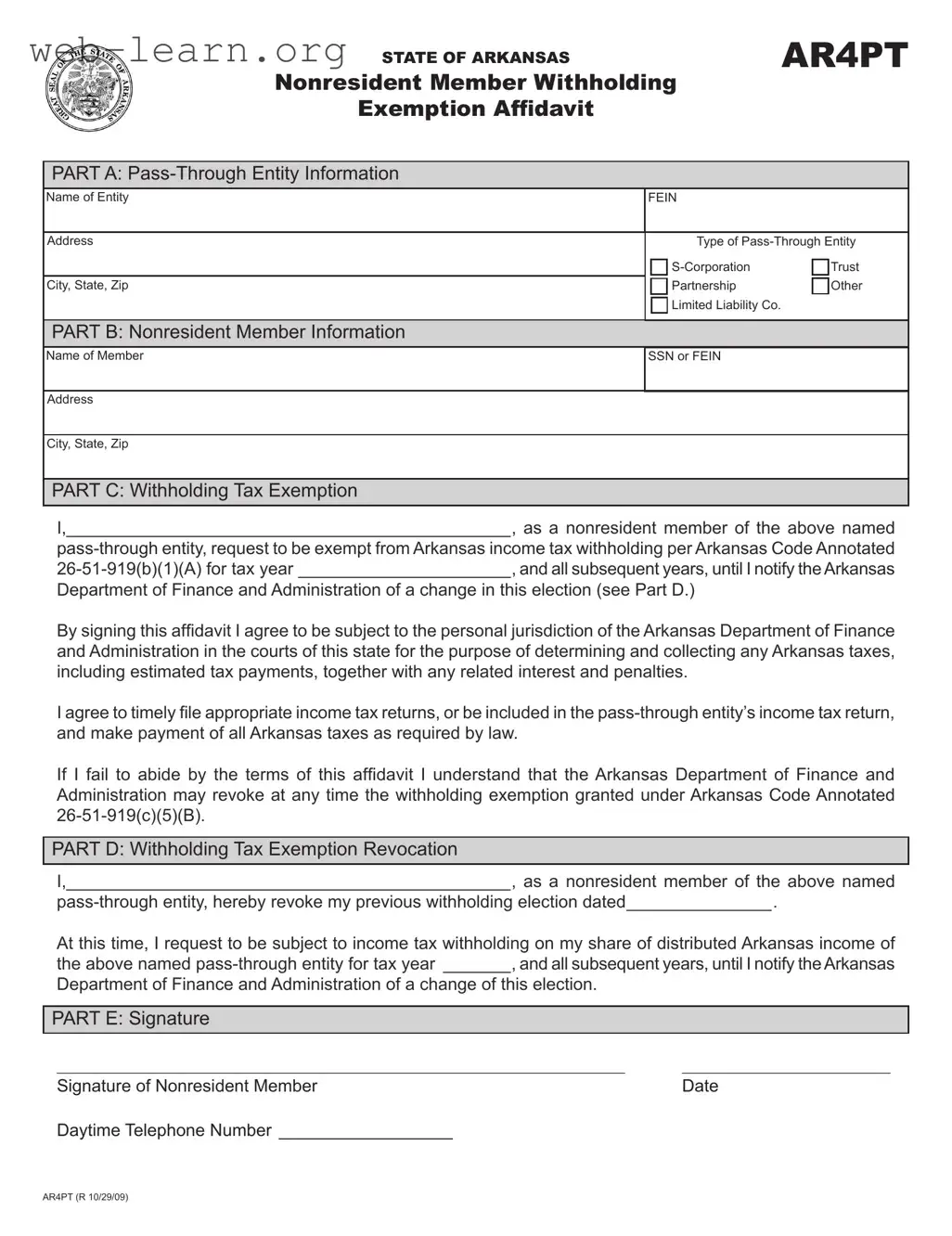
Navigating the complexities of tax obligations can be a daunting task, especially for nonresident members of pass-through entities in Arkansas. The Arkansas AR4PT form serves as a crucial tool for these individuals, allowing them to request an exemption from state income tax withholding on their share of distributed Arkansas income. This form is divided into several parts, each tailored to gather specific information. In the first section, pass-through entities, such as S-Corporations, partnerships, and limited liability companies, provide essential details about their organization. The subsequent section captures vital information about the nonresident member, including their name and identification number. Perhaps the most significant aspect of the AR4PT form is the withholding tax exemption request, where nonresident members can assert their eligibility for exemption under Arkansas law. Additionally, the form includes provisions for revoking a previous exemption, ensuring that members can adjust their tax status as needed. By understanding the ins and outs of the AR4PT form, nonresident members can better manage their tax responsibilities and ensure compliance with Arkansas tax regulations.


Sample - Arkansas Ar4Pt Form

____________________________________________________________ ______________________
Signature of Nonresident Member Date
Daytime Telephone Number __________________
PART A: Pass-Through Entity Information
PART B: Nonresident Member Information
PART C: Withholding Tax Exemption
Type of Pass-Through Entity
Name of Entity
Address
City, State, Zip
FEIN
S-Corporation Trust
Partnership Other
Limited Liability Co.
Name of Member
Address
City, State, Zip
SSN or FEIN
STATE OF ARKANSAS
Nonresident Member Withholding

AR4PT
PART D: Withholding Tax Exemption Revocation
PART E: Signature
I, ______________________________________________, as a nonresident member of the above named
pass-through entity, request to be exempt from Arkansas income tax withholding per Arkansas Code Annotated
26-51-919(b)(1)(A) for tax year ______________________, and all subsequent years, until I notify the Arkansas
Department of Finance and Administration of a change in this election (see Part D.)

and Administration in the courts of this state for the purpose of determining and collecting any Arkansas taxes,
including estimated tax payments, together with any related interest and penalties.

and make payment of all Arkansas taxes as required by law.
                 
Administration may revoke at any time the withholding exemption granted under Arkansas Code Annotated
26-51-919(c)(5)(B).
I, ______________________________________________, as a nonresident member of the above named
pass-through entity, hereby revoke my previous withholding election dated _______________.

the above named pass-through entity for tax year _______, and all subsequent years, until I notify the Arkansas
Department of Finance and Administration of a change of this election.
AR4PT (R 10/29/09)
Instructions for Nonresident Member


Arkansas Code Annotated 26-51-919(b)(1)(A) requires a pass-through entity to withhold income tax at the rate of 7% on each


Instructions for Nonresident Member
Any nonresident member receiving a distribution of Arkansas income from a pass-through entity may claim an exemption from

.
A nonresident member who has previously received an exemption from the withholding requirement may revoke such exemption
.
.


the Arkansas Department of Finance and Administration (DFA) upon request. All pass-through entities must provide DFA on


 
spreadsheet format (such as Excel), a database format (such as Access), or a Delimited Text File. Due to security
reasons, the information cannot be sent electronically at this time. All of the information shown in Parts A and B

website at .
 
tax return, including extensions, at the address below.
 

d. For those pass-through entities that are granted a waiver, copies of all Nonresident Member Withholding Exemption

return, including extensions, at the address below.

Individual Income Tax Section
Pass-Through Entity


AR4PT Instr (R 10/29/09)

Form Information

Fact Name Details
Purpose of the Form The Arkansas AR4PT form allows nonresident members of pass-through entities to request an exemption from Arkansas income tax withholding.
Governing Law This form is governed by Arkansas Code Annotated 26-51-919(b)(1)(A), which outlines the withholding requirements for nonresident members.
Eligibility for Exemption Nonresident members who receive distributions from a pass-through entity can claim an exemption by submitting the completed AR4PT form.
Revocation of Exemption A nonresident member can revoke their withholding exemption by completing Part D of the AR4PT form and notifying the pass-through entity.
Retention of Records Pass-through entities are required to retain the original AR4PT forms and provide copies to the Arkansas Department of Finance and Administration upon request.
Annual Reporting Requirement Pass-through entities must report the names, addresses, and identification numbers of nonresident members who have submitted the AR4PT form on an annual basis.
Submission Method The AR4PT form must be submitted to the pass-through entity, which will then manage the filing with the Arkansas Department of Finance and Administration.

Detailed Guide for Filling Out Arkansas Ar4Pt

Completing the Arkansas AR4PT form is essential for nonresident members of pass-through entities who wish to claim an exemption from state income tax withholding. This form must be filled out carefully and submitted to the appropriate pass-through entity to ensure compliance with Arkansas tax regulations.

  1. Gather Required Information: Before starting, collect all necessary details, including the name, address, and FEIN of the pass-through entity, as well as your personal information like your name, SSN or FEIN, and address.
  2. Fill Out Part A: Enter the name of the pass-through entity, its FEIN, address, and type (S-Corporation, Trust, Partnership, etc.).
  3. Complete Part B: Provide your name, SSN or FEIN, address, and city, state, and zip code.
  4. Fill Out Part C: In this section, state your request for exemption from withholding by signing your name and indicating the tax year for which you seek exemption.
  5. Complete Part D (if applicable): If you are revoking a previous exemption, fill in the required information, including the date of the previous election and the tax year for which you wish to be subject to withholding.
  6. Sign and Date: In Part E, sign and date the form. Include your daytime telephone number for any necessary follow-up.
  7. Submit the Form: Deliver the completed AR4PT form to the pass-through entity. Ensure that they retain the original for their records.

Obtain Answers on Arkansas Ar4Pt

  1. What is the Arkansas AR4PT form?

    The Arkansas AR4PT form is a Nonresident Member Withholding Exemption Affidavit. It allows nonresident members of pass-through entities, such as partnerships and S-corporations, to request an exemption from Arkansas income tax withholding on their share of distributed Arkansas income. This form must be completed and submitted to the pass-through entity to claim the exemption.

  2. Who needs to fill out the AR4PT form?

    Any nonresident member receiving a distribution of Arkansas income from a pass-through entity can fill out the AR4PT form. This includes individuals who are part of partnerships, S-corporations, limited liability companies, and trusts that have Arkansas income.

  3. What information is required to complete the AR4PT form?

    The form consists of several parts that require specific information:

    • Part A: Information about the pass-through entity, including its name, address, and type.
    • Part B: Details about the nonresident member, such as their name, address, and Social Security Number (SSN) or Federal Employer Identification Number (FEIN).
    • Part C: A declaration for withholding tax exemption.
    • Part E: The member's signature and date.
  4. How does a nonresident member claim the exemption?

    A nonresident member can claim the exemption by completing Parts A, B, C, and E of the AR4PT form. After filling out the form, it must be submitted to the pass-through entity. If the member has previously claimed an exemption and wishes to revoke it, they must complete Parts A, B, D, and E instead.

  5. What happens if the information on the AR4PT form changes?

    If any information in Parts A or B changes, the nonresident member must file a new AR4PT form with the pass-through entity. This ensures that the entity has the most current information for tax purposes.

  6. What are the consequences of failing to comply with the AR4PT form requirements?

    If a nonresident member fails to comply with the terms of the AR4PT form, the Arkansas Department of Finance and Administration may revoke the withholding exemption. This could result in the member being subject to Arkansas income tax withholding on their share of distributed income.

  7. What does a pass-through entity need to do with the AR4PT form?

    The pass-through entity must retain the original AR4PT forms and provide copies to the Arkansas Department of Finance and Administration upon request. Additionally, they must report the names, addresses, and identification numbers of all nonresident members who have submitted the form on an annual basis.

  8. How can a pass-through entity file the required information with the Arkansas Department of Finance and Administration?

    Pass-through entities must file the nonresident member affidavit information on a CD or diskette using a specified format. This includes a spreadsheet or database format. The filing must be done by the due date of the entity’s income tax return, including extensions. If a hardship exists, a request for a waiver can be submitted to the Department.

Common mistakes

Filling out the Arkansas AR4PT form can be a straightforward process, but several common mistakes can lead to complications. One significant error occurs when individuals fail to provide complete information in Parts A and B. Each section requires specific details about both the pass-through entity and the nonresident member. Omitting any of this information can result in delays or rejections of the form.

Another frequent mistake involves incorrect identification numbers. Nonresident members must include their Social Security Number (SSN) or Federal Employer Identification Number (FEIN) accurately. A simple typo in these numbers can lead to issues with tax filings and compliance, causing unnecessary stress and potential penalties.

People often overlook the requirement to sign the affidavit. Part E clearly states that the nonresident member must provide a signature and date. Without this, the form is incomplete and cannot be processed. It's essential to double-check that all necessary signatures are present before submission.

Additionally, some individuals misinterpret the exemption request. The affidavit must explicitly state the desire for an exemption from Arkansas income tax withholding. Failing to clearly indicate this can result in automatic withholding, negating the purpose of submitting the form.

Another common error is neglecting to update the affidavit when information changes. If there are any changes to the details provided in Parts A or B, a new affidavit must be submitted. Many people forget this requirement, leading to complications in tax reporting and compliance.

Finally, misunderstanding the revocation process can create issues. If a nonresident member wishes to revoke a previous exemption, they must complete Parts A, B, D, and E. Confusion about this process can lead to continued withholding when it is not desired, causing frustration and potential financial impact.

Documents used along the form

The Arkansas AR4PT form is essential for nonresident members of pass-through entities seeking exemption from Arkansas income tax withholding. When filing this form, several other documents may also be necessary to ensure compliance with state tax regulations. Below is a list of commonly used forms and documents that often accompany the AR4PT.

  • Form AR4PT-A: This transmittal form is used by pass-through entities to report the names, addresses, and identification numbers of nonresident members who have submitted the AR4PT form. It must be filed annually with the Arkansas Department of Finance and Administration.
  • Form AR1000: This is the Arkansas Individual Income Tax Return. Nonresident members must file this form to report their Arkansas income and calculate any taxes owed, including those that may not have been withheld.
  • Form AR1000F: This is the Arkansas Individual Income Tax Return for Full-Year Nonresidents. Nonresidents who earn income in Arkansas must use this form to report their income and claim any applicable deductions or credits.
  • Form AR501: This is the Arkansas Withholding Tax Return. Pass-through entities must use this form to report and remit any withholding taxes they have collected from nonresident members, ensuring compliance with state tax laws.
  • Form W-9: This form is used to provide the pass-through entity with the nonresident member’s taxpayer identification number. It is crucial for accurate reporting and compliance with IRS regulations.

Understanding these additional forms and documents can help nonresident members navigate their tax obligations more effectively. Properly completing and submitting the AR4PT and its accompanying forms ensures compliance and helps avoid potential issues with the Arkansas Department of Finance and Administration.

Similar forms

The Arkansas AR4PT form serves a specific purpose in the context of tax withholding for nonresident members of pass-through entities. Several other documents share similarities with the AR4PT form, primarily in their function of managing tax obligations and exemptions. Below is a list detailing these documents and how they relate to the AR4PT form.

  • IRS Form W-9: This form is used by individuals and entities to provide their taxpayer identification number (TIN) to others who are required to file information returns with the IRS. Like the AR4PT, it establishes the identity of the taxpayer and their exemption status from certain withholding requirements.
  • IRS Form W-8BEN: Non-U.S. persons use this form to certify their foreign status and claim beneficial ownership of income for which they seek exemption from U.S. withholding tax. Both forms are aimed at determining withholding obligations for nonresident individuals.
  • IRS Form 1042-S: This form reports income paid to foreign persons and the amount of tax withheld. Similar to the AR4PT, it addresses tax obligations and exemptions for nonresident members but focuses on reporting rather than claiming exemption.
  • California Form 590: This form is used to request an exemption from withholding on California source income for nonresidents. Like the AR4PT, it allows nonresident members to claim an exemption from state income tax withholding.
  • New York State Form IT-2104: This form allows employees to claim exemption from New York State withholding tax. It parallels the AR4PT in that both forms require individuals to affirm their nonresident status and request exemption from withholding.
  • Florida Department of Revenue Form DR-1: This application is used to apply for an exemption from Florida sales and use tax. While it serves a different tax purpose, it similarly requires a formal declaration of exemption status from taxation.
  • Texas Form 01-114: This form is used to claim exemption from Texas franchise tax for certain entities. Like the AR4PT, it involves a declaration of status that affects tax withholding and reporting obligations.

Each of these documents plays a crucial role in the management of tax obligations for nonresident individuals or entities, highlighting the importance of proper documentation in ensuring compliance with tax laws.

Dos and Don'ts

When filling out the Arkansas AR4PT form, it’s essential to approach the task with care. Here are four important do's and don'ts to keep in mind:

  • Do ensure accuracy: Double-check all information entered in Parts A, B, and C. Mistakes can lead to delays or issues with your exemption status.
  • Do submit timely: Make sure to file the completed affidavit with the pass-through entity as soon as possible to avoid any withholding on your distributions.
  • Don't forget to update: If any information changes in Parts A or B, submit a new affidavit immediately. Failing to do so could jeopardize your exemption.
  • Don't ignore the signature: Ensure that you sign and date the form in Part E. An unsigned affidavit will not be considered valid.

Misconceptions

Misconceptions about the Arkansas AR4PT form can lead to confusion for nonresident members and pass-through entities. Here are eight common misconceptions explained:

  • Only residents need to file the AR4PT form. Nonresident members also need to file this form if they wish to claim an exemption from Arkansas income tax withholding.
  • The AR4PT form guarantees exemption from all taxes. The form only exempts nonresident members from withholding taxes. Members are still responsible for filing income tax returns and paying any taxes owed.
  • Once filed, the exemption lasts indefinitely. The exemption remains valid until the nonresident member revokes it or notifies the Arkansas Department of Finance and Administration of a change.
  • All pass-through entities must withhold taxes for nonresident members. Pass-through entities are not required to withhold taxes if a nonresident member submits a completed AR4PT form.
  • Filing the AR4PT form is optional. For nonresident members wishing to avoid withholding, submitting the form is necessary. Without it, the entity must withhold taxes.
  • The AR4PT form can be submitted electronically. Currently, the form must be submitted in paper format. Electronic submissions are not accepted due to security reasons.
  • Only one AR4PT form is needed for multiple years. If any information changes, a new AR4PT form must be filed with the pass-through entity to reflect those changes.
  • Pass-through entities can ignore the AR4PT form requirements. Entities must retain the original forms and provide information to the Arkansas Department of Finance and Administration upon request.

Key takeaways

Filling out the Arkansas AR4PT form can seem daunting, but understanding its key elements can make the process smoother. Here are some important takeaways to keep in mind:

  • Purpose of the Form: The AR4PT form is designed for nonresident members of pass-through entities to request an exemption from Arkansas income tax withholding.
  • Pass-Through Entity Details: You must provide information about the pass-through entity, including its name, address, and type (such as S-Corporation or Partnership).
  • Member Information: Fill out your personal details accurately, including your name, Social Security Number (SSN) or Federal Employer Identification Number (FEIN), and address.
  • Exemption Request: By signing the affidavit, you are requesting to be exempt from withholding for the specified tax year and any subsequent years until you notify the Arkansas Department of Finance and Administration of any changes.
  • Jurisdiction Agreement: Signing the form means you agree to the jurisdiction of the Arkansas Department of Finance and Administration for tax matters.
  • Revocation Process: If you need to revoke your exemption, you can do so by completing the appropriate sections of the form and submitting it to the pass-through entity.
  • Record Keeping: The pass-through entity must keep the original forms on file and provide copies to the Arkansas Department of Finance and Administration upon request.
  • Filing Requirements: Pass-through entities are required to file nonresident member information annually, using specified formats such as a CD or diskette.

By following these guidelines, you can navigate the AR4PT form with confidence and ensure compliance with Arkansas tax regulations.