Homepage Blank Arkansas 10 336 Form
Outline

The Arkansas 10 336 form serves as a vital tool for individuals with disabilities seeking special license plates or certificates that facilitate easier access to transportation. This form is divided into two main parts: one for licensed physicians to certify an individual’s disability and another for organizations that provide transportation for persons with disabilities. For physicians, the form requires essential details such as the patient's name and address, along with a certification that the individual is disabled, either temporarily or permanently. The physician must also specify the nature of the disability by selecting from a list of conditions that affect mobility. Organizations, on the other hand, must provide their details and confirm that they operate vehicles primarily used for transporting individuals with disabilities. Additionally, the form emphasizes the importance of accurate information, as misuse or false claims can lead to serious legal consequences. By completing the Arkansas 10 336 form, individuals and organizations can help ensure that those with disabilities receive the support and accommodations they need for safe and accessible transportation.
Sample - Arkansas 10 336 Form

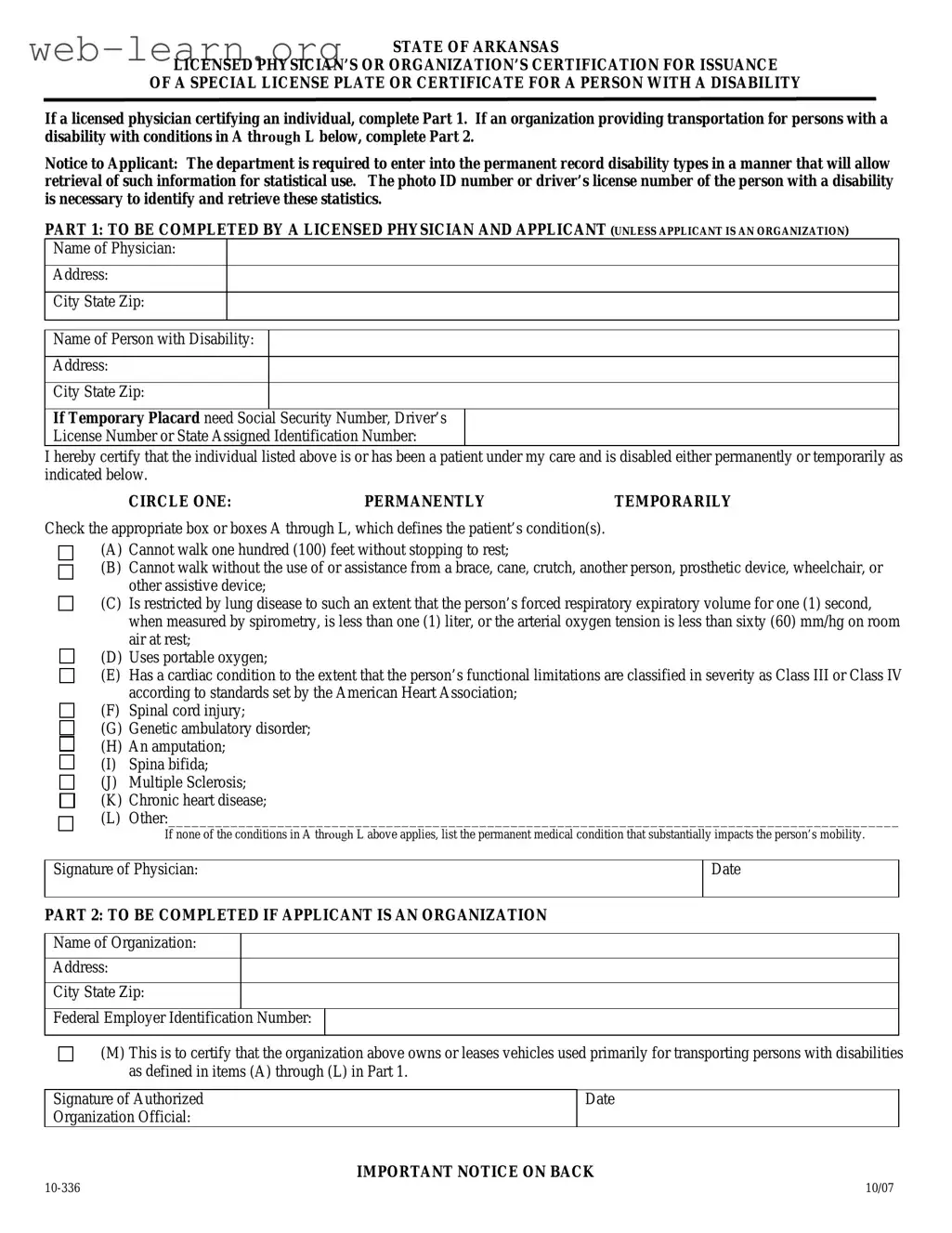
STATE OF ARKANSAS
LICENSED PHYSICIAN’S OR ORGANIZATION’S CERTIFICATION FOR ISSUANCE
OF A SPECIAL LICENSE PLATE OR CERTIFICATE FOR A PERSON WITH A DISABILITY
If a licensed physician certifying an individual, complete Part 1. If an organization providing transportation for persons with a
disability with conditions in A through L below, complete Part 2.
Notice to Applicant: The department is required to enter into the permanent record disability types in a manner that will allow
retrieval of such information for statistical use. The photo ID number or driver’s license number of the person with a disability
is necessary to identify and retrieve these statistics.
PART 1: TO BE COMPLETED BY A LICENSED PHYSICIAN
AND APPLICANT (UNLESS APPLICANT IS AN ORGANIZATION)
Name of Physician:
Address:
City State Zip:
Name of Person with Disability:
Address:
City State Zip:
If Temporary Placard need Social Security Number, Driver’s
License Number or State Assigned Identification Number:
I hereby certify that the individual listed above is or has been a patient under my care and is disabled either permanently or temporarily as
indicated below.
CIRCLE ONE: PERMANENTLY TEMPORARILY
Check the appropriate box or boxes A through L, which defines the patient’s condition(s).
(A) Cannot walk one hundred (100) feet without stopping to rest;
(B) Cannot walk without the use of or assistance from a brace, cane, crutch, another person, prosthetic device, wheelchair, or
other assistive device;
(C) Is restricted by lung disease to such an extent that the person’s forced respiratory expiratory volume for one (1) second,
when measured by spirometry, is less than one (1) liter, or the arterial oxygen tension is less than sixty (60) mm/hg on room
air at rest;
(D) Uses portable oxygen;
(E) Has a cardiac condition to the extent that the person’s functional limitations are classified in severity as Class III or Class IV
according to standards set by the American Heart Association;
(F) Spinal cord injury;
(G) Genetic ambulatory disorder;
(H) An amputation;
(I) Spina bifida;
(J) Multiple Sclerosis;
(K) Chronic heart disease;
(L) Other:______________________________________________________________________________________________
If none of the conditions in A through L above applies, list the permanent medical condition that substantially impacts the person’s mobility.
Signature of Physician: Date
PART 2: TO BE COMPLETED IF APPLICANT IS AN ORGANIZATION
Name of Organization:
Address:
City State Zip:
Federal Employer Identification Number:
(M) This is to certify that the organization above owns or leases vehicles used primarily for transporting persons with disabilities
as d
efined in items (A) through (L) in Part 1.
Signature of Authorized
Or
ganization Official:
Date
IMPO
RTANT NOTICE ON BACK
10-336 10/07
APPLICANTS AND PERSONS DRIVING FOR APPLICANTS WHO REQUEST
A SPECIAL LICENSE PLATE OR SPECIAL CERTIFICATE FOR PERSONS WITH A DISABILITY
The following requirements are provided in accordance with Ark. Code Ann. §27-15-307(7).
The privilege to park in spaces reserved for persons with disabilities shall be available only when the
vehicle is being used to transport the person for whom the special plate or certificate was issued.
Special certificates must be displayed on the inside rearview mirror, or on the dashboard, if the vehicle is of
a type that does not have an inside rearview mirror.
Any individual who provides false information to obtain a special plate or certificate, or assists an
unqualified person in acquiring a special license plate or special certificate shall be deemed guilty of a
Class A misdemeanor.
Any person who abuses the privileges granted by a special license plate or certificate shall be deemed
guilty of a Class A misdemeanor.
Any unauthorized vehicle found to be parked in an area designated for the exclusive use of a person with a
disability shall be subject to impoundment by the appropriate law enforcement agency. In addition to
impoundment, the owner of the vehicle shall upon conviction be subject to fine of not less than one
hundred dollars ($100) nor more than five hundred dollars ($500) for the first offense, nor less than two
hundred fifty dollars ($250) nor more one thousand dollars ($1000) for the second and subsequent offense,
plus applicable towing, impoundment, and related fees as well as court costs. Upon the second or
subsequent conviction, the court shall suspend the driver’s license for up to six (6) months. The driver may
apply to the Office of Driver Services of the Arkansas Department of Finance and Administration for a
restricted license during the period of suspension.
If a person to whom a special certificate or license plate has been issued moves to another state, the person
shall surrender the special certificate or plate to the nearest Revenue Office.
If a person to whom a special certificate or license plate has been issued dies, the special certificate or
license plate shall be returned to the Revenue Office within thirty (30) days after the death of the person to
whom the special certificate or plate was issued.
The special certificate issued for the permanently disabled shall expire four (4) years from the last day of
the month in which it was issued. The applicant shall not be required to obtain re-certification of his
qualifying disability in order to renew his special certificate.
The special temporary certificate shall expire three (3) months from the last day of the month in which it
was issued.

Form Information

Fact Name Details
Purpose of Form The Arkansas 10 336 form certifies the eligibility of individuals with disabilities for special license plates or certificates, facilitating access to parking and transportation.
Governing Law This form operates under Ark. Code Ann. §27-15-307(7), which outlines the requirements and privileges associated with special license plates for persons with disabilities.
Certification Process Part 1 must be completed by a licensed physician for individuals, while Part 2 is for organizations that provide transportation for persons with disabilities.
Expiration of Certificates The special certificate for permanently disabled individuals expires four years after issuance, while temporary certificates are valid for three months.

Detailed Guide for Filling Out Arkansas 10 336

Filling out the Arkansas 10 336 form is an important step in obtaining a special license plate or certificate for individuals with disabilities. The process requires specific information about the individual or organization applying for the certification. Below are the steps to complete the form accurately.

  1. Obtain the Form: Download or request a physical copy of the Arkansas 10 336 form.
  2. Identify the Correct Section: Determine whether you are filling out Part 1 for an individual or Part 2 for an organization.
  3. Complete Part 1 (if applicable):
    • Enter the name of the licensed physician.
    • Provide the physician's address, including city, state, and zip code.
    • Fill in the name of the person with a disability.
    • Include the address of the individual, with city, state, and zip code.
    • If applying for a temporary placard, provide the Social Security Number, Driver’s License Number, or State Assigned Identification Number.
    • Circle whether the disability is permanent or temporary.
    • Check the appropriate box or boxes (A through L) that define the individual's condition(s).
    • If none of the conditions apply, list the permanent medical condition impacting mobility.
    • Sign and date the form as the physician.
  4. Complete Part 2 (if applicable):
    • Enter the name of the organization.
    • Provide the organization’s address, including city, state, and zip code.
    • Include the Federal Employer Identification Number.
    • Certify that the organization owns or leases vehicles used for transporting persons with disabilities.
    • Sign and date the form as an authorized official of the organization.
  5. Review the Form: Check for any missing information or errors before submission.
  6. Submit the Form: Send the completed form to the appropriate department as instructed.

After submitting the form, you will receive further instructions or notifications regarding the status of your application. It is essential to keep a copy of the completed form for your records. If additional information is required, the department will reach out to you directly.

Obtain Answers on Arkansas 10 336

  1. What is the purpose of the Arkansas 10 336 form?

    The Arkansas 10 336 form serves as a certification for individuals with disabilities to obtain a special license plate or certificate. This document can be completed by a licensed physician or an organization that provides transportation for persons with disabilities. It helps identify individuals who require special parking privileges due to their mobility challenges.

  2. Who is eligible to complete Part 1 of the form?

    Part 1 of the Arkansas 10 336 form must be completed by a licensed physician who is certifying an individual with a disability. The physician must have a valid relationship with the patient and be able to confirm their disability status, whether permanent or temporary.

  3. What information is required in Part 1?

    In Part 1, the physician must provide their name, address, and the name and address of the person with a disability. Additionally, the physician must indicate whether the disability is permanent or temporary, and check the relevant boxes that describe the patient's condition from a provided list.

  4. What conditions qualify for a special license plate or certificate?

    The form includes a list of conditions that qualify for a special license plate or certificate. These include, but are not limited to:

    • Inability to walk without assistance
    • Severe lung disease
    • Cardiac conditions classified as Class III or IV
    • Spinal cord injury
    • Amputation
    • Multiple Sclerosis
    • Chronic heart disease

    If none of the listed conditions apply, the physician can specify another permanent medical condition that substantially impacts mobility.

  5. What should an organization do to complete Part 2 of the form?

    If the applicant is an organization, Part 2 must be completed. The organization must provide its name, address, and Federal Employer Identification Number. The authorized official must certify that the organization owns or leases vehicles primarily used for transporting persons with disabilities as defined in Part 1.

  6. What are the consequences of providing false information on the form?

    Providing false information to obtain a special license plate or certificate is a serious offense. Individuals found guilty of this act may face a Class A misdemeanor charge. This applies to both the person providing false information and those assisting unqualified individuals in acquiring these privileges.

  7. What happens if a special certificate or license plate is no longer needed?

    If a person with a special certificate or license plate moves to another state or passes away, they must return the certificate or plate to the nearest Revenue Office. This must be done within a specified time frame, typically within thirty days after the death of the individual.

  8. How long is the special certificate valid?

    The special certificate issued for permanently disabled individuals is valid for four years from the last day of the month in which it was issued. For temporary certificates, the validity period is three months. Renewal does not require re-certification of the qualifying disability for permanent certificates.

Common mistakes

Completing the Arkansas 10 336 form requires careful attention to detail. One common mistake is failing to provide the correct identification number for the person with a disability. This number, which can be a photo ID number, driver’s license number, or state-assigned identification number, is essential for the department to track disability statistics accurately. Without this information, the application may be delayed or rejected.

Another frequent error involves neglecting to specify whether the disability is permanent or temporary. The form requires the applicant to circle one option, yet some individuals overlook this step. This oversight can lead to confusion and may result in the issuance of an incorrect license plate or certificate.

Inaccurate completion of the medical condition section is also a prevalent issue. Applicants must check the appropriate boxes (A through L) that correspond to the individual’s condition. Failing to check any boxes or selecting the wrong ones can lead to significant complications in the approval process. It is vital that the conditions listed accurately reflect the individual’s health status.

Moreover, signatures are critical. The form requires the signature of the licensed physician or an authorized organization official. Some applicants forget to include this signature, which can render the application invalid. It is important to double-check that all required signatures are present before submission.

Additionally, individuals often overlook the requirement to provide an address for both the physician and the person with a disability. Missing this information can hinder the processing of the application. Ensuring that all addresses are complete and accurate is essential for timely communication from the department.

Lastly, applicants sometimes fail to read the important notices on the back of the form. These notices outline the responsibilities and potential penalties associated with the misuse of the special license plate or certificate. Ignoring this information can lead to unintentional violations of the law, resulting in fines or other legal repercussions.

Documents used along the form

When applying for a special license plate or certificate for a person with a disability in Arkansas, the Arkansas 10 336 form is essential. However, several other documents may also be required to support your application. Understanding these additional forms can streamline the process and ensure that everything is in order. Below are some common forms and documents that often accompany the Arkansas 10 336 form.

  • Application for Special License Plate: This form is typically used to formally request a special license plate for individuals with disabilities. It includes personal information and details about the vehicle.
  • Physician’s Statement of Disability: This document provides a detailed account from a licensed physician regarding the individual's disability. It serves as a crucial piece of evidence to support the claims made in the Arkansas 10 336 form.
  • Proof of Residency: Applicants may need to submit documentation that verifies their residency in Arkansas. This can include utility bills, lease agreements, or bank statements showing the applicant's name and address.
  • Vehicle Registration Document: A copy of the vehicle registration is often required. This document confirms that the vehicle for which the special license plate is being requested is registered in the applicant's name.
  • Identification Document: A government-issued ID, such as a driver’s license or state ID, is necessary to verify the identity of the applicant. This helps ensure that the application process is secure and legitimate.

Being prepared with these documents can significantly enhance the efficiency of your application process. Ensuring that all necessary forms are completed accurately and submitted together will help avoid delays and potential complications. Always check with the relevant authorities for any updates or additional requirements that may apply.

Similar forms

The Arkansas 10 336 form serves as a certification for the issuance of special license plates or certificates for individuals with disabilities. Several other documents share similarities with this form in terms of purpose, structure, and the information they require. Below is a list of seven such documents:

  • ADA Paratransit Eligibility Application: This application is used to determine eligibility for paratransit services under the Americans with Disabilities Act. Like the Arkansas 10 336 form, it requires detailed information about the applicant's disability and mobility limitations.
  • State Disability Parking Permit Application: This document is required to apply for a disability parking permit in various states. Similar to the Arkansas 10 336 form, it necessitates a physician's certification of the applicant's disability and includes specific criteria that must be met.
  • Social Security Administration Disability Benefits Application: Individuals seeking disability benefits must complete this application, which includes medical documentation and personal information. Both forms aim to establish the nature and extent of the applicant's disability.
  • Medicaid Disability Application: This application is used to determine eligibility for Medicaid based on disability. It shares the need for medical documentation and personal information, paralleling the requirements of the Arkansas 10 336 form.
  • Veterans Affairs Disability Compensation Claim: Veterans seeking compensation for service-related disabilities must fill out this claim form. Both documents require verification of the disability and may involve similar medical assessments.
  • State-Specific Disability Identification Card Application: Many states offer identification cards for individuals with disabilities. The application process often mirrors that of the Arkansas 10 336 form, requiring medical certification and personal details.
  • Accessible Housing Application: Individuals seeking accessible housing often need to submit an application that includes information about their disability. Like the Arkansas 10 336 form, this document typically requires a physician's verification and outlines specific criteria for eligibility.

Dos and Don'ts

When filling out the Arkansas 10 336 form, it is essential to follow specific guidelines to ensure accuracy and compliance. Here is a list of things you should and shouldn't do:

  • Do provide complete and accurate information for both the physician and the applicant.
  • Do include the photo ID number or driver's license number of the person with a disability.
  • Do circle the appropriate condition(s) that apply to the individual in Part 1.
  • Do ensure that the physician signs and dates the form before submission.
  • Don't leave any required fields blank; all information is necessary for processing.
  • Don't provide false information or assist someone who does; this could lead to legal consequences.
  • Don't forget to return the special certificate or plate if the person moves or passes away.
  • Don't misuse the special license plate or certificate; doing so may result in penalties.

Misconceptions

Understanding the Arkansas 10 336 form is crucial for those seeking a special license plate or certificate for persons with disabilities. However, several misconceptions surround this form. Let’s clarify some of these misunderstandings.

  • Misconception 1: Only permanent disabilities qualify for a special license plate.
  • This is not true. The form accommodates both permanent and temporary disabilities. Individuals can receive a special certificate even if their disability is temporary, as long as it meets the specified criteria.

  • Misconception 2: A physician's signature is optional.
  • In fact, a licensed physician must certify the individual’s disability. This certification is essential for both the applicant and the organization seeking the special plate or certificate.

  • Misconception 3: The special license plate can be used by anyone.
  • This is a common misunderstanding. The special plate or certificate is only valid when the vehicle is used to transport the individual for whom it was issued. Misuse can lead to serious penalties.

  • Misconception 4: There is no expiration for the special certificate.
  • On the contrary, the special certificate for permanently disabled individuals expires four years after issuance. Temporary certificates expire three months after issuance. Renewal does not require re-certification for permanent disabilities.

Key takeaways

When filling out the Arkansas 10 336 form, there are several important points to keep in mind. Understanding these can help ensure a smooth application process for a special license plate or certificate for individuals with disabilities.

  • Part 1 and Part 2: Determine whether you need to complete Part 1 or Part 2 of the form. Part 1 is for licensed physicians certifying an individual, while Part 2 is for organizations providing transportation for persons with disabilities.
  • Required Information: Be prepared to provide essential details such as the name and address of the physician or organization, as well as the name and address of the person with a disability.
  • Disability Certification: The physician must certify the individual's disability, indicating whether it is permanent or temporary. Specific conditions must be checked off to validate the claim.
  • Photo ID Requirement: Include the photo ID number or driver’s license number of the person with a disability. This information is crucial for statistical tracking and identification.
  • Display of Certificate: Once obtained, the special certificate must be displayed properly in the vehicle, either on the inside rearview mirror or dashboard.
  • Consequences of Misuse: Be aware that providing false information or misusing the privileges granted by the special license plate or certificate can lead to serious penalties, including fines and misdemeanor charges.
  • Expiration and Renewal: Note the expiration terms. The special certificate for permanently disabled individuals lasts four years, while the temporary certificate is valid for three months. No re-certification is needed for renewal of the permanent certificate.