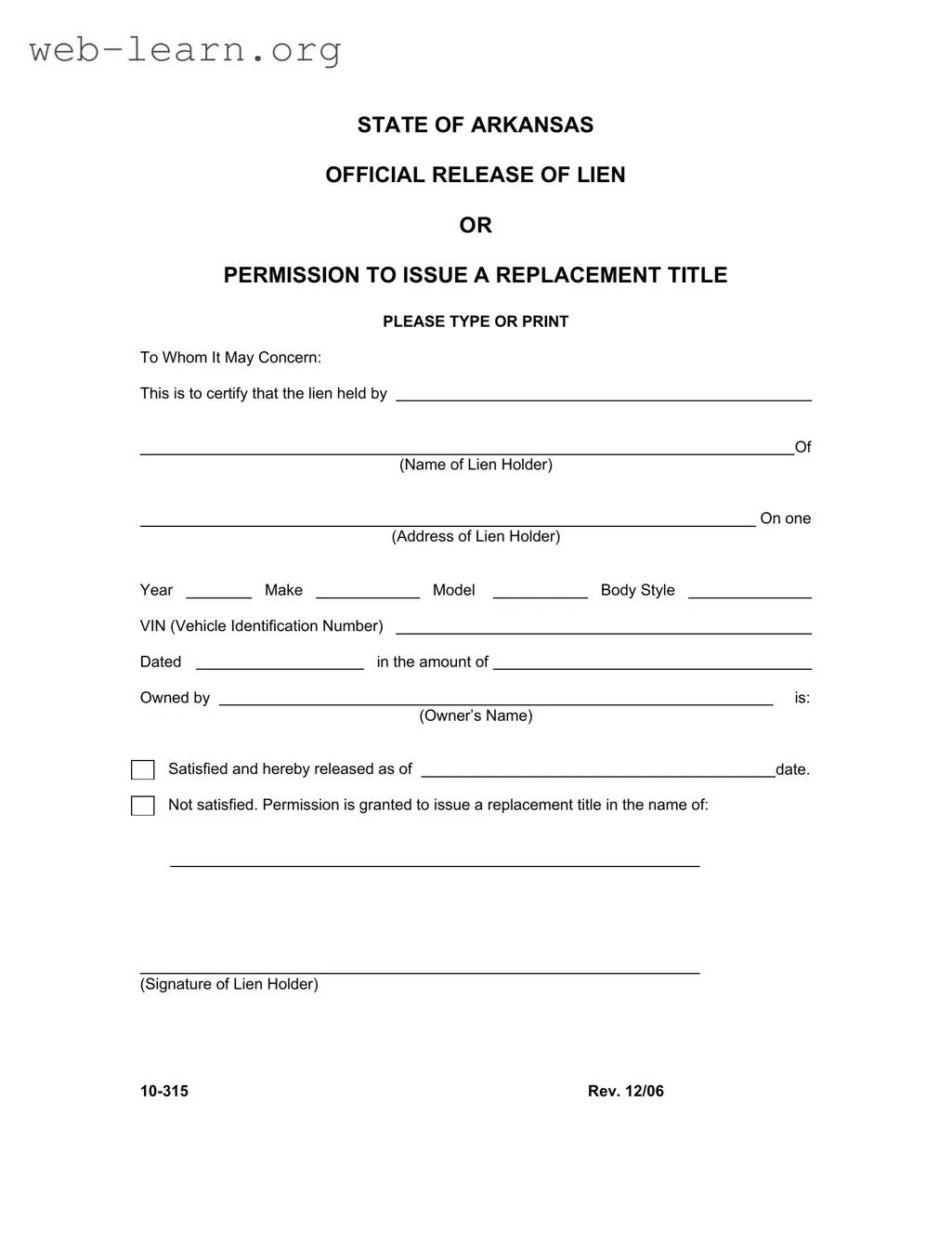
The Arkansas 10 315 form serves a crucial role in the process of lien release and the issuance of replacement titles for vehicles. This official document is primarily utilized when a lien holder, such as a bank or financing company, has satisfied their claim on a vehicle. It certifies that the lien has been released, allowing the vehicle owner to obtain a clear title. The form requires specific information, including the name and address of the lien holder, details about the vehicle such as its year, make, model, body style, and Vehicle Identification Number (VIN). Additionally, it includes the owner's name and the date of the lien release. In cases where the lien is not satisfied, the form also provides permission for the issuance of a replacement title in the name of the vehicle owner. Properly completing this form is essential for ensuring that all parties involved have a clear understanding of the lien status, ultimately facilitating smoother transactions and ownership transfers in the future.

| Fact Name | Description |
|---|---|
| Purpose of Form | The Arkansas 10 315 form is used to officially release a lien on a vehicle or to grant permission to issue a replacement title. |
| Governing Law | This form is governed by the Arkansas Code Annotated § 27-14-1001, which outlines the procedures for lien releases and title replacements. |
| Parties Involved | The form involves two main parties: the lien holder and the vehicle owner. Their information must be clearly provided. |
| Required Information | Essential details include the lien holder's name and address, vehicle information (year, make, model, body style, VIN), and the owner's name. |
| Release Status | The form allows the lien holder to indicate whether the lien is satisfied or not. This status must be clearly marked. |
| Signature Requirement | A signature from the lien holder is required to validate the release of the lien or permission for a replacement title. |
| Revision Date | The current version of the form is the 10-315 REV. 12/06, indicating it was last revised in December 2006. |
Once you have gathered all necessary information, you can begin filling out the Arkansas 10 315 form. This form is essential for releasing a lien or granting permission for a replacement title. Careful attention to detail is important to ensure that all information is accurate and complete.
The Arkansas 10 315 form is used to officially release a lien on a vehicle or to grant permission to issue a replacement title. This form certifies that the lien held by a lien holder has been satisfied or indicates that it is not satisfied.
The form should be completed by the lien holder, which is typically a bank, credit union, or other financial institution that financed the vehicle. The owner of the vehicle may also need to be involved in the process, especially when a replacement title is requested.
Essential information includes:
If a lien holder refuses to sign the Arkansas 10 315 form, it is important to first understand their reasons. Communication is key. You may need to provide proof of payment or discuss any outstanding issues. If necessary, seek legal advice to explore your options for resolving the situation.
Once completed, the Arkansas 10 315 form should be submitted to the Arkansas Department of Finance and Administration. It is recommended to keep a copy for your records. Additionally, check if there are any specific submission guidelines or fees associated with the process.
Filling out the Arkansas 10 315 form can seem straightforward, but many people make common mistakes that can lead to delays or complications. One frequent error is failing to include the complete name of the lien holder. The form requires precise information. Omitting any part of the name can create confusion and lead to processing issues.
Another mistake is neglecting to provide the correct address of the lien holder. This detail is crucial for verification purposes. If the address is incorrect, it may hinder the release process. Always double-check this information to ensure accuracy.
People often forget to include the Vehicle Identification Number (VIN). This number is unique to each vehicle and is essential for identifying the specific lien. Without it, the form may be deemed incomplete, causing unnecessary delays.
Many individuals also overlook the importance of signing the form. The signature of the lien holder is required to validate the release. Without it, the form will not be accepted, and you may have to start the process over again.
Some individuals mistakenly mark the wrong status of the lien. The form requires a clear indication of whether the lien is satisfied or not. If this is marked incorrectly, it can lead to legal complications down the line.
Another common error is not dating the form. The date of release is an important piece of information that must be included. Omitting this can lead to questions about the validity of the release.
People sometimes fail to provide the owner's name accurately. This name must match the title to avoid discrepancies. If there are any differences, it can complicate the process of obtaining a replacement title.
Finally, a lack of attention to detail can lead to overall errors in the form. Simple typos or unclear handwriting can cause significant problems. It’s advisable to take your time when filling out the form to ensure everything is legible and correct.
When dealing with vehicle titles and liens in Arkansas, several forms and documents may be required in conjunction with the Arkansas 10 315 form. Each of these documents serves a specific purpose and can facilitate the process of title transfer or lien release. Below is a list of commonly used forms.
Using the appropriate forms in conjunction with the Arkansas 10 315 form can streamline the process of managing vehicle titles and liens. Ensure that all documents are completed accurately to avoid delays or complications.
The Arkansas 10 315 form is used to release a lien on a vehicle or grant permission to issue a replacement title. Several other documents serve similar purposes in different contexts. Below are seven documents that share similarities with the Arkansas 10 315 form:
When filling out the Arkansas 10 315 form, keep these tips in mind:
Understanding the Arkansas 10 315 form is essential for anyone involved in vehicle ownership and lien releases. However, several misconceptions can lead to confusion. Here are seven common misconceptions about this form:
This is not true. Any individual or entity that has a legal claim to a vehicle due to a loan or other financial obligation can be a lien holder.
The Arkansas 10 315 form is required for any vehicle with a lien, regardless of whether it is new or used.
This is a misconception. If a lien is released but the debt is later reinstated, a new lien can be placed on the vehicle.
Notarization is not a requirement for the Arkansas 10 315 form. However, it is always a good practice to have important documents notarized for added verification.
This is incorrect. Filing the Arkansas 10 315 form is necessary to officially release a lien and update the vehicle's title.
While the form can be filled out at any time, it should be submitted as soon as the lien is satisfied to avoid complications with title transfers.
While the lien holder must sign the form, the vehicle owner can assist in completing the necessary information.
Being aware of these misconceptions can help ensure that the process of releasing a lien and obtaining a replacement title goes smoothly.
Here are key takeaways for filling out and using the Arkansas 10 315 form:
Following these steps will help ensure that the form is completed correctly and processed without issues.