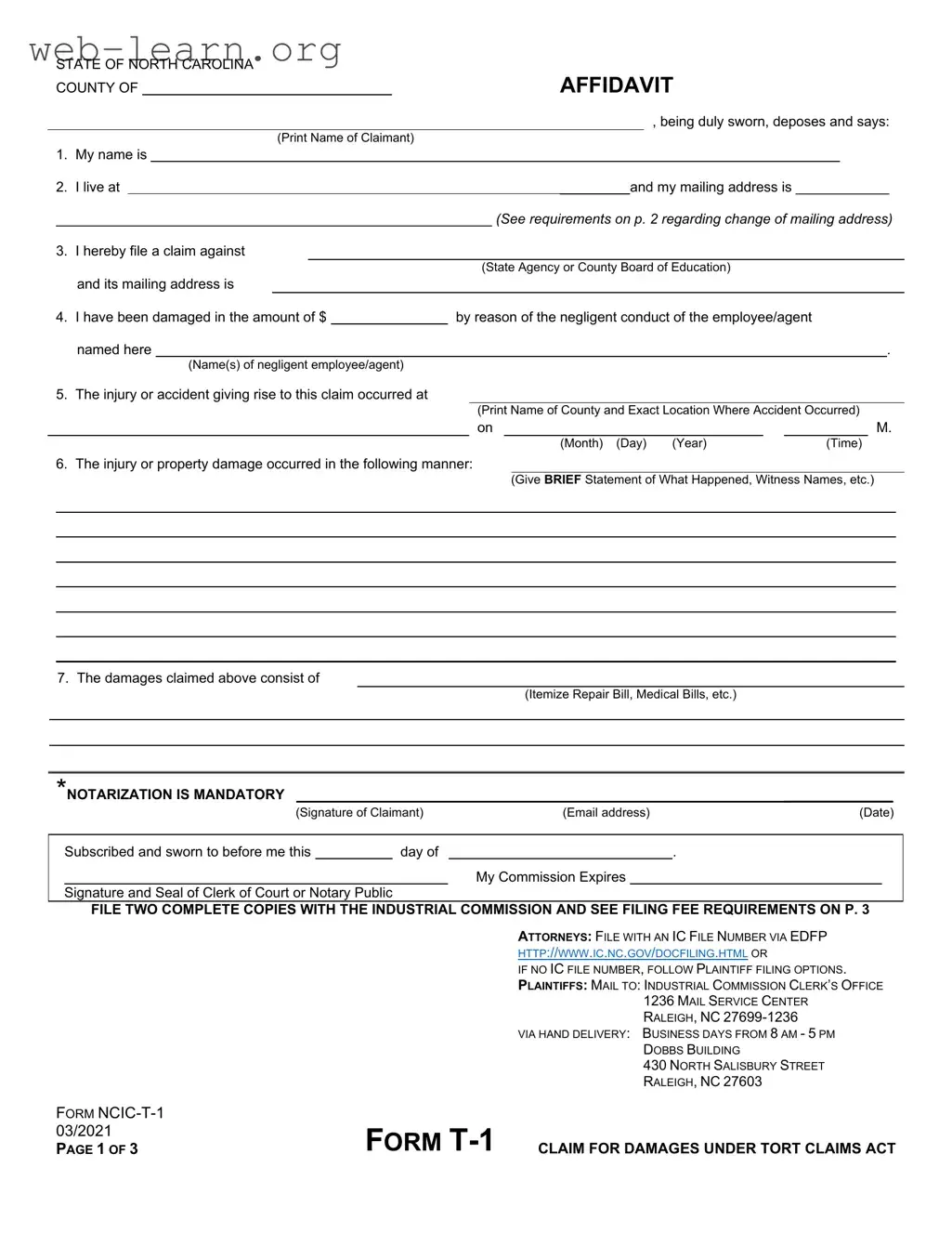
Homepage Blank Arizona Tort Claim Form
Outline

The Arizona Tort Claim form is a crucial document for individuals seeking to file a claim for damages due to the negligent actions of state employees or agencies. This form serves as the official notice to the state regarding the specifics of the claim, ensuring that all necessary information is provided for a thorough review. Claimants must include their personal details, such as name and address, alongside the name of the state agency or employee involved in the incident. Additionally, the form requires a clear statement of the damages incurred, including the amount being claimed and a brief description of the incident that led to the injury or property damage. It’s essential to specify the time and location of the event, along with any witnesses who may support the claim. Notarization is mandatory, emphasizing the importance of authenticity in the submission. Furthermore, claimants must be aware of the filing fee requirements and the process for submitting the form to the appropriate agency. Understanding these elements is vital for ensuring that the claim is processed efficiently and effectively.


Sample - Arizona Tort Claim Form

FORM NCIC-T-1
03/2021
PAGE 1 OF 3
FORM T-1
CLAIM FOR DAMAGES UNDER TORT CLAIMS ACT
STATE OF NORTH CAROLINA
COUNTY OF AFFIDAVIT
, being duly sworn, deposes and says:
(Print Name of Claimant)
1. My name is
2. I live at _________and my mailing address is ____________
________________________________________________________ (See requirements on p. 2 regarding change of mailing address)
3. I hereby file a claim against
(State Agency or County Board of Education)
and its mailing address is
4. I have been damaged in the amount of $ by reason of the negligent conduct of the employee/agent
named here .
(Name(s) of negligent employee/agent)
(Print Name of County and Exact Location Where Accident Occurred)
on
M.
(Month) (Day) (Year)
(Time)
6. The injury or property damage occurred in the following manner:
(Give BRIEF Statement of What Happened, Witness Names, etc.)
7. The damages claimed above consist of
(Itemize Repair Bill, Medical Bills, etc.)
*NOTARIZATION IS MANDATORY ______________
(Signature of Claimant) (Email address) (Date)
Subscribed and sworn to before me this day of .
My Commission Expires
Signature and Seal of Clerk of Court or Notary Public
FILE TWO COMPLETE COPIES WITH THE INDUSTRIAL COMMISSION AND SEE FILING FEE REQUIREMENTS ON P. 3
ATTORNEYS: FILE WITH AN IC FILE NUMBER VIA EDFP
HTTP://WWW.IC.NC.GOV/DOCFILING.HTML OR
IF NO IC FILE NUMBER, FOLLOW PLAINTIFF FILING OPTIONS.
PLAINTIFFS: MAIL TO: INDUSTRIAL COMMISSION CLERKS OFFICE
1236 MAIL SERVICE CENTER
RALEIGH, NC 27699-1236
VIA HAND DELIVERY: BUSINESS DAYS FROM 8 AM - 5 PM
DOBBS BUILDING
430 NORTH SALISBURY STREET
RALEIGH, NC 27603
FORM NCIC-T-1
03/2021
PAGE 2 OF 3
FORM T-1
CLAIM FOR DAMAGES UNDER TORT CLAIMS ACT
INSTRUCTIONS
The North Carolina Tort Claims Act requires that every affidavit submitted must show ALL of the following:
1. The name of the claimant.
2. The name of the state department, institution or agency against which the claim is filed.
3. The name of the state employee upon whose alleged negligence the claim is based.
4. The amount of damages sought to be recovered.
5. The time and place where the injury occurred.
6. A brief statement of the facts and circumstances surrounding the injury.
7. If the claim involves a school bus, the claim should be filed against the particular COUNTY Board of Education
concerned and NOT against the State Board of Education.
8. A claim for property damage to a motor vehicle must be in the NAME OF THE REGISTERED OWNER OF THE
VEHICLE ONLY.
INDUSTRIAL COMMISSION REQUIREMENTS REGARDING CONTACT INFORMATION (INCLUDING CHANGE OF
MAILING ADDRESS) ARE SET OUT IN THE RULE APPEARING BELOW:
11 NCAC 23B .0105 CONTACT INFORMATION
(a) "Contact information" for purposes of this Rule shall include telephone number, facsimile number, email address, and
mailing address.
(b) All persons or entities without legal representation who have matters pending before the Commission shall inform the
Commission of any change in contact information by filing a written notice via the Commission's Electronic Document
Filing Portal ("EDFP"), email to [email protected], facsimile to (919) 715-0282, U.S. mail sent to Office of the Clerk,
1236 Mail Service Center, Raleigh North Carolina 27699-1236, private courier service in accordance with Rule .0101 of
this Section, or hand delivery in accordance with Rule .0101 of this Section.
(c) A plaintiff without legal representation who was an inmate in the North Carolina Division of Adult Corrections at the
time of filing his or her tort claim, shall, within 30 days of release, provide the Commission with written notice of his or her
post-release contact information in any manner authorized in Paragraph (b) of this Rule. Following the initial written notice
of post-release contact information, the previously incarcerated plaintiff shall continue to inform the Commission of all
changes in contact information in accordance with Paragraph (b) of this Rule.
(d) All attorneys of record with matters before the Commission shall provide and maintain current contact information for
the Commission's records via EDFP.
(e) Instructions on how to provide and update contact information via EDFP are available at
https://www.ic.nc.gov/docfiling.html.
FORM NCIC-T-1
03/2021
PAGE 3 OF 3
FORM T-1
CLAIM FOR DAMAGES UNDER TORT CLAIMS ACT
INDUSTRIAL COMMISSION REQUIREMENTS REGARDING FILING FEES ARE SET OUT IN THE RULE
APPEARING BELOW:
11 NCAC 23B .0103 FILING FEES
(a) No tort claim shall be accepted for filing with the Commission unless the claim is accompanied by an attorney's check,
certified check, money order, or electronic transfer of funds in payment of a filing fee in an amount equal to the filing fee
required for the filing of a civil action in the Superior Court division of the General Court of Justice.
(b) The provisions of Paragraph (a) of this Rule notwithstanding, a tort claim that is accompanied by a Petition to Sue as
an Indigent shall be accepted for filing upon the date of its receipt.
(c) A Petition to Sue as an Indigent shall consist of an affidavit sufficient to satisfy the provisions of G.S. 1-110, stating
that plaintiff is unable to comply with Paragraph (a) of this Rule.
(d) If the Commission determines the plaintiff is able to pay the fee assessed under this Rule, an Order shall be issued
directing payment of that fee, and the plaintiff shall, within 30 days from receipt of the Order, forward to the Commission
an attorney's check, certified check, money order, or electronic transfer of funds for the full amount required to be paid.
Failure to submit the required amount of the filing fee within this time shall result in the tort claim being dismissed without
prejudice.
(e) Upon consideration of a prison inmate's Petition to Sue as an Indigent, the Commission shall determine whether the
inmate's tort claim is frivolous and whether to dismiss the claim, pursuant to G.S. 1-110. Appeals from the dismissal of a
frivolous tort claim pursuant to G.S. 1-110 shall proceed directly to the Full Commission and shall be decided without oral
argument.

Form Information

Fact Name Details
Governing Law The Arizona Tort Claims Act governs the submission and processing of tort claims against the state and its agencies.
Claim Submission Claims must be submitted using the official Arizona Tort Claim form, which requires specific information about the claimant and the incident.
Filing Deadline Claimants have 180 days from the date of the incident to file a tort claim against the state or its agencies.
Required Information The form must include the claimant's name, address, the agency involved, a description of the incident, and the amount of damages sought.
Notarization Claims submitted must be notarized to verify the identity of the claimant and the authenticity of the information provided.
Two Copies Claimants are required to file two complete copies of the claim form with the appropriate state agency.
Contact Information Claimants must provide current contact information, including any changes, to ensure proper communication regarding the claim.

Detailed Guide for Filling Out Arizona Tort Claim

Filling out the Arizona Tort Claim form is an important step in seeking compensation for damages caused by negligence. Once you have completed the form, it is essential to submit it properly, ensuring that all required information is included and that you follow the filing procedures outlined by the appropriate authorities.

  1. Provide Your Information: Start by entering your full name, residential address, and mailing address in the designated fields.
  2. Identify the Agency: Specify the state agency or county board of education against which you are filing the claim, including its mailing address.
  3. Detail the Negligent Party: Write the name of the employee or agent whose negligence led to your claim.
  4. State the Damages: Clearly indicate the amount of damages you are claiming due to the incident.
  5. Describe the Incident: Provide the date, time, and exact location of the injury or accident. Be as specific as possible.
  6. Explain the Circumstances: Offer a brief statement outlining how the injury or property damage occurred, including any witness names if applicable.
  7. Itemize Damages: List and itemize the damages you are claiming, such as repair bills or medical expenses.
  8. Sign and Notarize: Sign the form and ensure it is notarized. This step is mandatory for the claim to be valid.
  9. Make Copies: Prepare two complete copies of the filled-out form for submission.
  10. Submit the Form: Mail the completed form to the Industrial Commission Clerk’s Office or deliver it in person during business hours.

Obtain Answers on Arizona Tort Claim

  1. What is the purpose of the Arizona Tort Claim form?

    The Arizona Tort Claim form is used to file a claim against a state agency or the county board of education for damages resulting from the negligent actions of its employees or agents. This form serves as an official notification to the state regarding the claim and outlines the details of the incident that caused the injury or property damage.

  2. What information must be included in the Tort Claim form?

    When filling out the Tort Claim form, it is essential to provide comprehensive information, including:

    • Your name and contact information.
    • The name and address of the state agency or county board of education against which you are filing the claim.
    • The name of the employee or agent whose negligence caused the injury.
    • The amount of damages you are seeking.
    • The date, time, and location of the incident.
    • A brief statement describing the circumstances surrounding the injury, including witness names if applicable.

    Completing these sections accurately is crucial for the processing of your claim.

  3. How do I submit the Arizona Tort Claim form?

    To submit the Tort Claim form, you must file two complete copies with the Industrial Commission. Ensure that you also include any required filing fees, which are typically equal to those for filing a civil action in the Superior Court. You can submit your claim via mail, hand delivery, or through the Commission's Electronic Document Filing Portal if you have an attorney.

  4. What happens if my claim is not filed correctly?

    If the Tort Claim form is not completed correctly or if it lacks necessary information, the claim may be dismissed. It is crucial to follow all instructions carefully and ensure that all required fields are filled out accurately. If you are unsure about any part of the process, consider seeking legal advice to help you navigate the requirements.

Common mistakes

Filling out the Arizona Tort Claim form can be a daunting task, and many people make mistakes that can delay or even derail their claims. One common mistake is failing to provide complete contact information. It's essential to include your full mailing address, email, and phone number. If any of this information changes, it must be updated promptly. Neglecting to do so can lead to missed communications from the agency.

Another frequent error is not specifying the exact state agency or county board against which the claim is being filed. Many individuals mistakenly assume that the agency's name is well-known, but it must be clearly stated on the form. This ensures that the claim is directed to the right department for processing.

Some claimants also fail to identify the employee or agent whose alleged negligence caused the damage. This detail is critical. Without naming the responsible party, the claim lacks a key element needed for review. Additionally, providing vague or incomplete descriptions of the incident can hinder the claim. A brief, clear statement of what happened, including witness names, is necessary for a thorough evaluation.

Another mistake involves inaccurately stating the amount of damages sought. Claimants sometimes underestimate or overestimate their losses. It is vital to itemize all damages, including repair bills and medical expenses, to support the claim effectively. Inaccurate figures can lead to complications in the review process.

Some individuals neglect to notarize their forms. Notarization is mandatory, and failing to have the form signed by a notary public can result in automatic rejection. Similarly, not filing the required two complete copies with the Industrial Commission can cause delays. Ensure that you understand the filing fee requirements as well; omitting payment can lead to dismissal of the claim.

Finally, many claimants forget to keep a copy of their submitted forms for their records. This is a crucial step, as it provides proof of what was submitted and when. Keeping organized records can help in case any follow-up is necessary.

Documents used along the form

The Arizona Tort Claim form is a critical document for individuals seeking compensation for damages caused by negligence from state employees or agencies. Alongside this form, several other documents may be required to support the claim process. Below is a list of commonly used forms and documents that complement the Arizona Tort Claim form.

  • Notice of Claim: This document formally notifies the state agency of the intention to file a tort claim. It includes essential details about the claimant, the nature of the claim, and the damages sought.
  • Claimant's Affidavit: An affidavit where the claimant swears to the truthfulness of the information provided in the claim. This document often requires notarization to validate the claim.
  • Medical Records Release: This form allows the release of medical records related to the injury or damages claimed. It is essential for substantiating medical expenses and treatment details.
  • Incident Report: A report detailing the circumstances of the incident that led to the claim. This document can provide a factual basis for the claim and is often prepared by law enforcement or agency officials.
  • Witness Statements: Written statements from individuals who witnessed the incident. These can support the claimant’s account of the events and provide additional evidence.
  • Repair Estimates: Documentation that outlines the costs associated with repairs or replacements due to the incident. This helps itemize damages and supports the monetary claim.
  • Filing Fee Payment Receipt: A receipt showing payment of the required filing fee. This is necessary for the claim to be processed and indicates compliance with procedural requirements.
  • Petition to Sue as an Indigent: If a claimant cannot afford the filing fee, this petition allows them to request a waiver based on financial hardship. It includes an affidavit detailing the claimant’s financial situation.

These forms and documents play a vital role in the tort claim process. Each serves a specific purpose, helping to ensure that the claim is complete and properly supported. Properly completing and submitting these documents can significantly impact the outcome of the claim.

Similar forms

The Arizona Tort Claim form shares similarities with several other documents used in legal contexts. Below are six documents that are comparable and a brief explanation of how they relate to the Arizona Tort Claim form.

  • North Carolina Tort Claim Form: This form requires claimants to provide personal details, the nature of the claim, and specifics about the injury or damages, similar to the Arizona form.
  • Personal Injury Complaint: A personal injury complaint outlines the facts of the case, the parties involved, and the damages sought, much like the Arizona Tort Claim form.
  • Notice of Claim: This document notifies a government entity of a potential claim, requiring similar information about the claimant and the nature of the claim as found in the Arizona Tort Claim form.
  • Claim for Damages: A general claim for damages form often includes details about the incident, the parties involved, and the damages sought, paralleling the structure of the Arizona Tort Claim form.
  • Affidavit of Claims: This affidavit requires a sworn statement from the claimant, detailing the claim and supporting facts, similar to the sworn nature of the Arizona Tort Claim form.
  • Medical Malpractice Claim Form: This form gathers information about the claimant, the alleged negligence, and the damages, resembling the requirements of the Arizona Tort Claim form.

Dos and Don'ts

When filling out the Arizona Tort Claim form, there are several important dos and don'ts to keep in mind. Adhering to these guidelines can help ensure your claim is processed smoothly.

  • Do provide your full name and accurate contact information.
  • Do clearly identify the state agency or county board involved in your claim.
  • Do specify the name of the employee or agent whose negligence caused your injury.
  • Do itemize all damages you are claiming, including medical bills and repair costs.
  • Don't leave out any required details, such as the date and location of the incident.
  • Don't file your claim without the necessary notarization.
  • Don't forget to submit two complete copies of your claim.
  • Don't ignore the filing fee requirements; ensure payment is included with your submission.

Misconceptions

Misconceptions about the Arizona Tort Claim form can lead to confusion and delays. Here are seven common misunderstandings:

  • Only serious injuries require a claim. Many believe that only significant injuries warrant filing a tort claim. In reality, any injury or property damage caused by negligence can be the basis for a claim.
  • The form can be submitted without notarization. Some people think notarization is optional. However, notarization is mandatory for the claim to be valid.
  • Claims can be filed without all required information. It is a misconception that incomplete forms will be accepted. All required information must be provided to avoid dismissal.
  • Filing fees do not apply to everyone. Some individuals assume that filing fees are waived for all claimants. In fact, a fee is required unless a Petition to Sue as an Indigent is filed and accepted.
  • Claims can be filed against any state entity. There is a belief that claims can be directed at any state agency. Claims must be filed against the specific agency or board responsible for the alleged negligence.
  • There is no deadline for filing. Many think they can file a claim at any time. There are strict deadlines that must be adhered to, or the claim may be barred.
  • Witness statements are not necessary. Some believe that witness statements are optional. Providing witness information can strengthen a claim and is often necessary for a complete submission.

Key takeaways

Key Takeaways for Filling Out and Using the Arizona Tort Claim Form:

  • Ensure that all required information is complete and accurate. This includes your name, address, and the details of the claim against the state agency or county board of education.
  • Clearly state the amount of damages you are claiming. Be specific about how the negligent conduct of the employee or agent caused your damages.
  • Provide a brief but detailed description of the incident, including the exact location, date, and time of the injury or accident.
  • Include the names of any witnesses who can corroborate your account of the incident. This can strengthen your claim significantly.
  • Remember to notarize the form. This step is mandatory and ensures the authenticity of your claim.
  • File two complete copies of the form with the Industrial Commission and adhere to any applicable filing fee requirements.