Homepage Blank Arizona Repossession Affidavit Form
Outline

The Arizona Repossession Affidavit form is an essential document for lienholders who have repossessed a vehicle due to a default on a loan or lease agreement. This form serves several critical purposes, including certifying the legal ownership of the vehicle and confirming that the repossession was carried out in compliance with state laws. It requires detailed information such as the Vehicle Identification Number (VIN), year, make, and model of the vehicle, as well as the names of the registered owners. The affidavit also includes a section for a bill of sale, which facilitates the transfer of ownership to a new buyer, if applicable. Notably, it mandates the disclosure of the vehicle's odometer reading, ensuring that the mileage is accurately reported to prevent any potential legal issues. By signing the affidavit, the lienholder acknowledges their responsibility and protects themselves from liability related to the contents of the document. This form is not only a legal requirement but also a safeguard for all parties involved in the transaction, emphasizing the importance of accuracy and honesty in the reporting of vehicle details.
Sample - Arizona Repossession Affidavit Form

Vehicle
Division
I
I
I
I I
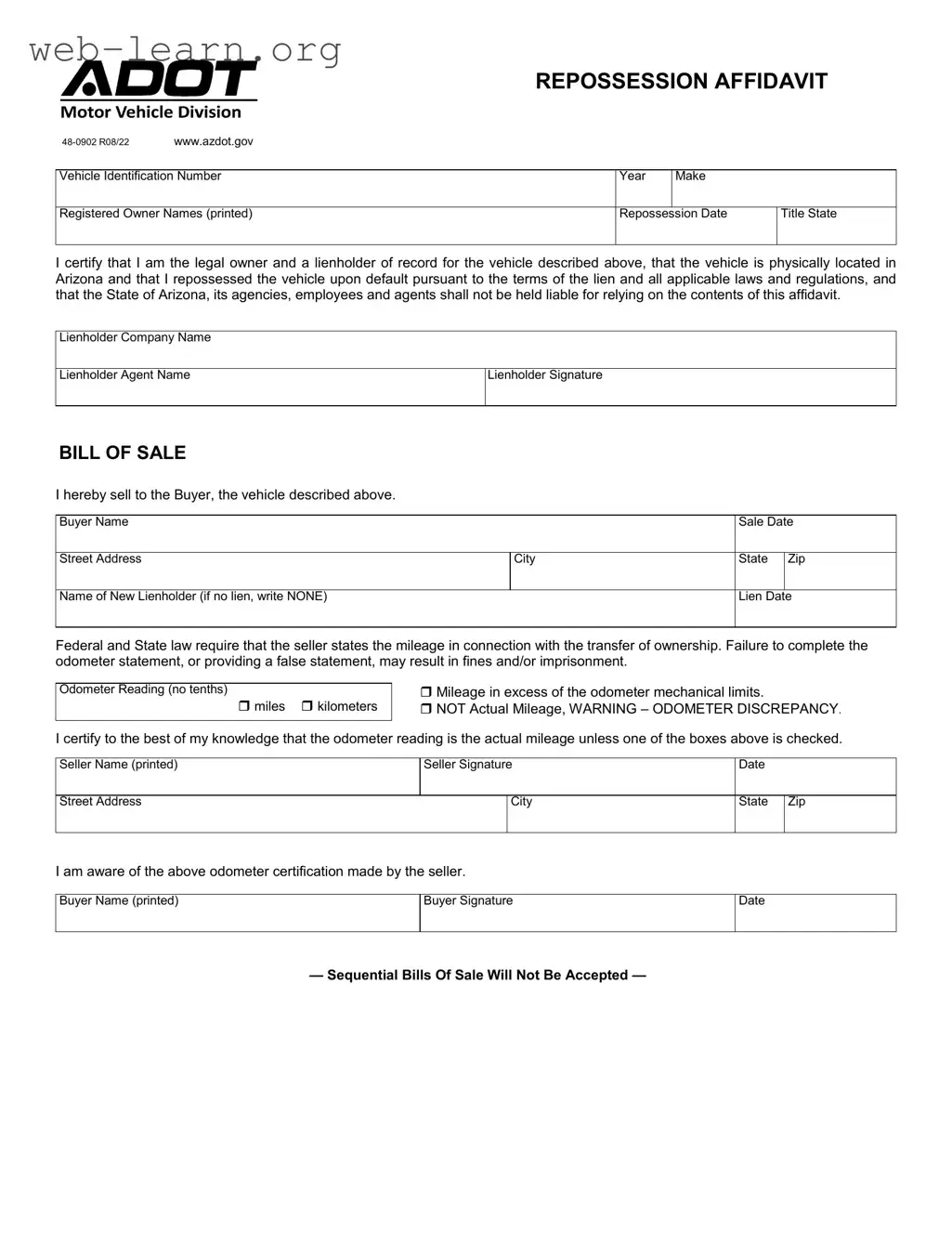
REPOSSESSION AFFIDAVIT
48-0902 R08/22 www.azdot.gov
Vehicle Identification Number
Year
Make
Registered Owner Names (printed)
Repossession Date
Title State
I certify that I am the legal owner and a lienholder of record for the vehicle described above, that the vehicle is physically located in
Arizona and that I repossessed the vehicle upon default pursuant to the terms of the lien and all applicable laws and regulations, and
that the State of Arizona, its agencies, employees and agents
shall not be held liable for relying on the contents of this affidavit.
Lienholder Company Name
Lienholder Agent Name
BILL OF SALE
I hereby sell to the Buyer, the vehicle described above.
Buyer Name
Sale Date
Street Address
City
State
Zip
Name of New Lienholder (if no lien, write NONE)
Lien Date
Federal and State law require that the seller states the mileage in
connection with the transfer of ownership. Failure to complete the
odometer statement, or providing a false statement, may result in fines and/or imprisonment.
Odometer Reading (no tenths)
Mileage in excess of the odometer mechanical limits.
miles kilometers
NOT Actual Mileage, WARNING ODOMETER DISCREPANCY.
I certify to the best of my knowledge that the odometer reading is the actual mileage unless one of the boxes above is checke
d.
Seller Name (printed)
Seller Signature
Date
Street Address
City
State
Zip
I am aware of the above odometer certification made by the seller.
Buyer Name (printed)
Buyer Signature
Date
Sequential Bills Of Sale Will Not Be Accepted

Form Information

Fact Name Details
Governing Law The Arizona Repossession Affidavit is governed by Arizona Revised Statutes § 47-9601 et seq.
Purpose This affidavit serves to document the repossession of a vehicle by a lienholder after a default.
Legal Ownership The affiant must certify that they are the legal owner and a lienholder of record for the vehicle in question.
Location Requirement The vehicle must be physically located in Arizona at the time of repossession.
Liability Disclaimer The affidavit includes a disclaimer stating that the State of Arizona and its agencies are not liable for the affidavit's contents.
Odometer Statement Federal and state law mandates that the seller must disclose the vehicle's mileage during the ownership transfer.
Signature Requirement Both the seller and the buyer must sign the affidavit to validate the transaction.
Bill of Sale Inclusion The affidavit includes a section for a bill of sale, confirming the sale of the vehicle to the buyer.

Detailed Guide for Filling Out Arizona Repossession Affidavit

After completing the Arizona Repossession Affidavit form, you will need to submit it to the appropriate authorities. Ensure that all information is accurate and that signatures are in place. This step is crucial for a smooth processing of your affidavit.

  1. Start by entering the Vehicle Identification Number (VIN) at the top of the form.
  2. Fill in the Year and Make of the vehicle.
  3. Provide the names of the Registered Owners as printed.
  4. Indicate the Repossession Date.
  5. Write the Title State.
  6. Certify your legal ownership by checking the box that states you are the legal owner and a lienholder of record for the vehicle.
  7. Confirm that the vehicle is located in Arizona and that you repossessed it upon default.
  8. Fill in the Lienholder Company Name and the Lienholder Agent Name.
  9. Sign the form in the Lienholder Signature section.
  10. Complete the Bill of Sale section by entering the Buyer Name and the Sale Date.
  11. Provide the Street Address, City, State, and Zip code of the buyer.
  12. List the Name of New Lienholder (or write NONE if there is no lien).
  13. Enter the Lien Date.
  14. Fill in the Odometer Reading and check the appropriate box regarding mileage.
  15. Print your name in the Seller Name section and sign it.
  16. Include the Date, Street Address, City, State, and Zip of the seller.
  17. Have the buyer print their name in the Buyer Name section and sign it.

Obtain Answers on Arizona Repossession Affidavit

  1. What is the Arizona Repossession Affidavit form?

    The Arizona Repossession Affidavit form is a legal document used by lienholders to formally declare the repossession of a vehicle. This affidavit certifies that the lienholder is the legal owner of the vehicle and that they have repossessed it due to the owner's default on the terms of the lien. It is important for ensuring that all parties involved are aware of the repossession and that the process complies with state laws.

  2. Who needs to complete this form?

    This form must be completed by the lienholder of the vehicle. The lienholder is typically a financial institution or an individual who has provided a loan for the vehicle purchase. They must certify their ownership and the circumstances surrounding the repossession.

  3. What information is required on the form?

    The form requires several key pieces of information, including:

    • The vehicle identification number (VIN)
    • The year and make of the vehicle
    • The names of the registered owners
    • The date of repossession
    • The lienholder's company name and agent name
    • The odometer reading at the time of repossession

    Providing accurate information is crucial, as inaccuracies may lead to legal complications.

  4. What happens if I do not complete the odometer statement?

    Federal and state laws require that the odometer reading is stated during the transfer of ownership. If you fail to complete this statement or provide false information, you may face fines or even imprisonment. It is essential to ensure that the odometer reading is accurate and that the appropriate boxes regarding mileage discrepancies are checked if applicable.

  5. Is the State of Arizona liable for the contents of this affidavit?

    No, the affidavit includes a clause stating that the State of Arizona, along with its agencies and employees, shall not be held liable for relying on the contents of the affidavit. This means that the lienholder assumes responsibility for the accuracy of the information provided.

  6. Can I use a sequential bill of sale with this affidavit?

    No, the Arizona Repossession Affidavit specifically states that sequential bills of sale will not be accepted. It is important to follow the guidelines provided in the affidavit to ensure that the repossession process is valid and legally recognized.

  7. What should I do after completing the affidavit?

    After completing the Arizona Repossession Affidavit, it should be filed with the appropriate authorities, such as the Arizona Department of Transportation. Keeping a copy for your records is also advisable. This will help protect your interests and provide proof of the repossession should any disputes arise in the future.

Common mistakes

Filling out the Arizona Repossession Affidavit form can seem straightforward, but many individuals encounter pitfalls that can lead to complications. One common mistake is failing to accurately complete the vehicle identification section. This section requires precise information about the vehicle, including the Vehicle Identification Number (VIN), year, and make. Omitting or miswriting any of these details can cause delays in the repossession process, as authorities may struggle to verify ownership or the vehicle's status.

Another frequent error involves the certification statement. The form includes a declaration that the signer is the legal owner and a lienholder of record. Some individuals mistakenly assume that signing this statement is merely a formality. In reality, this declaration carries legal weight. If someone is not the rightful owner or lienholder, they could face serious legal repercussions, including potential criminal charges for fraud.

People often overlook the importance of the odometer statement as well. Federal and state laws require the seller to disclose the vehicle's mileage during ownership transfer. Failing to complete this section or providing inaccurate information can result in significant fines or even imprisonment. It is crucial to either provide the correct mileage or check the appropriate box if the odometer reading is not accurate. Ignoring this requirement can lead to legal complications down the line.

Moreover, some individuals neglect to include the lienholder's information. If there is a new lienholder or if the lienholder information is incomplete, it can create confusion regarding ownership and financial responsibilities. It is essential to ensure that all relevant parties are properly identified to avoid potential disputes later.

Another mistake involves the signatures. The form requires both the seller and buyer to sign, but sometimes individuals forget to do so. A missing signature can render the affidavit invalid, leading to delays or even rejection of the repossession claim. Double-checking that all necessary signatures are present can save time and frustration.

Lastly, individuals may not be aware of the requirement for sequential bills of sale. Some mistakenly think that multiple bills of sale can be submitted, but the form clearly states that sequential bills will not be accepted. This misunderstanding can lead to further complications in the repossession process, as the affidavit may be deemed incomplete. Understanding these nuances is vital for a smooth and legally compliant repossession.

Documents used along the form

The Arizona Repossession Affidavit form is often used in conjunction with several other documents to ensure compliance with legal requirements during the vehicle repossession process. Below is a list of related forms and documents that may be necessary.

  • Bill of Sale: This document transfers ownership of the vehicle from the seller to the buyer. It includes details such as the sale date, buyer's information, and vehicle identification details.
  • Odometer Disclosure Statement: Required by federal and state law, this statement certifies the vehicle's mileage at the time of sale. It helps prevent fraud related to odometer tampering.
  • Notice of Default: This form informs the borrower of their default on the loan. It typically outlines the terms of the loan and the consequences of failing to make payments.
  • Replevin Action Document: If a repossession is contested, this legal document may be necessary to recover the vehicle through court proceedings.
  • Security Agreement: This document outlines the terms of the loan secured by the vehicle. It specifies the rights and responsibilities of both the borrower and the lender.
  • Repossession Order: Issued by a court, this order authorizes the repossession of the vehicle, often required when a borrower disputes the repossession.
  • Personal Property Receipt: This form lists personal items found in the vehicle during repossession. It provides a record of items returned to the borrower.
  • Affidavit of Repossession: Similar to the Repossession Affidavit, this document may be used to confirm the repossession process and details surrounding it.
  • Lien Release Form: Once the loan is paid off, this document releases the lien on the vehicle, allowing for clear ownership transfer.
  • Power of Attorney: This document may be used to grant permission to a third party to act on behalf of the lienholder during the repossession process.

These documents work together to facilitate a smooth repossession process while ensuring that all legal requirements are met. It is essential to complete each form accurately to avoid potential disputes or legal issues.

Similar forms

The Arizona Repossession Affidavit form shares similarities with several other important documents used in vehicle transactions and legal processes. Here are six such documents:

  • Bill of Sale: This document serves as proof of the sale of a vehicle. Like the Repossession Affidavit, it includes details about the vehicle, the seller, and the buyer, ensuring that all parties are aware of the transaction.
  • Title Transfer Document: This form is used to officially transfer ownership of a vehicle from one party to another. Similar to the Repossession Affidavit, it requires the signatures of both the seller and the buyer, confirming the change in ownership.
  • Odometer Disclosure Statement: This statement is required by federal law when transferring vehicle ownership. It is closely related to the Repossession Affidavit, as both documents involve the accurate reporting of the vehicle's mileage to prevent fraud.
  • Security Agreement: This document outlines the terms of a loan secured by the vehicle. It is similar to the Repossession Affidavit in that both involve the legal rights of the lienholder and borrower, especially regarding repossession in case of default.
  • Notice of Default: This notice informs a borrower that they have defaulted on their loan agreement. Like the Repossession Affidavit, it is a crucial part of the repossession process, establishing the grounds for reclaiming the vehicle.
  • Repossession Order: This legal document authorizes a lender to take possession of a vehicle. It parallels the Repossession Affidavit, as both confirm the lender's right to repossess the vehicle under specific circumstances.

Dos and Don'ts

When filling out the Arizona Repossession Affidavit form, it's important to follow certain guidelines to ensure accuracy and compliance. Here are four things to do and not do:

  • Do provide accurate vehicle information, including the Vehicle Identification Number (VIN) and make.
  • Do ensure that all signatures are complete and correctly dated.
  • Don't leave any required fields blank; this may delay the process.
  • Don't submit the form without verifying the odometer reading and its accuracy.

By adhering to these guidelines, you can facilitate a smoother process when submitting your affidavit.

Misconceptions

There are several misconceptions surrounding the Arizona Repossession Affidavit form. Understanding these can help ensure a smoother process for all parties involved. Here are seven common misunderstandings:

  1. Only banks can file a repossession affidavit. Many believe that only financial institutions can complete this form. In reality, any legal owner and lienholder of record can file it.
  2. The affidavit guarantees the return of the vehicle. Some think that submitting the affidavit automatically ensures the vehicle will be returned. However, it is only a declaration of repossession and does not guarantee the vehicle's recovery.
  3. The affidavit can be filed without proper documentation. A common myth is that the affidavit can be submitted without necessary supporting documents. In fact, proper documentation is essential to validate the repossession.
  4. Odometer readings are optional. Many people assume that providing an odometer reading is not required. This is incorrect; federal and state laws mandate that the mileage must be accurately stated.
  5. Liability falls on the state if the affidavit is incorrect. There is a misconception that the State of Arizona will be liable for any inaccuracies in the affidavit. In truth, the legal owner and lienholder are responsible for the information provided.
  6. Filing the affidavit is a lengthy process. Some believe that submitting the affidavit takes a lot of time. While it does require attention to detail, it can be completed relatively quickly if all information is prepared in advance.
  7. All vehicles can be repossessed at any time. There is a belief that any vehicle can be repossessed whenever the owner chooses. However, repossession must adhere to specific legal guidelines and terms outlined in the lien agreement.

Clarifying these misconceptions can help ensure compliance with the law and protect the rights of all parties involved in the repossession process.

Key takeaways

Filling out and using the Arizona Repossession Affidavit form requires attention to detail and adherence to legal requirements. Here are key takeaways to consider:

  • The form must be completed accurately to reflect the vehicle's information, including the Vehicle Identification Number (VIN), year, and make.
  • Only the legal owner and lienholder of record can fill out and sign the affidavit, certifying their ownership and the repossession.
  • It is essential to indicate the repossession date and ensure that the vehicle is physically located in Arizona.
  • The affidavit includes a certification that the State of Arizona and its agents will not be held liable for the affidavit's contents.
  • Completing the odometer statement is mandatory. Failing to do so or providing false information may lead to legal penalties.
  • When transferring ownership, the seller must provide the odometer reading and check the appropriate box regarding the mileage status.
  • Sequential bills of sale are not accepted, so ensure that the sale is documented properly.
  • Both the seller and buyer must sign and date the form to validate the transaction and acknowledge the odometer certification.