In the realm of real estate transactions, understanding the tools available for property transfers is essential for both buyers and sellers. One such tool is the Arizona Quitclaim Deed form, a straightforward yet powerful document that facilitates the transfer of ownership rights in a property. This form is particularly useful when the parties involved have a clear understanding of the property’s title status, as it allows for the transfer of interest without guaranteeing that the title is free of claims or encumbrances. Whether you are dealing with family property, settling an estate, or simply transferring ownership between friends, a Quitclaim Deed can simplify the process. It requires minimal information, typically including the names of the parties, a description of the property, and the signature of the grantor. Importantly, while it offers a quick way to transfer property, it does not provide the same level of protection as other types of deeds, such as warranty deeds, which assure the grantee of a clear title. Understanding these nuances can help ensure that you choose the right method for your specific situation.
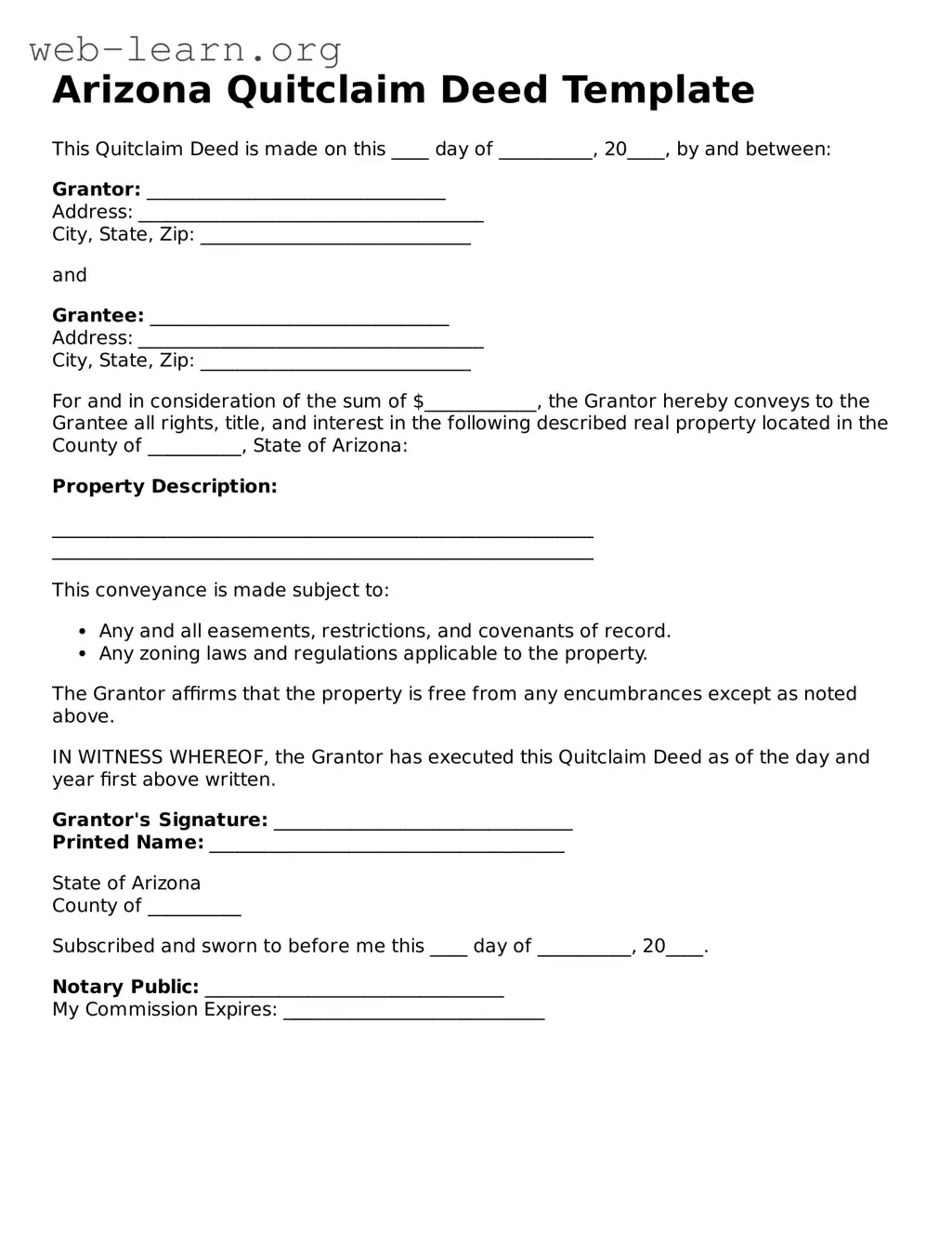
Arizona Quitclaim Deed Template
This Quitclaim Deed is made on this ____ day of __________, 20____, by and between:
Grantor: ________________________________
Address: _____________________________________
City, State, Zip: _____________________________
and
Grantee: ________________________________
Address: _____________________________________
City, State, Zip: _____________________________
For and in consideration of the sum of $____________, the Grantor hereby conveys to the Grantee all rights, title, and interest in the following described real property located in the County of __________, State of Arizona:
Property Description:
__________________________________________________________
__________________________________________________________
This conveyance is made subject to:
The Grantor affirms that the property is free from any encumbrances except as noted above.
IN WITNESS WHEREOF, the Grantor has executed this Quitclaim Deed as of the day and year first above written.
Grantor's Signature: ________________________________
Printed Name: ______________________________________
State of Arizona
County of __________
Subscribed and sworn to before me this ____ day of __________, 20____.
Notary Public: ________________________________
My Commission Expires: ____________________________
| Fact Name | Details |
|---|---|
| Definition | A Quitclaim Deed is a legal document used to transfer ownership of real property without any warranties about the title. |
| Usage | This form is often used between family members or in situations where the parties know each other well. |
| Governing Law | The Arizona Quitclaim Deed is governed by Arizona Revised Statutes, Title 33, Chapter 6. |
| Recording | Once completed, the deed must be recorded with the county recorder's office to provide public notice of the property transfer. |
After obtaining the Arizona Quitclaim Deed form, the next steps involve carefully filling out the necessary information to ensure a smooth transfer of property ownership. Accuracy is crucial, as any errors could lead to complications down the road. Below are the steps to guide you through the process of completing this form.
What is a Quitclaim Deed in Arizona?
A Quitclaim Deed is a legal document used to transfer ownership of real estate in Arizona. It allows one party, known as the grantor, to transfer their interest in a property to another party, the grantee, without making any guarantees about the title. This means the grantor is not responsible for any claims or liens against the property.
When should I use a Quitclaim Deed?
Use a Quitclaim Deed when you want to transfer property ownership quickly and without the need for extensive title searches. Common situations include transferring property between family members, adding or removing a spouse from the title, or clearing up title issues. However, it’s important to note that this type of deed does not provide the same level of protection as a warranty deed.
How do I complete an Arizona Quitclaim Deed?
To complete a Quitclaim Deed in Arizona, follow these steps:
Ensure that all information is accurate to avoid future disputes.
Do I need a lawyer to prepare a Quitclaim Deed?
No, you do not need a lawyer to prepare a Quitclaim Deed in Arizona. Many people choose to complete the form themselves using templates available online. However, consulting with a legal professional can help ensure that the deed meets all necessary legal requirements and protects your interests.
How do I record a Quitclaim Deed in Arizona?
To record a Quitclaim Deed, take the signed document to the County Recorder’s Office in the county where the property is located. You will need to pay a recording fee. Once recorded, the deed becomes part of the public record, providing official notice of the transfer.
Are there any tax implications when using a Quitclaim Deed?
Generally, transferring property via a Quitclaim Deed may not trigger immediate tax consequences. However, it’s important to consider potential property tax reassessments or capital gains tax if the property is sold later. Consulting a tax professional is advisable to understand any implications specific to your situation.
Can I revoke a Quitclaim Deed?
Once a Quitclaim Deed is executed and recorded, it cannot be revoked unilaterally. If you wish to reverse the transfer, you will need to execute another deed, such as a Quitclaim Deed back to the original owner, or a different type of deed, depending on the circumstances. Legal guidance may be beneficial in this process.
Completing a Quitclaim Deed form in Arizona can be straightforward, but several common mistakes can lead to complications. One frequent error is failing to include all necessary parties. When transferring property, both the grantor (the person giving the property) and the grantee (the person receiving the property) must be clearly identified. Omitting one of these parties can invalidate the deed.
Another mistake involves using incorrect legal descriptions of the property. The description must be precise and match the information recorded with the county assessor. Inaccuracies in the legal description can create confusion and potential disputes over property boundaries.
Signatures are essential on the Quitclaim Deed. A common oversight is neglecting to have the document signed by all parties involved. If one party does not sign, the deed may not be legally effective. Furthermore, signatures should be notarized to ensure the authenticity of the document.
People often forget to include the date of the transaction. This detail is crucial as it establishes when the transfer of property took place. Without a date, it may be difficult to determine the timeline of ownership, which can lead to legal complications.
Another frequent issue is not providing the correct consideration. While a Quitclaim Deed can be executed without monetary exchange, it is still important to indicate any consideration, even if it is nominal. This helps clarify the intent of the parties involved.
Inaccurate filing can also occur due to improper formatting. The Quitclaim Deed must adhere to specific guidelines set by the state. Failing to follow these guidelines can result in the deed being rejected by the county recorder’s office.
Some individuals overlook the need for a witness. In Arizona, a Quitclaim Deed must be signed in the presence of a witness, which adds an additional layer of verification. Skipping this step can lead to challenges in the deed’s legitimacy.
People sometimes neglect to check for existing liens or encumbrances on the property. Before transferring ownership, it is wise to ensure that there are no outstanding debts or claims against the property. Failure to address these issues can lead to disputes after the transfer.
Lastly, individuals may not retain copies of the Quitclaim Deed after submission. Keeping a copy for personal records is important, as it serves as proof of the transfer. Without a copy, it may be difficult to resolve future disputes regarding ownership.
The Arizona Quitclaim Deed is a crucial document for transferring property ownership without warranties. However, several other forms and documents are often used in conjunction with it to ensure a smooth transaction. Below is a list of these documents, each serving a specific purpose in the property transfer process.
Utilizing these documents alongside the Arizona Quitclaim Deed can help facilitate a seamless property transfer. Each form plays a vital role in safeguarding the interests of both parties involved in the transaction.
When filling out the Arizona Quitclaim Deed form, it’s important to follow certain guidelines to ensure accuracy and compliance. Here are five things you should and shouldn't do:
Following these tips can help ensure that your Quitclaim Deed is processed smoothly.
Understanding the Arizona Quitclaim Deed form is essential for anyone considering transferring property. However, several misconceptions can lead to confusion. Here are five common misunderstandings:
Many people believe that a quitclaim deed transfers full ownership of a property. While it does transfer whatever interest the grantor has, it does not guarantee that the grantor has any legal claim to the property. If the grantor does not own the property, the recipient receives nothing.
Some assume that quitclaim deeds are only suitable for transferring property between family members. In reality, they can be used in various situations, including divorces, business partnerships, or even sales. They are a versatile tool for any property transfer.
Another misconception is that transferring property via a quitclaim deed removes all liabilities associated with that property. This is not true. Any existing liens or debts tied to the property remain with it, regardless of the transfer.
Some individuals mistakenly think that quitclaim deeds and warranty deeds serve the same purpose. However, a warranty deed provides a guarantee that the grantor holds clear title to the property and has the right to sell it. In contrast, a quitclaim deed offers no such assurances.
Lastly, many believe that filing a quitclaim deed is not necessary. While the deed can be signed and handed over, it must be recorded with the county recorder's office to be legally effective. Failing to do so may result in disputes over ownership in the future.
When filling out and using the Arizona Quitclaim Deed form, keep these key takeaways in mind:
Idaho Quit Claim Deed Form - In some cases, a Quitclaim Deed may be used to correct errors in property records.
Quitclaim Deed Illinois - This document is a quick and easy way to transfer property in a straightforward manner.
Indiana Quit Claim Deed Pdf - It is important for parties to fully trust each other when using this deed.
New York Quitclaim Deed - This document helps clarify property rights when moving properties into an LLC.