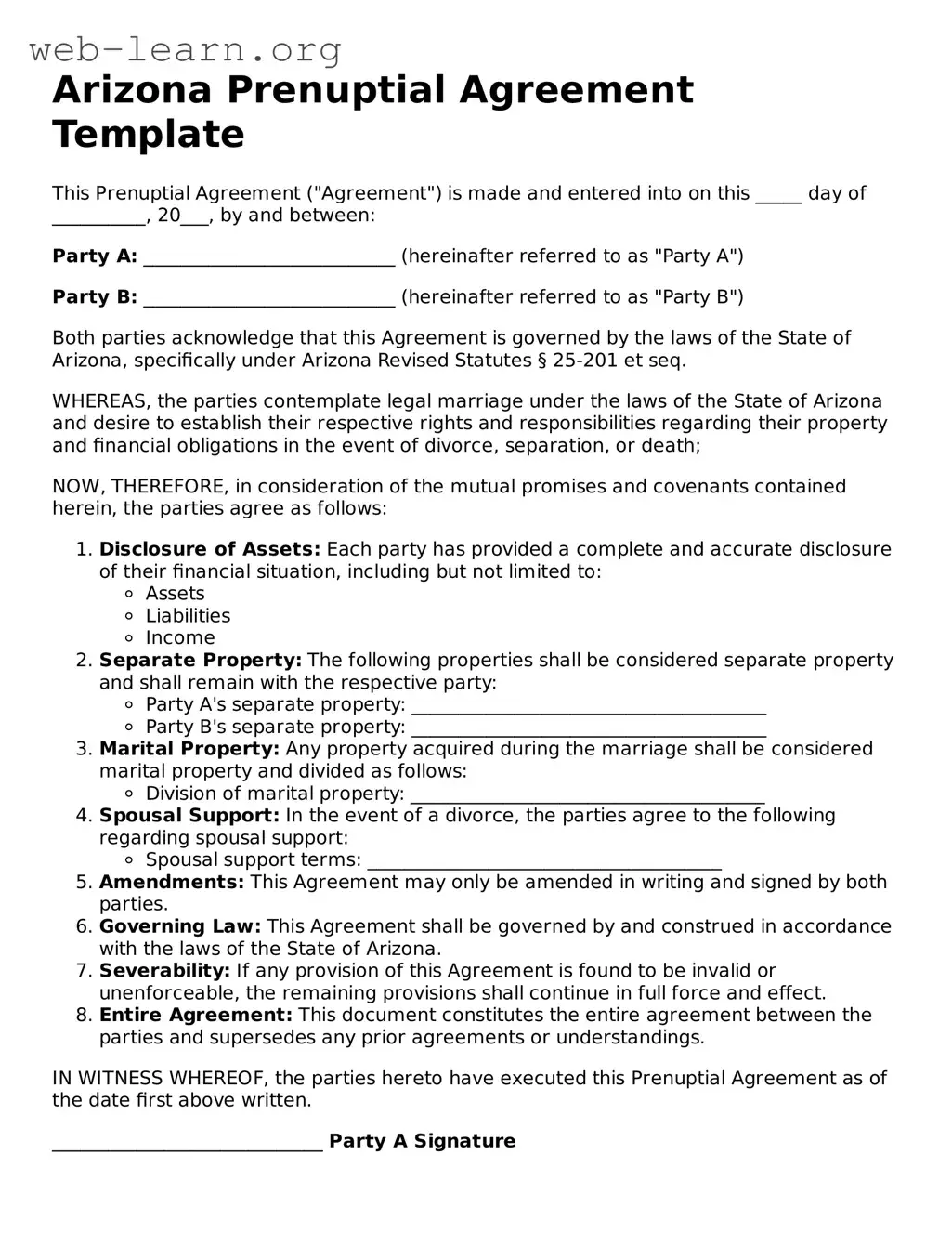
In Arizona, a prenuptial agreement serves as a crucial tool for couples planning to marry, allowing them to outline their financial rights and responsibilities before entering into marriage. This legally binding document can address various aspects, including the division of property, spousal support, and the management of debts. By discussing these matters upfront, couples can reduce potential conflicts in the event of a divorce or separation. The Arizona Prenuptial Agreement form must meet specific requirements to be enforceable, such as being in writing and signed by both parties. Additionally, full disclosure of assets and liabilities is essential to ensure fairness and transparency. Couples may also choose to include provisions regarding the ownership of future earnings and gifts, which can further clarify financial expectations. Understanding these elements is vital for anyone considering a prenuptial agreement in Arizona, as it can provide peace of mind and a solid foundation for the marriage ahead.
Arizona Prenuptial Agreement Template
This Prenuptial Agreement ("Agreement") is made and entered into on this _____ day of __________, 20___, by and between:
Party A: ___________________________ (hereinafter referred to as "Party A")
Party B: ___________________________ (hereinafter referred to as "Party B")
Both parties acknowledge that this Agreement is governed by the laws of the State of Arizona, specifically under Arizona Revised Statutes § 25-201 et seq.
WHEREAS, the parties contemplate legal marriage under the laws of the State of Arizona and desire to establish their respective rights and responsibilities regarding their property and financial obligations in the event of divorce, separation, or death;
NOW, THEREFORE, in consideration of the mutual promises and covenants contained herein, the parties agree as follows:
IN WITNESS WHEREOF, the parties hereto have executed this Prenuptial Agreement as of the date first above written.
_____________________________ Party A Signature
_____________________________ Party B Signature
_____________________________ Date
_____________________________ Date
| Fact Name | Details |
|---|---|
| Definition | An Arizona prenuptial agreement is a legal contract between two individuals before marriage, outlining the division of assets and responsibilities in the event of divorce or separation. |
| Governing Law | Arizona Revised Statutes, Title 25, Chapter 2 governs prenuptial agreements in Arizona. |
| Written Requirement | The agreement must be in writing to be enforceable in court. |
| Voluntary Agreement | Both parties must enter into the agreement voluntarily, without any coercion or undue influence. |
| Full Disclosure | Each party must fully disclose their financial situation, including assets and debts, prior to signing the agreement. |
| Legal Representation | It is advisable for each party to have independent legal counsel to review the agreement before signing. |
| Modification | The agreement can be modified or revoked at any time, but changes must also be in writing and signed by both parties. |
| Enforceability | Courts will enforce prenuptial agreements that are fair and reasonable at the time of enforcement. |
| Notarization | While notarization is not required, it is recommended to strengthen the agreement's validity. |
| Limitations | Agreements cannot include terms that are illegal or against public policy, such as waiving child support obligations. |
Filling out the Arizona Prenuptial Agreement form is an important step for couples looking to outline their financial arrangements before marriage. This process requires attention to detail and clear communication between both parties. Follow these steps to ensure the form is completed accurately.
Once the form is filled out and signed, both parties should keep a copy for their records. It’s advisable to consult with a legal professional to ensure that the agreement meets all legal requirements and protects both parties' interests.
What is a prenuptial agreement?
A prenuptial agreement, often called a prenup, is a legal contract created by two individuals before they get married. This agreement outlines how assets and debts will be divided in the event of a divorce or separation. It can also address issues such as spousal support and inheritance rights.
Why should I consider a prenuptial agreement in Arizona?
There are several reasons why a prenup might be beneficial. If you or your partner have significant assets, a prenup can help protect those assets. It can also provide clarity and peace of mind regarding financial matters, reducing potential conflicts in the future. Additionally, if one partner has children from a previous relationship, a prenup can ensure that their interests are protected.
What can be included in a prenuptial agreement?
In Arizona, a prenup can cover a variety of topics, including:
However, it cannot include provisions related to child custody or child support, as these issues are determined based on the best interests of the child at the time of divorce.
How do I create a prenuptial agreement in Arizona?
To create a valid prenuptial agreement in Arizona, both parties should ideally consult with their own attorneys to ensure their interests are protected. The agreement must be in writing and signed by both parties. It’s important to disclose all assets and debts fully and honestly. The agreement should be signed well in advance of the wedding to avoid any claims of coercion.
Can a prenuptial agreement be changed after marriage?
Yes, a prenuptial agreement can be modified or revoked after marriage. Both parties must agree to the changes, and it is best to document any modifications in writing. Consulting with legal professionals during this process is advisable to ensure that the new agreement is enforceable.
Is a prenuptial agreement enforceable in Arizona?
Generally, prenuptial agreements are enforceable in Arizona as long as they meet certain legal requirements. These include being in writing, signed by both parties, and entered into voluntarily without coercion. If either party did not disclose their assets or debts, or if the agreement is found to be unconscionable, a court may choose not to enforce it.
What happens if we don’t have a prenuptial agreement?
If a couple does not have a prenuptial agreement, Arizona law will govern the division of assets and debts in the event of a divorce. This means that the court will determine how property is divided based on the principles of community property, which generally means that assets acquired during the marriage are owned jointly by both spouses.
When should I start discussing a prenuptial agreement with my partner?
It’s best to start discussing a prenuptial agreement early in the engagement process. This allows both partners to express their thoughts and feelings about finances and expectations for the marriage. Open communication can help avoid misunderstandings and ensure that both parties feel comfortable with the agreement.
Filling out a prenuptial agreement form in Arizona can be a straightforward process, but several common mistakes can lead to complications. One frequent error is not fully understanding the purpose of the agreement. A prenuptial agreement is designed to outline how assets will be divided in the event of a divorce. Without a clear understanding, individuals may overlook important provisions.
Another mistake is failing to disclose all assets and liabilities. Complete transparency is crucial. If one party hides financial information, it can lead to disputes later on. Both parties should provide a comprehensive list of their assets, debts, and income to ensure fairness and clarity.
Many people also neglect to seek legal advice. While it is possible to fill out the form independently, consulting with an attorney can provide valuable insights. An attorney can help ensure that the agreement complies with Arizona laws and addresses both parties' needs adequately.
Moreover, individuals often forget to consider future changes in circumstances. Life events such as having children or changing jobs can impact the agreement. It’s wise to include provisions that address potential future scenarios to avoid conflicts later.
Additionally, some couples make the mistake of not discussing the agreement openly. Communication is key to a successful prenuptial agreement. Both parties should feel comfortable discussing their expectations and concerns to create a fair and balanced document.
Another common error is using vague language. Specificity is essential in legal documents. Ambiguous terms can lead to misunderstandings and disputes. Clear definitions and detailed clauses will help prevent confusion in the future.
People sometimes overlook the need for notarization. In Arizona, having the prenuptial agreement notarized can lend credibility and enforceability to the document. Failing to do so may lead to challenges in court.
Moreover, couples may forget to review and update the agreement over time. As life evolves, so do financial situations. Regularly reviewing the agreement ensures it remains relevant and reflects current circumstances.
Finally, individuals may rush through the process. Taking the time to carefully consider each section of the agreement is vital. Hasty decisions can lead to oversights that may affect both parties in the long run.
A prenuptial agreement is a legal document that outlines the financial and personal rights of each party in a marriage. In Arizona, this agreement can be accompanied by several other forms and documents that help clarify the intentions of both parties and protect their interests. Below is a list of related documents commonly used alongside a prenuptial agreement.
These documents serve to clarify the intentions of both parties and provide a comprehensive framework for managing financial and personal matters in a marriage. Each document plays a unique role in protecting the interests of individuals and ensuring that their rights are upheld.
A Prenuptial Agreement is a legal document that outlines the financial and personal arrangements between two individuals before they marry. Several other documents share similarities with a Prenuptial Agreement, as they also address important personal and financial matters. Here are four such documents:
When filling out the Arizona Prenuptial Agreement form, it’s crucial to approach the process with care. Here are some key dos and don’ts to keep in mind:
By following these guidelines, you can create a solid foundation for your prenuptial agreement that protects both parties.
Understanding prenuptial agreements is crucial for anyone considering marriage in Arizona. Unfortunately, several misconceptions can cloud judgment and lead to misunderstandings. Here are eight common misconceptions about the Arizona Prenuptial Agreement form:
Addressing these misconceptions is essential for anyone considering a prenuptial agreement. Open discussions about financial matters can lead to a healthier partnership and a more secure future.
Filling out and using the Arizona Prenuptial Agreement form requires careful consideration and attention to detail. Here are key takeaways to keep in mind:
By keeping these key points in mind, individuals can navigate the process of creating a prenuptial agreement more effectively, ensuring that it serves its intended purpose.
New York Prenup - A prenuptial agreement can include provisions for pets and their care after divorce.
Illinois Prenup - A Prenuptial Agreement can protect personal property acquired before marriage.
California Prenup - A prenuptial agreement can facilitate a smoother transition in case of separation.