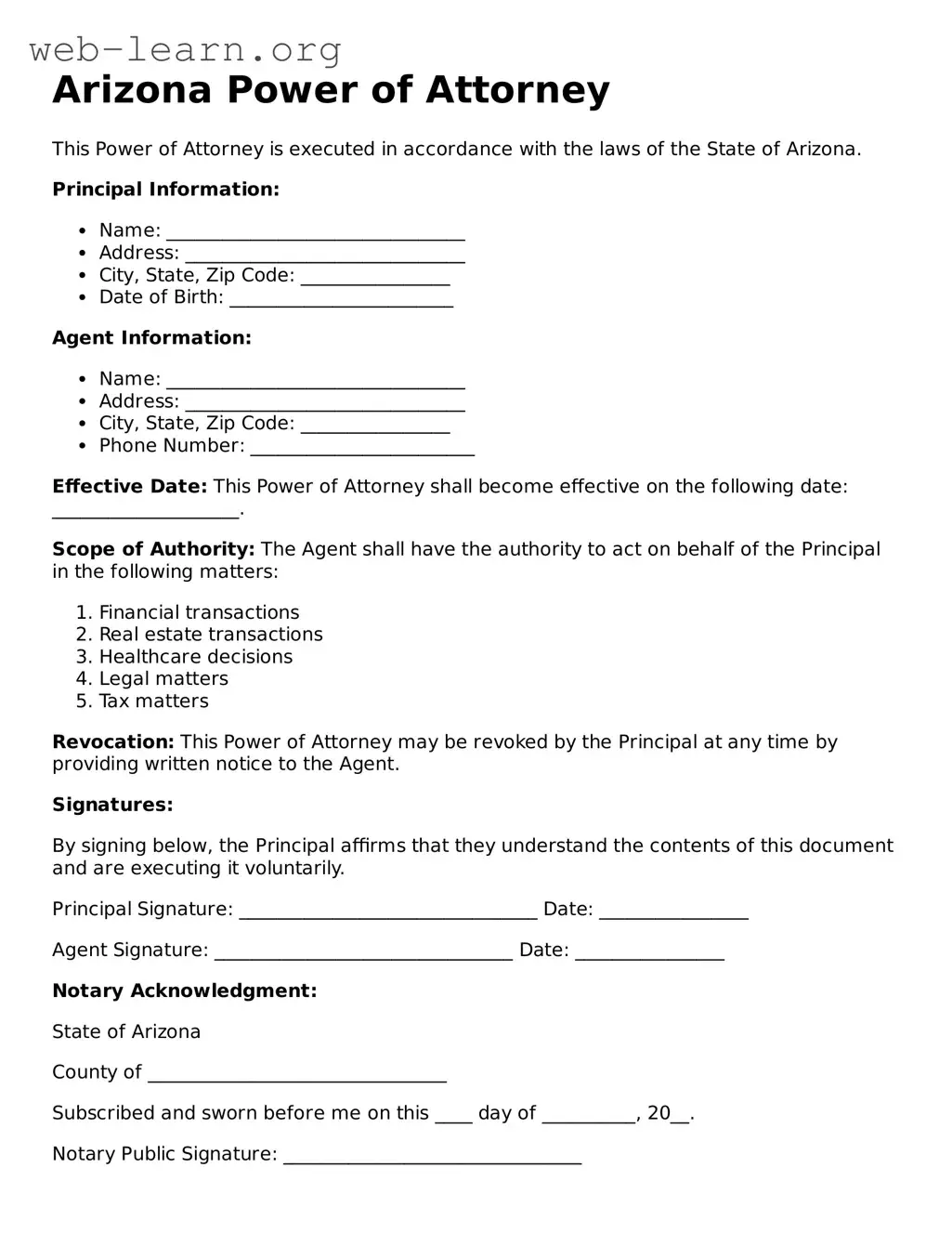
In the state of Arizona, the Power of Attorney form serves as a crucial legal document that empowers individuals to designate someone they trust to make decisions on their behalf. This can be particularly important in situations where a person may become incapacitated or unable to communicate their wishes effectively. The form can cover a wide range of responsibilities, from managing financial matters and real estate transactions to making healthcare decisions. It is important to understand that the authority granted can be broad or limited, depending on the specific needs of the individual. Additionally, the document must be executed in accordance with Arizona law, which includes certain requirements for signatures and witnesses. With careful consideration and proper execution, a Power of Attorney can provide peace of mind, ensuring that your affairs are handled according to your wishes, even when you cannot be present to oversee them.
Arizona Power of Attorney
This Power of Attorney is executed in accordance with the laws of the State of Arizona.
Principal Information:
Agent Information:
Effective Date: This Power of Attorney shall become effective on the following date: ____________________.
Scope of Authority: The Agent shall have the authority to act on behalf of the Principal in the following matters:
Revocation: This Power of Attorney may be revoked by the Principal at any time by providing written notice to the Agent.
Signatures:
By signing below, the Principal affirms that they understand the contents of this document and are executing it voluntarily.
Principal Signature: ________________________________ Date: ________________
Agent Signature: ________________________________ Date: ________________
Notary Acknowledgment:
State of Arizona
County of ________________________________
Subscribed and sworn before me on this ____ day of __________, 20__.
Notary Public Signature: ________________________________
My Commission Expires: ________________________________
| Fact Name | Description |
|---|---|
| Definition | The Arizona Power of Attorney form allows an individual (the principal) to appoint another person (the agent) to make decisions on their behalf. |
| Governing Law | The form is governed by Arizona Revised Statutes, Title 14, Chapter 5. |
| Types of Authority | The form can grant general or specific powers. General powers allow broad decision-making, while specific powers limit the agent's authority to particular tasks. |
| Durability | A Power of Attorney can be durable, meaning it remains effective even if the principal becomes incapacitated. |
| Revocation | The principal can revoke the Power of Attorney at any time, as long as they are mentally competent. |
| Agent Requirements | In Arizona, the agent must be at least 18 years old and mentally competent. |
| Witnesses | The form must be signed in the presence of either one or two witnesses, or it can be notarized. |
| Healthcare Decisions | A separate document is needed for healthcare decisions, as the Power of Attorney primarily covers financial and legal matters. |
| Signing | The principal must sign the document, or if unable, another person can sign on their behalf in their presence. |
| Limitations | Some actions, such as making a will or changing beneficiary designations, cannot be authorized through a Power of Attorney. |
Filling out the Arizona Power of Attorney form is a straightforward process that allows you to designate someone to act on your behalf. Once completed, this document will enable your chosen agent to manage your affairs according to your wishes. Here are the steps to fill out the form effectively.
Once you have completed these steps, ensure you keep a copy for your records. The next step is to communicate with your agent about your wishes and any specific instructions you may have.
What is a Power of Attorney (POA) in Arizona?
A Power of Attorney is a legal document that allows one person (the principal) to designate another person (the agent) to make decisions on their behalf. In Arizona, this can cover a wide range of matters, including financial decisions, healthcare choices, and property management. The principal must be of sound mind when creating the POA, and the agent must act in the best interest of the principal.
What types of Power of Attorney are available in Arizona?
Arizona recognizes several types of Power of Attorney, including:
How do I create a Power of Attorney in Arizona?
Creating a Power of Attorney in Arizona involves several steps:
Can I revoke a Power of Attorney in Arizona?
Yes, you can revoke a Power of Attorney at any time, as long as you are mentally competent. To do this, you should create a written revocation document and notify your agent. It is also advisable to inform any institutions that may have relied on the original POA. This ensures that your wishes are respected and that the previous agent no longer has authority to act on your behalf.
Filling out a Power of Attorney (POA) form in Arizona can seem straightforward, but many individuals make critical mistakes that can lead to complications later. One common error is failing to specify the powers granted. A POA can be general or limited, and without clear definitions, the agent may not have the authority needed to act on behalf of the principal. It's essential to outline exactly what powers are being granted, whether it’s managing finances, making healthcare decisions, or handling real estate transactions.
Another frequent mistake is not signing the document correctly. In Arizona, the principal must sign the POA in the presence of a notary public. If this step is overlooked, the document may not be legally binding. Additionally, if the agent or any witnesses are required to sign, their signatures must also be included. Ensuring that all necessary parties sign the document correctly is crucial for its validity.
People often overlook the importance of updating their Power of Attorney. Life circumstances change, and so do relationships. If the principal's situation changes—such as a divorce or the death of the designated agent—failing to update the POA can create significant issues. Regularly reviewing and revising the document ensures that it reflects current wishes and circumstances.
Lastly, individuals sometimes neglect to discuss their intentions with the chosen agent. A Power of Attorney is a significant responsibility, and the agent should fully understand their role and the principal's wishes. Without this conversation, misunderstandings can arise, potentially leading to actions that do not align with the principal's desires. Open communication is vital to ensure that the agent can act in the principal's best interests.
When preparing a Power of Attorney (POA) in Arizona, it is often beneficial to consider additional documents that can complement or enhance the authority granted. These documents can provide clarity, ensure your wishes are respected, and facilitate smoother transactions. Below is a list of forms and documents commonly used alongside the Arizona Power of Attorney.
Having these documents in place can provide peace of mind, knowing that your wishes regarding health care and financial matters are clearly articulated. Always consider consulting with a legal professional to ensure that all documents meet your specific needs and comply with Arizona law.
When completing the Arizona Power of Attorney form, it is essential to follow certain guidelines to ensure the document is valid and meets your needs. Here is a list of things you should and shouldn't do:
When it comes to understanding the Arizona Power of Attorney form, several misconceptions can lead to confusion. Below are nine common misunderstandings, along with clarifications to help you navigate this important legal document.
While many people associate a Power of Attorney with financial decisions, it can also grant authority for medical and personal matters. In Arizona, a separate document, known as a Health Care Power of Attorney, specifically addresses health-related decisions.
This is not true. In Arizona, individuals can revoke a Power of Attorney at any time, as long as they are mentally competent. The revocation should be documented in writing to ensure clarity.
While it is advisable to seek legal counsel for complex situations, individuals can create a Power of Attorney on their own using the appropriate forms. Arizona provides templates that are accessible to the public.
A Power of Attorney can be effective immediately or can be set to activate only upon incapacitation. This flexibility allows individuals to plan for various scenarios regarding their decision-making needs.
While agents are expected to act in the principal's best interest, the specific duties and limitations of the agent should be clearly outlined in the Power of Attorney document. This helps to avoid misunderstandings.
A Power of Attorney and a living will serve different purposes. A living will outlines an individual's wishes regarding medical treatment in the event of incapacitation, while a Power of Attorney designates someone to make decisions on their behalf.
While individuals can choose almost anyone to act as their agent, it is advisable to select someone trustworthy and capable of handling the responsibilities involved. This ensures that your interests are well represented.
People of all ages can benefit from having a Power of Attorney. Unexpected situations can arise at any time, making it prudent for anyone, regardless of age, to consider this legal tool.
A Power of Attorney cannot violate existing laws or regulations. It must adhere to Arizona's legal framework, and any actions taken by the agent must be lawful. Understanding this helps to maintain compliance.
By dispelling these misconceptions, individuals can better understand the significance of the Arizona Power of Attorney form and make informed decisions about their legal and personal affairs.
Filling out a Power of Attorney (POA) form in Arizona can be a straightforward process, but understanding its key aspects is essential. Here are some important takeaways to consider:
Understanding these key points can help ensure that your Power of Attorney is set up correctly and serves your needs effectively.
How to Get Power of Attorney in Michigan - Can be used for tax-related decisions and filings.
Alabama Power of Attorney Form - This form can help avoid potential disputes among family members.
Hawaii Poa - This form can help facilitate the management of your assets and liabilities.