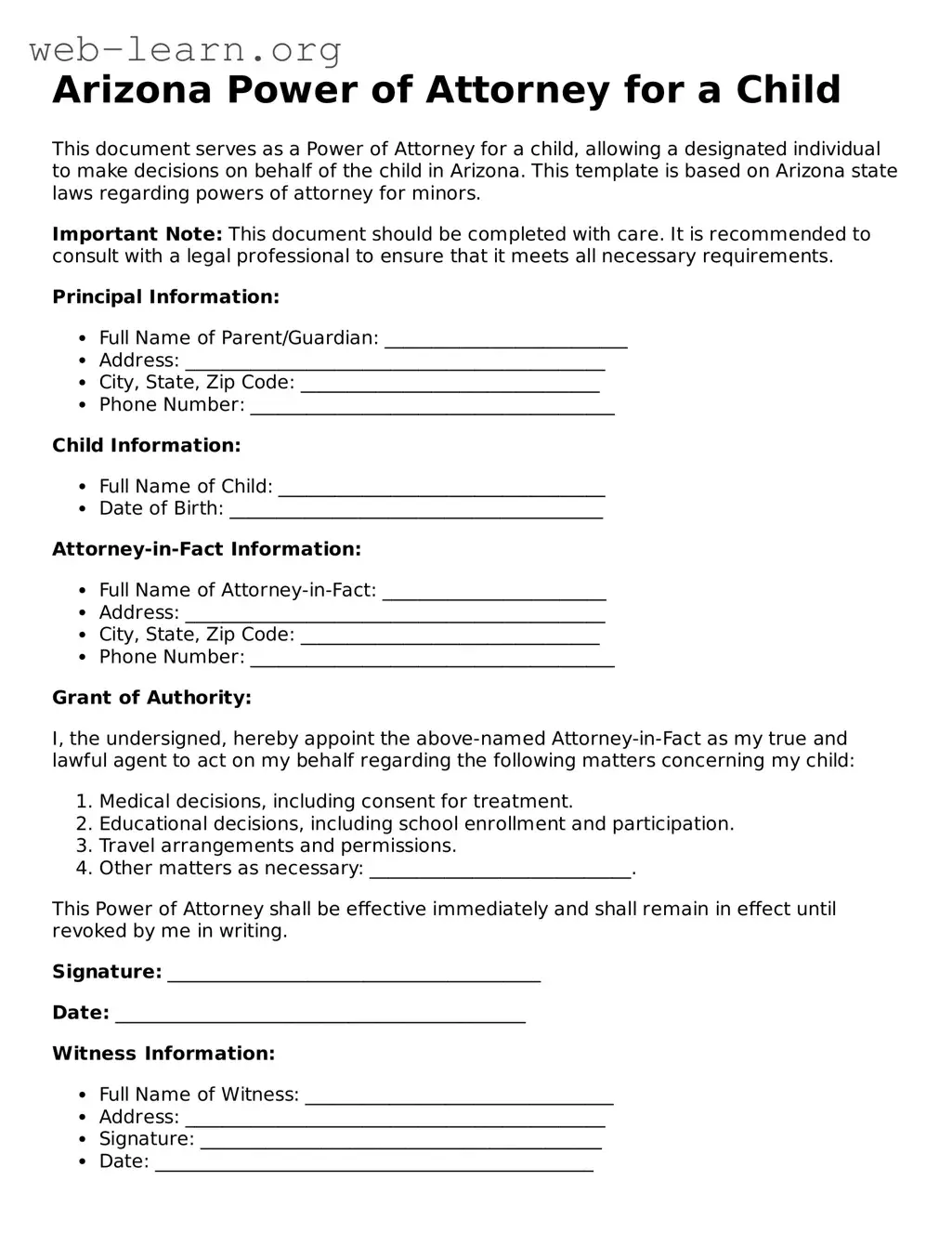
When parents or guardians need to delegate authority for the care of a child, the Arizona Power of Attorney for a Child form serves as a vital tool. This legal document allows a parent or legal guardian to appoint another individual—often a relative or trusted friend—to make decisions regarding the child’s welfare. It covers a range of responsibilities, including medical care, educational decisions, and general day-to-day needs. The form is particularly useful in situations where parents are temporarily unavailable, such as during travel or medical emergencies. By completing this form, parents can ensure that their child continues to receive proper care and support, while also granting the designated individual the legal authority to act on their behalf. Understanding the nuances of this form can help families navigate complex situations with confidence and peace of mind.
Arizona Power of Attorney for a Child
This document serves as a Power of Attorney for a child, allowing a designated individual to make decisions on behalf of the child in Arizona. This template is based on Arizona state laws regarding powers of attorney for minors.
Important Note: This document should be completed with care. It is recommended to consult with a legal professional to ensure that it meets all necessary requirements.
Principal Information:
Child Information:
Attorney-in-Fact Information:
Grant of Authority:
I, the undersigned, hereby appoint the above-named Attorney-in-Fact as my true and lawful agent to act on my behalf regarding the following matters concerning my child:
This Power of Attorney shall be effective immediately and shall remain in effect until revoked by me in writing.
Signature: ________________________________________
Date: ____________________________________________
Witness Information:
Notary Public:
State of Arizona, County of ________________
Subscribed and sworn before me this ___ day of __________, 20__.
Notary Public Signature: ________________________________
My Commission Expires: ________________________________
| Fact Name | Description |
|---|---|
| Purpose | The Arizona Power of Attorney for a Child form allows a parent or guardian to grant temporary authority to another adult to make decisions on behalf of their child. |
| Governing Law | This form is governed by Arizona Revised Statutes, Title 14, Chapter 5, which outlines the laws regarding powers of attorney. |
| Duration | The authority granted can be temporary or for a specified duration, depending on the needs of the parent or guardian. |
| Eligibility | Any adult can be designated as an agent, as long as they are willing to accept the responsibilities involved. |
| Revocation | The parent or guardian can revoke the power of attorney at any time, as long as they provide notice to the agent. |
| Notarization | While notarization is not required, having the document notarized can provide additional legal protection and clarity. |
| Medical Decisions | The form can allow the agent to make medical decisions for the child, but specific medical powers may need to be explicitly stated. |
| Education Decisions | The agent may also have the authority to make educational decisions, including enrollment in schools or special programs. |
| Usage Scenarios | This form is often used when parents are traveling, deployed, or otherwise unable to care for their child temporarily. |
Filling out the Arizona Power of Attorney for a Child form is an important step in ensuring that your child's needs are met when you are unable to be present. This document allows you to designate someone to make decisions on behalf of your child. Follow the steps below to complete the form accurately.
After completing the form, make copies for your records and provide a copy to the individual you designated. It's also wise to inform relevant parties, such as schools or healthcare providers, about this arrangement to ensure a smooth process when the need arises.
What is a Power of Attorney for a Child in Arizona?
A Power of Attorney for a Child in Arizona is a legal document that allows a parent or guardian to grant another adult the authority to make decisions on behalf of their child. This can include decisions about education, healthcare, and general welfare. The document is often used when a parent is unavailable, such as during travel or extended work commitments.
Who can be appointed as an agent in the Power of Attorney?
The agent, also known as the attorney-in-fact, can be any responsible adult. This might be a relative, friend, or trusted neighbor. It is important to choose someone who understands the child’s needs and can act in their best interest. The agent does not have to be a legal professional.
How long is the Power of Attorney valid?
The Power of Attorney for a Child can be set for a specific period or remain in effect until revoked by the parent or guardian. If a specific end date is not included, it typically remains valid until the child turns 18 years old. Parents should keep a copy of the document and inform the agent about its terms.
Can the Power of Attorney be revoked?
Yes, the Power of Attorney can be revoked at any time by the parent or guardian. To do this, the parent should provide a written notice to the agent and any relevant parties, like schools or healthcare providers. It is advisable to keep a record of the revocation for future reference.
Filling out the Arizona Power of Attorney for a Child form can be a straightforward process, but there are common mistakes that can lead to complications. One frequent error is failing to specify the duration of the power of attorney. Without a clear start and end date, the authority granted may be ambiguous, which can cause confusion for caregivers and legal authorities.
Another mistake is not identifying the child clearly. It’s crucial to provide the child's full name, date of birth, and any other identifying information. Omitting this information can lead to challenges in verifying the child’s identity and the legitimacy of the document.
Many people overlook the importance of notarization. In Arizona, the Power of Attorney for a Child must be notarized to be legally binding. Skipping this step can render the document invalid, leaving caregivers without the authority they need to act on behalf of the child.
Additionally, individuals often forget to include alternate agents. Designating a backup agent ensures that there is someone ready to step in if the primary agent is unavailable. This oversight can lead to gaps in care, which can be detrimental to the child's well-being.
Another common issue is not discussing the arrangement with the child. While it may seem unnecessary, having an open conversation with the child can help them understand the situation. This understanding can ease any anxiety they may have and foster a sense of security.
Finally, failing to review the form for accuracy before submission is a critical mistake. Errors in names, dates, or other details can cause delays or complications. A thorough review can help catch these mistakes and ensure the document is processed smoothly.
When creating a Power of Attorney for a Child in Arizona, there are several other documents that may be beneficial to consider. These documents can help clarify the responsibilities and rights of the parties involved, ensuring that the child's needs are met effectively.
By utilizing these additional documents, parents can provide comprehensive support for their child's well-being and ensure that caregivers have the necessary authority to act in the child's best interest.
The Power of Attorney for a Child form allows a parent or guardian to designate another adult to make decisions on behalf of their child. Several other documents serve similar purposes in different contexts. Here are nine documents that share similarities with the Power of Attorney for a Child:
When filling out the Arizona Power of Attorney for a Child form, it's essential to approach the process with care. Here’s a helpful list of dos and don’ts to guide you through the form:
By following these guidelines, you can navigate the process more smoothly and ensure that the form is filled out correctly. This will help protect the interests of the child involved.
When it comes to the Arizona Power of Attorney for a Child form, several misconceptions can lead to confusion. Here are four common misunderstandings:
Understanding these misconceptions can help parents make informed decisions about their child's care and legal arrangements.
Filling out and using the Arizona Power of Attorney for a Child form is an important process for parents and guardians. Here are five key takeaways to consider:
How to Get Power of Attorney in Oregon - Parents may want to consult with a professional to ensure the form meets their needs.
Power of Attorney for Child Traveling With Grandparents - Legal advice may be beneficial when drafting this document to ensure compliance.
How to Get Power of Attorney in Florida - A Power of Attorney for a Child form allows a parent to designate another adult to make decisions for their child.