When starting a business in Arizona, particularly a Limited Liability Company (LLC), having a well-structured Operating Agreement is essential. This document serves as the backbone of the LLC, outlining the rules and regulations that govern the company's operations. It details the roles and responsibilities of each member, including how profits and losses will be distributed. Additionally, the Operating Agreement addresses important aspects such as decision-making processes, voting rights, and procedures for adding or removing members. By clearly defining these elements, the agreement helps to prevent disputes and misunderstandings among members. Furthermore, it can enhance the credibility of the LLC and provide clarity to external parties, such as banks and potential investors. Understanding the significance of this form can lead to a smoother operation and greater success for your business in Arizona.
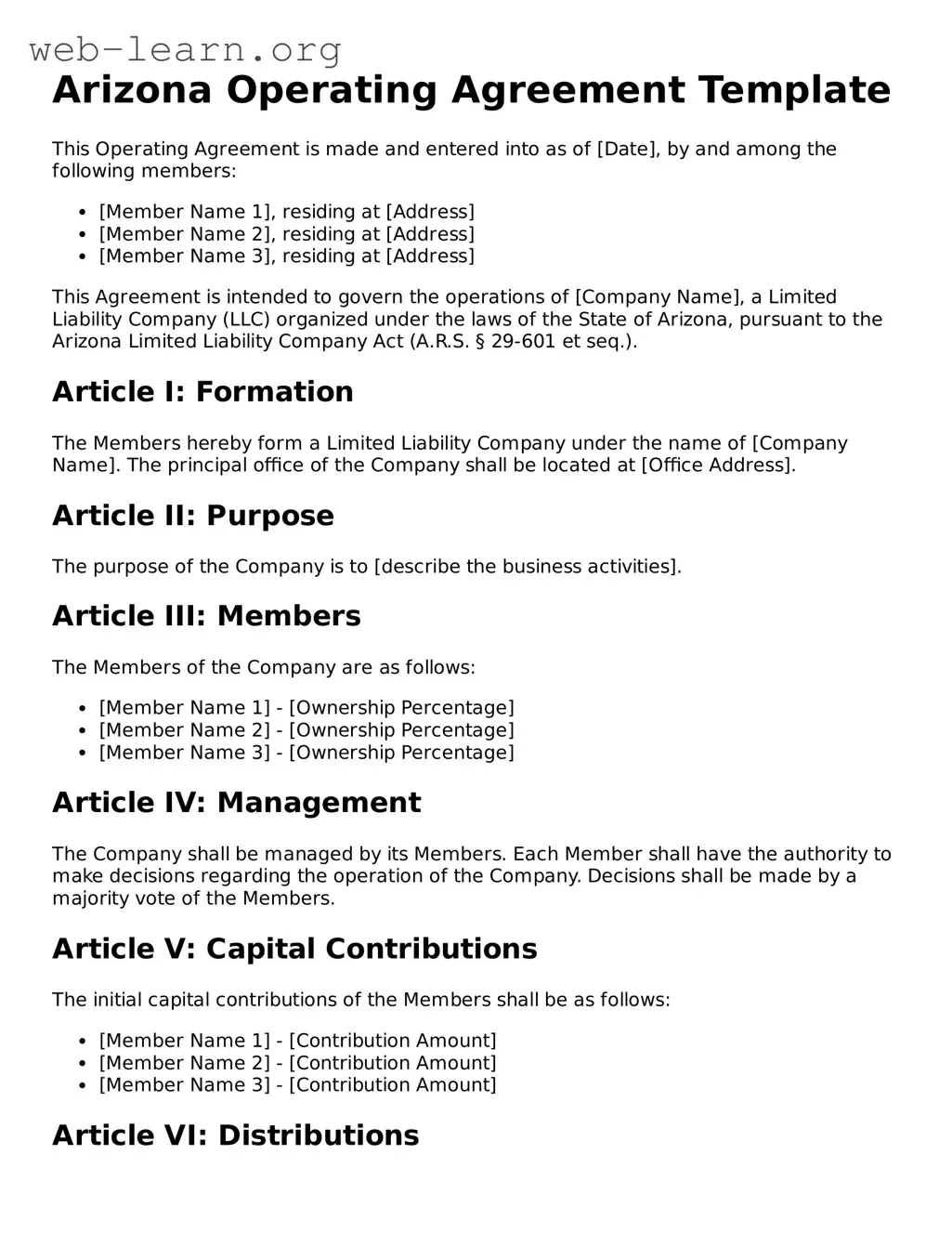
Arizona Operating Agreement Template
This Operating Agreement is made and entered into as of [Date], by and among the following members:
This Agreement is intended to govern the operations of [Company Name], a Limited Liability Company (LLC) organized under the laws of the State of Arizona, pursuant to the Arizona Limited Liability Company Act (A.R.S. § 29-601 et seq.).
Article I: Formation
The Members hereby form a Limited Liability Company under the name of [Company Name]. The principal office of the Company shall be located at [Office Address].
Article II: Purpose
The purpose of the Company is to [describe the business activities].
Article III: Members
The Members of the Company are as follows:
Article IV: Management
The Company shall be managed by its Members. Each Member shall have the authority to make decisions regarding the operation of the Company. Decisions shall be made by a majority vote of the Members.
Article V: Capital Contributions
The initial capital contributions of the Members shall be as follows:
Article VI: Distributions
Distributions of profits and losses shall be allocated to the Members in proportion to their respective ownership percentages.
Article VII: Amendments
This Operating Agreement may be amended only by a written agreement signed by all Members.
Article VIII: Governing Law
This Agreement shall be governed by and construed in accordance with the laws of the State of Arizona.
IN WITNESS WHEREOF, the Members have executed this Operating Agreement as of the date first above written.
__________________________
[Member Name 1]
__________________________
[Member Name 2]
__________________________
[Member Name 3]
| Fact Name | Description |
|---|---|
| Governing Law | The Arizona Operating Agreement is governed by Arizona Revised Statutes, Title 29, which pertains to limited liability companies. |
| Purpose | This form outlines the management structure and operational procedures of an LLC in Arizona. |
| Members' Rights | The agreement specifies the rights and responsibilities of the members, ensuring clarity in ownership and management roles. |
| Flexibility | Arizona law allows for significant flexibility in customizing the Operating Agreement to meet the specific needs of the LLC. |
| Dispute Resolution | Provisions for resolving disputes among members can be included, promoting effective conflict management. |
| Amendments | The agreement can be amended as needed, provided that all members agree to the changes in writing. |
| Filing Requirement | While the Operating Agreement is not required to be filed with the state, it is essential for internal governance. |
| Tax Implications | The Operating Agreement can outline tax treatment options for the LLC, affecting how income is reported and taxed. |
Completing the Arizona Operating Agreement form is a crucial step for those forming a limited liability company (LLC) in Arizona. After filling out the form, you will have a structured document that outlines the management and operational procedures of your LLC. This will help ensure clarity and prevent disputes among members.
What is an Arizona Operating Agreement?
An Arizona Operating Agreement is a legal document that outlines the management structure and operating procedures of a Limited Liability Company (LLC) in Arizona. This agreement serves as a foundational document for the LLC, detailing the rights and responsibilities of its members, as well as the rules governing the operation of the business.
Is an Operating Agreement required in Arizona?
No, Arizona law does not require LLCs to have an Operating Agreement. However, having one is highly recommended. An Operating Agreement helps prevent misunderstandings among members and provides a clear framework for decision-making and conflict resolution. It can also protect personal assets and establish credibility with banks and investors.
What should be included in the Operating Agreement?
The Operating Agreement should cover several key areas, including:
Including these elements can help ensure smooth operations and clarify expectations among members.
Can I modify the Operating Agreement after it is created?
Yes, the Operating Agreement can be modified. Members can agree to changes at any time, provided they follow the procedures outlined in the agreement itself. It is advisable to document any amendments in writing and have all members sign off on the changes to maintain clarity and legal standing.
How does the Operating Agreement affect taxes?
The Operating Agreement does not directly affect how taxes are assessed on the LLC. However, it can influence how profits and losses are allocated among members, which may have tax implications. Members should consult with a tax professional to understand how their specific agreement may impact their tax obligations.
Where can I find a template for an Arizona Operating Agreement?
Templates for an Arizona Operating Agreement can be found online through various legal document preparation services. It is important to choose a template that is specifically designed for Arizona LLCs, as state laws can vary. Additionally, consider having a legal professional review the agreement to ensure it meets all necessary requirements and adequately reflects the intentions of the members.
Filling out the Arizona Operating Agreement form is a crucial step for any limited liability company (LLC) owner. However, many individuals make common mistakes that can lead to complications down the line. Understanding these pitfalls can save time, money, and legal headaches.
One frequent error is failing to include all members of the LLC. It’s essential to list every member and their respective ownership percentages. Omitting a member can create disputes later, as it may lead to misunderstandings about profit distribution and decision-making authority. Always ensure that the agreement accurately reflects the current membership structure.
Another mistake often made is neglecting to define the roles and responsibilities of each member. Clarity is key in any business relationship. Without clearly defined roles, conflicts can arise regarding who is responsible for what tasks. This can lead to confusion and inefficiencies, which ultimately affect the company’s performance.
People also frequently overlook the importance of including provisions for handling disputes. An effective Operating Agreement should outline how disagreements will be resolved. Whether through mediation, arbitration, or another method, having a clear process can prevent conflicts from escalating and ensure a smoother resolution.
Additionally, many individuals fail to update the Operating Agreement as changes occur. Life and business circumstances evolve, and so should your agreement. If a member leaves, a new member joins, or roles change, it is vital to revise the document accordingly. Keeping the agreement current helps maintain clarity and prevents potential legal issues.
Finally, a common oversight is not having the agreement reviewed by a legal professional. While it may seem tempting to fill out the form independently, seeking legal advice can provide valuable insights. A lawyer can help ensure that the agreement complies with state laws and meets the specific needs of the LLC.
When forming a Limited Liability Company (LLC) in Arizona, the Operating Agreement serves as a foundational document outlining the management structure and operational guidelines. However, several other forms and documents complement the Operating Agreement, ensuring that the LLC operates smoothly and in compliance with state regulations. Below is a list of these essential documents.
Each of these documents plays a crucial role in establishing and maintaining the integrity of an LLC in Arizona. Properly preparing and organizing these forms can help prevent misunderstandings and legal issues down the road, ensuring that the LLC operates effectively and in accordance with the law.
Partnership Agreement: This document outlines the roles, responsibilities, and profit-sharing arrangements among partners in a business. Like an Operating Agreement, it helps establish clear guidelines for decision-making and dispute resolution within the partnership.
Bylaws: Bylaws serve as the internal rules for a corporation. Similar to an Operating Agreement, they detail the governance structure, including the roles of directors and officers, and the procedures for meetings and voting.
Shareholders Agreement: This document governs the relationship between shareholders in a corporation. It is akin to an Operating Agreement in that it addresses issues like transfer of shares, voting rights, and how decisions are made, ensuring all parties understand their rights and obligations.
Joint Venture Agreement: A Joint Venture Agreement outlines the terms of collaboration between two or more parties for a specific project. Similar to an Operating Agreement, it defines each party's contributions, responsibilities, and how profits or losses will be shared, promoting clarity and cooperation.
When filling out the Arizona Operating Agreement form, it's important to be thorough and accurate. Here are seven key things to keep in mind:
Following these guidelines can help ensure a smooth process when submitting your Operating Agreement in Arizona.
Understanding the Arizona Operating Agreement form is crucial for anyone involved in managing a limited liability company (LLC) in the state. However, several misconceptions can cloud judgment and lead to confusion. Here are five common misconceptions:
By clarifying these misconceptions, LLC members can better understand the importance of the Arizona Operating Agreement and how it can serve their business interests.
When filling out and using the Arizona Operating Agreement form, it is essential to keep several key points in mind. Understanding these can help ensure the document serves its intended purpose effectively.
By adhering to these key takeaways, individuals can create a comprehensive Operating Agreement that meets the needs of their LLC and fosters a collaborative business environment.
Florida Operating Agreement Template - The Operating Agreement can provide a clear framework for growth and expansion.
Colorado Llc Operating Agreement - The agreement can detail the management structure, whether member-managed or manager-managed.
Idaho Llc Operating Agreement - It can specify how to handle intellectual property rights.
How to Write an Operating Agreement - It may include procedures for adding or removing members from the LLC.