In Arizona, the Notice to Quit form serves as a crucial tool for landlords when they need to terminate a tenancy. This form is typically used to inform tenants that they must vacate the rental property, either due to non-payment of rent, lease violations, or other reasons specified by law. It outlines the timeframe in which tenants must respond or vacate, ensuring that both parties understand their rights and responsibilities. The document must be delivered in a specific manner, often through personal service or certified mail, to ensure it is legally binding. Clarity is key; the form should detail the reasons for termination and any necessary steps the tenant must take to resolve the situation, if applicable. Understanding the Notice to Quit is essential for both landlords and tenants, as it sets the stage for the next steps in the rental process, whether that involves eviction proceedings or potential resolution of the issues at hand.
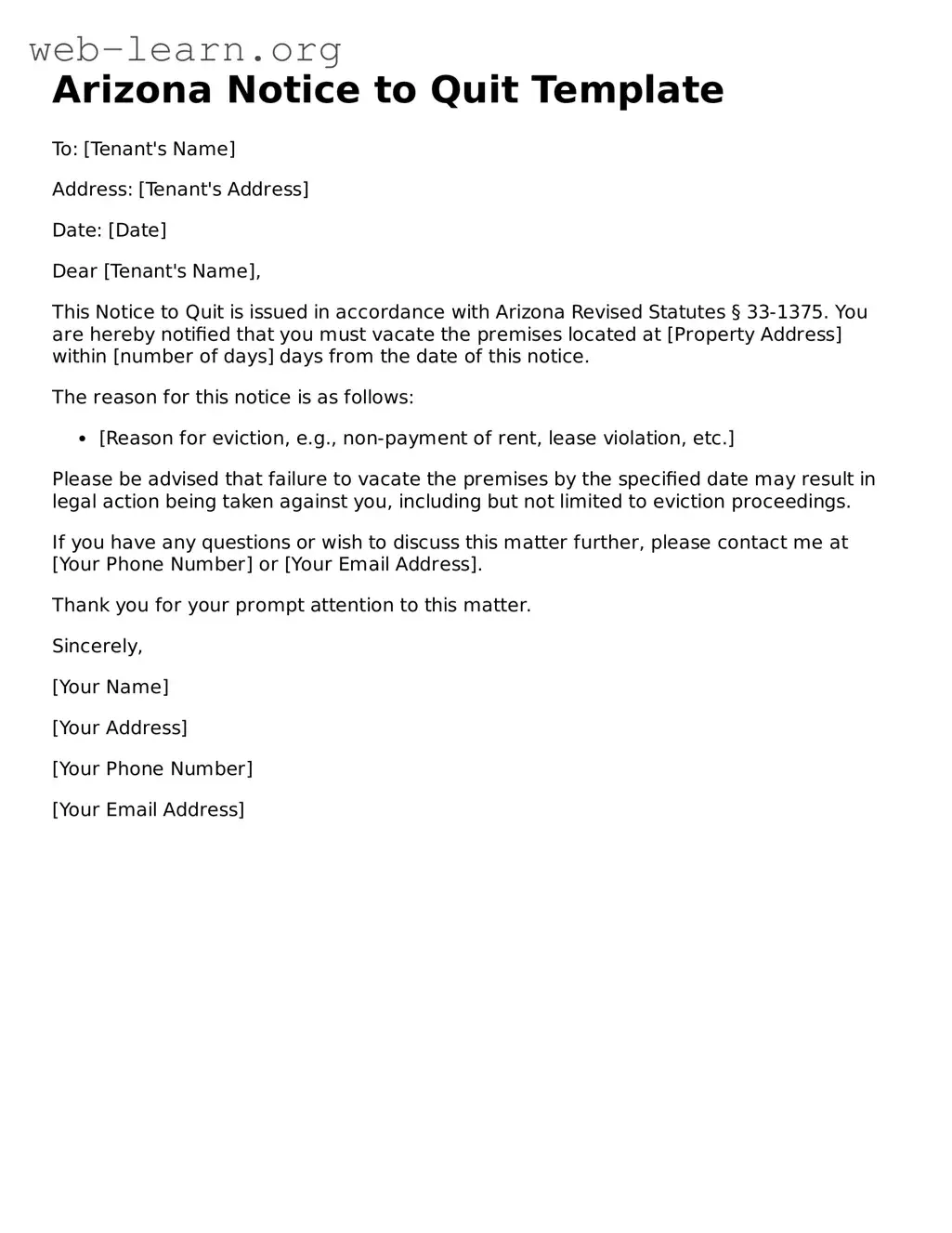
Arizona Notice to Quit Template
To: [Tenant's Name]
Address: [Tenant's Address]
Date: [Date]
Dear [Tenant's Name],
This Notice to Quit is issued in accordance with Arizona Revised Statutes § 33-1375. You are hereby notified that you must vacate the premises located at [Property Address] within [number of days] days from the date of this notice.
The reason for this notice is as follows:
Please be advised that failure to vacate the premises by the specified date may result in legal action being taken against you, including but not limited to eviction proceedings.
If you have any questions or wish to discuss this matter further, please contact me at [Your Phone Number] or [Your Email Address].
Thank you for your prompt attention to this matter.
Sincerely,
[Your Name]
[Your Address]
[Your Phone Number]
[Your Email Address]
| Fact Name | Description |
|---|---|
| Purpose | The Arizona Notice to Quit form is used by landlords to inform tenants that they must vacate the rental property. |
| Governing Law | This form is governed by Arizona Revised Statutes § 33-1368, which outlines the eviction process. |
| Delivery Methods | The notice can be delivered in person, via certified mail, or by posting it on the property. |
| Timeframe | Typically, tenants are given a specific timeframe to vacate, often ranging from 5 to 30 days, depending on the reason for eviction. |
| Legal Consequences | If the tenant does not comply, the landlord may proceed with legal action to evict them from the property. |
After obtaining the Arizona Notice to Quit form, it is essential to complete it accurately. This form is a formal request for a tenant to vacate a rental property. Once filled out, the form should be delivered to the tenant according to the state's regulations.
What is the Arizona Notice to Quit form?
The Arizona Notice to Quit form is a legal document used by landlords to inform tenants that they must vacate the rental property. This notice is typically issued when a tenant has violated the terms of their lease or has failed to pay rent. The form serves as a formal request for the tenant to leave the premises, providing them with a specific timeframe to do so.
How long does a tenant have to respond to a Notice to Quit?
The response time can vary depending on the reason for the notice. Generally, tenants are given a minimum of five days to respond if the notice is due to non-payment of rent. For other lease violations, the timeframe may differ. It is crucial for tenants to read the notice carefully to understand the specific deadlines and requirements.
What should a tenant do upon receiving a Notice to Quit?
Upon receiving a Notice to Quit, tenants should take immediate action. First, review the notice to understand the reason for the eviction. Next, consider addressing the issue—whether that means paying overdue rent or rectifying any lease violations. If tenants believe the notice is unjust, they may wish to seek legal advice or respond formally to the landlord.
What happens if a tenant does not comply with the Notice to Quit?
If a tenant does not comply with the Notice to Quit, the landlord may proceed with legal action to evict the tenant. This process typically involves filing an eviction lawsuit in court. It is important for tenants to understand that ignoring the notice can lead to further legal complications and potential loss of their housing.
When filling out the Arizona Notice to Quit form, individuals often encounter several common mistakes that can lead to delays or complications in the eviction process. One frequent error is failing to provide accurate tenant information. It is essential to include the full name of the tenant as it appears on the lease agreement. Omitting or misspelling this information can result in the notice being deemed invalid.
Another mistake involves not specifying the reason for the eviction. Arizona law requires that the Notice to Quit clearly states the grounds for termination of the tenancy. Whether it is due to non-payment of rent or violation of lease terms, clarity is crucial. A vague or unclear reason can lead to disputes and prolong the eviction process.
Additionally, individuals often neglect to include the correct date by which the tenant must vacate the premises. The notice must provide a specific deadline that complies with Arizona law. Failure to do so may render the notice ineffective, as tenants may not understand the urgency of the situation.
Some may also overlook the requirement for proper delivery of the Notice to Quit. Arizona law mandates that the notice be delivered in a specific manner, such as by personal service or certified mail. Not adhering to these guidelines can result in the notice being challenged in court.
Moreover, individuals frequently forget to sign and date the Notice to Quit. A signature is a critical element that confirms the authenticity of the document. Without it, the notice may be considered incomplete and unenforceable.
Lastly, individuals sometimes fail to keep a copy of the Notice to Quit for their records. Retaining a copy is essential for future reference, especially if the eviction process escalates to court proceedings. Having documentation can provide necessary evidence of compliance with legal requirements.
The Arizona Notice to Quit form is an important document used in landlord-tenant relationships, particularly when a landlord seeks to terminate a rental agreement. Alongside this form, several other documents may be necessary to ensure compliance with state laws and to facilitate the eviction process. Below is a list of commonly used forms and documents that often accompany the Notice to Quit.
Understanding these documents is crucial for both landlords and tenants to navigate the eviction process effectively and to ensure that all legal requirements are met. Proper documentation helps protect the rights of both parties involved.
The Notice to Quit form serves as a formal communication from a landlord to a tenant, indicating the desire to terminate a rental agreement. Several other documents share similarities with the Notice to Quit in terms of purpose and function. Below is a list of seven such documents:
When filling out the Arizona Notice to Quit form, it is essential to follow specific guidelines to ensure accuracy and compliance with legal requirements. Below is a list of things you should and shouldn't do during this process.
Misconception 1: The Notice to Quit is the same as an eviction notice.
Many individuals mistakenly believe that a Notice to Quit is an official eviction notice. In reality, it is a preliminary step that a landlord may take to inform a tenant of a lease violation or the need to vacate the property. An eviction process involves legal proceedings that follow the issuance of a Notice to Quit.
Misconception 2: A tenant can ignore the Notice to Quit.
Some tenants think that they can simply disregard a Notice to Quit without consequences. However, ignoring this notice may lead to further legal action, including eviction. It is crucial for tenants to understand the importance of responding appropriately to such notices.
Misconception 3: A Notice to Quit must be delivered in person.
While personal delivery is one method of serving a Notice to Quit, it is not the only option. Landlords can also send the notice via certified mail or post it on the property, depending on state laws. The method of delivery may vary, but it must comply with legal requirements.
Misconception 4: The Notice to Quit must provide a reason for termination.
Some believe that landlords are required to specify a reason for issuing a Notice to Quit. In Arizona, this is not always necessary. Landlords can issue a notice without providing a specific cause, especially in cases of month-to-month leases.
Misconception 5: A Notice to Quit is a final decision.
Many tenants think that receiving a Notice to Quit means they must leave immediately. This is not accurate. The notice is a request to vacate, and tenants typically have a set period to respond or remedy the situation before further action is taken.
When dealing with the Arizona Notice to Quit form, understanding its purpose and proper usage is essential for both landlords and tenants. Here are five key takeaways to keep in mind:
By keeping these points in mind, both landlords and tenants can navigate the process of the Arizona Notice to Quit more effectively.
Landlord:23dca7yshec= Eviction Letter - Tenants receive this notice as an opportunity to address issues before facing eviction.
Florida Eviction Notice - The notice may vary in format depending on local laws.
Eviction Notice Idaho - It is advisable to deliver the notice in a way that provides proof of receipt.