Homepage Blank Arizona Lsu Form
Outline

The Arizona Loan Status Update (LSU) form is a crucial document in the home-buying process, providing essential information about a buyer's loan status to both the seller and the broker. This form must be delivered within five days of contract acceptance, ensuring timely communication regarding the buyer's financing. Key sections of the LSU include details about the lender, the type of loan, and the buyer's financial qualifications. It outlines whether the buyer is relying on seller concessions and includes pre-qualification information that helps assess the buyer's ability to secure financing. Additionally, the form tracks the progress of the loan application, from initial documentation to closing, ensuring all parties are informed of any updates. The lender is responsible for providing updates upon request, fostering transparency throughout the transaction. Overall, the LSU is designed to streamline communication and facilitate a smoother closing process for all involved.
Sample - Arizona Lsu Form

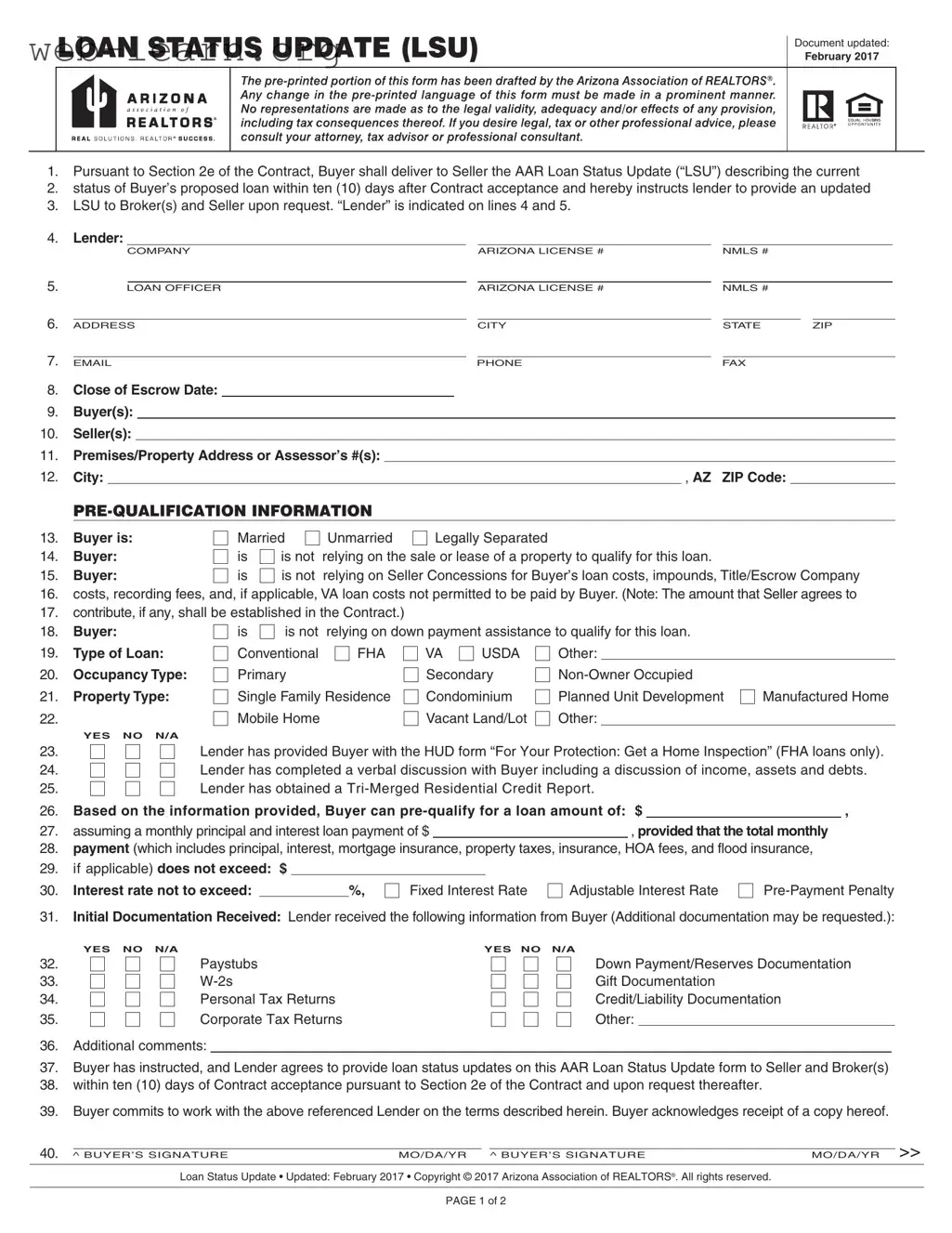
Pursuant to Section 2e of the Contract, Buyer shall deliver to Seller the AAR Loan Status Update (“LSU”) describing the current
status of Buyer’s proposed loan within ten (10) days after Contract acceptance and hereby instructs lender to provide an updated
LSU to Broker(s) and Seller upon request. “Lender” is indicated on lines 4 and 5.
Lender:
COMPANY ARIZONA LICENSE # NMLS #
LOAN OFFICER ARIZONA LICENSE # NMLS #
ADDRESS CITY STATE ZIP
EMAIL PHONE FAX
Close of Escrow Date:
Buyer(s):
Seller(s):
Premises/Property Address or Assessor’s #(s):
City: , AZ ZIP Code:
PRE-QUALIFICATION INFORMATION
Buyer is: Married Unmarried Legally Separated
Buyer:
is is not relying on the sale or lease of a property to qualify for this loan.
Buyer:
is is not relying on Seller Concessions for Buyer’s loan costs, impounds, Title/Escrow Company
costs, recording fees, and, if applicable, VA loan costs not permitted to be paid by Buyer. (Note: The amount that Seller agrees to
contribute, if any, shall be established in the Contract.)
Buyer:
is
is not relying on down payment assistance to qualify for this loan.
Type of Loan:
Conventional FHA VA USDA Other:
Occupancy Type:
Primary Secondary Non-Owner Occupied
Property Type:
Single Family Residence Condominium Planned Unit Development Manufactured Home
Mobile Home Vacant Land/Lot Other:
YES NO N/A
Lender has provided Buyer with the HUD form “For Your Protection: Get a Home Inspection” (FHA loans only).
Lender has completed a verbal discussion with Buyer including a discussion of income, assets and debts.
Lender has obtained a Tri-Merged Residential Credit Report.
Based on the information provided, Buyer can pre-qualify for a loan amount of: $ ,
assuming a monthly principal and interest loan payment of $ , provided that the total monthly
payment (which includes principal, interest, mortgage insurance, property taxes, insurance, HOA fees, and flood insurance,
if applicable) does not exceed: $
Interest rate not to exceed: %,
Fixed Interest Rate Adjustable Interest Rate Pre-Payment Penalty
Initial Documentation Received: Lender received the following information from Buyer (Additional documentation may be requested.):
YES NO N/A
YES NO N/A
Paystubs Down Payment/Reserves Documentation
W-2s Gift Documentation
Personal Tax Returns Credit/Liability Documentation
Corporate Tax Returns Other:
Additional comments:
Buyer has instructed, and Lender agrees to provide loan status updates on this AAR Loan Status Update form to Seller and Broker(s)
within ten (10) days of Contract acceptance pursuant to Section 2e of the Contract and upon request thereafter.
Buyer commits to work with the above referenced Lender on the terms described herein. Buyer acknowledges receipt of a copy hereof.
^ BUYER’S SIGNATURE MO/DA/YR ^ BUYER’S SIGNATURE MO/DA/YR
1.
2.
3.
4.
5.
6.
7.
8.
9.
10.
11.
12.
13.
14.
15.
16.
17.
18.
19.
20.
21.
22.
23.
24.
25.
26.
27.
28.
29.
30.
31.
32.
33.
34.
35.
36.
37.
38.
39.
40.
Document updated:
February 2017
LOAN STATUS UPDATE (LSU)
Loan Status Update • Updated: February 2017 • Copyright © 2017 Arizona Association of REALTORS
®
. All rights reserved.
PAGE 1 of 2
>>
Loan Status Update (LSU)
>>
Page 2 of 2
PAGE 2 of 2
DOCUMENTATION
Lender received the Contract and all Addenda / /
Lender received Buyer’s name, income, social security number, Premises address,
estimate of value of the Premises, and mortgage loan amount sought / /
Lender sent Loan Estimate / /
Buyer indicated to Lender an intent to proceed with the transaction after having
received the Loan Estimate / /
Lender received a signed Form 1003 and Lender disclosures / /
Payment for the appraisal has been received / /
Lender ordered the appraisal / /
Lender identified down payment source / /
Lender received and reviewed the Title Commitment / /
Buyer locked the loan program and financing terms, including interest rate and points / /
Lock expiration date
Lender received the Initial Documentation listed on lines 32-35 / /
Appraisal received / /
Premises/Property appraised for at least the purchase price / /
Closing Disclosure provided to Buyer / /
Closing Disclosure received by Buyer / /
UNDERWRITING AND APPROVAL
Lender submitted the loan package to the Underwriter / /
Lender obtained loan approval with Prior to Document (“PTD”) Conditions / /
Appraisal conditions have been met / /
Buyer has loan approval without PTD Conditions / /
CLOSING
Lender ordered the Closing Loan Documents and Instructions / /
Lender received signed Closing Loan Documents from all parties / /
All Lender Quality Control Reviews have been completed / /
All Prior to Funding (“PTF”) Conditions have been met and Buyer has obtained
loan approval without conditions / /
Funds have been ordered / /
All funds have been received by Escrow Company / /
Close of escrow occurs when the deed has been recorded at the appropriate county recorder’s office.
^ LOAN OFFICER’S SIGNATURE MO/DA/YR
YES NO
DATE
COMPLETED
LENDER
INITIALS
Premises/Property Address or Assessor’s #(s):
Loan Status Update • Updated: February 2017 • Copyright © 2017 Arizona Association of REALTORS
®
. All rights reserved.
41.
42.
43.
44.
45.
46.
47.
48.
49.
50.
51.
52.
53.
54.
55.
56.
57.
58.
59.
60.
61.
62.
63.
64.
65.
66.
67.
68.
69.
70.
71.

Form Information

Fact Name Details
Document Purpose The Loan Status Update (LSU) is used to inform the seller about the current status of the buyer's proposed loan.
Submission Timeline Buyers must deliver the LSU to the seller within five days after the acceptance of the contract.
Governing Law This form is governed by Arizona law, specifically under the guidelines set forth by the Arizona Association of REALTORS®.
Lender Information The form requires the lender's name, license number, and contact details, ensuring transparency in the loan process.
Loan Types Buyers can indicate various loan types including Conventional, FHA, VA, and USDA, allowing for flexibility in financing options.
Occupancy Type The form allows buyers to specify the occupancy type of the property, such as primary residence or investment property.
Documentation Requirements Buyers must provide initial documentation to the lender, including paystubs and tax returns, to facilitate the loan approval process.

Detailed Guide for Filling Out Arizona Lsu

Filling out the Arizona Loan Status Update (LSU) form is an essential step in the loan process. This form ensures that all parties involved are informed about the current status of the loan. Timely completion is crucial, as it must be submitted within five days after the acceptance of the contract.

  1. Begin by entering the Lender's Name on the designated line.
  2. Provide the Arizona License Number of the lender.
  3. Fill in the Loan Officer's Name and their NMLS Number.
  4. Complete the Address, City, State, and ZIP Code fields for the lender.
  5. Include the Email, Phone, and Fax numbers for the lender.
  6. Specify the Closing Loan Documents Delivery Date and the Close of Escrow Date.
  7. List the names of the Buyer(s) and Seller(s).
  8. Enter the Premises/Property Address or Assessor’s Number(s).
  9. Fill in the City, AZ ZIP Code, and indicate the Type of Loan.
  10. Indicate the Occupancy Type and Property Type.
  11. Answer the questions regarding the Buyer’s marital status and reliance on property sales.
  12. Complete the sections regarding Loan Pre-Qualification Information.
  13. Provide the estimated Loan Amount and the Monthly Payment.
  14. Fill in the Interest Rate and any Initial Requested Documentation.
  15. Include any Additional Comments if necessary.
  16. Ensure that the Buyer has instructed the lender to provide updates and has acknowledged receipt of the form.
  17. Obtain the Buyer's Signature and the date.
  18. For the second page, complete the Documentation section, marking the necessary boxes.
  19. Complete the Underwriting and Approval section, ensuring all conditions are met.
  20. Finally, fill in the Closing section to confirm all requirements have been satisfied.
  21. Have the Loan Officer's Signature and date included at the end.

Obtain Answers on Arizona Lsu

  1. What is the Arizona LSU form?

    The Arizona Loan Status Update (LSU) form is a document used to provide updates on the status of a buyer's proposed loan during a real estate transaction. It ensures that both the seller and broker are informed about the loan process and any changes that may occur.

  2. When must the LSU be submitted?

    The buyer is required to submit the LSU to the seller within five (5) days after the acceptance of the contract. This timeline helps maintain transparency and keeps all parties informed of the loan status.

  3. Who is responsible for completing the LSU?

    The buyer is responsible for providing the necessary information in the LSU. Additionally, the lender must complete certain sections of the form, particularly regarding loan approval and documentation.

  4. What information is included in the LSU?

    The LSU includes details such as:

    • Loan officer information
    • Closing loan documents delivery date
    • Buyer and seller information
    • Loan type and occupancy type
    • Pre-qualification information
    • Documentation received by the lender
  5. What happens if the buyer relies on the sale of another property to qualify for the loan?

    If the buyer is relying on the sale or lease of another property, they must indicate this on the LSU. This information is crucial for the lender to assess the buyer's financial situation and loan eligibility.

  6. What types of loans can be indicated on the LSU?

    The LSU allows for various loan types, including:

    • Conventional
    • FHA
    • VA
    • USDA
    • Other types as specified by the lender
  7. What is the significance of the buyer's signature on the LSU?

    The buyer's signature on the LSU indicates their acknowledgment of the information provided and their intention to proceed with the lender as described in the form. It serves as a formal agreement between the buyer and the lender.

  8. How does the LSU facilitate communication between parties?

    The LSU facilitates communication by requiring the lender to provide updates to the seller and brokers within five days of contract acceptance and upon request thereafter. This ensures that all parties are kept informed throughout the loan process.

  9. What are the consequences of not submitting the LSU on time?

    Failure to submit the LSU within the specified timeframe could lead to delays in the transaction process. It may also affect the buyer's credibility and relationship with the seller and lender.

  10. Can the LSU be amended after submission?

    Yes, the LSU can be amended if there are changes in the loan status or other relevant information. It is important to keep all parties updated to avoid misunderstandings or complications in the transaction.

Common mistakes

Filling out the Arizona Loan Status Update (LSU) form can be straightforward, but many people make common mistakes that can lead to delays or complications in the loan process. One frequent error is failing to provide accurate lender information. Lines 4 and 5 require specific details about the lender, including the company name and license number. If this information is incorrect or missing, it can hinder communication and processing.

Another mistake is neglecting to sign the document. The form requires the buyer's signature at the end. Without it, the lender cannot proceed with the loan application. Buyers should ensure they sign and date the form appropriately, as this confirms their intent to move forward with the loan.

Some individuals overlook the importance of selecting the correct type of loan and occupancy type. Section 18 and 19 of the form require clear choices regarding these options. Choosing incorrectly can lead to confusion and may affect the loan terms. Buyers should carefully consider their situation and select the options that accurately reflect their needs.

In addition, failing to provide complete pre-qualification information can be detrimental. Section 13 through 21 asks for crucial details about the buyer's marital status, reliance on property sales, and loan costs. Incomplete responses can raise red flags for lenders and delay the approval process.

Many also forget to include the necessary documentation. Lines 30 to 35 list various documents that the lender may require. If these documents are not provided, it can lead to further requests and slow down the process. Buyers should ensure they have all necessary paperwork ready before submitting the form.

Another common error is not keeping track of deadlines. The form specifies that the LSU must be delivered within five days after contract acceptance. Missing this deadline can create complications and potentially jeopardize the loan agreement. Timeliness is crucial in real estate transactions.

Buyers sometimes fail to communicate effectively with their lenders. Section 23 emphasizes the importance of a verbal discussion about income, assets, and debts. If this conversation does not happen, the lender may not fully understand the buyer's financial situation, leading to potential issues later on.

Lastly, not reviewing the completed form before submission can lead to avoidable mistakes. Buyers should take the time to double-check all entries for accuracy and completeness. A thorough review can prevent many of the common pitfalls associated with filling out the Arizona LSU form.

Documents used along the form

The Arizona Loan Status Update (LSU) form is a crucial document in the home buying process, providing essential information about the buyer's loan status. Alongside the LSU, several other forms and documents are commonly used to ensure a smooth transaction. Below is a brief overview of four key documents that often accompany the LSU.

  • Good Faith Estimate (GFE): This document outlines the estimated costs associated with the mortgage loan, including closing costs, interest rates, and monthly payments. It helps buyers understand their financial obligations before finalizing the loan.
  • Truth in Lending Disclosure (TIL): The TIL provides important information regarding the terms of the loan, including the annual percentage rate (APR) and any fees associated with the loan. This disclosure ensures transparency and helps buyers compare loan offers.
  • Loan Application (Form 1003): This standardized form collects detailed information about the borrower, including employment history, income, and debts. It is essential for lenders to assess the buyer's creditworthiness and determine loan eligibility.
  • Title Commitment: This document outlines the terms of the title insurance policy and identifies any issues that may affect the property’s title. It ensures that the buyer will receive clear ownership of the property upon closing.

Understanding these documents can significantly enhance the home buying experience. Each plays a vital role in ensuring that all parties are informed and protected throughout the transaction process. Familiarity with these forms will help buyers navigate their mortgage journey with confidence.

Similar forms

The Arizona Loan Status Update (LSU) form is an essential document in real estate transactions, particularly when it comes to tracking the status of a buyer's loan. Several other documents share similar purposes or functions in the context of real estate and loan processing. Below is a list of ten such documents, highlighting their similarities with the Arizona LSU form.

  • Loan Estimate (LE): Like the LSU, the Loan Estimate provides borrowers with important details about their loan, including estimated monthly payments, interest rates, and closing costs. Both documents aim to keep all parties informed about the loan's status and terms.
  • Good Faith Estimate (GFE): The GFE outlines the estimated costs associated with a mortgage loan. Similar to the LSU, it helps buyers understand their financial obligations and allows for better planning in the home-buying process.
  • Closing Disclosure (CD): This document is provided to borrowers before closing and details the final terms of the loan. Both the Closing Disclosure and LSU ensure transparency in the loan process, allowing buyers to verify that the terms match their expectations.
  • Pre-Approval Letter: A pre-approval letter indicates that a lender has evaluated a buyer's financial situation and is willing to lend a specified amount. Like the LSU, it provides critical information about the buyer's loan status and eligibility.
  • Loan Application (Form 1003): The loan application gathers essential information from the borrower. Both the loan application and LSU are key documents in the loan process, facilitating communication between buyers and lenders.
  • Underwriting Approval Letter: This letter confirms that a lender has approved a loan based on the buyer's financial profile. Similar to the LSU, it reflects the progress of the loan and reassures the buyer that they are on track to secure financing.
  • Title Commitment: This document outlines the terms under which a title company will insure the title of the property. Like the LSU, it is crucial for ensuring that all parties are aware of any potential issues that may affect the transaction.
  • Appraisal Report: An appraisal report assesses the property's value. Both the appraisal and LSU serve to provide critical information that can influence the loan process and the buyer's decisions.
  • Property Inspection Report: This report details the condition of the property and any necessary repairs. Similar to the LSU, it helps buyers understand the implications of their purchase and any financial commitments they may face.
  • Seller's Disclosure Statement: This document provides information about the property's condition and any known issues. Like the LSU, it ensures that all parties have access to important information that may impact the transaction.

Understanding these documents can empower buyers and sellers to navigate the complexities of real estate transactions more effectively. Each serves a unique purpose, yet they all contribute to a clearer picture of the loan process and property acquisition.

Dos and Don'ts

When filling out the Arizona Loan Status Update (LSU) form, it's important to follow certain guidelines. Here’s a list of things you should and shouldn't do:

  • Do provide accurate information about the lender on lines 4 and 5.
  • Do ensure all required signatures are included at the end of the form.
  • Do submit the LSU within five days after the contract acceptance.
  • Do double-check that all contact information is correct.
  • Do indicate the loan type clearly in the designated section.
  • Don't leave any sections blank unless they are marked as optional.
  • Don't forget to include the property address and assessor’s number.
  • Don't provide outdated or incorrect documentation.
  • Don't ignore the deadlines for submitting updates.
  • Don't skip the initial requested documentation section.

By following these guidelines, you can help ensure that the LSU form is completed correctly and efficiently.

Misconceptions

1. The LSU is only for FHA loans. This is incorrect. The Loan Status Update (LSU) applies to various loan types, including Conventional, VA, USDA, and others, not just FHA loans.

2. Buyers can submit the LSU at any time. This misconception overlooks the requirement. Buyers must deliver the LSU within five days after contract acceptance, as specified in the contract.

3. The lender automatically provides updates without a request. While lenders are instructed to provide updates, they do so upon request from the buyer, broker, or seller.

4. The LSU is a binding contract. The LSU is not a contract but a status update document. It provides information about the loan process without creating binding obligations.

5. Buyers do not need to provide any documentation. Buyers are required to submit initial documentation, including paystubs and tax returns, as part of the loan process.

6. The LSU guarantees loan approval. The LSU does not guarantee approval. It merely reflects the current status of the loan application and any conditions that need to be met.

7. All lenders follow the same timeline. Each lender may have different processes and timelines for completing loan updates and approvals, so timelines can vary significantly.

Key takeaways

When filling out the Arizona Loan Status Update (LSU) form, there are several important points to keep in mind to ensure a smooth process. Here are ten key takeaways:

  • Timeliness is crucial. Buyers must submit the LSU within five days after the contract is accepted.
  • Clear communication with the lender. Buyers should instruct their lender to provide updates to both the broker and seller upon request.
  • Accurate information is essential. Fill in the lender's details, including their company name, license number, and contact information.
  • Document everything. Ensure that the initial requested documentation is listed accurately, as this will help in the approval process.
  • Understand the loan types. Familiarize yourself with different loan options such as Conventional, FHA, VA, and USDA.
  • Occupancy matters. Indicate whether the property will be a primary residence, secondary home, or an investment property.
  • Pre-qualification is key. The form should reflect the buyer's pre-qualification status and the loan amount they can afford.
  • Review for completeness. Double-check that all required fields are filled out before submission to avoid delays.
  • Keep copies. Buyers should retain a copy of the completed LSU for their records.
  • Signatures are necessary. Ensure that both buyers sign the document to confirm their agreement and understanding.

By following these guidelines, buyers can navigate the LSU process more effectively, ensuring that their loan status updates are accurate and timely.