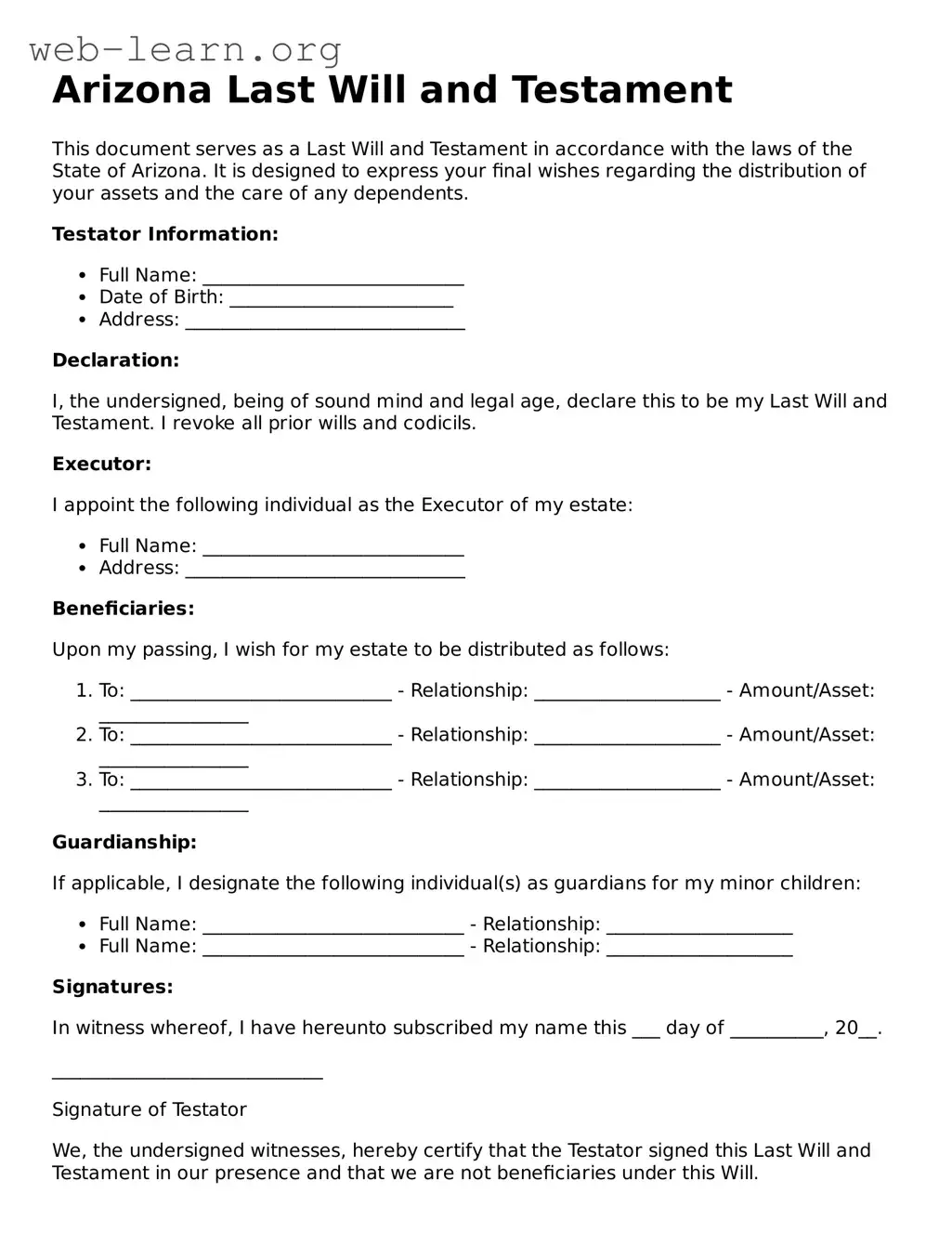
Creating a Last Will and Testament is an essential step for anyone looking to ensure their wishes are honored after their passing. In Arizona, this legal document allows individuals to outline how their assets will be distributed, designate guardians for minor children, and specify final arrangements. The form is straightforward, requiring clear identification of the testator—the person making the will—and the witnesses who will validate the document. It also includes space for detailing specific bequests, which can include personal property, real estate, or financial accounts. Additionally, the Arizona Last Will and Testament form provides an opportunity to name an executor, the individual responsible for carrying out the instructions laid out in the will. Understanding the components of this form is crucial for anyone seeking to navigate the complexities of estate planning effectively.
Arizona Last Will and Testament
This document serves as a Last Will and Testament in accordance with the laws of the State of Arizona. It is designed to express your final wishes regarding the distribution of your assets and the care of any dependents.
Testator Information:
Declaration:
I, the undersigned, being of sound mind and legal age, declare this to be my Last Will and Testament. I revoke all prior wills and codicils.
Executor:
I appoint the following individual as the Executor of my estate:
Beneficiaries:
Upon my passing, I wish for my estate to be distributed as follows:
Guardianship:
If applicable, I designate the following individual(s) as guardians for my minor children:
Signatures:
In witness whereof, I have hereunto subscribed my name this ___ day of __________, 20__.
_____________________________
Signature of Testator
We, the undersigned witnesses, hereby certify that the Testator signed this Last Will and Testament in our presence and that we are not beneficiaries under this Will.
_____________________________
Signature of Witness 1
_____________________________
Signature of Witness 2
| Fact Name | Description |
|---|---|
| Governing Law | The Arizona Last Will and Testament is governed by Arizona Revised Statutes, Title 14, Chapter 2. |
| Age Requirement | In Arizona, you must be at least 18 years old to create a valid will. |
| Witness Requirement | Two witnesses must sign the will for it to be valid, and they should not be beneficiaries. |
| Revocation | A will can be revoked by creating a new will or by physically destroying the original document. |
| Holographic Wills | Arizona recognizes holographic wills, which are handwritten and signed by the testator, without the need for witnesses. |
| Self-Proving Wills | A self-proving will includes a notarized affidavit from the witnesses, simplifying the probate process. |
| Executor Appointment | The will allows you to appoint an executor, who will manage your estate after your passing. |
Once you have gathered your personal information and determined your wishes regarding the distribution of your assets, you can proceed to fill out the Arizona Last Will and Testament form. This process will help ensure that your intentions are clearly documented and legally recognized.
What is a Last Will and Testament?
A Last Will and Testament is a legal document that outlines how a person's assets and affairs should be handled after their death. It specifies who will inherit property, appoints guardians for minor children, and can even name an executor to manage the estate. This document is essential for ensuring that your wishes are honored and can help prevent disputes among heirs.
Why is it important to have a Last Will and Testament in Arizona?
In Arizona, if you die without a will, your assets will be distributed according to state law, which may not align with your wishes. Having a will allows you to designate beneficiaries, choose guardians for your children, and express your preferences clearly. It provides peace of mind and ensures that your loved ones are taken care of according to your wishes.
Who can create a Last Will and Testament in Arizona?
In Arizona, any adult who is at least 18 years old and of sound mind can create a Last Will and Testament. This includes individuals who are residents of Arizona or those who own property in the state. It is crucial that the person creating the will understands the implications of their decisions.
What are the requirements for a valid Last Will and Testament in Arizona?
For a will to be valid in Arizona, it must meet certain requirements:
These requirements help ensure that the will reflects the true intentions of the testator and minimizes the risk of disputes.
Can I change or revoke my Last Will and Testament?
Yes, you can change or revoke your will at any time while you are alive and mentally competent. In Arizona, you can create a new will that explicitly revokes the previous one, or you can make amendments (called codicils) to the existing will. It is advisable to follow legal procedures to avoid confusion or disputes later on.
What happens if I die without a Last Will and Testament?
If you die without a will, Arizona's intestacy laws will dictate how your assets are distributed. Generally, your property will go to your closest relatives, which may not reflect your wishes. Additionally, without a will, you lose the opportunity to appoint guardians for your minor children, which can lead to complications and uncertainty for your family.
How do I ensure my Last Will and Testament is properly executed?
To ensure that your will is properly executed, follow these steps:
Storing your will in a safe place and informing your executor of its location is also essential for its execution.
Can I use an online service to create my Last Will and Testament?
Yes, many online services offer templates and guidance for creating a will. However, it is crucial to ensure that the service complies with Arizona laws. While online tools can be convenient, consulting with an attorney can provide personalized advice and help avoid potential pitfalls.
What should I do after creating my Last Will and Testament?
After creating your will, review it periodically, especially after major life events such as marriage, divorce, or the birth of a child. Inform your executor and trusted family members about the will's location. Finally, keep your will in a safe but accessible place, ensuring it can be easily located when needed.
Creating a Last Will and Testament is an important step in ensuring that one’s wishes are honored after death. However, many individuals make common mistakes when filling out the Arizona Last Will and Testament form. Understanding these pitfalls can help avoid potential issues in the future.
One frequent mistake is failing to properly identify the testator. The testator is the person making the will. It is crucial to include the full legal name and address. Omitting this information can lead to confusion and disputes among heirs.
Another common error is neglecting to name an executor. The executor is responsible for managing the estate and ensuring that the terms of the will are followed. Without a designated executor, the court may appoint someone who may not align with the testator’s wishes.
Many individuals also forget to sign the will in the presence of witnesses. In Arizona, two witnesses are required to validate the will. If this step is overlooked, the will may be considered invalid, leaving the estate to be distributed according to state laws rather than the testator’s wishes.
Additionally, people sometimes fail to date the will. A date is essential for establishing the most recent version of the will. If multiple wills exist, the court may struggle to determine which one is valid if no date is provided.
Another mistake involves not being clear about the distribution of assets. Vague language can lead to misinterpretation and disputes among beneficiaries. It is important to specify what each beneficiary will receive to avoid confusion.
Some individuals also neglect to update their wills after significant life events, such as marriage, divorce, or the birth of a child. Failing to make necessary updates can result in unintended consequences, such as excluding a new spouse or child from the will.
Moreover, people often overlook the importance of including a residuary clause. This clause addresses any assets not specifically mentioned in the will. Without it, any remaining assets may be distributed according to state law rather than the testator's wishes.
Another mistake is not considering the implications of joint ownership. Jointly owned property typically passes to the surviving owner outside of the will. This can lead to confusion if not properly addressed within the will.
Finally, individuals sometimes forget to store the will in a safe and accessible location. A will that cannot be found after the testator’s death will not serve its intended purpose. It is advisable to inform trusted family members or legal representatives about the will’s location.
In summary, avoiding these ten common mistakes can significantly enhance the effectiveness of an Arizona Last Will and Testament. Proper attention to detail ensures that the testator's intentions are honored and that the estate is distributed according to their wishes.
When preparing a Last Will and Testament in Arizona, several other documents may be necessary to ensure that your estate is managed according to your wishes. These documents serve various purposes, from appointing guardians to managing health care decisions. Below is a list of commonly used forms that often accompany a will.
Understanding these documents can help you create a comprehensive estate plan that reflects your wishes and protects your loved ones. Each document plays a vital role in ensuring that your intentions are clearly communicated and legally recognized.
A Last Will and Testament is an important legal document that outlines how a person's assets and affairs should be handled after their death. There are several other documents that share similarities with a Last Will and Testament, each serving specific purposes in estate planning and management. Here are seven documents that are comparable:
Each of these documents plays a vital role in ensuring that an individual's wishes are respected and carried out, providing peace of mind for both the individual and their loved ones.
When filling out the Arizona Last Will and Testament form, it is essential to follow certain guidelines to ensure that your will is valid and reflects your wishes. Here is a list of things you should and shouldn't do:
By following these guidelines, you can help ensure that your Last Will and Testament is properly executed and reflects your intentions.
Understanding the Arizona Last Will and Testament form is essential for anyone looking to plan their estate. However, several misconceptions can lead to confusion and potential issues in the future. Here are eight common misconceptions:
While it is possible to create a will on your own, seeking legal guidance ensures that your will meets all state requirements and accurately reflects your wishes. A professional can help avoid mistakes that could invalidate the document.
In Arizona, a handwritten will, also known as a holographic will, can be valid if it meets specific criteria. However, relying solely on a handwritten document can lead to complications. It's advisable to use a formal template to ensure clarity and compliance.
Every adult should consider having a will, regardless of their financial status. A will provides clarity on how your assets will be distributed and can ease the burden on loved ones during a difficult time.
This is a common misconception. A will can be amended or revoked at any time as long as the person creating it is of sound mind. Regularly reviewing and updating your will is essential to reflect any life changes.
In Arizona, verbal agreements regarding the distribution of assets are not legally binding. A written will is necessary to ensure that your wishes are honored and recognized by the court.
Many people believe that having a will allows them to bypass the probate process. In reality, a will must go through probate, which is the legal process of validating the will and distributing assets. However, certain assets can be structured to avoid probate.
Not all assets need to be listed in a will. For instance, assets held in a trust or those with designated beneficiaries, like life insurance policies and retirement accounts, do not need to be included. It's important to understand how different assets are treated.
A will can also designate guardians for minor children and outline your preferences for medical decisions in case you become incapacitated. This makes it a crucial document for planning not just for death, but for various life circumstances.
Clarifying these misconceptions can empower individuals to make informed decisions about their estate planning. A well-prepared will can provide peace of mind and ensure that your wishes are respected.
When filling out and using the Arizona Last Will and Testament form, keep the following key takeaways in mind:
Colorado Diy Will - Allows individuals to disinherit certain relatives if desired.
How to Make a Will in Arkansas - Serves to minimize disputes among heirs by clearly stating intentions.
Kansas Will - Establish a clear plan for how you want your estate handled after your death.
Free Illinois Will Template - Ensures that your wishes regarding your personal belongings are clear.