In Arizona, families choosing to homeschool their children must navigate specific legal requirements to ensure compliance with state laws. One of the essential steps in this process is the submission of the Homeschool Letter of Intent form. This form serves as a formal notification to the local school district that a parent or guardian intends to educate their child at home. It typically requires basic information such as the child's name, date of birth, and the educational curriculum planned for the year. Parents must also provide their contact information and indicate whether they are homeschooling one child or multiple children. While the process may seem daunting, it is designed to protect the educational rights of families and ensure that children receive a quality education. Understanding the nuances of this form can help parents feel more confident in their decision to homeschool, allowing them to focus on providing a nurturing and effective learning environment for their children.
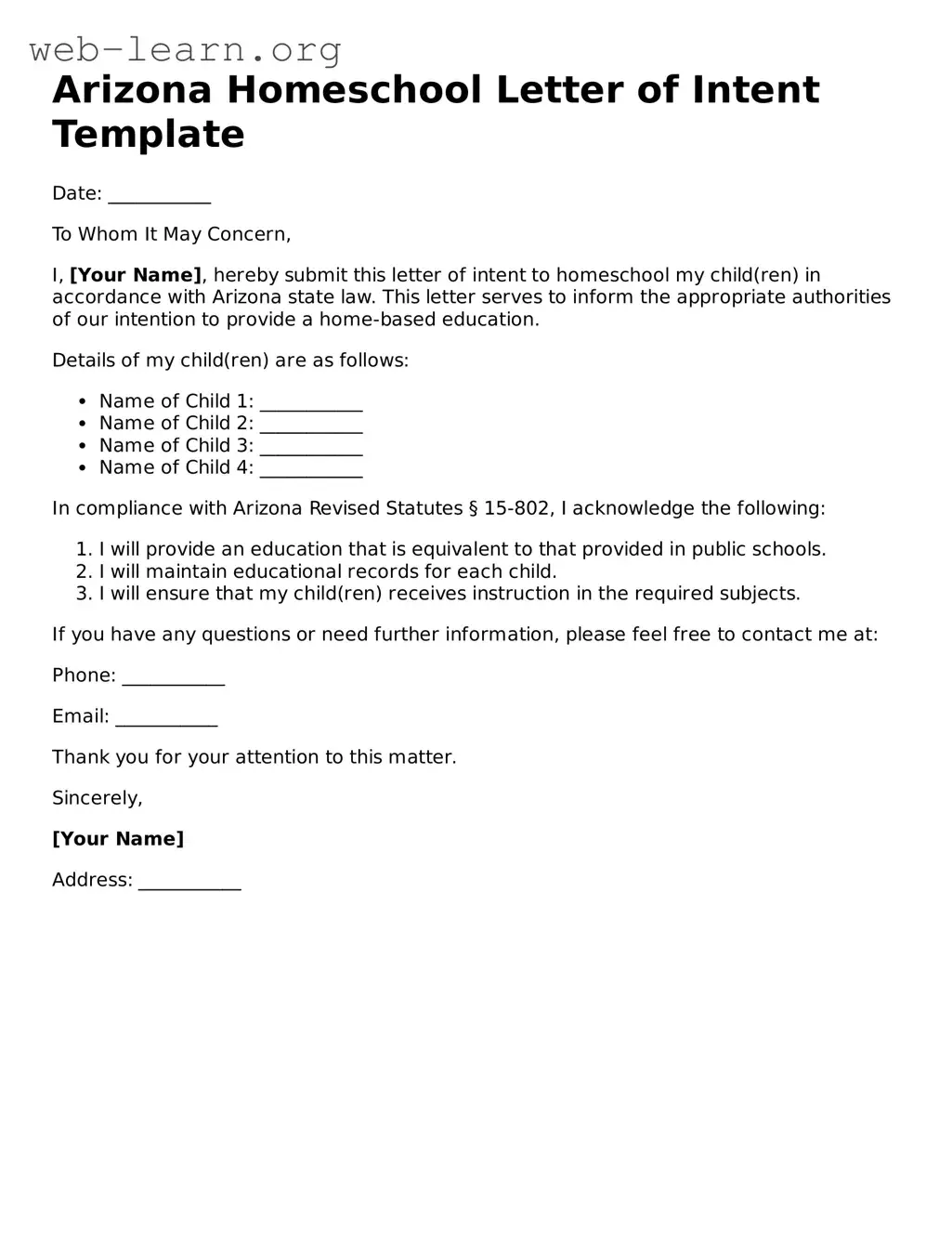
Arizona Homeschool Letter of Intent Template
Date: ___________
To Whom It May Concern,
I, [Your Name], hereby submit this letter of intent to homeschool my child(ren) in accordance with Arizona state law. This letter serves to inform the appropriate authorities of our intention to provide a home-based education.
Details of my child(ren) are as follows:
In compliance with Arizona Revised Statutes § 15-802, I acknowledge the following:
If you have any questions or need further information, please feel free to contact me at:
Phone: ___________
Email: ___________
Thank you for your attention to this matter.
Sincerely,
[Your Name]
Address: ___________
| Fact Name | Details |
|---|---|
| Governing Law | The Arizona Homeschool Letter of Intent is governed by Arizona Revised Statutes § 15-802. |
| Who Must File | Parents or guardians intending to homeschool their children must file this form. |
| Filing Deadline | The form should be submitted within 30 days of beginning to homeschool. |
| Where to Submit | Parents can submit the form to their local school district. |
| Content Requirements | The form must include the names and ages of the children being homeschooled. |
| Notification of Changes | Parents must notify the school district of any changes in their homeschooling status. |
| Record Keeping | While not required to submit, parents should maintain educational records for their homeschooled children. |
| Legal Status | Filing the Letter of Intent establishes the legal status of homeschooling in Arizona. |
| Duration of Intent | The Letter of Intent remains valid as long as the child is homeschooled. |
| Educational Approach | Parents have the flexibility to choose their educational approach, including curriculum and teaching methods. |
Once you have decided to homeschool your child in Arizona, the next step is to complete the Homeschool Letter of Intent form. This form is essential for officially notifying the state of your intention to educate your child at home. After submitting this form, you can begin your homeschooling journey with confidence, knowing that you have taken the necessary steps to comply with state regulations.
What is the Arizona Homeschool Letter of Intent?
The Arizona Homeschool Letter of Intent is a document that parents or guardians submit to their local school district to formally notify them of their decision to homeschool their children. This letter indicates that the parent is taking responsibility for their child's education outside of the traditional public school system.
Who needs to submit the Letter of Intent?
Any parent or guardian who wishes to homeschool their child in Arizona must submit the Letter of Intent. This applies to children who are of compulsory school age, typically between the ages of 6 and 16.
When should I submit the Letter of Intent?
The Letter of Intent should be submitted at the beginning of your homeschooling journey. It is advisable to send it before the start of the school year or as soon as you decide to withdraw your child from public or private school.
What information is required in the Letter of Intent?
The Letter of Intent must include the following information:
Is there a specific format for the Letter of Intent?
While there is no official format mandated by the state, the letter should be clear and concise. It is recommended to include all required information and sign the document to ensure it is valid.
Where do I send the Letter of Intent?
The completed Letter of Intent should be sent to your local school district office. Each district may have different submission processes, so it is wise to check their specific requirements.
What happens after I submit the Letter of Intent?
Once the Letter of Intent is submitted, the school district may acknowledge receipt of your letter. You are not required to wait for a response to begin homeschooling your child. However, it is important to keep a copy of the letter for your records.
Are there any additional requirements after submitting the Letter of Intent?
After submitting the Letter of Intent, you are responsible for providing an educational program that meets Arizona's homeschooling laws. This includes keeping educational records and providing instruction that is equivalent to what is offered in public schools.
Filling out the Arizona Homeschool Letter of Intent form can feel overwhelming, especially for first-time homeschoolers. One common mistake is forgetting to include the required information. This can lead to delays in processing your application. Make sure to provide all necessary details, such as the names and ages of your children.
Another frequent error is not signing the form. A signature is essential to validate your intent to homeschool. Without it, the form may be considered incomplete. Double-check that you’ve signed and dated the document before submission.
Some people overlook the deadline for submitting the Letter of Intent. Arizona law requires this form to be filed within 30 days of starting your homeschool program. Missing this deadline can lead to complications. Keep track of your timeline to ensure compliance.
Inaccurate information is another issue that can arise. When filling out the form, make sure all details are correct. This includes spelling names correctly and providing accurate birthdates. Errors can cause confusion and may require you to resubmit the form.
Many individuals forget to keep a copy of the completed form for their records. It’s important to have documentation of your intent to homeschool. This can be useful for future reference or if any questions arise.
Some parents assume that they only need to submit the form once. However, if you have multiple children or if your situation changes, you may need to update your information. Always stay informed about your obligations regarding the form.
Another mistake is not understanding the implications of the form. The Letter of Intent is not just a formality; it signifies your commitment to homeschooling. Take the time to understand what this means for your family and your educational approach.
Failing to notify the school district can also be a pitfall. Once you submit your Letter of Intent, it’s courteous to inform your local school district. This helps ensure that they are aware of your homeschooling status and can update their records accordingly.
Lastly, some individuals rush through the process without reading the instructions carefully. Each section of the form has specific requirements. Taking the time to read through everything can save you from making unnecessary mistakes.
When families decide to homeschool in Arizona, they often need to complete various forms and documents to ensure compliance with state regulations. While the Homeschool Letter of Intent is a crucial starting point, several other documents can help facilitate a smooth homeschooling experience. Below is a list of commonly used forms that complement the Homeschool Letter of Intent.
By preparing these additional documents, you can create a comprehensive homeschooling plan that meets both your family's needs and state requirements. This organized approach not only supports your child's education but also offers peace of mind as you embark on this rewarding journey.
The Homeschool Letter of Intent form is similar to several other documents that serve specific purposes in educational and legal contexts. Here are six documents that share similarities:
When filling out the Arizona Homeschool Letter of Intent form, it's crucial to follow certain guidelines to ensure a smooth process. Here are seven important dos and don'ts to consider:
By adhering to these guidelines, you can help ensure that your homeschooling journey begins without unnecessary complications.
Here are ten common misconceptions about the Arizona Homeschool Letter of Intent form:
This is not true. Arizona law allows parents to homeschool their children. The Letter of Intent is a way to formally notify the state of your decision to homeschool.
In Arizona, submitting a Letter of Intent is a requirement for homeschooling. It must be filed with the Arizona Department of Education.
While the state provides guidelines, there is no strict format. Parents can write the letter in their own words as long as it includes the necessary information.
This is a misconception. Any child can be homeschooled in Arizona, regardless of their needs or abilities.
Parents can choose to stop homeschooling at any time. The Letter of Intent is not a binding contract.
This is not accurate. Families from various backgrounds and beliefs choose to homeschool for different reasons, including academic flexibility and personalized learning.
In Arizona, parents do not need to have teaching credentials to homeschool their children. The law allows parents to take on this responsibility.
This is a misconception. Many public schools allow homeschooled students to participate in extracurricular activities, such as sports and clubs.
Numerous resources exist for homeschooling families, including online courses, local co-ops, and community support groups.
While some families prefer a structured schedule, homeschooling can be flexible. Parents can tailor the learning experience to fit their child’s needs and family lifestyle.
Filling out the Arizona Homeschool Letter of Intent form is a crucial step for parents wishing to homeschool their children. Here are some key takeaways to keep in mind:
By understanding these key points, parents can navigate the process of filing the Arizona Homeschool Letter of Intent with confidence.
Homeschool Programs Indiana - A way to affirm your rights as a homeschooling parent.
Colorado Homeschool Testing Requirements - Many families find that homeschooling allows for a more hands-on approach to learning.
Do Homeschool Parents Get Paid - Important form to start the homeschooling process legally.
Kansas Home-schooling - Provides a space for any special considerations regarding the child's education.