Homepage Blank Arizona Financial Form
Outline

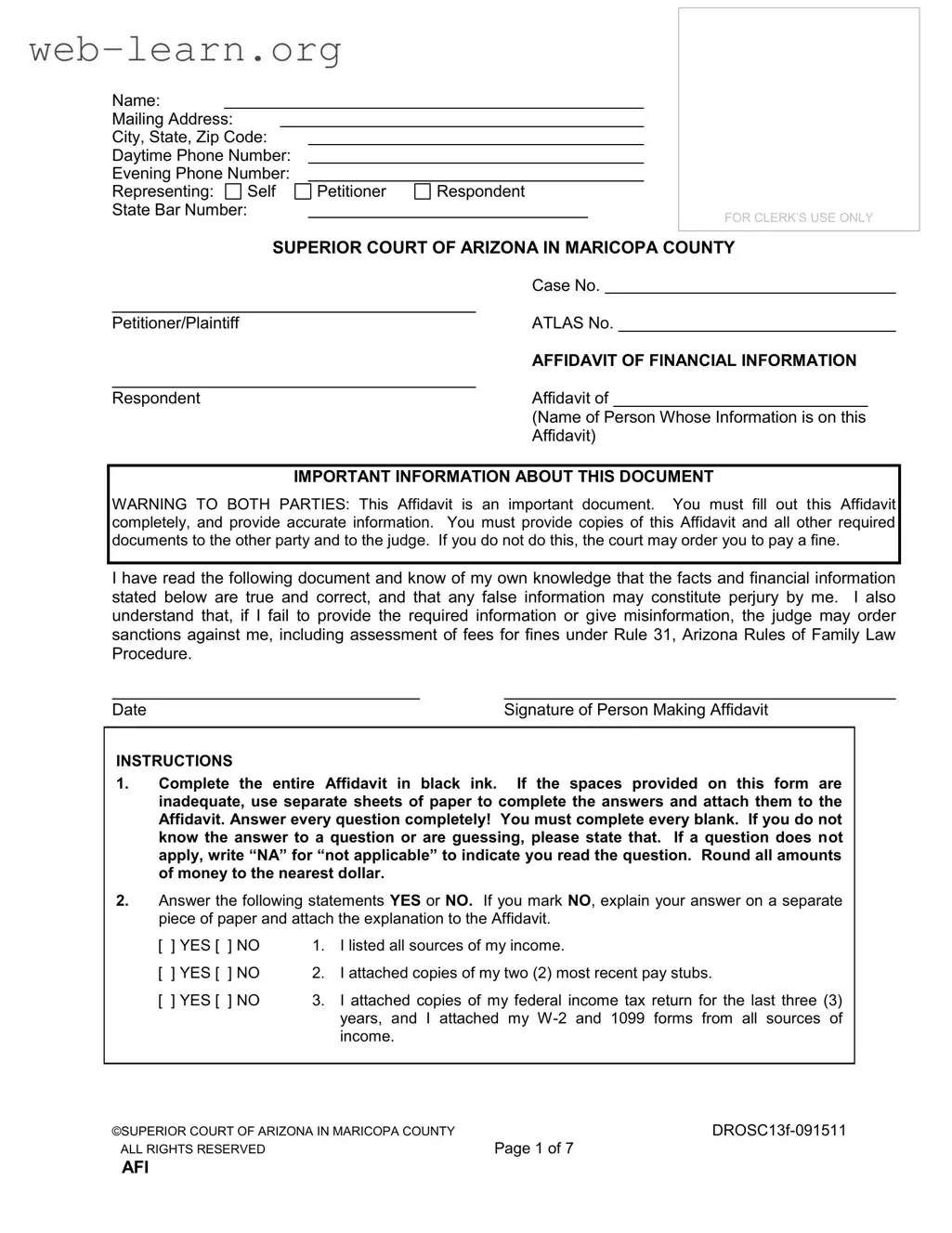
The Arizona Financial form serves as a critical document for individuals navigating legal proceedings in the state, particularly in matters involving family law. This form collects essential financial information from both parties involved in a case, whether they are petitioners or respondents. It requires individuals to provide their personal details, including names, addresses, and contact numbers, along with their relationship to the case at hand. The form emphasizes the importance of accurate and complete information, warning that any discrepancies could lead to serious legal consequences. Participants must disclose their income sources, employment history, and household composition, as well as provide documentation such as recent pay stubs and tax returns. Additionally, the form addresses child support and spousal maintenance, requiring parties to outline their monthly expenses and any court-ordered financial obligations. By ensuring transparency and accountability, the Arizona Financial form plays a vital role in facilitating fair legal outcomes.


Sample - Arizona Financial Form

©SUPERIOR COURT OF ARIZONA IN MARICOPA COUNTY DROSC13f-091511
ALL RIGHTS RESERVED Page 1 of 7
AFI
Name:
Mailing Address:
City, State, Zip Code:
Daytime Phone Number:
Evening Phone Number:
Representing: Self Petitioner Respondent
State Bar Number:
SUPERIOR COURT OF ARIZONA IN MARICOPA COUNTY
Case No.
Petitioner/Plaintiff ATLAS No.
AFFIDAVIT OF FINANCIAL INFORMATION
Respondent Affidavit of
(Name of Person Whose Information is on this
Affidavit)
IMPORTANT INFORMATION ABOUT THIS DOCUMENT
WARNING TO BOTH PARTIES: This Affidavit is an important document. You must fill out this Affidavit
completely, and provide accurate information. You must provide copies of this Affidavit and all other required
documents to the other party and to the judge. If you do not do this, the court may order you to pay a fine.
I have read the following document and know of my own knowledge that the facts and financial information
stated below are true and correct, and that any false information may constitute perjury by me. I also
understand that, if I fail to provide the required information or give misinformation, the judge may order
sanctions against me, including assessment of fees for fines under Rule 31, Arizona Rules of Family Law
Procedure.
Date Signature of Person Making Affidavit
FOR CLERK’S USE ONLY
INSTRUCTIONS
1. Complete the entire Affidavit in black ink. If the spaces provided on this form are
inadequate, use separate sheets of paper to complete the answers and attach them to the
Affidavit. Answer every question completely! You must complete every blank. If you do not
know the answer to a question or are guessing, please state that. If a question does not
apply, write “NA” for “not applicable” to indicate you read the question. Round all amounts
of money to the nearest dollar.
2. Answer the following statements YES or NO. If you mark NO, explain your answer on a separate
piece of paper and attach the explanation to the Affidavit.
[ ] YES [ ] NO 1. I listed all sources of my income.
[ ] YES [ ] NO 2. I attached copies of my two (2) most recent pay stubs.
[ ] YES [ ] NO 3. I attached copies of my federal income tax return for the last three (3)
years, and I attached my W-2 and 1099 forms from all sources of
income.
©SUPERIOR COURT OF ARIZONA IN MARICOPA COUNTY DROSC13f-091511
ALL RIGHTS RESERVED Page 2 of 7
AFI
Case No. _________________
1. GENERAL INFORMATION:
A. Name: Date of Birth:
B. Current Address:
C. Date of Marriage: Date of Divorce:
D. Last date when you and the other party lived together:
E. Full names of child(ren) common to the parties (in this case), their dates of birth:
Name Date of Birth
F. The name, date of birth, relationship to you, and gross monthly income for each individual who
lives in your household:
Name Date of Birth Relationship to you Income
G. Any other person for whom you contribute support:
Name Age Relationship Reside With Court Order to
to You You (Y/N) Support (Y/N)
H. Attorney’s Fees paid in this matter $ . Source of funds
2. EMPLOYMENT INFORMATION:
A. Your job/occupation/profession/title:
Name and address of current employer:
Date employment began:
How often are you paid: [ ] Weekly [ ] Every other week [ ] Monthly [ ] Twice a month
[ ] Other
B. If you are not working, why not?
C. Previous employer name and address:
Previous job/occupation/profession/title:
Date previous job began: Date previous job ended:
Reason you left job:
Gross monthly pay at previous job: $
D. Total gross income from last three (3) years’ tax returns (attach copies of pages 1 and 2 of your
federal income tax returns for the last three (3) years):
Year $ Year $ Year $
E. Your total gross income from January 1 of this year to the date of this Affidavit (year-to-date
income): $
©SUPERIOR COURT OF ARIZONA IN MARICOPA COUNTY DROSC13f-091511
ALL RIGHTS RESERVED Page 3 of 7
AFI
Case No.
3. YOUR EDUCATION/TRAINING: List name of school, length of time there, year of last attendance,
and degree earned:
A. High School:
B. College:
C. Post-Graduate:
D. Occupational Training:
4. YOUR GROSS MONTHLY INCOME:
List all income you receive from any source, whether private or governmental, taxable or not.
List all income payable to you individually or payable jointly to you and your spouse.
Use a monthly average for items that vary from month to month.
Multiply weekly income and deductions by 4.33. Multiply biweekly income by 2.165 to arrive at
the total amount for the month.
A. Gross salary/wages per month $
Attach copies of your two most recent pay stubs.
Rate of Pay $ per [ ] hour [ ] week [ ] month [ ] year
B. Expenses paid for by your employer:
1. Automobile $
2. Auto expenses, such as gas, repairs, insurance $
3. Lodging $
4. Other (Explain) $
C. Commissions/Bonuses $
D. Tips $
E. Self-employment Income (See below) $
F. Social Security benefits $
G. Worker's compensation and/or disability income $
H. Unemployment compensation $
I. Gifts/Prizes $
J. Payments from prior spouse $
K. Rental income (net after expenses) $
L. Contributions to household living expense by others $
M. Other (Explain:) $
(Include dividends, pensions, interest, trust income, annuities
or royalties.)
TOTAL: $
5. SELF-EMPLOYMENT INCOME (if applicable):
If you are self-employed, attach of a copy of the Schedule C for your business from your last tax
return and the most recent income/expense statement from your business.
If self employed, provide the following information:
Name, address and telephone no. of business:
Type of business entity:
State and Date of incorporation:
Nature of your interest:
Nature of business:
Percent ownership:
Number of shares of stock:
©SUPERIOR COURT OF ARIZONA IN MARICOPA COUNTY DROSC13f-091511
ALL RIGHTS RESERVED Page 4 of 7
AFI
Case No.
Total issued and outstanding shares:
Gross sales/revenue last 12 months:
6. SCHEDULE OF ALL MONTHLY EXPENSES FOR CHILDREN:
DO NOT LIST any expenses for the other party, or child(ren) who live(s) with the other party,
unless you are paying those expenses.
Use a monthly average for items that vary from month to month.
If you are listing anticipated expenses, indicate this by putting an asterisk (*) next to the
estimated amount.
A. HEALTH INSURANCE:
Do you have health insurance available? Yes
No Are you enrolled?_________
1. Total monthly cost $
2. Premium cost to insure you alone $
3. Premium cost to insure child(ren) common to the parties $
4. List all people covered by your insurance coverage:
5. Name of insurance company and Policy/Group Number:
B. DENTAL/VISION INSURANCE:
1. Total monthly cost $
2. Premium cost to insure you alone $
3. Premium cost to insure child(ren) common to the parties $
4. List all people covered by your insurance coverage:
5. Name of insurance company and Policy/Group Number:
C. UNREIMBURSED MEDICAL AND DENTAL EXPENSES:
(Cost to you after, or in addition to, any insurance reimbursement)
1. Drugs and medical supplies $
2. Other $
TOTAL: $
D. CHILD CARE COSTS:
1. Total monthly child care costs $
(Do not include amounts paid by D.E.S.)
2. Name(s) of child(ren) cared for and amount per child:
$
$
$
INSTRUCTIONS
Both parties must answer item 6 if either party asks for child support. These expenses include only those
expenses for children who are common to the parties, which means one party is the birth/adoptive mother and
the other is the birth/adoptive father of the children.
©SUPERIOR COURT OF ARIZONA IN MARICOPA COUNTY DROSC13f-091511
ALL RIGHTS RESERVED Page 5 of 7
AFI
Case No.
3. Name(s) and address(es) of child care provider(s):
E. EMPLOYER PRETAX PROGRAM:
Do you participate in an employer program for pretax payment of child care expenses?
(Cafeteria Plan)? [ ] YES [ ] NO
F. COURT ORDERED CHILD SUPPORT:
1. Court ordered current child support for child(ren)
not common to the parties $
2. Court ordered cash medical support for child(ren)
not common to the parties $
3. Amount of any arrears payment $
4. Amount per month actually paid in last 12 mos. $
Attach proof that you are paying
5. Name(s) and relationship of minor child(ren) who you support
or who live with you, but are not common to the parties.
G. COURT ORDERED SPOUSAL MAINTENANCE/SUPPORT (Alimony):
1. Court ordered spousal maintenance/support you actually
pay to previous spouse: $
H. EXTRAORDINARY EXPENSES :
1. For Children (Educational Expense/Special Needs/Other): $
Explain:
2. For Self: $
Explain:
7. SCHEDULE OF ALL MONTHLY EXPENSES:
Do NOT list any expenses for the other party, or children who live with the other party unless
you are paying those expenses.
Use a monthly average for items that vary from month to month.
If you are listing anticipated expenses, indicate this by putting an asterisk (*) next to the
estimated amount.
INSTRUCTIONS
Both parties must answer items 7 and 8 if either party is requesting:
Spousal maintenance
Division of expenses
Attorneys’ fees and costs
Adjustment or deviation from the child support amount
Enforcement
©SUPERIOR COURT OF ARIZONA IN MARICOPA COUNTY DROSC13f-091511
ALL RIGHTS RESERVED Page 6 of 7
AFI
Case No.
A. HOUSING EXPENSES:
1. House payment:
a. First Mortgage $
b. Second Mortgage $
c. Homeowners Association Fee $
d. Rent $
2. Repair & upkeep $
3. Yard work/Pool/Pest Control $
4. Insurance & taxes not included in house payment $
5. Other (Explain) $
TOTAL: $
B. UTILITIES:
1. Water, sewer, and garbage $
2. Electricity $
3. Gas $
4. Telephone $
5. Mobile phone/pager $
6. Internet Provider $
7. Cable/Satellite television $
8. Other (Explain:) $
TOTAL: $
C. FOOD:
1. Food, milk, and household supplies $
2. School lunches $
3. Meals outside home $
TOTAL: $
D. CLOTHING:
1. Clothing for you $
2. Uniforms or special work clothes $
3. Clothing for children living with you $
4. Laundry and cleaning $
TOTAL: $
E. TRANSPORTATION OR AUTOMOBILE EXPENSES:
1. Car insurance $
2. List all cars and individuals covered:
3. Car payment, if any $
4. Car repair and maintenance $
5. Gas and oil $
6. Bus fare/parking fees $
7. Other (explain): $
TOTAL: $
F. MISCELLANEOUS:
1. School and school supplies $
2. School activities or fees $
3. Extracurricular activities of child(ren) $
©SUPERIOR COURT OF ARIZONA IN MARICOPA COUNTY DROSC13f-091511
ALL RIGHTS RESERVED Page 7 of 7
AFI
Case No.
4. Church/contributions $
5. Newspapers, magazines and books $
6. Barber and beauty shop $
7. Life insurance (beneficiary: ) $
8. Disability insurance $
9. Recreation/entertainment $
10. Child(ren)'s allowance(s) $
11. Union/Professional dues $
12. Voluntary retirement contributions and savings deductions $
13. Family gifts $
14. Pet Expenses $
15. Cigarettes $
16. Alcohol $
17. Other (explain): $
TOTAL: $
8. OUTSTANDING DEBTS AND ACCOUNTS: List all debts and installment payments you currently
owe, but do not include items listed in Item 7 “Monthly Schedule of Expenses”. Follow the format
below. Use additional paper if necessary.
Creditor Name
Purpose of Debt
Unpaid
Balance
Min.
Monthly
Payment
Amount of
Your
Payment

Form Information

Fact Name Fact Description
Form Purpose The Arizona Financial Form is used to provide a comprehensive overview of an individual's financial situation in legal proceedings.
Governing Law This form is governed by the Arizona Rules of Family Law Procedure, specifically Rule 31.
Required Information Individuals must provide accurate personal and financial details, including income, expenses, and assets.
Signature Requirement The affidavit must be signed by the person providing the financial information, affirming its accuracy under penalty of perjury.
Submission Process Completed forms must be shared with both the opposing party and the court to ensure transparency in the legal process.
Consequences of Inaccuracy Failure to provide truthful information can lead to fines or sanctions imposed by the court.
Format Requirements The affidavit must be filled out in black ink, and if more space is needed, additional sheets can be attached.

Detailed Guide for Filling Out Arizona Financial

Filling out the Arizona Financial form is an essential step in your legal process. It requires careful attention to detail and accuracy. Once you have completed the form, you will need to provide copies to the other party involved and to the judge. This ensures that everyone has the necessary information to move forward in the case.

  1. Gather necessary information: Collect all relevant financial documents, including pay stubs, tax returns, and any other income sources.
  2. Complete the Affidavit: Use black ink to fill out the entire form. If you run out of space, attach separate sheets as needed.
  3. Answer all questions: Make sure to respond to every question completely. If you do not know an answer, indicate that. For questions that do not apply, write “NA.”
  4. List your income sources: Clearly indicate all sources of income and round amounts to the nearest dollar.
  5. Provide employment information: Fill in details about your current and previous employment, including job titles, employer names, and income amounts.
  6. Detail your education: Include information about your schooling, such as the names of institutions attended and degrees earned.
  7. Calculate monthly expenses: List all monthly expenses, particularly those related to children, and provide averages where applicable.
  8. Review your answers: Double-check all information for accuracy and completeness before signing the affidavit.
  9. Sign and date the affidavit: Ensure that you sign the document, affirming that the information provided is true to the best of your knowledge.
  10. Make copies: Create copies of the completed form and any attached documents for the other party and the court.

Obtain Answers on Arizona Financial

  1. What is the purpose of the Arizona Financial form?

    The Arizona Financial form is designed to provide the court with a comprehensive overview of your financial situation. It helps determine issues like child support, spousal maintenance, and the division of expenses. This form must be filled out accurately and completely to ensure fair consideration in court proceedings.

  2. Who needs to complete the Arizona Financial form?

    Both parties involved in a family law case, such as divorce or child custody, are required to complete this form. Whether you are the petitioner or the respondent, providing this information is essential for the court's understanding of your financial circumstances.

  3. What happens if I don't provide accurate information on the form?

    Providing false information on the Arizona Financial form can lead to serious consequences, including potential fines or sanctions from the court. It is crucial to ensure that all information is truthful and complete, as inaccuracies may be considered perjury.

  4. How should I fill out the form?

    Use black ink to complete the form, and ensure every section is filled out. If a question does not apply to you, write "NA" to indicate that you have read the question. If you need more space, feel free to attach additional sheets. Remember to round all monetary amounts to the nearest dollar.

  5. What types of income should I report?

    Report all sources of income, whether they are taxable or not. This includes wages, bonuses, self-employment income, social security benefits, and any other income that contributes to your financial situation. Be thorough to provide a complete picture of your finances.

  6. Do I need to provide documentation with the form?

    Yes, you must attach supporting documents such as your two most recent pay stubs and your federal income tax returns for the last three years. This documentation helps verify the information you provide in the form.

  7. What if I am self-employed?

    If you are self-employed, you will need to include additional information about your business. Attach your Schedule C from your last tax return and provide the most recent income/expense statement from your business. This ensures the court has a clear understanding of your financial situation.

  8. How do I report monthly expenses for children?

    When reporting monthly expenses for children, focus only on those common to both parties. List all relevant costs, such as health insurance, child care, and any court-ordered child support. Be sure to provide average monthly amounts and indicate any anticipated expenses with an asterisk.

  9. What if I have questions while filling out the form?

    If you have questions or need assistance while completing the Arizona Financial form, consider seeking help from a legal professional or a family law clinic. They can provide guidance to ensure you fill out the form correctly and understand your obligations.

  10. Where do I submit the completed form?

    Once you have completed the Arizona Financial form, you must submit it to the court along with any required supporting documents. Be sure to provide copies to the other party involved in the case, as required by law. This ensures that everyone has access to the same information.

Common mistakes

Filling out the Arizona Financial form can be a daunting task, and mistakes can lead to complications in your case. One common error is failing to provide complete information. Every section of the form must be filled out thoroughly. If a question does not apply to you, simply write “NA” to show that you have read the question. Leaving blanks can raise red flags and may result in the court requesting additional information, which can delay your proceedings.

Another frequent mistake is not rounding amounts correctly. The instructions specify that all monetary figures should be rounded to the nearest dollar. Failing to do this can lead to discrepancies in your reported income and expenses. These discrepancies may not only confuse the court but could also impact any financial decisions made regarding your case.

Additionally, some individuals forget to attach necessary documentation. The form requires copies of recent pay stubs, tax returns, and other financial documents. Without these attachments, your affidavit may be deemed incomplete. This oversight can lead to delays and may require you to resubmit your paperwork, causing unnecessary stress.

Another mistake involves misrepresenting income sources. It’s crucial to list all sources of income accurately. If you mark “NO” on the income question, you must provide an explanation. Misrepresentation can lead to serious consequences, including sanctions for perjury. Always ensure that you provide truthful and complete information.

People also often neglect to sign and date the affidavit. This step is essential, as the signature confirms that you understand the importance of the document and the accuracy of the information provided. An unsigned affidavit may be rejected outright, further complicating your case.

Lastly, failing to communicate with the other party can lead to problems. The form requires that copies of the affidavit be shared with the other party and the judge. Not doing so can result in fines and other penalties. Clear communication helps ensure that all parties are on the same page, which can facilitate a smoother legal process.

Documents used along the form

The Arizona Financial form is a critical document used in family law cases, particularly for disclosing financial information in divorce or child support proceedings. Alongside this form, several other documents may be required to provide a comprehensive view of an individual's financial situation. Below is a list of commonly associated forms and documents.

  • Affidavit of Support: This document outlines the financial support one party provides to another, often used in cases involving spousal or child support. It details income, expenses, and any other financial obligations.
  • Income Verification Documents: These may include recent pay stubs, tax returns, and W-2 forms. They serve to verify the income reported on the financial affidavit and provide evidence of financial stability or need.
  • Child Support Worksheet: This worksheet calculates the expected child support payments based on the income of both parents and the needs of the child. It helps the court determine fair support amounts.
  • Expense Declaration: This document lists all monthly expenses incurred by an individual, including housing, utilities, and childcare. It provides the court with a clear picture of financial obligations.
  • Financial Disclosure Statement: This statement requires a detailed account of all assets and liabilities. It helps ensure transparency in financial matters during divorce proceedings.
  • Tax Returns: Providing copies of the last few years of tax returns is often necessary. They give insight into an individual’s income and financial history.
  • Property Valuation Documents: If there are assets such as real estate involved, documentation that assesses the value of these properties may be required. This helps in the equitable distribution of assets.
  • Proof of Payments: This includes receipts or bank statements showing payments made for child support or spousal maintenance. Such documentation is crucial for verifying compliance with court orders.

Collectively, these documents create a clearer financial picture for the court, ensuring that decisions regarding support and division of assets are fair and informed. Properly preparing and submitting these forms can significantly impact the outcome of a case.

Similar forms

The Arizona Financial form shares similarities with several other important documents used in legal and financial contexts. Here’s a list of those documents and how they relate to the Arizona Financial form:

  • Affidavit of Support: Like the Arizona Financial form, this affidavit requires individuals to provide detailed financial information to demonstrate their ability to support someone, often in immigration cases.
  • Financial Disclosure Statement: This document is similar in that it requires parties to disclose their financial situation, including income, expenses, and assets, typically used in divorce proceedings.
  • Income Verification Form: This form serves to verify an individual's income, much like the Arizona Financial form, which asks for detailed income information from various sources.
  • Child Support Worksheet: This worksheet helps calculate child support obligations and requires similar financial disclosures as the Arizona Financial form, focusing on income and expenses.
  • Spousal Support Application: Individuals seeking spousal support must provide financial details, akin to the requirements of the Arizona Financial form.
  • Bankruptcy Petition: In bankruptcy cases, individuals must disclose their financial status, including debts and income, paralleling the comprehensive financial information required by the Arizona Financial form.
  • Loan Application: When applying for a loan, applicants must provide financial documentation to assess their ability to repay, similar to the income and expense disclosures on the Arizona Financial form.
  • Tax Return: Tax returns provide a detailed account of an individual's income, much like the financial disclosures required in the Arizona Financial form.
  • Budget Sheet: A budget sheet outlines monthly income and expenses, reflecting the financial breakdown required in the Arizona Financial form.

Dos and Don'ts

When filling out the Arizona Financial form, it is essential to approach the task with care and attention. Here are four important do's and don'ts to keep in mind:

  • Do complete the entire Affidavit in black ink. Ensure that every section is filled out accurately.
  • Do provide copies of your two most recent pay stubs and tax returns. This documentation is crucial for verifying your financial information.
  • Do be honest and thorough in your responses. If you do not know the answer to a question, it is better to indicate that than to leave it blank.
  • Do review your completed form before submission. Double-check for any errors or omissions to avoid potential complications.
  • Don't guess or provide inaccurate information. Doing so could lead to serious consequences, including sanctions from the court.
  • Don't forget to sign the Affidavit. Your signature attests to the truthfulness of the information provided.
  • Don't include expenses related to the other party or their children unless you are responsible for those expenses.
  • Don't submit the form without attaching all required documents. Missing paperwork can delay your case.

Misconceptions

Misconceptions about the Arizona Financial form can lead to confusion and mistakes in the legal process. Here are nine common misconceptions along with clarifications to help you better understand this important document.

  • It’s optional to complete the form. Many believe that filling out the Arizona Financial form is optional. In reality, it is a crucial document that must be completed accurately and submitted to the court and the other party.
  • Only one party needs to file the form. Some think that only one party in a case needs to provide financial information. However, both parties are required to submit their own forms to ensure transparency and fairness.
  • Providing inaccurate information is not a big deal. Many underestimate the importance of accuracy. Providing false information can lead to serious consequences, including perjury charges and potential fines.
  • All financial information is private. While you may feel that your financial details are private, the information provided in this form is generally accessible to both parties and the court. Transparency is essential in legal proceedings.
  • Only income needs to be reported. Some individuals think they only need to list their income. In fact, the form requires you to disclose all sources of income, assets, and liabilities to give a complete financial picture.
  • It’s acceptable to leave blanks if unsure. Leaving blanks can lead to complications. If you don’t know the answer to a question, it’s better to indicate that rather than leaving it blank. Use “NA” for questions that do not apply to you.
  • Past financial information is irrelevant. Some believe that only current financial status matters. However, the form requires you to provide information from the past three years to give context to your current situation.
  • You can submit the form without supporting documents. This is a common misconception. You must attach necessary supporting documents, such as pay stubs and tax returns, to substantiate the information provided in the form.
  • It’s okay to estimate financial figures. While some think rough estimates are acceptable, it’s important to provide precise figures. Round amounts to the nearest dollar and ensure that all calculations are accurate.

Understanding these misconceptions can help you navigate the Arizona Financial form more effectively. Completing this document accurately is essential for the court to make informed decisions regarding your case.

Key takeaways

Key Takeaways for Filling Out the Arizona Financial Form:

  • Ensure all sections of the form are completed using black ink. If more space is needed, attach additional sheets.
  • Provide accurate financial information. Incomplete or incorrect submissions may lead to fines or sanctions.
  • Include all necessary documents, such as recent pay stubs and tax returns, to support your financial claims.
  • Clearly indicate "NA" for questions that do not apply to you and answer every question honestly, even if unsure.