Homepage Blank Arizona Estate Form
Outline

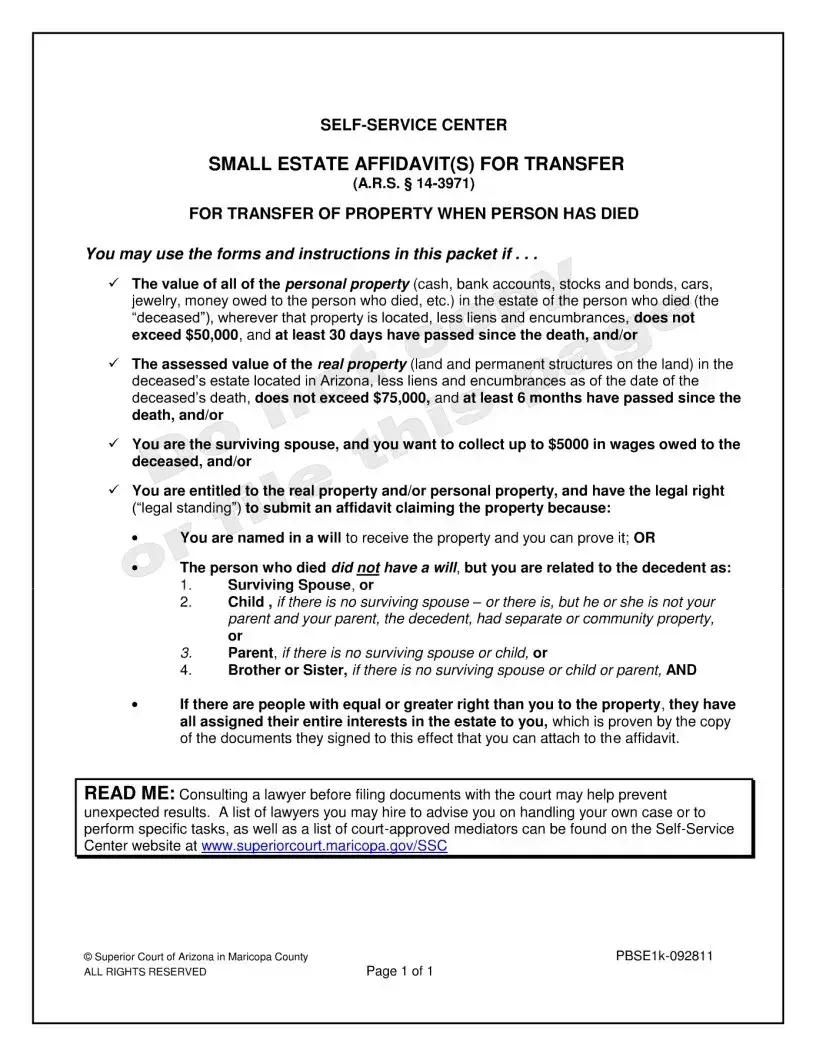
When a loved one passes away, navigating the complexities of their estate can feel overwhelming. In Arizona, the Small Estate Affidavit serves as a streamlined process for transferring property without the need for formal probate proceedings, provided certain conditions are met. This form is particularly useful when the total value of personal property—such as cash, bank accounts, and vehicles—does not exceed $50,000, or when real property is assessed at less than $75,000. Additionally, it allows surviving spouses to collect up to $5,000 in wages owed to the deceased. To utilize this affidavit, at least 30 days must have elapsed since the death, or six months for real property. Importantly, the person filing the affidavit must have a legal right to the property, either through a will or by being a close relative, such as a spouse, child, parent, or sibling. The process requires careful documentation, including proof of entitlement and any necessary signatures from individuals with equal or greater claims to the estate. By understanding the requirements and procedures outlined in the Arizona Small Estate Affidavit, individuals can more effectively manage the transfer of their loved one’s assets during a challenging time.
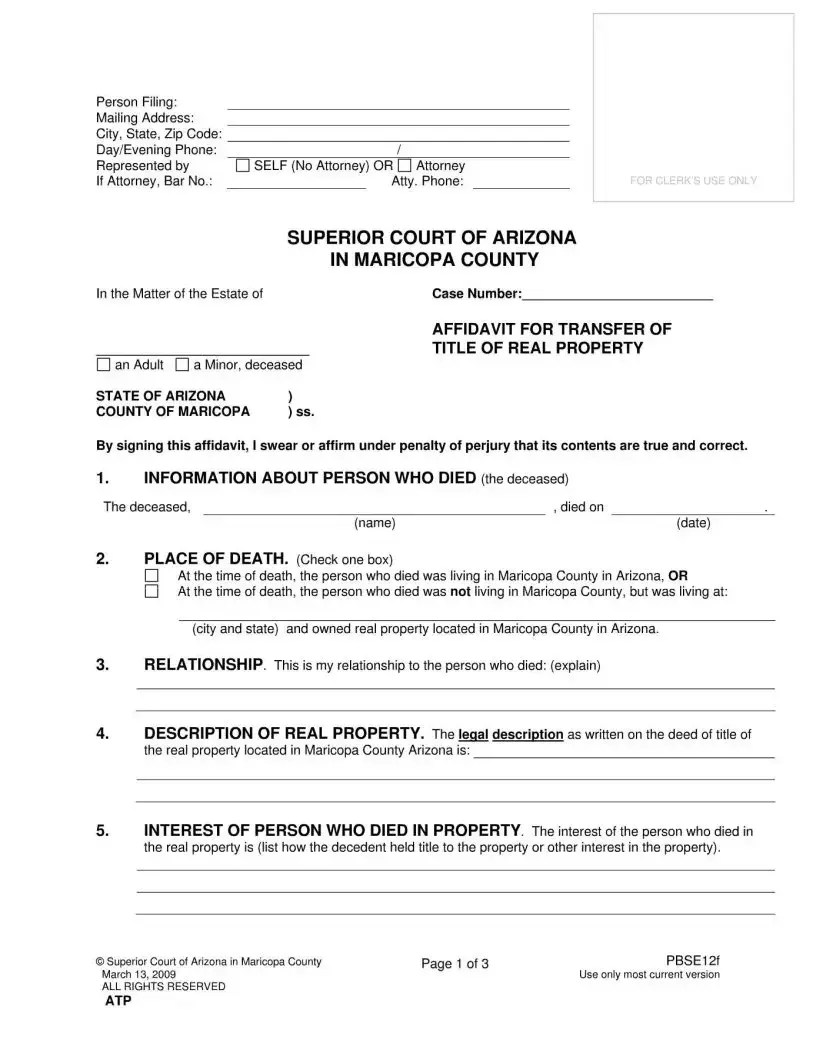
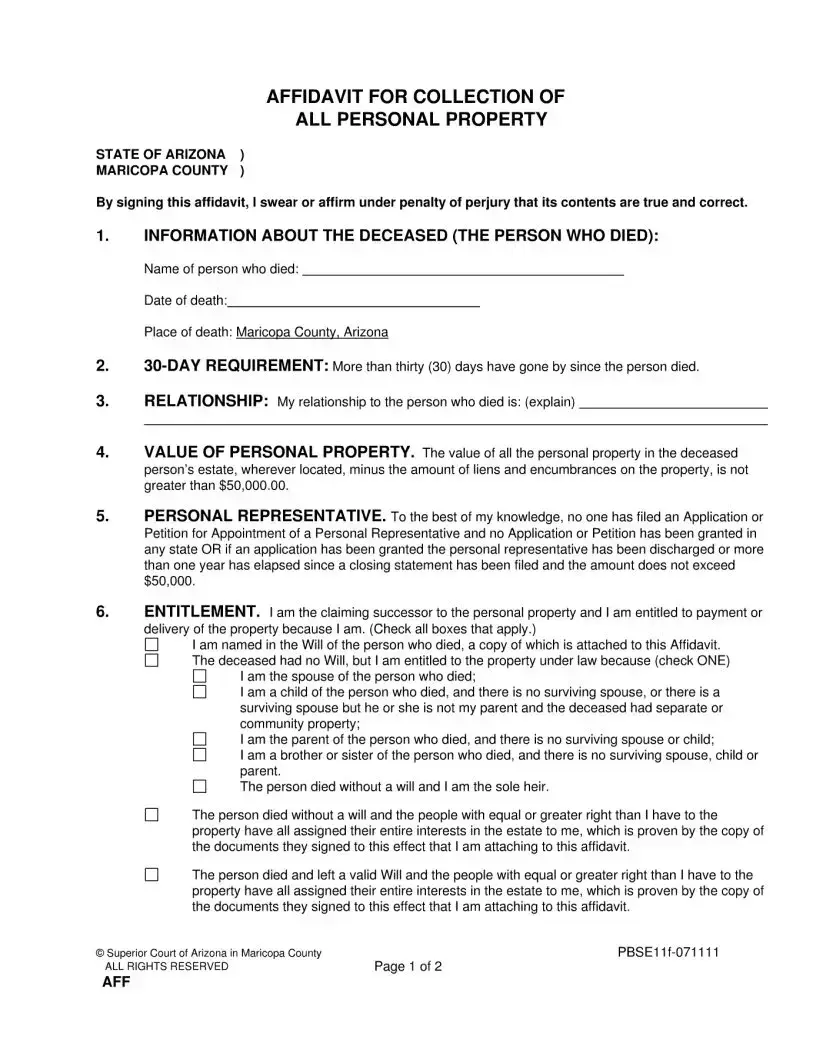
Sample - Arizona Estate Form

Form Information

Fact Name Details
Governing Law The Small Estate Affidavit is governed by A.R.S. § 14-3971.
Eligibility Criteria The total value of personal property must not exceed $50,000.
Time Requirement At least 30 days must pass since the death of the individual.
Real Property Limit The assessed value of real property must not exceed $75,000.
Surviving Spouse A surviving spouse can claim up to $5,000 in wages owed to the deceased.
Legal Standing Claimants must have legal standing to submit the affidavit.
Proof of Relationship Claimants must prove their relationship to the deceased, either through a will or by law.
Assignment of Interests If others have equal rights, they must assign their interests to the claimant.
Consultation Recommendation Consulting a lawyer before filing may help avoid unexpected outcomes.

Detailed Guide for Filling Out Arizona Estate

Filling out the Arizona Estate form is an important step in the process of transferring property after someone has passed away. This guide will help you navigate through the necessary steps to complete the Small Estate Affidavit. Ensure you have all required information and documents ready before you begin.

  1. Gather necessary documents, including the deceased's will (if applicable), proof of relationship, and any documents showing the assignment of interests from others with equal or greater rights.
  2. Open the Small Estate Affidavit form and read through the instructions carefully to understand what information is required.
  3. In the section for INFORMATION ABOUT THE DECEASED, fill in the name, date of death, and place of death of the person who has died.
  4. Confirm that more than thirty (30) days have passed since the death. You may need to check the date on the death certificate.
  5. Indicate your relationship to the deceased in the designated space. Be clear and concise in your explanation.
  6. Assess the total value of the personal property in the estate. Ensure this amount, minus any liens or encumbrances, does not exceed $50,000.
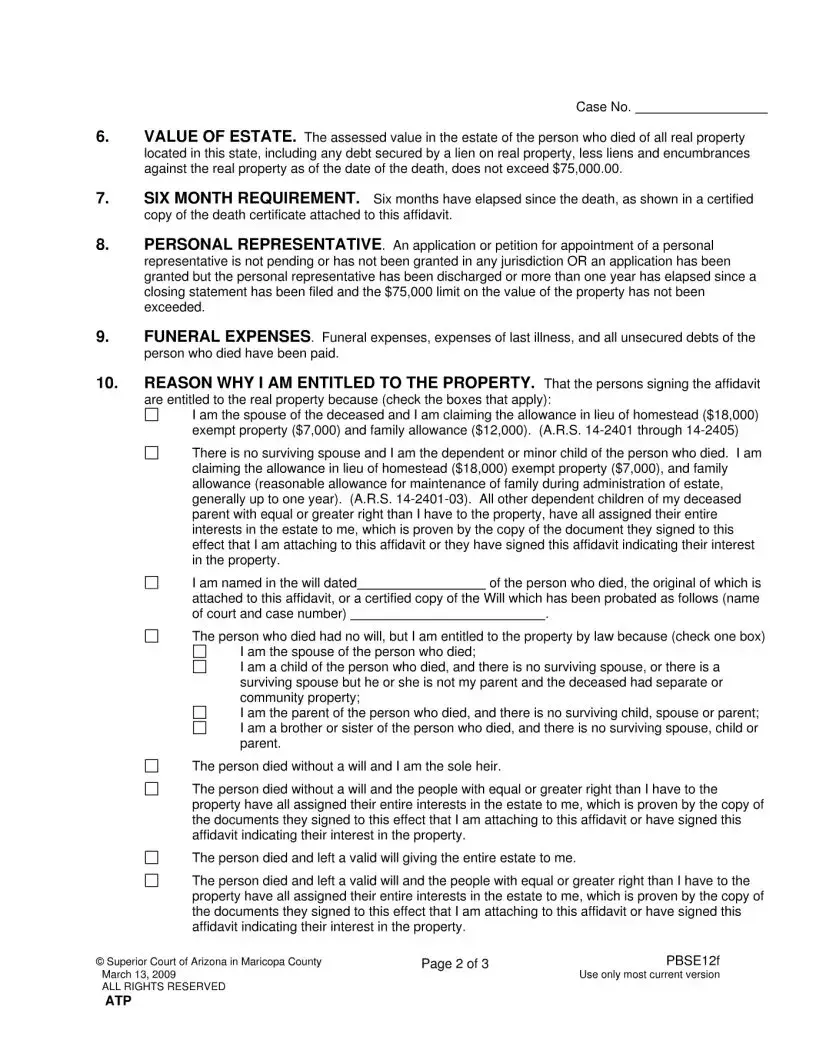
  7. In the section titled PERSONAL REPRESENTATIVE, confirm whether any applications for a personal representative have been filed. Check the appropriate box based on your situation.
  8. In the ENTITLEMENT section, check all boxes that apply to your claim to the property. Provide any necessary explanations or attach additional documents as needed.
  9. Review the completed form for accuracy. Ensure all required fields are filled in and that you have attached any necessary documents.
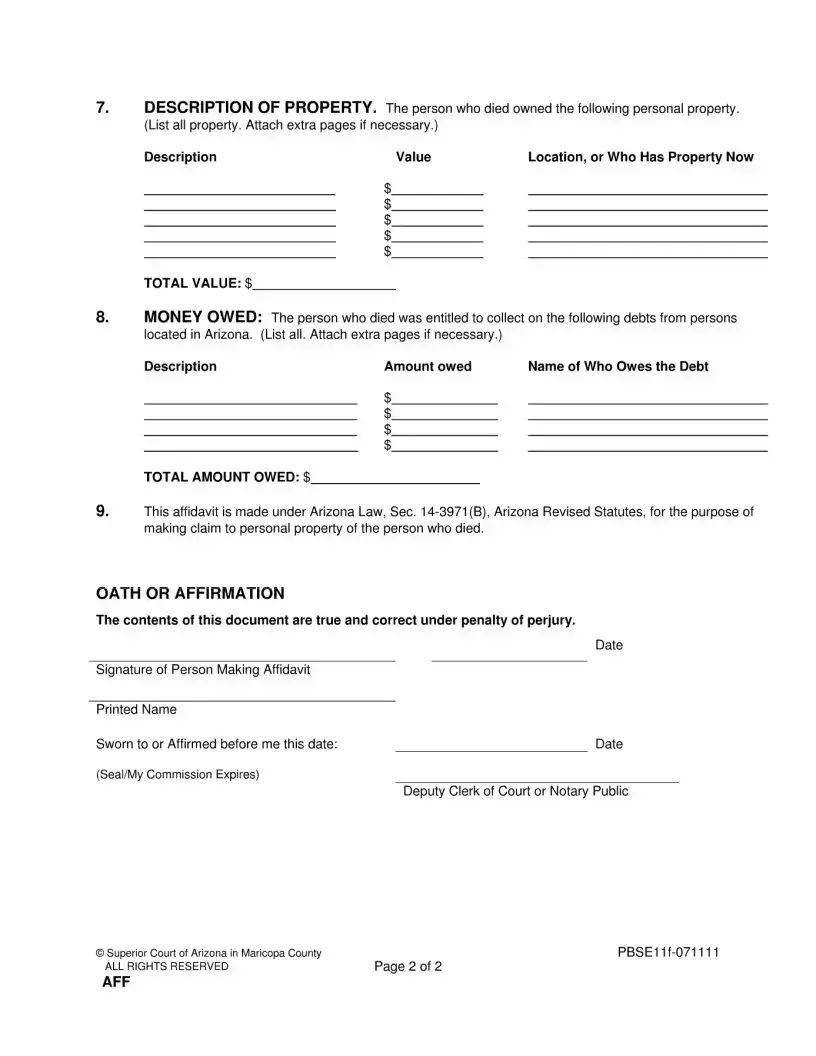
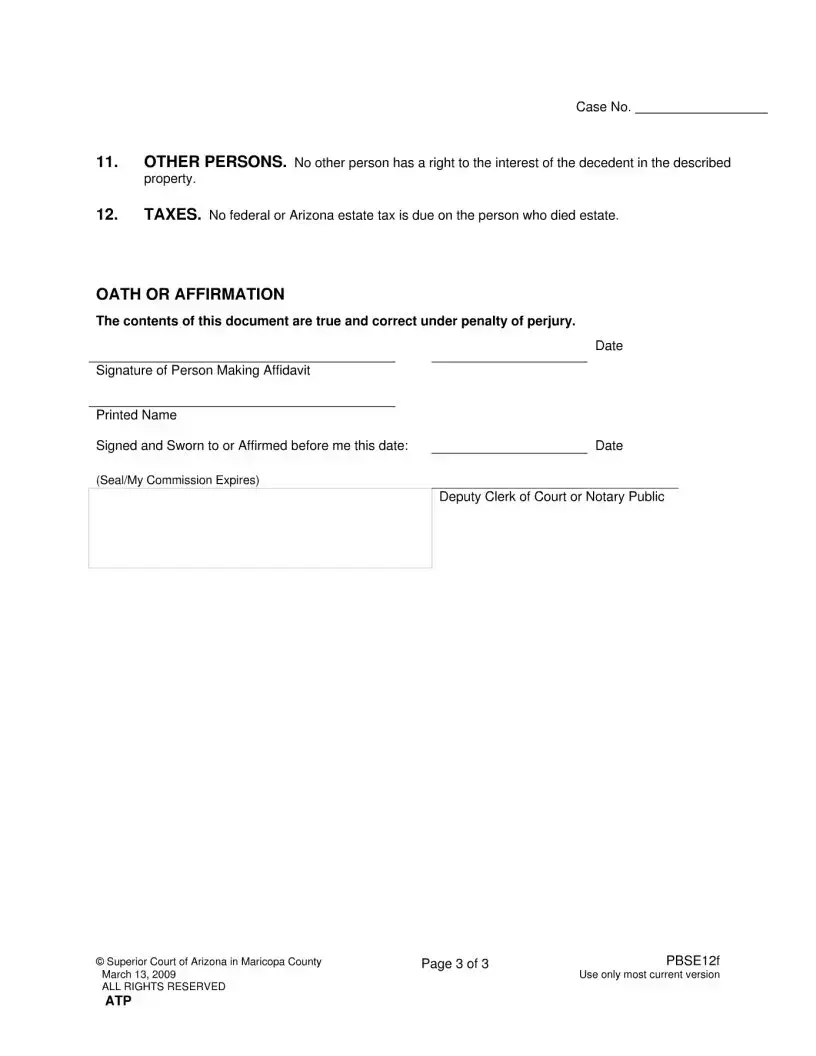
  10. Sign and date the affidavit, affirming that the contents are true and correct under penalty of perjury.

Once you have completed the form, you may need to file it with the appropriate court. Be sure to follow any additional procedures outlined in the instructions provided with the form. This may include submitting additional documents or paying a filing fee. Always keep copies of everything for your records.

Obtain Answers on Arizona Estate

  1. What is the Small Estate Affidavit?

    The Small Estate Affidavit is a legal document used in Arizona to transfer property from a deceased person’s estate when the total value of the estate is below a certain threshold. This affidavit allows heirs or beneficiaries to claim property without going through a full probate process.

  2. What are the eligibility requirements for using the Small Estate Affidavit?

    To use the Small Estate Affidavit, the following conditions must be met:

    • The total value of personal property must not exceed $50,000.
    • At least 30 days must have passed since the person's death.
    • If claiming real property, its assessed value must not exceed $75,000, and at least 6 months must have passed since the death.
    • The claimant must have legal standing, such as being named in a will or being a close relative of the deceased.
  3. Who can use the Small Estate Affidavit?

    Eligible individuals include:

    • The surviving spouse.
    • Children of the deceased, if there is no surviving spouse.
    • Parents, siblings, or other close relatives if there are no children or spouse.
  4. What documents are needed to file the Small Estate Affidavit?

    When filing, you will need to provide:

    • A completed Small Estate Affidavit form.
    • Proof of your relationship to the deceased, such as a birth certificate or marriage certificate.
    • A copy of the will, if applicable.
    • Any documents proving that other potential claimants have assigned their interests to you.
  5. What happens after filing the Small Estate Affidavit?

    After filing, the court will review your documents. If everything is in order, you will receive a court order that allows you to collect or transfer the property. It's important to keep copies of all documents for your records.

  6. Can I consult a lawyer before filing the affidavit?

    Yes, it is highly recommended to consult a lawyer before filing any documents. Legal advice can help ensure that you understand the process and avoid potential issues.

  7. Where can I find more information about the Small Estate Affidavit?

    For more details, you can visit the Superior Court of Arizona's Self-Service Center website. This site provides resources, forms, and additional guidance for individuals navigating the estate transfer process.

Common mistakes

Filling out the Arizona Estate form can be straightforward, but many make common mistakes that can lead to delays or complications. One frequent error is failing to meet the 30-day requirement. The form requires that at least 30 days have passed since the death of the deceased. If this requirement is not met, the affidavit cannot be processed.

Another mistake is not accurately assessing the value of personal property. The total value of all personal property must not exceed $50,000. Many individuals underestimate or overestimate the value, which can result in rejection of the affidavit. It’s essential to provide a precise evaluation of all assets.

Many people also overlook the importance of clearly stating their relationship to the deceased. This section is crucial, as it establishes legal standing. If the relationship is not explained properly, the court may question the validity of the claim.

Inadequate documentation is another common issue. Applicants often forget to attach necessary supporting documents, such as a will or evidence of entitlement. These documents are vital to substantiate claims and must be included with the affidavit.

Some individuals mistakenly believe that a personal representative is not required if they have not filed an application. However, the form requires an affirmation that no application has been filed or that the representative has been discharged. Omitting this information can lead to complications.

Another error involves the selection of the appropriate checkboxes regarding entitlement to the property. It’s important to check all applicable boxes. Failing to do so can create confusion and delay the process.

Many applicants also neglect to provide complete and accurate information about the deceased, such as the name, date, and place of death. This information must be correct and thorough to avoid any issues with processing the affidavit.

Additionally, some people do not keep a copy of the completed affidavit for their records. This can be problematic if questions arise later regarding the submission. Always retain a copy for personal reference.

Lastly, individuals often ignore the recommendation to consult with a lawyer. While it’s not mandatory, seeking legal advice can help clarify any uncertainties and ensure that the form is filled out correctly. Taking this step may save time and prevent potential issues down the road.

Documents used along the form

When dealing with the passing of a loved one, several important documents may accompany the Arizona Estate form to ensure a smooth transition of assets. Each of these forms serves a specific purpose and helps clarify the legal process involved in estate management. Below is a list of commonly used documents that you may encounter.

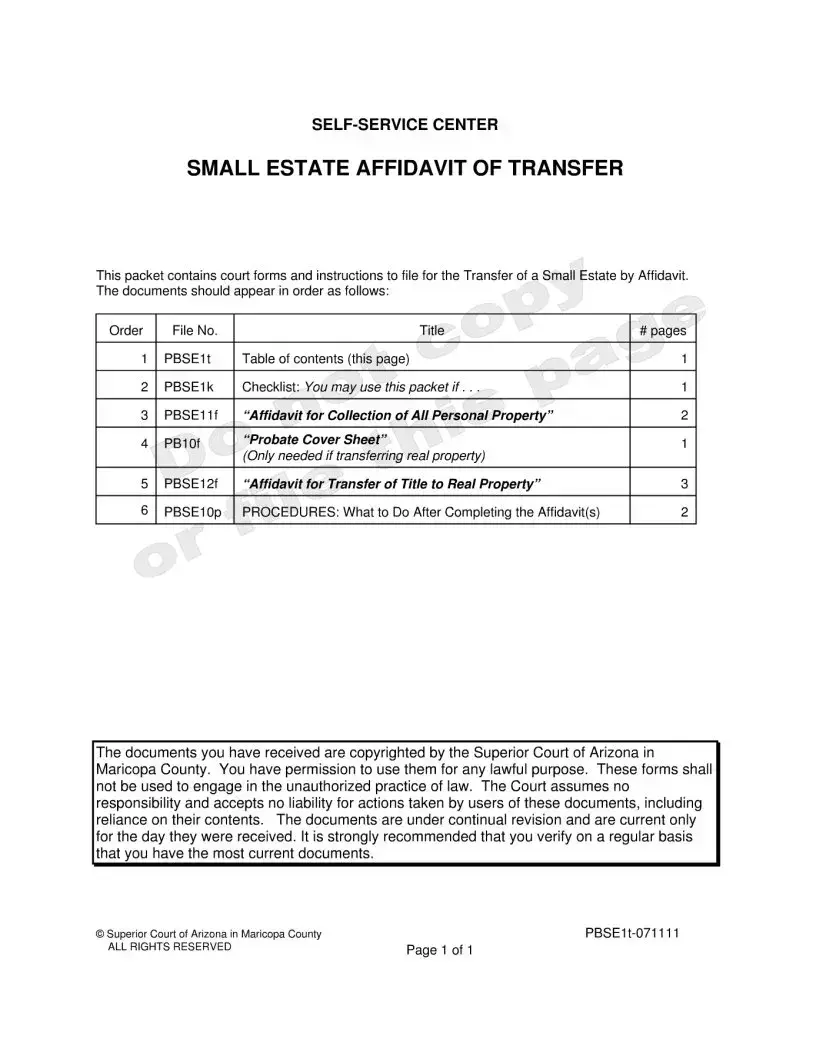
  • Small Estate Affidavit: This form allows heirs to claim the deceased's personal property without going through a lengthy probate process, provided the estate meets certain value limits.
  • Affidavit for Collection of All Personal Property: This document is used to affirm the claimant's right to collect personal property from the estate, confirming the value is within the small estate limits.
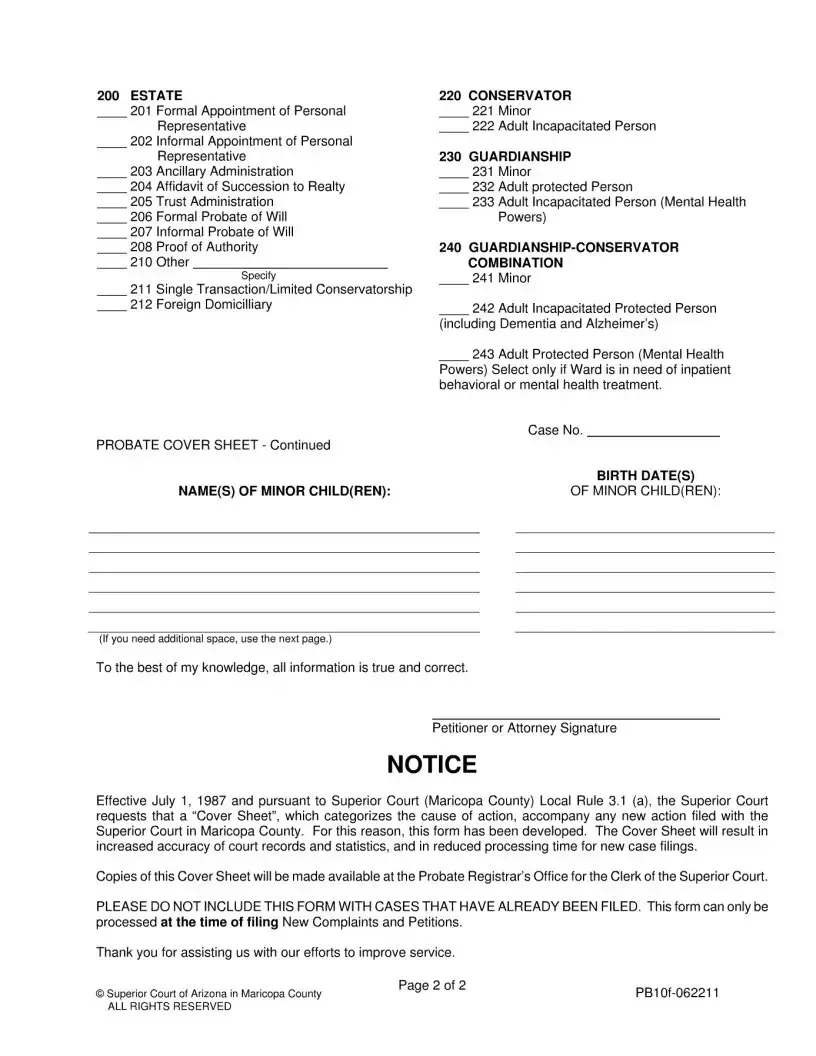
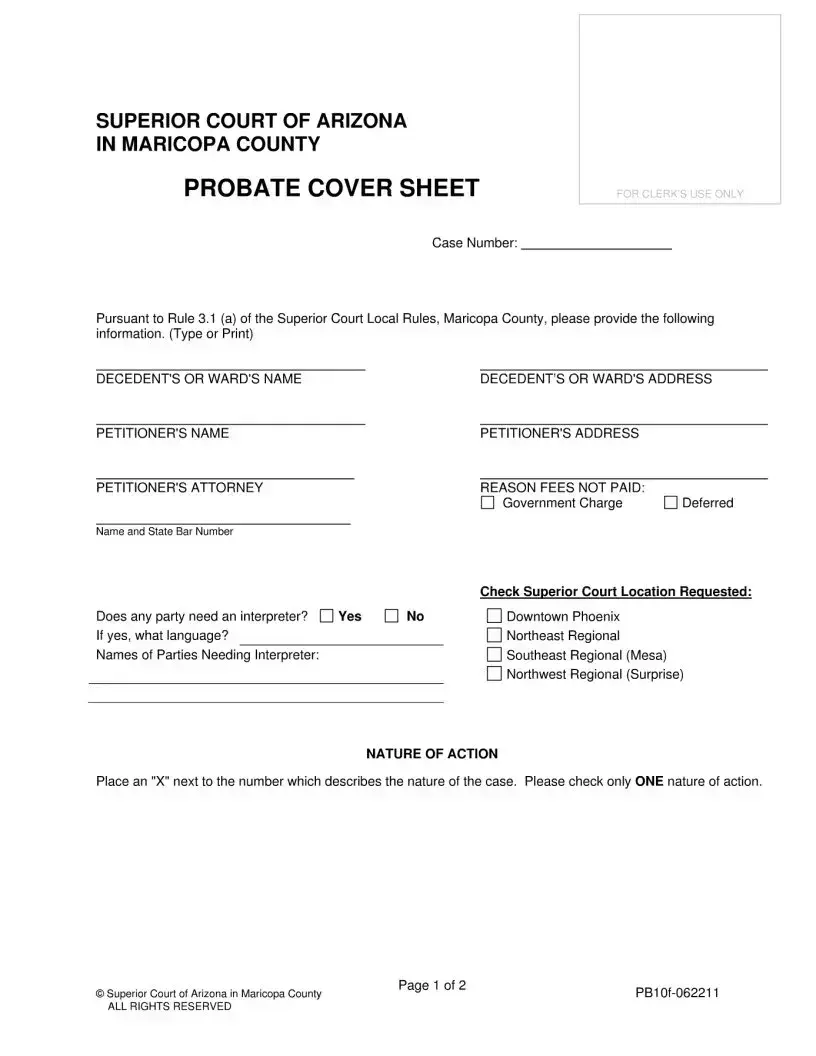
  • Probate Cover Sheet: Required when transferring real property, this form provides essential information to the court regarding the probate case.
  • Affidavit for Transfer of Title to Real Property: This affidavit is necessary to transfer ownership of real estate from the deceased to the rightful heir or beneficiary.
  • Procedures: What to Do After Completing the Affidavit(s): This document outlines the steps to follow after completing the affidavits, ensuring that all legal requirements are met.

Understanding these documents can greatly assist you in navigating the estate process. It is advisable to consult with a legal professional if you have questions or need guidance specific to your situation.

Similar forms

The Arizona Estate form, specifically the Small Estate Affidavit, shares similarities with several other legal documents used in estate management and property transfer. Below is a list detailing these documents and how they relate to the Arizona Estate form.

  • Affidavit of Heirship: This document establishes the identity of the heirs of a deceased person and their right to inherit property. Like the Small Estate Affidavit, it is used when the decedent did not leave a will, allowing heirs to claim their inheritance.
  • Last Will and Testament: A will outlines how a person's assets should be distributed after their death. The Small Estate Affidavit can be used by heirs named in a will to claim property without going through probate, provided certain conditions are met.
  • Probate Petition: This document initiates the probate process, where a court oversees the distribution of a deceased person's estate. The Small Estate Affidavit serves as a simpler alternative for smaller estates, bypassing the lengthy probate process.
  • Transfer on Death Deed: This deed allows individuals to transfer real property to beneficiaries upon death without probate. Similar to the Small Estate Affidavit, it simplifies the transfer process for property ownership.
  • Small Estate Affidavit in Other States: Many states have their own versions of the Small Estate Affidavit, allowing heirs to claim property without probate. The general principles and requirements are often similar across jurisdictions.
  • Declaration of Trust: This document outlines the management of assets held in trust and can facilitate the transfer of property upon death. Like the Small Estate Affidavit, it can avoid probate for assets held in the trust.
  • Claim of Exemption: This document is used to claim certain assets as exempt from creditors. It is similar to the Small Estate Affidavit in that it protects specific property from being used to settle debts of the deceased.
  • Affidavit for Collection of Personal Property: This document is specifically designed for collecting personal property of a deceased individual. It is closely related to the Small Estate Affidavit as both serve to facilitate the transfer of property without formal probate proceedings.

Understanding these documents can help individuals navigate the complexities of estate management and ensure a smoother transition of assets after a loved one’s passing.

Dos and Don'ts

When filling out the Arizona Estate form, there are important guidelines to follow to ensure a smooth process. Here is a list of things you should and shouldn't do:

  • Do verify that the total value of personal property does not exceed $50,000.
  • Do ensure at least 30 days have passed since the person's death before submitting the affidavit.
  • Do confirm your relationship to the deceased is accurately described in the form.
  • Do attach any necessary documents that prove your entitlement to the property.
  • Don't forget to check if there is a will, as this can affect your claim.
  • Don't submit the form without reviewing it for accuracy and completeness.

Following these guidelines can help avoid complications and ensure that the process of transferring the estate is handled correctly.

Misconceptions

Here are seven common misconceptions about the Arizona Estate form:

  1. Only large estates can use the Small Estate Affidavit. Many people think this form is only for estates with significant assets. In reality, it can be used for estates with personal property valued at $50,000 or less.
  2. All heirs must agree to use the Small Estate Affidavit. Some believe that every heir must consent to this process. However, only those with equal or greater rights to the property need to assign their interests to you.
  3. You need a lawyer to file the Small Estate Affidavit. While consulting a lawyer can be helpful, it's not required. The forms are designed for self-service, allowing individuals to file on their own.
  4. The Small Estate Affidavit can be used immediately after death. Many think they can file right away. The law requires that at least 30 days pass after the death before filing for personal property.
  5. The form is only for personal property. Some people assume it can't be used for real property. In fact, it can also apply to real estate, as long as the assessed value is under $75,000.
  6. All debts must be paid before using the Small Estate Affidavit. It’s a common belief that all debts of the deceased must be settled first. However, you can still use the affidavit if the total value of the estate falls within the limits.
  7. You must have a will to use the Small Estate Affidavit. This is not true. Even if the deceased did not leave a will, eligible heirs can still file using the affidavit.

Key takeaways

When dealing with the Arizona Estate form, particularly the Small Estate Affidavit, there are several important points to keep in mind. Understanding these can streamline the process and ensure compliance with state laws.

  • Eligibility Criteria: You can use the Small Estate Affidavit if the total value of personal property does not exceed $50,000, and at least 30 days have passed since the death. Alternatively, if the assessed value of real property is under $75,000 and six months have elapsed since the death, you may also qualify.
  • Relationship to the Deceased: Your relationship to the deceased plays a crucial role. You must demonstrate your legal right to claim the property, whether through a will or by being a close relative, such as a spouse, child, or sibling.
  • Documentation Requirements: When filing the affidavit, ensure you include any necessary documents, such as a copy of the will or signed statements from others with equal rights to the property. This documentation supports your claim and facilitates the transfer process.
  • Consulting Legal Help: While you can file the affidavit on your own, consulting with a lawyer is advisable. Legal guidance can help you navigate potential pitfalls and ensure that all documents are correctly filled out and submitted.

By keeping these key takeaways in mind, you can approach the process with greater confidence and clarity.