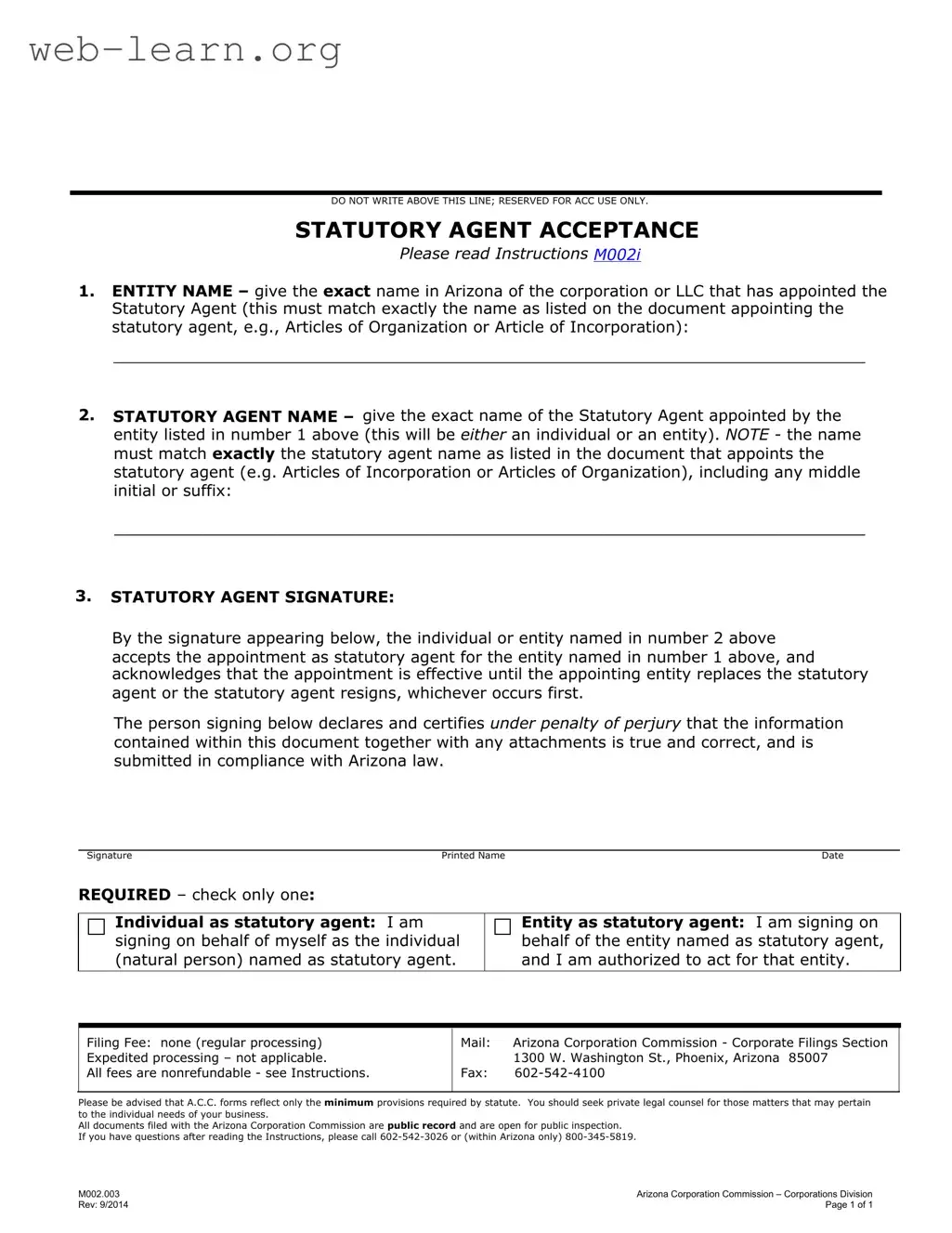
When forming a corporation or limited liability company (LLC) in Arizona, one crucial step involves appointing a statutory agent. This agent acts as a designated representative for your business, receiving legal documents and official communications on behalf of the entity. The Arizona Agent form is essential for this process, as it outlines the necessary information required to formalize the appointment. The form requires the exact name of the corporation or LLC, ensuring it matches the name listed in the founding documents, such as the Articles of Organization or Articles of Incorporation. Additionally, it asks for the name of the statutory agent, which can be an individual or another entity, and this name must also align with the corresponding documents. The signature of the statutory agent is a vital component, signifying acceptance of the role and acknowledging that the appointment remains effective until either the agent resigns or is replaced by the business. This form is straightforward, with no filing fee for regular processing, but it is important to remember that all submitted documents become public records. Understanding these elements can help streamline your business formation process and ensure compliance with Arizona law.

| Fact Name | Details |
|---|---|
| Governing Law | The Arizona Agent form is governed by Arizona Revised Statutes (ARS) Title 10, Chapter 29. |
| Entity Name Requirement | The form requires the exact name of the corporation or LLC as registered in Arizona. |
| Statutory Agent Name | The appointed statutory agent's name must match the name on the document that appoints them. |
| Signature Requirement | The statutory agent must sign the form to accept the appointment officially. |
| Appointment Duration | The appointment remains effective until the entity replaces the statutory agent or the agent resigns. |
| Public Record | All documents filed with the Arizona Corporation Commission are public records and can be inspected by the public. |
| Filing Fee | No filing fee is required for regular processing of the form. |
| Legal Counsel Recommendation | It is advised to seek private legal counsel for specific business needs beyond the minimum statutory requirements. |
Completing the Arizona Agent form is a straightforward process that requires careful attention to detail. Ensure that all information provided matches the documents appointing the statutory agent. Follow these steps closely to fill out the form correctly.
Once the form is filled out, double-check all entries for accuracy. After submission, the document will become part of the public record, and you may wish to retain a copy for your records. If any questions arise during the process, contact the Arizona Corporation Commission for assistance.
What is the purpose of the Arizona Agent form?
The Arizona Agent form is used to appoint a statutory agent for a corporation or LLC in Arizona. The statutory agent is responsible for receiving legal documents on behalf of the entity. This ensures that the business can be reached for any legal matters.
Who can be a statutory agent in Arizona?
A statutory agent can be either an individual or an entity. The agent must have a physical address in Arizona and must be available during regular business hours to receive legal documents.
What information is required on the form?
The form requires the following information:
Is there a filing fee for the Arizona Agent form?
There is no filing fee for regular processing of the Arizona Agent form. However, all fees are nonrefundable. Expedited processing is not applicable for this form.
How long is the appointment of a statutory agent valid?
The appointment remains effective until the entity replaces the statutory agent or the statutory agent resigns. This ensures that there is always a designated person or entity to receive legal documents.
Can the statutory agent resign?
Yes, the statutory agent can resign. If this occurs, the entity must appoint a new statutory agent to ensure compliance with Arizona law.
Are the documents filed with the Arizona Corporation Commission public records?
Yes, all documents filed with the Arizona Corporation Commission are public records. They are open for public inspection, meaning anyone can access this information.
What should I do if I have questions about the form?
If you have questions after reading the instructions, you can call the Arizona Corporation Commission at 602-542-3026 or 800-345-5819 (within Arizona only). They can provide assistance with any concerns you may have.
What happens if the information provided on the form is incorrect?
Providing incorrect information can lead to legal complications. The person signing the form certifies that the information is true and correct under penalty of perjury. It is crucial to ensure accuracy before submission.
Do I need legal counsel to complete the Arizona Agent form?
While it is not required, it is advisable to seek private legal counsel for matters that pertain to the individual needs of your business. Legal professionals can provide guidance tailored to your specific situation.
Filling out the Arizona Agent form can seem straightforward, but many people make common mistakes that can lead to delays or complications. One of the most frequent errors is failing to provide the exact entity name. This name must match precisely with what is listed in the official documents, such as the Articles of Organization or Articles of Incorporation. Even a minor discrepancy, like an omitted word or a typo, can result in the rejection of the form.
Another common mistake involves the statutory agent name. Just as with the entity name, this must be the exact name as it appears in the appointing documents. If the statutory agent has a middle initial or a suffix, such as “Jr.” or “LLC,” it’s crucial to include those details. Omitting them can cause unnecessary complications.
Many individuals overlook the importance of the signature. The person signing the form must be the same individual or representative listed as the statutory agent. If someone else signs on behalf of the agent without proper authorization, it can invalidate the appointment.
Completing the date section is another area where mistakes frequently occur. Failing to date the form can lead to confusion about when the appointment becomes effective. It’s essential to provide the date clearly and accurately.
Some individuals mistakenly check the wrong box when indicating whether they are signing as an individual or on behalf of an entity. This choice is critical, as it clarifies the capacity in which the signer is acting. An incorrect selection can lead to questions about the validity of the appointment.
Furthermore, many people neglect to read the instructions carefully. Each section of the form has specific requirements, and overlooking these can lead to incomplete submissions. Taking the time to understand the instructions can prevent errors that might delay processing.
Another mistake is assuming that the form is confidential. It’s important to remember that all documents filed with the Arizona Corporation Commission are public records. This means that any information provided will be accessible to the public, so it’s vital to ensure that all details are accurate and appropriate.
Some individuals fail to consider the implications of the filing fee. While the regular processing fee is none, it’s essential to be aware that all fees are nonrefundable. If the form is rejected due to errors, the filing fee will not be returned.
Lastly, many people do not seek legal counsel when necessary. The Arizona Agent form only covers the minimum requirements, and specific business needs may require additional legal considerations. Consulting with a lawyer can help ensure that all aspects of the appointment are properly addressed.
When appointing a statutory agent in Arizona, several other forms and documents may accompany the Arizona Agent form. Each of these documents plays a vital role in the overall process of establishing a business entity and ensuring compliance with state regulations.
Understanding these accompanying documents can help ensure that the process of establishing a business in Arizona goes smoothly. Each form serves a specific purpose, contributing to the legal framework that supports the operation of your business entity.
The Arizona Agent form serves a specific purpose in the realm of business formation and management. However, several other documents share similarities in function and intent. Here are five documents that are comparable to the Arizona Agent form:
When filling out the Arizona Agent form, it is important to follow certain guidelines to ensure accuracy and compliance. Below is a list of things to do and avoid during this process.
Adhering to these guidelines can help facilitate a smooth filing process with the Arizona Corporation Commission.
Understanding the Arizona Agent form is crucial for anyone involved in setting up a corporation or LLC in the state. However, several misconceptions can lead to confusion. Here are four common myths surrounding this form:
Many believe that any person can serve as a statutory agent. In reality, the agent must be a resident of Arizona or an entity authorized to conduct business in the state. This ensures that there is a reliable point of contact for legal documents.
Some think that the name of the statutory agent can be flexible. However, the name must match exactly as it appears in the appointing documents, such as the Articles of Organization or Articles of Incorporation. Any discrepancies can lead to legal complications.
It's a common belief that failing to maintain a statutory agent is inconsequential. In fact, if a business does not have an active statutory agent, it may face penalties, including the potential for losing its good standing status with the state.
Some people think that the role of a statutory agent is not important and can be overlooked. This is misleading. The statutory agent is responsible for receiving important legal documents and notifications. Ignoring this role can lead to missed opportunities to respond to legal actions or other significant communications.
When filling out and using the Arizona Agent form, it is important to understand several key aspects. Here are some essential takeaways:
Understanding these points can help ensure that the form is completed accurately and effectively, minimizing the risk of delays or issues in the processing of your statutory agent appointment.