Homepage Blank Arizona 600A Form
Outline

The Arizona 600A form is a crucial document for individuals seeking to reclaim unclaimed property in the state. Designed specifically for original owners, this form facilitates the process of claiming assets that may have been forgotten or lost over time. To initiate a claim, individuals must provide essential information such as their name, Social Security number, and a brief description of the property they are seeking. The form also requires a physical signature and may need to be notarized, ensuring the authenticity of the claim. It is important to read the accompanying instructions carefully, as they outline the necessary steps and documentation required to substantiate ownership. The Arizona Department of Revenue provides a comprehensive guide to assist claimants in navigating the process, including details on acceptable proof of identity and ownership. By understanding the key components of the Arizona 600A form, individuals can take the first steps toward reclaiming what is rightfully theirs, bringing peace of mind and closure to their search for lost assets.

Sample - Arizona 600A Form

ADOR 10690 (5/21) Page 1 of 2
1
2
3
ARIZONA FORM
600A
Property ID Number or a brief description of the property you are claiming
Original Property Owner’s Name
Original Property Owner’s Social Security Number or Tax Identification Number
Original Unclaimed Property Owner’s Address as reported by the Holder
Unknown
Claimant’s Name
Same as above
Claimant’s Social Security or Tax Identification Number
Same as above
Claimant’s Date of Birth
Email Address
Telephone Number
Joint Owner’s Name
Not applicable
Joint Owner’s Social Security Number
Joint Owner’s Date of Birth
Address where you would like correspondence, including payment sent
City or town
State
ZIP Code
In consideration of the payment or delivery of unclaimed property as a result of this claim, I agree to indemnify the State of Arizona and hold
it harmless for and from all claims and loss, cost, damages and expenses that the State of Arizona may sustain by reason of turning over
the said property and by reason of its refusal hereafter to pay said property or any part thereof to any other person(s). I agree that if, for any
reason, it is found that I am not entitled to payments I receive as a result of this claim or I receive duplicate payment, I will return the funds
to the Arizona Department of Revenue within 15 days of demand. I swear and attest that all claims, assertions and signatures made in
this claim are true and material and that all photocopies I have or will provide are the same as the original documents. Furthermore, I swear
and acknowledge that any false statement made in this claim subjects me to penalties related to perjury and the subornation of perjury.
Claimant’s Signature
Date
Claimant’s Signature
Date
STATE OF
SUBSCRIBED AND SWORN BEFORE ME THIS
DAY OF
20 , BY:
PRINT NAME OF SIGNOR
(NOTARY SEAL)
NOTARY PUBLIC
Arizona Department of Revenue
Claim for Unclaimed Property - Original Owner
Mail to: Arizona Department of Revenue • Unclaimed Property Unit • PO Box 29026 • Phoenix, AZ 85038-9026
Email to: [email protected] • This form requires a physical signature.
You must read page 2, which may be on the reverse side, before completing this form.
Unclaimed Property Hotline: (602) 364-0380 or outside the Phoenix area toll free: (877) 492-9957
For additional information see our website www.azdor.gov/unclaimed-property
ADOR 10690 (5/21) Page 2 of 2
Arizona Department of Revenue
Claim for Unclaimed Property - Original Owner
ARIZONA FORM
600A
This form should only be used to claim property of which you are the original owner.
If you are claiming property as the heir or beneciary of a deceased owner (Form 600B), the agent of an entity (Form 600C) or the agent
of a living owner (Form 600D), you must complete the appropriate form.
FORM INSTRUCTIONS
Section 1 of page 1
Regardless of how you answer this Section, we will do a complete search of our database to identify and work to return
all unclaimed property belonging to the pertinent owner.
In this section, we ask that you please provide the property ID or a brief description of the property you are claiming. It is not required
to complete this section but we ask, if known, that you provide the property ID, if not known it is not required nor helpful to collect this
number. If you do not know the property ID number, but are looking for a specic lost asset, it is helpful to give us a brief description,
such as, “Southwest Cactus Wren Federal Credit Union Money Order Check #1008 321 6587” or “IRA funds from employer Jackson
and Lynch Welding”. Lastly, if you simply wish to collect all miscellaneous unclaimed property you may leave the section blank.
In the remaining questions in this section, you are required to provide the name of the individual you believe to be the owner, this
may be your name, and if known, the address, and tax ID number reported by the business or entity that remitted the property to the
State of Arizona. If unknown you may leave this Section blank.
Section 2 of page 1
It is very important that you complete this Section fully and accurately. You are required to provide us with your current or correct
name and your current/correct contact information. If you provide an email address, we will provide you with a receipt of your claim
with 15 to 20 business days of receipt; this information is no longer provided in hard copy. Providing an email address also expedites
communication and helps us more e󰀩ciently serve you. The address that you record in this Section will be the address that payment will
be sent to should your claim be approved.
Section 3 of page 1
You must sign and date the form, we require a physical signature. In this section, please read the declarations carefully. There is
a notary section under the signature, you may choose to have the form notarized or provide a legible photocopy of valid government
issued photo identication; such as a driver’s license or passport. If there are joint owners, they must also sign the claim form (see
evidence requirements below for all joint owner exceptions).
YOU ARE REQUIRED TO SUBMIT THE FOLLOWING EVIDENCE WITH THIS FORM:
You must provide proof of your identity as the claimant. Please provide a clear copy of o󰀩cial photo identication or have your
signature on the claim form notarized. If your name has changed since the property was reported to the State of Arizona, you must
provide verication of your name change, such as, a court order, marriage license or divorce decree.
You must provide proof of ownership. The Arizona Unclaimed Property Section does not release funds based on name similarity
alone, must provide a match to another reported factor, most commonly social security number or match to the reported (not current)
address.
Provide proof that you lived at or received mail at the address reported to the State of Arizona as the last known address of the
original owner. If you do not know what address was reported to the State of Arizona, you can complete an inquiry at www.
missingmoney.com. Acceptable proof includes; the original nancial instrument, a statement from the entity that originally held the
asset, a canceled envelope addressed to you, a credit report, lease/mortgage, property/income tax documentation, school/military
records, past government issued identication or utility bills/statements. Please see our website: azdor.gov/unclaimed-property for
a full list of acceptable proof. If you cannot nd acceptable proof or do not know the reported address you may provide proof of your
social security number and we will attempt to connect you to the reported address.
Provide proof of your social security number. Providing your Social Security number (SSN) is optional. However, if you choose not to
provide your SSN, there may be insu󰀩cient information available to determine whether you are the owner of the unclaimed property
held by the Section and in some cases may result in your claim being denied. If you provide your SSN, the Section will only disclose
it to employees involved in paying your claim and to the federal government as required by law.
Joint owners must le together unless:
• One of the owners is deceased. In this case, a copy of the joint owner’s death certicate is required.
The owners are now divorced. In this case, a certied copy of the divorce decree and complete property settlement are required.
The owners have lost contact. In this case, a notarized statement that conrms that the owners had no marital relationship, and have
lost all contact is required.
Please be aware that each claim is unique and that once your claim is received, the Section may need to request additional information
and will allow you an opportunity to provide the additional evidence rather than denying your claim. If you have any questions or
cannot provide the evidence requested we recommend that you complete the claim form and submit the evidence, you can
provide, along with a note explaining your circumstances. A claims specialist may be able to clarify and assist you with the evidence
requirement.
Mail to: Arizona Department of Revenue • Unclaimed Property Unit • PO Box 29026 • Phoenix, AZ 85038-9026
Email to: [email protected] • This form requires a physical signature.
For additional information see our website • www.azdor.gov/unclaimed-property.

Form Information

Fact Name Description
Purpose The Arizona 600A form is used by original property owners to claim unclaimed property held by the state.
Submission Method Claims can be submitted by mail or email, but a physical signature is required on the form.
Governing Law This form is governed by Arizona Revised Statutes, Title 44, Chapter 3, which pertains to unclaimed property.
Evidence Requirements Claimants must provide proof of identity, ownership, and, optionally, their Social Security number to support their claim.

Detailed Guide for Filling Out Arizona 600A

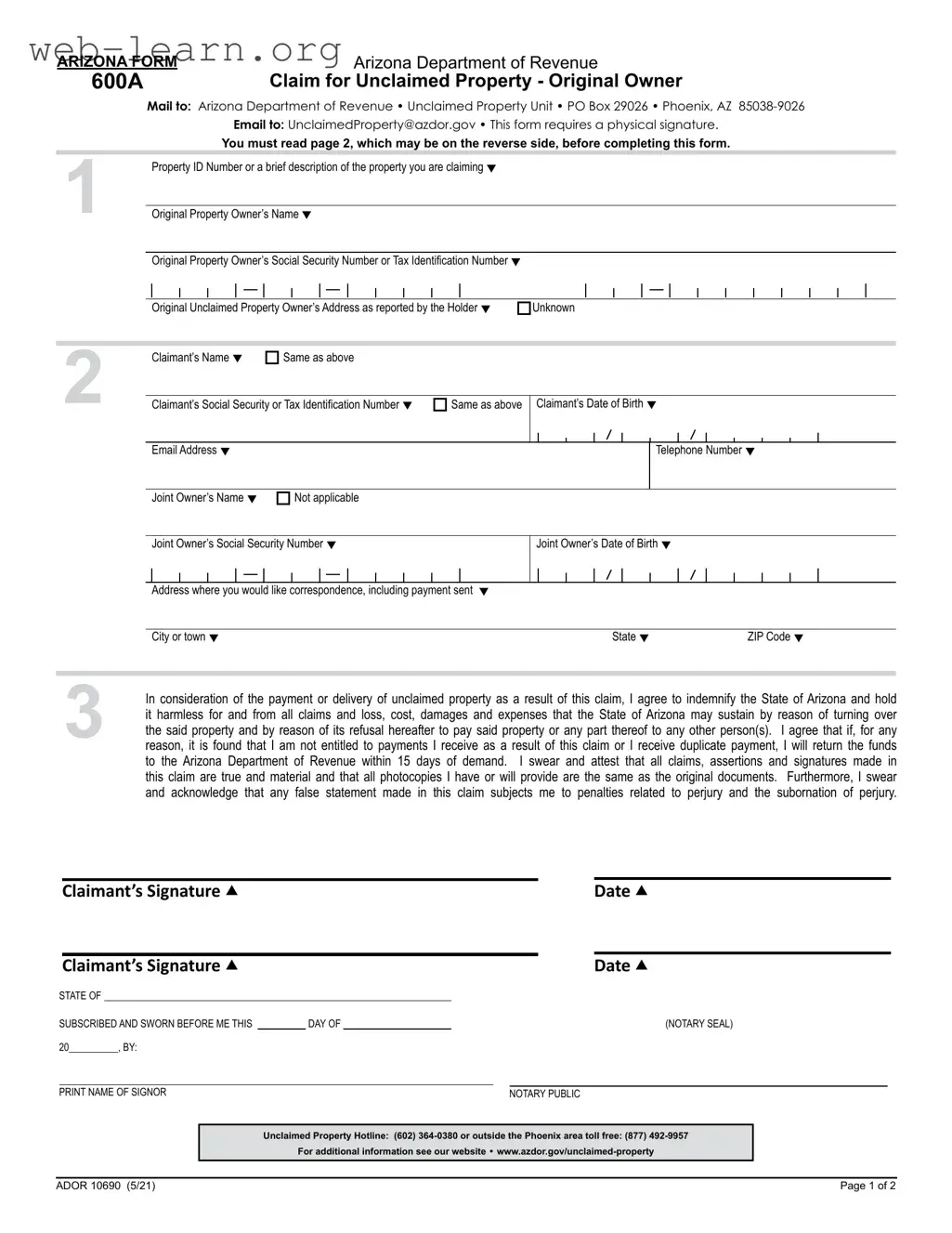
Filling out the Arizona 600A form is a straightforward process. It requires personal information and details about the unclaimed property you are trying to claim. Ensure that all information is accurate and complete to facilitate a smooth processing of your claim.

  1. Obtain the Arizona 600A form from the Arizona Department of Revenue website or your local office.
  2. In Section 1, provide the Property ID Number or a brief description of the property you are claiming. If you do not know the Property ID, you may leave this section blank.
  3. Enter the Original Property Owner’s Name and their Social Security Number or Tax Identification Number.
  4. Fill in the Original Unclaimed Property Owner’s Address as reported by the holder. If this is unknown, you can leave it blank.
  5. In Section 2, enter your Claimant’s Name. Indicate if it is the same as the original owner's name.
  6. Provide your Social Security or Tax Identification Number, Date of Birth, Email Address, and Telephone Number.
  7. If applicable, include the Joint Owner’s Name and their Social Security Number and Date of Birth.
  8. Specify the address where you would like correspondence and payment sent, including City, State, and ZIP Code.
  9. Read the indemnity agreement in Section 3 carefully. Sign and date the form where indicated.
  10. Decide if you want to have the form notarized or provide a photocopy of a valid government-issued photo ID.
  11. Gather and attach the required evidence, including proof of identity and ownership, as specified in the instructions.
  12. Mail the completed form and evidence to the Arizona Department of Revenue at the address provided, or email it if applicable.

Obtain Answers on Arizona 600A

  1. What is the Arizona 600A form used for?

    The Arizona 600A form is used to claim unclaimed property when you are the original owner. This could include forgotten bank accounts, uncashed checks, or other assets that have been reported to the state as unclaimed. If you are not the original owner but are claiming as an heir, agent, or beneficiary, you will need to use a different form.

  2. How do I fill out the Arizona 600A form?

    To complete the form, you will need to provide specific information in three main sections:

    • Section 1: Include the property ID number or a brief description of the property you are claiming, along with your name, Social Security number, and address.
    • Section 2: Fill in your current contact information, including an email address, so you can receive updates on your claim.
    • Section 3: Sign and date the form. You may also need to have it notarized or include a valid photo ID.

  3. What proof do I need to submit with the form?

    You must provide several pieces of evidence to support your claim:

    • Proof of identity, such as a government-issued photo ID or a notarized signature.
    • Proof of ownership, which can include documents showing your name and the address reported for the original owner.
    • Proof of your Social Security number, although this is optional.

    Make sure to check the Arizona Department of Revenue website for a complete list of acceptable documentation.

  4. Can I submit the form online?

    No, the Arizona 600A form requires a physical signature, so you cannot submit it online. You can mail it to the Arizona Department of Revenue or send it via email, but it must include your signature. Make sure to follow the mailing instructions carefully.

  5. What happens after I submit my claim?

    Once your claim is submitted, the Arizona Department of Revenue will review it. They will search their database to identify any unclaimed property that belongs to you. You should receive a receipt of your claim via email within 15 to 20 business days. If additional information is needed, they will reach out to you.

  6. What if my claim is denied?

    If your claim is denied, you will be informed of the reasons. Each claim is unique, and the department may request additional information to support your case. If you believe your claim was unfairly denied, you can contact the Unclaimed Property Hotline for assistance.

Common mistakes

Filling out the Arizona 600A form can be a straightforward process, but many people make common mistakes that can delay their claims for unclaimed property. One frequent error is failing to provide the Property ID Number or a brief description of the property. While it's not mandatory, including this information can help expedite the process and ensure that your claim is processed more efficiently.

Another mistake involves incomplete or incorrect personal information. Claimants often overlook the necessity of providing their current name, Social Security Number, and contact details. If any of this information is incorrect or missing, it can lead to complications or even denial of the claim. Remember, the address you provide is where any correspondence, including payment, will be sent, so accuracy is essential.

Some individuals neglect to read the important declarations on the form. This section outlines the responsibilities and liabilities associated with the claim. Ignoring this can lead to misunderstandings about what is required of you as the claimant. Additionally, not signing the form can render it invalid. A physical signature is required, so make sure to check that you have signed and dated the document.

Providing insufficient proof of identity is another common pitfall. The Arizona Department of Revenue requires clear copies of official identification or notarization of your signature. Failing to include these documents can result in delays or denials. If your name has changed, don’t forget to include documentation that verifies this change, such as a marriage license or court order.

People also frequently misunderstand the requirements for joint ownership. If you are claiming property that has joint owners, all parties must sign the claim form. If one owner is deceased, a death certificate is necessary. Not providing the required documentation can complicate the process significantly.

Sometimes, claimants submit proof of ownership that does not match the information on file with the state. The Arizona Unclaimed Property Section looks for a match based on various factors, such as Social Security numbers or reported addresses. If the information does not align, the claim may be denied, so ensure that you have all necessary documentation ready.

Another mistake is not providing proof of residence at the reported address. Acceptable proof includes utility bills, lease agreements, or any official documents that show you lived at the address associated with the unclaimed property. If you cannot find such proof, the claim could be at risk of denial.

Some claimants opt not to provide their Social Security number, thinking it is optional. While it is true that providing your SSN is not mandatory, not doing so may result in insufficient information to verify your ownership of the unclaimed property. Consider including it to avoid potential complications.

Lastly, many people fail to follow up after submitting their claim. It’s important to keep an eye on the status of your claim and respond promptly to any requests for additional information from the Arizona Department of Revenue. Ignoring these communications can lead to unnecessary delays in receiving your unclaimed property.

By being aware of these common mistakes, you can navigate the Arizona 600A form more effectively and increase your chances of a successful claim.

Documents used along the form

When filing a claim for unclaimed property in Arizona using the 600A form, there are several other documents that may be necessary or helpful to complete the process smoothly. Understanding these forms can make the experience less daunting and ensure that you have everything you need to support your claim.

  • Arizona Form 600B: This form is used when you are claiming property as the heir or beneficiary of a deceased owner. If the original owner has passed away, you will need to provide documentation, such as a death certificate, to establish your relationship to the deceased.
  • Arizona Form 600C: If you are an agent acting on behalf of an entity (like a business), you’ll need this form. It requires proof of your authority to act for the entity, ensuring that the claim is valid and properly submitted.
  • Arizona Form 600D: This form is for agents of living owners. If you are helping someone who is still alive but unable to claim their property themselves, this form allows you to submit the claim on their behalf, provided you have the necessary authorization.
  • Proof of Identity Documents: Along with the 600A form, you must submit proof of your identity. Acceptable documents include a government-issued photo ID or a notarized signature. This is crucial for verifying your identity as the claimant.

Gathering these forms and documents ahead of time can streamline the process of claiming unclaimed property. It’s always a good idea to double-check that you have everything required to avoid delays and ensure your claim is processed efficiently.

Similar forms

The Arizona 600A form is used to claim unclaimed property as the original owner. Similar forms exist for different situations regarding unclaimed property claims. Here are ten documents that are comparable to the Arizona 600A form:

  • Arizona Form 600B: This form is for heirs or beneficiaries claiming property from a deceased owner. It requires proof of relationship to the deceased, similar to how the 600A requires proof of ownership.
  • Arizona Form 600C: Used by agents of entities to claim property. Like the 600A, it necessitates identification and proof of authority to act on behalf of the entity.
  • Arizona Form 600D: This form allows agents of living owners to claim property. It parallels the 600A in that it requires a physical signature and proof of identity.
  • IRS Form 1040: This is the standard individual income tax return. Both forms require personal information and signatures to validate claims or requests.
  • Form W-9: Request for Taxpayer Identification Number. Similar to the 600A, it collects identifying information, including Social Security numbers, to process claims or payments.
  • Form 4506-T: Request for Transcript of Tax Return. This form is similar in that it requires personal information and is used to verify identity for tax-related claims.
  • State of Arizona Affidavit: Used in various legal situations, this document requires a sworn statement and personal identification, akin to the signature and declarations in the 600A.
  • Power of Attorney Form: This document allows one person to act on behalf of another. Like the 600A, it requires signatures and identification to validate authority.
  • Claim for Refund Form: Used for tax refund requests, this form also requires personal information and proof of identity, similar to the requirements of the 600A.
  • Application for a Driver’s License: This form collects personal information and requires proof of identity, paralleling the identity verification needed in the 600A.

Dos and Don'ts

When filling out the Arizona 600A form for claiming unclaimed property, it is important to follow certain guidelines to ensure your application is processed smoothly. Below is a list of things you should and shouldn't do.

  • Do provide accurate and complete information in all sections of the form.
  • Do include your current contact information, including an email address, to expedite communication.
  • Do sign the form physically, as electronic signatures are not accepted.
  • Do submit proof of your identity and ownership of the property being claimed.
  • Don't leave sections blank unless specifically indicated as optional.
  • Don't submit the form without the necessary supporting documents, as this could delay processing.

Following these guidelines can help ensure that your claim for unclaimed property is handled efficiently and effectively.

Misconceptions

Misconceptions about the Arizona 600A form can lead to confusion and potential claim denials. Here are six common misunderstandings:

  • Only the original owner can file a claim. Many believe that only the original owner can submit the Arizona 600A form. However, heirs or beneficiaries may need to use different forms, such as Form 600B, to claim property from deceased owners.
  • Providing a property ID is mandatory. Some think that they must provide a property ID to file a claim. While it is helpful, it is not required. If the property ID is unknown, a brief description of the property can suffice.
  • Email communication is not an option. There is a misconception that submitting a claim does not allow for email communication. In fact, providing an email address on the form can expedite the process and allow for quicker updates regarding the claim.
  • Notarization is always required. Many assume that notarization is mandatory for all claims. While it is an option, claimants can also submit a legible photocopy of a valid government-issued photo ID instead of notarizing the form.
  • Proof of ownership is unnecessary. Some individuals believe they can claim property based solely on name similarity. In reality, proof of ownership is essential. This can include documentation that matches the reported address or social security number.
  • Joint owners can file separately. There is a belief that joint owners can submit claims independently. However, they must file together unless specific circumstances, such as death or divorce, apply.

Understanding these misconceptions can help ensure that claims are filed correctly and efficiently, minimizing delays in receiving unclaimed property.

Key takeaways

When navigating the Arizona 600A form for claiming unclaimed property, it is essential to understand a few key points to ensure a smooth process. Here are some important takeaways:

  • Purpose of the Form: This form is specifically designed for original property owners to claim their unclaimed property. If you are not the original owner, you must use a different form.
  • Accurate Information is Crucial: Fill out all sections of the form accurately. Providing your current name and contact information will help expedite the processing of your claim.
  • Property Identification: While it is not mandatory to provide a property ID, including a brief description of the property can be beneficial. This helps the Department of Revenue identify the claim more efficiently.
  • Signature Requirement: A physical signature is necessary for the claim to be valid. Consider having the form notarized or include a photocopy of a valid government-issued ID.
  • Proof of Ownership: You must submit evidence proving your identity and ownership of the property. Acceptable documents include financial statements, utility bills, or any official correspondence that links you to the reported address.
  • Joint Ownership Considerations: If the property has joint owners, both must sign the form unless specific circumstances apply, such as one owner being deceased or divorced.

By keeping these points in mind, you can approach the Arizona 600A form with greater confidence and clarity. Each claim is unique, and if you encounter challenges, do not hesitate to reach out for assistance. Your diligence in completing the form accurately will aid in reclaiming what is rightfully yours.