Homepage Blank Arizona 5000 Form
Outline

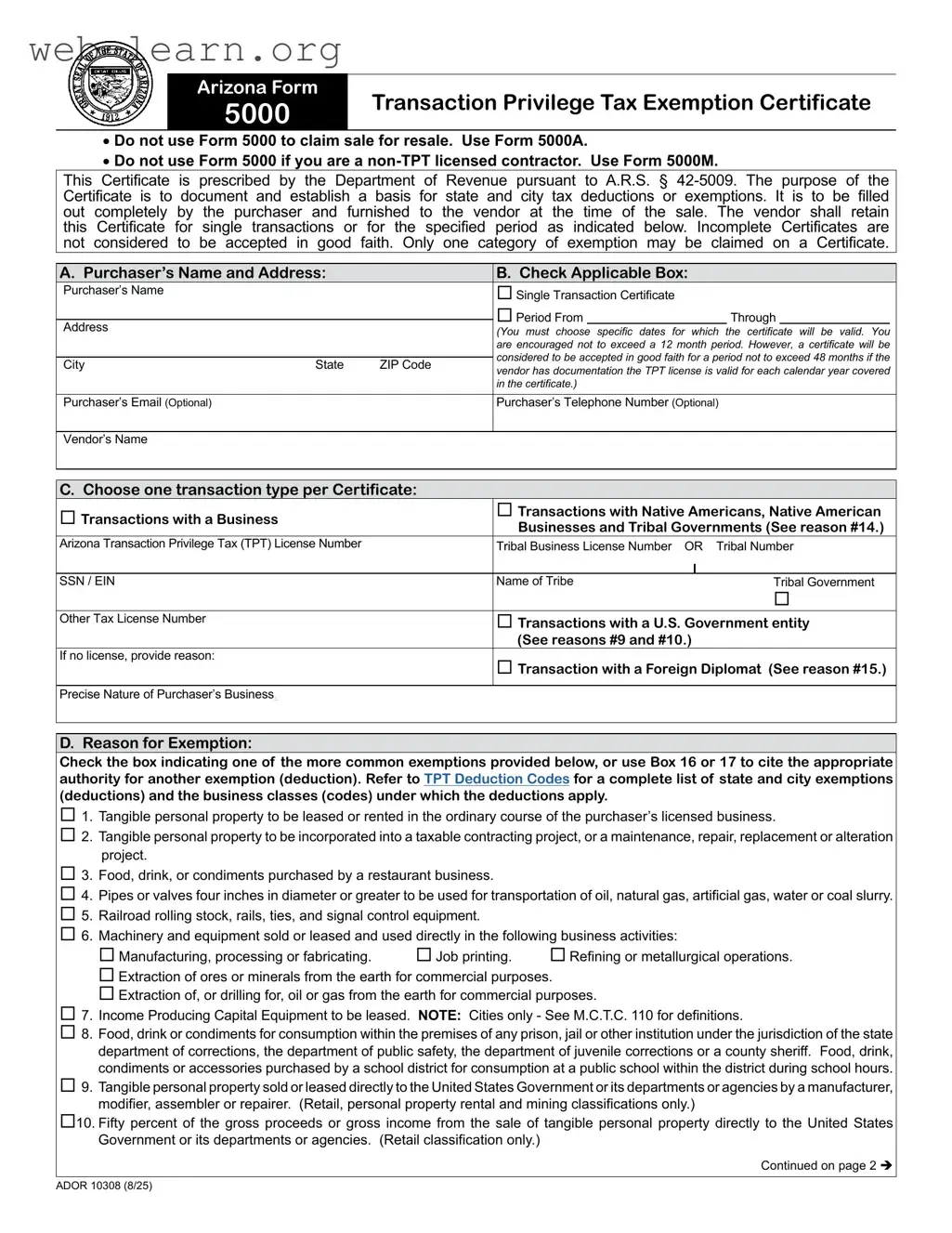
The Arizona 5000 form, officially known as the Transaction Privilege Tax Exemption Certificate, serves a crucial role in the state's tax framework. This form is designed for purchasers who wish to document and establish a basis for state and city tax deductions or exemptions. It is essential for vendors to retain this certificate, either for single transactions or for a specified period, as indicated on the form. To ensure compliance, it must be filled out completely by the purchaser and presented to the vendor at the time of sale. Notably, only one category of exemption can be claimed per certificate, and incomplete submissions are not accepted in good faith. The form requires essential details such as the purchaser's name, address, and applicable tax license numbers, along with a clear indication of the reason for exemption. Various categories of exemptions are available, ranging from tangible personal property leased in the ordinary course of business to specific transactions involving government entities and Native American tribes. Understanding the proper use and requirements of the Arizona 5000 form is vital for both purchasers and vendors to navigate the complexities of transaction privilege tax regulations effectively.


Sample - Arizona 5000 Form

ADOR 10308 (8/25)
Arizona Form
5000
Transaction Privilege Tax Exemption Certificate
This Certificate is prescribed by the Department of Revenue pursuant to A.R.S. § 42-5009. The purpose of the
Certificate is to document and establish a basis for state and city tax deductions or exemptions. It is to be filled
out completely by the purchaser and furnished to the vendor at the time of the sale. The vendor shall retain
this Certificate for single transactions or for the specified period as indicated below. Incomplete Certificates are
not considered to be accepted in good faith. Only one category of exemption may be claimed on a Certificate.
A. Purchaser’s Name and Address: B. Check Applicable Box:
Purchaser’s Name
Single Transaction Certificate
Period From Through
(You must choose specific dates for which the certificate will be valid. You
are encouraged not to exceed a 12 month period. However, a certificate will be
considered to be accepted in good faith for a period not to exceed 48 months if the
vendor has documentation the TPT license is valid for each calendar year covered
in the certificate.)
Address
City State ZIP Code
Purchaser’s Email (Optional) Purchaser’s Telephone Number (Optional)
Vendor’s Name
C. Choose one transaction type per Certificate:
Transactions with a Business
Transactions with Native Americans, Native American
Businesses and Tribal Governments (See reason #14.)
Arizona Transaction Privilege Tax (TPT) License Number
Tribal Business License Number OR Tribal Number
SSN / EIN Name of Tribe
Tribal Government
Other Tax License Number
Transactions with a U.S. Government entity
(See reasons #9 and #10.)
If no license, provide reason:
Transaction with a Foreign Diplomat (See reason #15.)
Precise Nature of Purchaser’s Business..
D. Reason for Exemption:
Check the box indicating one of the more common exemptions provided below, or use Box 16 or 17 to cite the appropriate
authority for another exemption (deduction). Refer to TPT Deduction Codes for a complete list of state and city exemptions
(deductions) and the business classes (codes) under which the deductions apply.
1. Tangible personal property to be leased or rented in the ordinary course of the purchaser’s licensed business.
2. Tangible personal property to be incorporated into a taxable contracting project, or a maintenance, repair, replacement or alteration
project.
3. Food, drink, or condiments purchased by a restaurant business.
4. Pipes or valves four inches in diameter or greater to be used for transportation of oil, natural gas, artificial gas, water or coal slurry.
5. Railroad rolling stock, rails, ties, and signal control equipment.
6. Machinery and equipment sold or leased and used directly in the following business activities:
Manufacturing, processing or fabricating. Job printing. Refining or metallurgical operations.
Extraction of ores or minerals from the earth for commercial purposes.
Extraction of, or drilling for, oil or gas from the earth for commercial purposes.
7. Income Producing Capital Equipment to be leased. NOTE: Cities only - See M.C.T.C. 110 for definitions.
8. Food, drink or condiments for consumption within the premises of any prison, jail or other institution under the jurisdiction of the state
department of corrections, the department of public safety, the department of juvenile corrections or a county sheriff. Food, drink,
condiments or accessories purchased by a school district for consumption at a public school within the district during school hours.
9. Tangible personal property sold or leased directly to the United States Government or its departments or agencies by a manufacturer,
modifier, assembler or repairer. (Retail, personal property rental and mining classifications only.)
10. Fifty percent of the gross proceeds or gross income from the sale of tangible personal property directly to the United States
Government or its departments or agencies. (Retail classification only.)
Continued on page 2
• Do not use Form 5000 to claim sale for resale. Use Form 5000A.
• Do not use Form 5000 if you are a non-TPT licensed contractor. Use Form 5000M.
ADOR 10308 (8/25)
11. Electricity, natural gas or liquefied petroleum gas sold to a qualified manufacturing or smelting business. A manufacturing or
smelting business that claims this exemption authorizes the release by the vendor of the information required to be provided
to the Department of Revenue pursuant to A.R.S. § 42-5063(C)(6). NOTE: The purchaser is required to attach the
worksheet from Form 5014. For more guidance, please review Transaction Privilege Procedure (TPP) 18-1. (Utilities
classification only.) (Not available for all Cities.)
12. Electricity or natural gas to a business that operates an international operations center in this state and that is certified by the
Arizona Commerce Authority. NOTE: Certification must be attached. (Utilities classification only.) (Not available for all Cities.)
13. Computer data center equipment sold to the owner, operator or qualified colocation tenant of a computer data center that is
certified by the Arizona Commerce Authority pursuant to A.R.S. § 41-1519. NOTE: Equipment must qualify and certification
must be attached.
14. Sale or lease of tangible personal property to affiliated Native Americans if the order is placed from and delivered to the
reservation. NOTE: The vendor shall retain adequate documentation to substantiate the transaction.
15. Foreign diplomat. NOTE: Limited to authorization on the U.S. Department of State Diplomatic Tax Exemption Card. The vendor
shall retain a copy of the U.S. Department of State Diplomatic Tax Exemption Card and any other documentation issued by the
U.S. Department of State. Motor vehicle purchases or leases must be pre-authorized by the Office of Foreign Missions (“OFM”).
See “Vehicle Tax Exemption” at
www.state.gov/ofm/tax/
16.*Other Deduction: Cite the Arizona Revised Statutes authority for the deduction. A.R.S. §
Description:
17.*Other Cities Deduction: Cite the Model City Tax Code authority for the deduction. M.C.T.C. §
Description:
*Refer to TPT Deduction Codes for a complete list of state and city exemptions (deductions) and the business classes (codes) under which
the deductions apply.
E. Describe the tangible personal property or service purchased or leased and its use below.
(Use additional pages if needed.)
F. Certification
A vendor that has reason to believe that this Certificate is not accurate or complete will not be relieved of the burden of
proving entitlement to the exemption. A vendor that accepts a Certificate in good faith will be relieved of the burden of proof
and the purchaser may be required to establish the accuracy of the claimed exemption. If the purchaser cannot establish
the accuracy and completeness of the information provided in the Certificate, the purchaser is liable for an amount equal to
the transaction privilege tax, penalty and interest which the vendor would have been required to pay if the vendor had not
accepted the Certificate. Misuse of this Certificate will subject the purchaser to payment of the A.R.S. § 42-5009 amount equal
to any tax, penalty or interest. Willful misuse of this Certificate will subject the purchaser to criminal penalties of a felony
pursuant to A.R.S. § 42-1127.
I, (print full name) I, (print full name) , hereby certify that these transactions are , hereby certify that these transactions are
exempt from Arizona transaction privilege tax and that the information on this Certificate is true, accurate and complete. exempt from Arizona transaction privilege tax and that the information on this Certificate is true, accurate and complete.
Further, if purchasing or leasing as an agent or officer, I certify that I am authorized to execute this Certificate on behalf of Further, if purchasing or leasing as an agent or officer, I certify that I am authorized to execute this Certificate on behalf of
the purchaser named above.the purchaser named above.
SIGNATURE OF PURCHASER DATE TITLE
Your Name (as shown on page 1) Arizona Transaction Privilege Tax License Number
Page 2 of 2
Print Form
Reset Form

Form Information

Fact Name Fact Description
Form Purpose The Arizona Form 5000 serves to document and establish a basis for state and city tax deductions or exemptions.
Governing Law This form is prescribed by the Arizona Department of Revenue under A.R.S. § 42-5009.
Usage Restrictions Form 5000 cannot be used for resale claims; Form 5000A should be used instead.
Contractor Limitations Non-TPT licensed contractors must use Form 5000M instead of Form 5000.
Completeness Requirement Purchasers must fill out the form completely; incomplete forms are not accepted in good faith.
Exemption Categories Only one category of exemption can be claimed per Certificate.
Validity Period Certificates are encouraged to cover a maximum of 12 months but can extend to 48 months under certain conditions.
Vendor Responsibilities Vendors must retain the Certificate for single transactions or for the specified period indicated.
Documentation Vendors must have documentation proving the TPT license is valid for each year covered by the Certificate.
Potential Penalties Misuse of the Certificate can result in tax liabilities and possible felony charges under A.R.S. § 42-1127(B).

Detailed Guide for Filling Out Arizona 5000

After gathering the necessary information, the Arizona Form 5000 can be filled out to document and establish a basis for state and city tax deductions or exemptions. This form must be completed by the purchaser and provided to the vendor at the time of the sale. It is essential to ensure that all sections are filled out accurately to avoid any issues.

  1. Obtain a copy of the Arizona Form 5000.
  2. In section A, enter the Purchaser’s Name and Address.
  3. Check the applicable box for the type of certificate: Single Transaction Certificate or Period From Through. If choosing the latter, specify the dates.
  4. Optionally, provide the Purchaser’s Email and Telephone Number.
  5. Enter the Vendor’s Name.
  6. In section C, select one transaction type per certificate by checking the appropriate box. Options include transactions with a business, Native Americans, or U.S. Government entities.
  7. If applicable, provide the Arizona Transaction Privilege Tax License Number, Tribal Business License Number, or SSN/EIN.
  8. In section D, indicate the reason for exemption by checking the relevant box. If none apply, use Box 16 or 17 to cite the appropriate authority.
  9. In section E, describe the tangible personal property or service purchased or leased and its intended use.
  10. In section F, print the full name of the purchaser and sign the certification statement, confirming the accuracy of the information provided.
  11. Include the date and title of the person signing the form.

Obtain Answers on Arizona 5000

  1. What is the Arizona 5000 form?

    The Arizona 5000 form, also known as the Transaction Privilege Tax Exemption Certificate, is a document used to claim exemptions from state and city transaction privilege taxes. It is specifically designed for purchasers who qualify for certain tax deductions or exemptions under Arizona law. The form must be filled out completely by the purchaser and provided to the vendor at the time of the sale.

  2. Who should use the Arizona 5000 form?

    This form is intended for licensed purchasers who are eligible for tax exemptions. It is important to note that if you are a non-TPT licensed contractor, you should use Form 5000M instead. Additionally, if you are claiming a sale for resale, you should use Form 5000A.

  3. How long is the Arizona 5000 form valid?

    The validity of the Arizona 5000 form can vary based on the type of exemption claimed. Generally, it is recommended not to exceed a 12-month period. However, if the vendor has documentation proving the TPT license is valid for each calendar year covered, the certificate can be accepted in good faith for up to 48 months.

  4. What information do I need to provide on the form?

    When filling out the Arizona 5000 form, you will need to provide several pieces of information:

    • Your name and address
    • The vendor's name
    • The type of transaction you are engaging in
    • The reason for the exemption
    • A description of the tangible personal property or service being purchased or leased

    Make sure to check only one category of exemption and to complete all required fields to ensure the form is accepted in good faith.

  5. What happens if the form is incomplete?

    An incomplete Arizona 5000 form will not be considered accepted in good faith. This means that if any required information is missing, the vendor may still be liable for the transaction privilege tax. It's crucial to ensure that all sections of the form are filled out accurately to avoid any potential issues.

  6. What are the consequences of misusing the Arizona 5000 form?

    Misuse of the Arizona 5000 form can lead to serious consequences. If a purchaser cannot establish the accuracy of the information provided, they may be liable for the amount equal to the transaction privilege tax, including penalties and interest. Additionally, willful misuse of the form may result in criminal penalties classified as a felony under Arizona law.

Common mistakes

Filling out the Arizona Form 5000 can be straightforward, but many people make common mistakes that can lead to issues. One frequent error is using the wrong form. For example, individuals often mistakenly use Form 5000 to claim sales for resale. Instead, they should use Form 5000A for that purpose. Similarly, non-TPT licensed contractors should not use Form 5000; they must fill out Form 5000M. Using the correct form is essential to avoid delays and complications.

Another common mistake involves failing to complete the form entirely. Incomplete Certificates are not accepted in good faith. This means that leaving out any required information can invalidate the form. Each section, including the purchaser's name, address, and the specific exemption reason, must be filled out completely. Omitting even a small detail can lead to significant problems down the line.

Many individuals also neglect to check the appropriate box for the exemption type. Only one category of exemption may be claimed on a Certificate. If multiple boxes are checked, it can confuse the vendor and lead to rejection of the Certificate. It is crucial to carefully review the options and select the one that accurately reflects the transaction.

Another mistake is not providing specific dates for the Certificate's validity. The form requires purchasers to indicate a specific period for which the certificate will be valid. Failing to do so can result in the vendor not accepting the Certificate. It is advisable to keep the validity period within 12 months, although a maximum of 48 months may be accepted under certain conditions.

People often forget to include their Arizona Transaction Privilege Tax (TPT) License Number or other necessary identification numbers. This information is vital for the vendor to process the Certificate correctly. Without it, the vendor may be unable to verify the exemption, leading to potential tax liabilities for the purchaser.

Lastly, many purchasers overlook the importance of the certification section. The purchaser must sign and date the form, certifying that the information is true and accurate. Failing to sign the Certificate can render it invalid. Moreover, if the vendor has reason to doubt the accuracy of the information provided, they may require further proof, placing the burden back on the purchaser.

Documents used along the form

The Arizona Form 5000 is an essential document for claiming transaction privilege tax exemptions. However, it is often accompanied by other forms and documents that serve various purposes in the tax exemption process. Below are four commonly used forms that you may encounter alongside the Arizona 5000 form.

  • Arizona Form 5000A: This form is specifically designed for businesses claiming a sale for resale exemption. It allows purchasers to document their intention to resell the items they are buying, ensuring compliance with tax regulations.
  • Arizona Form 5000M: Non-TPT licensed contractors should use this form. It serves to document exemptions for contractors who do not hold a transaction privilege tax license but still need to claim certain exemptions for their purchases.
  • Arizona Transaction Privilege Tax License Application: This application is necessary for businesses looking to obtain a transaction privilege tax license. It provides the state with essential information about the business and its operations, allowing for proper tax compliance.
  • Vendor Documentation: Vendors must retain documentation that substantiates the claimed exemptions. This can include invoices, contracts, and other records that demonstrate the legitimacy of the transaction and the basis for the exemption claimed on the 5000 form.

Understanding these accompanying forms and documents can help ensure that your tax exemption claims are processed smoothly and accurately. Proper documentation is crucial for compliance and can prevent potential issues with tax authorities in the future.

Similar forms

  • Arizona Form 5000A: This form is used specifically for claiming sales for resale. Unlike Form 5000, which is for tax exemptions, Form 5000A focuses on transactions where goods are purchased with the intent to resell them. It requires the purchaser to provide their resale information and is submitted to the vendor at the time of purchase.
  • Arizona Form 5000M: This form is designated for non-Transaction Privilege Tax (TPT) licensed contractors. It serves a similar purpose to Form 5000 but is tailored for contractors who do not hold a TPT license, allowing them to claim exemptions relevant to their specific circumstances.
  • Arizona Form 1099: This form is used to report various types of income other than wages, salaries, and tips. While it does not directly relate to tax exemptions like Form 5000, both documents serve as important tools for tax reporting and compliance, ensuring that the appropriate tax obligations are met.
  • Arizona Sales Tax Exemption Certificate: This document allows purchasers to claim exemption from sales tax on specific purchases. Similar to Form 5000, it requires the purchaser to provide details about the transaction and the reason for the exemption, streamlining the tax-exempt purchasing process.
  • IRS Form W-9: This form is used to provide taxpayer identification information to entities that are required to file information returns with the IRS. Like Form 5000, it plays a crucial role in ensuring proper documentation and compliance with tax regulations, though it focuses on reporting rather than exemptions.

Dos and Don'ts

When filling out the Arizona Form 5000, it is essential to adhere to specific guidelines to ensure accuracy and compliance. Here’s a list of what you should and shouldn’t do:

  • Do fill out the form completely with accurate information.
  • Do check the applicable box for the type of exemption you are claiming.
  • Do provide specific dates for the certificate's validity, ideally not exceeding 12 months.
  • Do retain a copy of the completed form for your records.
  • Do ensure that only one category of exemption is claimed on the form.
  • Do consult the Arizona Department of Revenue website for a complete list of exemptions.
  • Do sign and date the form to certify the accuracy of the information provided.
  • Don't use Form 5000 for resale claims; use Form 5000A instead.
  • Don't submit the form if you are a non-TPT licensed contractor; use Form 5000M.
  • Don't leave any sections of the form incomplete, as this may invalidate the certificate.
  • Don't claim multiple exemptions on a single certificate.
  • Don't forget to provide the vendor with the completed form at the time of sale.
  • Don't assume that the vendor will accept an incomplete certificate in good faith.
  • Don't misuse the certificate, as this could lead to penalties or legal consequences.

Misconceptions

Misconceptions about the Arizona 5000 form can lead to confusion and potential issues during transactions. Below are seven common misconceptions along with clarifications for each.

  • Form 5000 can be used for resale transactions. This is incorrect. For resale claims, Form 5000A should be used instead.
  • Non-TPT licensed contractors can use Form 5000. In fact, non-TPT licensed contractors must use Form 5000M for their transactions.
  • Incomplete forms are acceptable. This is a misconception. Incomplete Certificates are not accepted in good faith and can lead to complications.
  • Multiple exemption categories can be claimed on one form. Only one category of exemption may be claimed per Certificate.
  • The Certificate is valid indefinitely. While it can be valid for up to 48 months under certain conditions, it is generally encouraged to limit validity to 12 months.
  • All vendors are required to accept the Certificate. Vendors have the right to refuse acceptance if they believe the Certificate is inaccurate or incomplete.
  • Using the Certificate guarantees exemption from taxes. Misuse can lead to liability for taxes, penalties, and even criminal charges for willful misuse.

Key takeaways

When filling out and using the Arizona Form 5000, there are several important points to keep in mind:

  • Purpose of the Form: The Arizona Form 5000 is designed to document and establish a basis for state and city tax deductions or exemptions. It must be filled out completely by the purchaser and provided to the vendor at the time of the sale.
  • Single Transaction Only: Only one category of exemption can be claimed on a single Form 5000. If multiple exemptions apply, separate forms must be completed for each.
  • Validity Period: The form should specify a valid period for the exemption. While a 12-month period is encouraged, it may be accepted for up to 48 months if the vendor has documentation of a valid TPT license for each year covered.
  • Consequences of Inaccuracy: If the information on the form is incomplete or inaccurate, the vendor may still be held responsible for the tax. Misuse of the form can lead to penalties, including criminal charges.