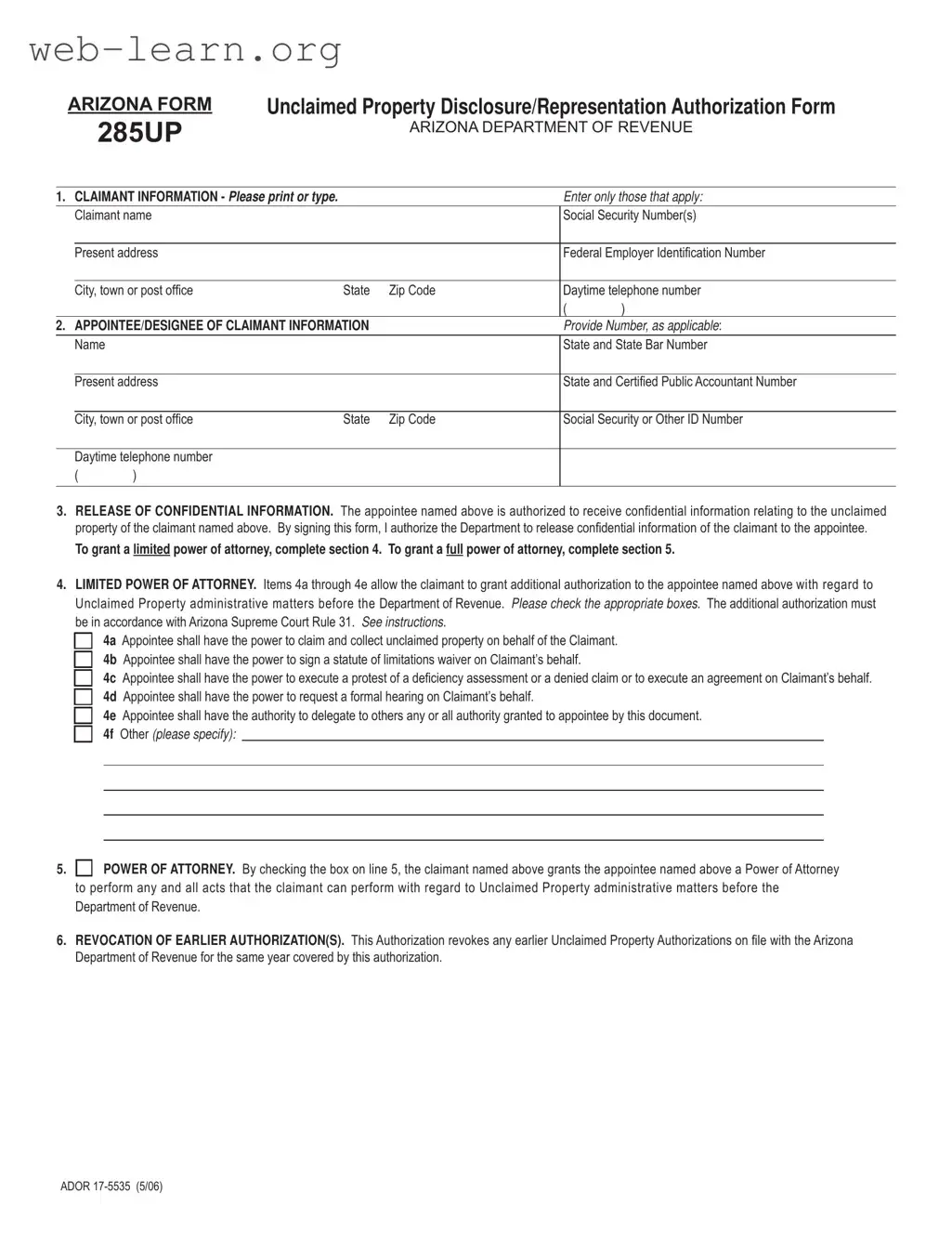
Homepage Blank Arizona 285Up Form
Outline

The Arizona 285Up form is a crucial document for individuals and corporations seeking to claim unclaimed property. This form, officially known as the Unclaimed Property Disclosure/Representation Authorization Form, serves multiple purposes. First, it allows claimants to provide their personal information, such as name, Social Security number, and contact details. Additionally, it enables the designation of an appointee or representative who can act on behalf of the claimant in matters related to unclaimed property. This appointee can receive confidential information from the Arizona Department of Revenue, which is vital for successfully navigating the claims process. The form also includes sections for granting limited or full power of attorney, allowing the appointee to perform specific actions, such as claiming property or signing waivers. Furthermore, the 285Up form revokes any previous authorizations for the same year, ensuring that the most current information is on file. For corporations, there are provisions to include controlled subsidiaries in the disclosure authorization. Completing this form accurately is essential, as it requires the claimant's signature to certify their authority and compliance with Arizona laws.


Sample - Arizona 285Up Form

Unclaimed Property Disclosure/Representation Authorization Form
ARIZONA DEPARTMENT OF REVENUE
ARIZONA FORM
285UP
1. CLAIMANT INFORMATION - Please print or type. Enter only those that apply:
Claimant name Social Security Number(s)
Present address Federal Employer Identi cation Number
City, town or post of ce State Zip Code Daytime telephone number
( )
2. APPOINTEE/DESIGNEE OF CLAIMANT INFORMATION Provide Number, as applicable:
Name State and State Bar Number
Present address State and Certi ed Public Accountant Number
City, town or post of ce State Zip Code Social Security or Other ID Number
Daytime telephone number
( )
3. RELEASE OF CONFIDENTIAL INFORMATION. The appointee named above is authorized to receive confidential information relating to the unclaimed
property of the claimant named above. By signing this form, I authorize the Department to release con dential information of the claimant to the appointee.
To grant a limited power of attorney, complete section 4. To grant a full power of attorney, complete section 5.
4. LIMITED POWER OF ATTORNEY. Items 4a through 4e allow the claimant to grant additional authorization to the appointee named above with regard to
Unclaimed Property administrative matters before the Department of Revenue. Please check the appropriate boxes. The additional authorization must
be in accordance with Arizona Supreme Court Rule 31. See instructions.
4a Appointee shall have the power to claim and collect unclaimed property on behalf of the Claimant.
4b Appointee shall have the power to sign a statute of limitations waiver on Claimant’s behalf.
4c Appointee shall have the power to execute a protest of a de ciency assessment or a denied claim or to execute an agreement on Claimant’s behalf.
4d Appointee shall have the power to request a formal hearing on Claimant’s behalf.
4e Appointee shall have the authority to delegate to others any or all authority granted to appointee by this document.
4f Other (please specify):
5. POWER OF ATTORNEY. By checking the box on line 5, the claimant named above grants the appointee named above a Power of Attorney
to perform any and all acts that the claimant can perform with regard to Unclaimed Property administrative matters before the
Department of Revenue.
6. REVOCATION OF EARLIER AUTHORIZATION(S). This Authorization revokes any earlier Unclaimed Property Authorizations on le with the Arizona
Department of Revenue for the same year covered by this authorization.
ADOR 17-5535 (5/06)
7. CORPORATIONS HAVING CONTROLLED SUBSIDIARIES. A.R.S. §42-2003(A)(1) provides that con dential information relating to a corporate taxpayer may
be disclosed to a designee of the taxpayer who is authorized in writing by the taxpayer. A principal corporate of cer of a parent corporation may execute a written
authorization for a controlled subsidiary. A principal corporate of cer of a parent corporation that desires to designate a person to receive con dential information
regarding the corporation’s controlled subsidiaries must either attach a list containing the names of each controlled subsidiary that the parent company wants
included in the disclosure authorization (a federal Form 851 may be used for this purpose) or Claimant may complete the following to include all controlled
subsidiaries in the disclosure authorization.
Include the following controlled subsidiaries. A controlled subsidiary, for purposes of A.R.S. §42-2003, is de ned as more than 50% ownership or control.
NAME FEDERAL I.D. NO.
7a
7b
7c
7d
7e
7f
8. SIGNATURE OF CLAIMANT. I hereby certify that I have the authority, within the meaning of A.R.S. §42-2003(A), to execute this authorization form on behalf of the
above claimant. I understand that to knowingly prepare or present a document which is fraudulent or false is a Class 5 felony pursuant to A.R.S. §42-1127(B)(2).
SIGNATURE DATE
PRINT NAME
TITLE
9. DECLARATION OF APPOINTEE. Complete if Appointee has been given authority under Section 4 or Section 5 or is otherwise authorized to pratice law as
defi ned in Rule 31 of the Arizona Rules of the Supreme Court.
Under penalties of perjury, I, the above named appointee, declare that I am one of the following:
a A full-time of cer, partner, member or manager of a limited liability company, or employee if the individual quali es under Rule 31(c)13 of the Arizona Rules
of the Supreme Court.
b Attorney - an active member of the State Bar of Arizona.
c Certi ed Public Accountant - duly quali ed to practice as a Certi ed Public Accountant in Arizona.
d Federally Authorized Tax Practitioner within the meaning of A.R.S. § 42-2069(D)(1). If appointee is engaged in practice with a federally authorized tax
practitioner, provide the practitioner’s name and CAF number below:
_______________________________________________________ ___________________________
PRACTITIONER’S NAME CAF NUMBER
e Other - This may be any individual, providing the total amount in dispute, including tax, penalties, and interest is less than $5,000.00.
DESIGNATION
Enter a letter (a, b, c d or e).
JURISDICTION
(State) SIGNATURE DATE
If this Declaration of Appointee is not signed and dated, the representation authorization will be returned.
Mail completed form to:
Arizona Department of Revenue
Unclaimed Property Unit
1600 W. Monroe Street
Phoenix, AZ 85007
ADOR 17-5535 (5/06)
AZ Form 285UP (2006) Page 2

Form Information

Fact Name Description
Form Title Arizona Unclaimed Property Disclosure/Representation Authorization Form 285UP
Governing Law A.R.S. §42-2003 governs the disclosure of confidential information related to unclaimed property.
Claimant Information The form requires claimants to provide personal details such as name, Social Security Number, and contact information.
Appointee Information Claimants can designate an appointee who will receive confidential information regarding their unclaimed property.
Power of Attorney Options Claimants can grant limited or full power of attorney to their appointee for handling unclaimed property matters.
Revocation Clause This form revokes any previous authorizations for unclaimed property for the same year.
Signature Requirement The claimant must sign the form, certifying their authority to execute it and acknowledging penalties for fraudulent information.

Detailed Guide for Filling Out Arizona 285Up

Completing the Arizona 285Up form requires careful attention to detail. This form is essential for designating an appointee to handle unclaimed property matters on your behalf. Follow these steps to ensure the form is filled out correctly and submitted without delay.

  1. Gather necessary information. Collect the required details for both the claimant and the appointee. This includes names, Social Security Numbers, addresses, and contact information.
  2. Claimant Information. In the first section, enter the claimant's name, Social Security Number(s), present address, Federal Employer Identification Number, city, state, zip code, and daytime telephone number. Ensure all information is accurate and legible.
  3. Appointee/Designee Information. Provide the name of the appointee along with their state and state bar number, if applicable. Include their present address, city, state, zip code, Social Security or other ID number, and daytime telephone number.
  4. Release of Confidential Information. Acknowledge that the appointee is authorized to receive confidential information by signing in the designated area. This step is crucial for granting them access to necessary details.
  5. Limited Power of Attorney. If you wish to grant specific powers to the appointee, check the appropriate boxes in section 4. You can choose from options such as claiming unclaimed property or signing waivers.
  6. Power of Attorney. If you want to grant full authority to the appointee, check the box in section 5. This allows them to perform any acts related to unclaimed property on your behalf.
  7. Revocation of Earlier Authorizations. Acknowledge that this form revokes any previous authorizations by signing in section 6.
  8. Corporations Having Controlled Subsidiaries. If applicable, list any controlled subsidiaries in section 7. Ensure you provide the necessary federal ID numbers.
  9. Signature of Claimant. In section 8, sign and date the form. Print your name and title, certifying your authority to execute the authorization.
  10. Declaration of Appointee. If applicable, the appointee must complete section 9, declaring their qualifications and signing the form. Make sure this section is filled out correctly to avoid delays.
  11. Mail the Completed Form. Once the form is filled out and signed, mail it to the Arizona Department of Revenue at the address provided. Ensure you send it to the Unclaimed Property Unit at 1600 W. Monroe Street, Phoenix, AZ 85007.

After submitting the form, keep a copy for your records. You may want to follow up with the Department of Revenue to confirm receipt and check the status of your authorization. Timely submission and accuracy are key to facilitating the process smoothly.

Obtain Answers on Arizona 285Up

  1. What is the purpose of the Arizona 285Up form?

    The Arizona 285Up form, also known as the Unclaimed Property Disclosure/Representation Authorization Form, allows individuals or corporations to authorize someone else to act on their behalf regarding unclaimed property matters. This includes the ability to claim and collect unclaimed property and receive confidential information from the Arizona Department of Revenue.

  2. Who can be designated as an appointee on the form?

    An appointee can be anyone the claimant trusts to handle their unclaimed property matters. This could include attorneys, certified public accountants, or any other individual. The appointee must meet certain qualifications, such as being a full-time officer or an active member of the State Bar of Arizona, or a certified public accountant in Arizona.

  3. What types of authority can be granted to the appointee?

    The form allows for different levels of authority. Claimants can grant:

    • The power to claim and collect unclaimed property.
    • The ability to sign waivers or execute protests on behalf of the claimant.
    • The authority to request formal hearings.
    • Full power of attorney to perform any acts related to unclaimed property matters.
  4. How does a claimant revoke previous authorizations?

    The Arizona 285Up form includes a section that automatically revokes any earlier authorizations for the same year. By submitting this form, the claimant is essentially stating that any previous designations are no longer valid.

  5. What happens if the appointee is not qualified?

    If the appointee does not meet the necessary qualifications outlined in the form, the authorization may be rejected. It is essential for claimants to ensure that their designated appointee is eligible to act on their behalf to avoid delays in processing their claims.

Common mistakes

Filling out the Arizona 285Up form can be a straightforward process, but there are common mistakes that can lead to delays or complications. One frequent error is failing to provide complete claimant information. This includes not listing the claimant's name, Social Security Number, or current address. Each piece of information is crucial for processing the claim.

Another mistake is neglecting to include the appointee's information. If someone is designated to act on behalf of the claimant, their details must be filled out accurately. Missing this information can result in the form being returned or rejected.

Many individuals overlook the section for the release of confidential information. This section requires a signature from the claimant to authorize the Department of Revenue to share confidential details with the appointee. Without this signature, the appointee may not receive the necessary information to assist the claimant.

It is also common to see mistakes in the power of attorney sections. Claimants sometimes fail to check the appropriate boxes or complete the necessary sections for limited or full power of attorney. This can lead to confusion about the extent of the appointee's authority.

Another issue arises when individuals do not revoke earlier authorizations. If there are previous forms on file, it is essential to indicate that the new authorization supersedes those. Failing to do so can create conflicts and delays in processing the claim.

When listing controlled subsidiaries, claimants often forget to include all relevant entities. This oversight can lead to incomplete disclosures, which may hinder the processing of claims related to those subsidiaries.

Signatures are a critical component of the form. Some claimants forget to sign or date the form, which results in automatic rejection. Each section that requires a signature must be carefully reviewed to ensure compliance.

Lastly, the declaration of the appointee can be a source of confusion. If the appointee does not meet the necessary qualifications or fails to provide the required information, the form will be returned. It is important to double-check that all qualifications are met and clearly stated.

By being aware of these common mistakes, individuals can fill out the Arizona 285Up form accurately and efficiently. Taking the time to review each section carefully will help avoid unnecessary delays and ensure a smoother process.

Documents used along the form

The Arizona 285Up form is essential for individuals or entities claiming unclaimed property in Arizona. It authorizes a designated representative to handle matters related to unclaimed property on behalf of the claimant. Alongside this form, several other documents may be necessary to ensure a smooth process. Below is a list of these forms and documents.

  • Power of Attorney (POA): This document grants a designated person the legal authority to act on behalf of the claimant in various matters, including financial decisions and legal actions related to unclaimed property.
  • Identification Documents: These may include a driver's license or passport, which verify the identity of the claimant and the appointee. Providing clear identification helps prevent fraud and ensures proper handling of the claim.
  • Proof of Ownership: Claimants should provide documentation that proves their ownership of the unclaimed property. This can include bank statements, account records, or any relevant financial documents.
  • Tax Identification Number (TIN): For businesses or corporations, a TIN may be required. This number helps identify the entity in tax matters and is crucial for processing claims.
  • Corporate Resolution: If the claimant is a corporation, a resolution from the board of directors may be needed. This document authorizes a specific individual to act on behalf of the corporation in matters related to unclaimed property.
  • Form 851: This federal form can be used to list controlled subsidiaries for corporate claimants. It helps in disclosing confidential information regarding the corporation’s subsidiaries as required by Arizona law.

Having these documents prepared and submitted along with the Arizona 285Up form can significantly streamline the claims process. Ensure that all information is accurate and complete to avoid delays. If you have questions about any specific document, consider consulting with a professional for guidance.

Similar forms

The Arizona 285Up form, which is used for Unclaimed Property Disclosure and Representation Authorization, shares similarities with several other legal documents. Each of these documents serves a purpose related to authorization, representation, or disclosure. Below is a list of eight documents that are similar to the Arizona 285Up form:

  • Power of Attorney (POA): This document grants someone the authority to act on behalf of another person in legal or financial matters. Like the Arizona 285Up form, it allows the appointee to manage specific tasks related to the claimant’s interests.
  • Limited Power of Attorney: This is a type of POA that restricts the authority granted to the appointee. The Arizona 285Up form includes options for limited powers, allowing specific actions related to unclaimed property.
  • Authorization for Release of Information: This document allows a third party to access confidential information. Similar to the Arizona 285Up form, it authorizes the release of sensitive data to the designated appointee.
  • Consent to Disclosure: This form permits the sharing of personal or financial information with designated individuals. It parallels the Arizona 285Up form in its focus on confidentiality and information sharing.
  • Representation Agreement: This document outlines the relationship between a client and their representative. Like the Arizona 285Up form, it establishes the authority and responsibilities of the appointee.
  • Client Engagement Letter: This letter formalizes the relationship between a service provider and a client. It often includes details about the scope of representation, similar to the authorizations in the Arizona 285Up form.
  • Tax Representation Authorization: This form allows a tax professional to represent a taxpayer before tax authorities. It is akin to the Arizona 285Up form in its function of granting authority to act on behalf of another.
  • Corporate Resolution: This document is used by corporations to authorize specific actions or decisions. It is similar to the Arizona 285Up form in that it can designate individuals to act on behalf of the corporation regarding unclaimed property matters.

Dos and Don'ts

When filling out the Arizona 285UP form, it is essential to follow specific guidelines to ensure your application is processed smoothly. Here’s a list of things you should and shouldn’t do:

  • Do print or type all information clearly to avoid any confusion.
  • Do include all applicable claimant information, such as name, Social Security number, and address.
  • Do check the appropriate boxes for additional authorizations if granting power of attorney.
  • Do ensure the appointee’s information is complete and accurate, including their state bar number if applicable.
  • Do sign and date the form to validate your authorization.
  • Don't leave any required fields blank; incomplete forms may be returned.
  • Don't provide false information, as this could lead to legal consequences.
  • Don't forget to revoke any earlier authorizations if applicable.
  • Don't submit the form without ensuring all signatures are present, especially from the appointee.
  • Don't overlook the mailing address; ensure it is sent to the correct department to avoid delays.

Misconceptions

Understanding the Arizona 285UP form is essential for anyone looking to claim unclaimed property. However, several misconceptions can lead to confusion. Here are five common misunderstandings:

  • The form is only for individuals. Many believe that only individuals can use the Arizona 285UP form. In reality, corporations and entities with controlled subsidiaries can also utilize this form to authorize someone to act on their behalf.
  • Confidential information can be shared without authorization. Some think that the Department of Revenue can release confidential information without proper authorization. This is incorrect. The form explicitly requires the claimant's authorization to share any confidential details with the appointee.
  • Power of attorney is automatically granted. There is a misconception that simply filling out the form grants full power of attorney. However, the claimant must specifically check the box to grant this power, and they can choose between limited or full authority.
  • Previous authorizations are still valid. Another misunderstanding is that earlier authorizations remain in effect. The Arizona 285UP form explicitly revokes any prior authorizations for the same year, ensuring that only the most recent authorization is valid.
  • Only lawyers can be appointed as representatives. Many assume that only licensed attorneys can be designated as appointees. However, the form allows for various types of representatives, including certified public accountants and other individuals, provided certain conditions are met.

Being aware of these misconceptions can help individuals and businesses navigate the process of claiming unclaimed property more effectively.

Key takeaways

1. Complete the Claimant Information: Fill in your name, Social Security Number, address, and contact details accurately. This information is crucial for processing your claim.

2. Designate an Appointee: If you choose to have someone represent you, provide their details, including their name, address, and relevant identification numbers.

3. Authorize Confidential Information Release: By signing the form, you allow the Department of Revenue to share your unclaimed property information with your appointee.

4. Choose Power of Attorney Type: Decide whether to grant limited or full power of attorney. Limited power allows specific actions, while full power permits all actions regarding your unclaimed property.

5. Revocation of Previous Authorizations: This form cancels any earlier authorizations you may have submitted for the same year. Ensure you understand this before signing.

6. Corporate Considerations: If you are a corporation, include a list of controlled subsidiaries if you wish to authorize disclosure for them. This is important for corporate claims.

7. Signature Requirement: Your signature certifies that you have the authority to submit this form. Be aware that submitting false information can lead to serious legal consequences.

8. Appointee Declaration: If your appointee is practicing law or is a CPA, they must declare their qualifications. This step is necessary for the authorization to be valid.

9. Submit the Form Promptly: Mail the completed form to the Arizona Department of Revenue without delay. Timely submission can expedite the processing of your claim.