Homepage Blank Arizona 140 Form
Outline

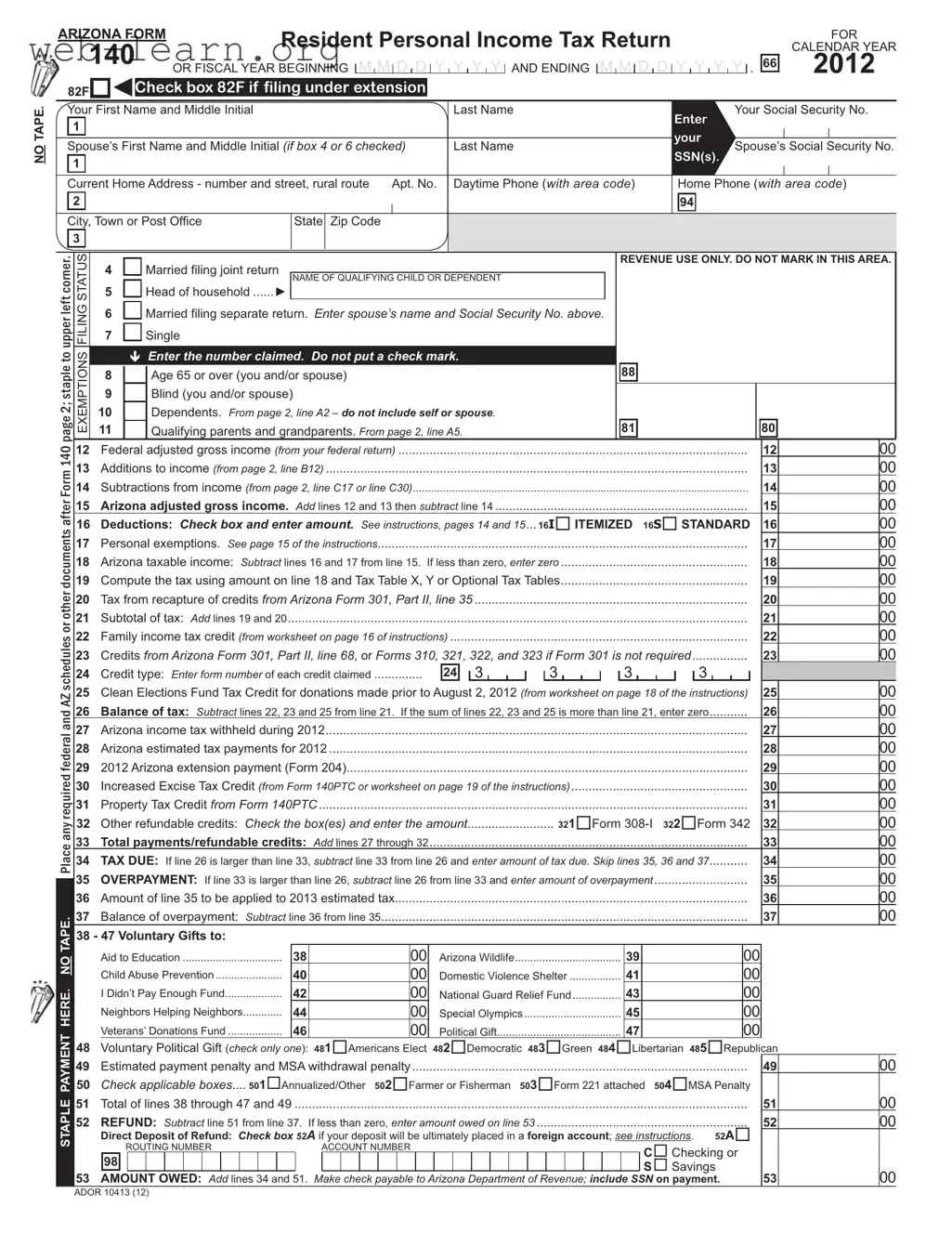
The Arizona Form 140 is an essential document for residents filing their personal income tax returns in the state. This form is used for reporting income, calculating tax liabilities, and claiming various credits and deductions. It covers a calendar year or a fiscal year, depending on the taxpayer's situation. Individuals must provide personal information, including their Social Security number and current home address, as well as details about their filing status—whether they are single, married filing jointly, or head of household. The form also includes sections for exemptions, which can reduce taxable income based on age, blindness, or dependents. Taxpayers need to report their federal adjusted gross income and account for any additions or subtractions to that income. The final tax calculation takes into consideration any credits claimed, which can further lower the amount owed. In addition, the form provides options for direct deposit of refunds and allows for voluntary contributions to various charitable funds. Understanding the intricacies of the Arizona Form 140 is crucial for ensuring accurate and timely filing, ultimately helping residents meet their tax obligations while maximizing potential refunds.
Sample - Arizona 140 Form

88
81 80
REVENUE USE ONLY. DO NOT MARK IN THIS AREA.
NO TAPE.
Place any required federal and AZ schedules or other documents after Form 140 page 2; staple to upper left corner.
OR FISCAL YEAR BEGINNING
M M D D Y Y Y Y
AND ENDING
M M D D Y Y Y Y
.
66
Resident Personal Income Tax Return
ARIZONA FORM
140
Your First Name and Middle Initial Last Name Your Social Security No.
1
Spouse’s First Name and Middle Initial (if box 4 or 6 checked) Last Name Spouse’s Social Security No.
1
Current Home Address - number and street, rural route Apt. No. Daytime Phone (with area code) Home Phone (with area code)
94
2
City, Town or Post Office State Zip Code
8 Age 65 or over (you and/or spouse)
9 Blind (you and/or spouse)
10 Dependents.
From page 2, line A2 – do not include self or spouse.
11
Qualifying parents and grandparents. From page 2, line A5.
12 Federal adjusted gross income (from your federal return) ..................................................................................................... 12 00
13 Additions to income (from page 2, line B12) .......................................................................................................................... 13 00
14 Subtractions from income (from page 2, line C17 or line C30) ............................................................................................................... 14 00
15 Arizona adjusted gross income. Add lines 12 and 13 then subtract line 14 ......................................................................... 15 00
16 Deductions: Check box and enter amount. See instructions, pages 14 and 15 ... 16I
ITEMIZED 16S
STANDARD 16 00
17 Personal exemptions. See page 15 of the instructions ........................................................................................................... 17 00
18 Arizona taxable income: Subtract lines 16 and 17 from line 15. If less than zero, enter zero ...................................................... 18 00
19 Compute the tax using amount on line 18 and Tax Table X, Y or Optional Tax Tables ...................................................... 19 00
20 Tax from recapture of credits from Arizona Form 301, Part II, line 35 ............................................................................... 20 00
21 Subtotal of tax: Add lines 19 and 20 ..................................................................................................................................... 21 00
22 Family income tax credit (from worksheet on page 16 of instructions) ...................................................................................... 22 00
23 Credits from Arizona Form 301, Part II, line 68, or Forms 310, 321, 322, and 323 if Form 301 is not required ................ 23 00
24 Credit type: Enter form number of each credit claimed ..............
24
3 3 3 3
25 Clean Elections Fund Tax Credit for donations made prior to August 2, 2012 (from worksheet on page 18 of the instructions) 25 00
26 Balance of tax: Subtract lines 22, 23 and 25 from line 21. If the sum of lines 22, 23 and 25 is more than line 21, enter zero ........... 26 00
27 Arizona income tax withheld during 2012 .......................................................................................................................... 27 00
28 Arizona estimated tax payments for 2012 ......................................................................................................................... 28 00
29 2012 Arizona extension payment (Form 204) .................................................................................................................... 29 00
30 Increased Excise Tax Credit (from Form 140PTC or worksheet on page 19 of the instructions) ................................................... 30 00
31 Property Tax Credit from Form 140PTC ............................................................................................................................ 31 00
32 Other refundable credits: Check the box(es) and enter the amount ......................... 321
Form 308-I 322
Form 342 32 00
33 Total payments/refundable credits: Add lines 27 through 32 ............................................................................................ 33 00
34 TAX DUE: If line 26 is larger than line 33, subtract line 33 from line 26 and enter amount of tax due. Skip lines 35, 36 and 37 ........... 34 00
35 OVERPAYMENT: If line 33 is larger than line 26, subtract line 26 from line 33 and enter amount of overpayment ........................... 35 00
36 Amount of line 35 to be applied to 2013 estimated tax ...................................................................................................... 36 00
37 Balance of overpayment: Subtract line 36 from line 35 .......................................................................................................... 37 00
38 - 47 Voluntary Gifts to:
48 Voluntary Political Gift (check only one): 481
Americans Elect 482
Democratic 483
Green 484
Libertarian 485
Republican
49 Estimated payment penalty and MSA withdrawal penalty ................................................................................................. 49 00
50 Check applicable boxes .... 501Annualized/Other 502
Farmer or Fisherman 503
Form 221 attached 504
MSA Penalty
51 Total of lines 38 through 47 and 49 ................................................................................................................................... 51 00
52 REFUND: Subtract line 51 from line 37. If less than zero, enter amount owed on line 53 ............................................................. 52 00
98
C Checking or
S Savings
Direct Deposit of Refund: Check box 52A if your deposit will be ultimately placed in a foreign account; see instructions. 52A
ROUTING NUMBER ACCOUNT NUMBER
53 AMOUNT OWED: Add lines 34 and 51. Make check payable to Arizona Department of Revenue; include SSN on payment. 53 00
Aid to Education .................................
38 00
Arizona Wildlife ...................................
39 00
Child Abuse Prevention ......................
40 00
Domestic Violence Shelter .................
41 00
I Didn’t Pay Enough Fund...................
42 00
National Guard Relief Fund ................
43 00
Neighbors Helping Neighbors.............
44 00
Special Olympics ................................
45 00
Veterans’ Donations Fund ..................
46 00
Political Gift.........................................
47 00
3
FILING STATUS
EXEMPTIONS
FOR
CALENDAR YEAR
2012
ADOR 10413 (12)
82F
Check box 82F if filing under extension
Enter
your
SSN(s).
4
Married filing joint return
5 Head of household ......:
NAME OF QUALIFYING CHILD OR DEPENDENT
6 Married filing separate return. Enter spouse’s name and Social Security No. above.
7 Single
STAPLE PAYMENT HERE. NO TAPE.
Enter the number claimed. Do not put a check mark.
PLEASE SIGN HERE
ADOR 10413 (12) AZ Form 140 (2012) Page 2 of 2
Your Name (as shown on page 1) Your Social Security No.
PART A: Dependents, Qualifying Parents and Grandparents - do not list yourself or spouse
If completing Part A, also complete Part C, lines C15 and/or C16 and C17.
A1 List children and other dependents. If more space is needed, attach a separate sheet.
NO. OF MONTHS LIVED
FIRST AND LAST NAME SOCIAL SECURITY NO. RELATIONSHIP IN YOUR HOME IN 2012
A2 Enter total number of persons listed in A1 here and on the front of this form, box 10; also complete Part C below. .. TOTAL A2
A3 a Enter the names of the dependents listed above who do not qualify as your dependent on your federal return:
b Enter dependents listed above who were not claimed on your federal return due to education credits:
A4 List qualifying parents and grandparents. If more space is needed, attach a separate sheet.
You cannot list the same person here and also on line A1. For information on who is a
qualifying parent or grandparent, see page 6 of the instructions.
NO. OF MONTHS LIVED
FIRST AND LAST NAME SOCIAL SECURITY NO. RELATIONSHIP IN YOUR HOME IN 2012
A5 Enter total number of persons listed in A4 here and on the front of this form, box 11 .............................................. TOTAL A5
PART B: Additions to Income
B6 Non-Arizona municipal interest .......................................................................................................................................... B6 00
B7 Ordinary income portion of lump-sum distributions excluded on your federal return ......................................................... B7 00
B8 Total federal depreciation. Also see the instructions for line C22 ............................................................................................ B8 00
B9 Medical savings account (MSA) distributions. See page 7 of the instructions........................................................................ B9 00
B10 I.R.C. §179 expense in excess of allowable amount. Also see the instructions for line C26 ................................................... B10 00
B11 Other additions to income. See instructions and attach your own schedule .............................................................................. B11 00
B12 Total: Add lines B6 through B11. Enter here and on the front of this form, line 13 ........................................................................ B12 00
PART C: Subtractions From Income
C13 Exemption: Age 65 or over. Multiply the number in box 8, page 1, by $2,100 ....................................... C13 00
C14 Exemption: Blind. Multiply the number in box 9, page 1, by $1,500 ....................................................... C14 00
C15 Exemption: Dependents. Multiply the number in box 10, page 1, by $2,300 ......................................... C15 00
C16 Exemption: Qualifying parents and grandparents. Multiply the number in
box 11, page 1, by $10,000
.................................................................................................................... C16 00
C17 Total exemptions: Add lines C13 through C16. If you have no other subtractions from
income, skip lines C18 through C30 and enter the amount on line C17 on Form 140, Page 1, line 14 ................... C17 00
C18 Interest on U.S. obligations such as U.S. savings bonds and treasury bills ...................................................................... C18 00
C19 Exclusion for federal, Arizona state or local government pensions (up to $2,500 per taxpayer) ....................................... C19 00
C20 Arizona state lottery winnings included as income on your federal return (up to $5,000 only) .......................................... C20 00
C21 U.S. Social Security or Railroad Retirement Act benefits included as income on your federal return (the taxable amount) . C21 00
C22 Recalculated Arizona depreciation .................................................................................................................................... C22 00
C23 Certain wages of American Indians ................................................................................................................................... C23 00
C24 Income tax refund from other states. See instructions ......................................................................................................... C24 00
C25 Deposits and employer contributions into MSAs. See page 11 of the instructions ................................................................. C25 00
C26 Adjustment for I.R.C. §179 expense not allowed .............................................................................................................. C26 00
C27 Pay received for active service as a member of the reserves, national guard or the U.S. armed forces .......................... C27 00
C28 Net operating loss adjustment. See instructions before you enter any amount here ................................................................. C28 00
C29 Other subtractions from income. See instructions and attach your own schedule .................................................................... C29 00
C30 Total: Add lines C17 through C29. Enter here and on the front of this form, line 14 ................................................. C30 00
Part D: Last Name(s) Used in Prior Years – if different from name(s) used in current year
D31
If you are sending a payment with this return, mail to Arizona Department of Revenue, PO Box 52016, Phoenix, AZ, 85072-2016.
If you are expecting a refund or owe no tax, or owe tax but are not sending a payment, mail to Arizona Department of Revenue, PO Box 52138, Phoenix, AZ, 85072-2138.
!
I have read this return and any attachments with it. Under penalties of perjury, I declare that to the best of my knowledge and belief, they are
true, correct and complete. Declaration of preparer (other than taxpayer) is based on all information of which preparer has any knowledge.
YOUR SIGNATURE DATE OCCUPATION
SPOUSE’S SIGNATURE DATE SPOUSE’S OCCUPATION
PAID PREPARER’S SIGNATURE DATE FIRM’S NAME (PREPARER’S IF SELF-EMPLOYED)
( )
PAID PREPARER’S TIN PAID PREPARER’S ADDRESS PAID PREPARER’S PHONE NO.
!

Form Information

Fact Name Details
Purpose The Arizona Form 140 is used for filing personal income tax returns for residents of Arizona.
Filing Period This form can be used for the calendar year or a fiscal year, depending on the taxpayer's preference.
Governing Law The form is governed by Arizona Revised Statutes, Title 43, which outlines the state's income tax laws.
Eligibility Residents of Arizona who earn income and are required to file a tax return must use this form.
Filing Extensions Taxpayers can check a box on the form if they are filing under an extension, allowing additional time to submit their return.

Detailed Guide for Filling Out Arizona 140

Filling out the Arizona Form 140 is an essential step in filing your state income tax return. It requires careful attention to detail to ensure all information is accurate. Below are the steps to help you navigate the process smoothly.

  1. Begin by checking the box if you are filing under an extension.
  2. Enter your first name, middle initial, and last name. Include your Social Security number.
  3. If applicable, provide your spouse's first name, middle initial, last name, and Social Security number.
  4. Fill in your current home address, including street number, rural route, apartment number, city, state, and zip code.
  5. Indicate your filing status by selecting one of the options: married filing jointly, head of household, married filing separately, or single.
  6. List the number of exemptions you are claiming, including age and blindness status if applicable.
  7. Provide your federal adjusted gross income as reported on your federal return.
  8. Complete the sections for additions and subtractions from income, following the instructions provided on the form.
  9. Calculate your Arizona adjusted gross income by adding and subtracting the relevant lines.
  10. Determine your deductions by checking the appropriate box for itemized or standard deductions and entering the amount.
  11. Calculate your Arizona taxable income by subtracting deductions from your adjusted gross income.
  12. Compute your tax using the tax table provided in the instructions.
  13. Complete the sections for tax credits and payments, including any withholding or estimated tax payments.
  14. If applicable, determine whether you owe tax or are due a refund by completing the relevant calculations.
  15. Sign and date the form, and ensure your spouse does the same if filing jointly.
  16. Mail the completed form to the appropriate address based on whether you are sending a payment or expecting a refund.

Once you have completed the form, review it carefully to ensure all information is accurate and complete. This will help avoid any delays in processing your return or receiving your refund.

Obtain Answers on Arizona 140

  1. What is the Arizona Form 140?

    The Arizona Form 140 is the Resident Personal Income Tax Return used by individuals to report their income and calculate their state tax liability. This form is specifically for residents of Arizona and is applicable for both calendar and fiscal years.

  2. Who needs to file Form 140?

    Any Arizona resident who earns income during the tax year must file Form 140. This includes individuals filing as single, married filing jointly, married filing separately, or head of household. Additionally, if you are claiming any dependents or qualifying parents and grandparents, you will need to complete this form.

  3. What information is required to complete Form 140?

    To complete Form 140, you will need to provide personal information such as your name, Social Security number, and current address. You must also report your federal adjusted gross income, any additions or subtractions to that income, and details about your deductions and exemptions. If applicable, include information about dependents and any tax credits you are claiming.

  4. How do I determine my Arizona adjusted gross income?

    Your Arizona adjusted gross income is calculated by taking your federal adjusted gross income and adding any state-specific income additions. From this total, you will subtract any applicable deductions and exemptions. The final amount is your Arizona adjusted gross income, which is reported on the form.

  5. What should I do if I owe taxes?

    If you owe taxes after completing Form 140, you will need to submit your payment along with the form. The amount due is calculated on the form itself. Payments can be made by check or electronic payment, and the form provides specific mailing addresses based on whether you are sending a payment or expecting a refund.

  6. Can I file Form 140 electronically?

    Yes, Arizona allows residents to file Form 140 electronically through various tax preparation software programs. E-filing can expedite the processing of your return and any potential refund. Make sure to follow the instructions provided by the software to ensure accurate submission.

  7. What are the penalties for not filing Form 140?

    Failing to file Form 140 by the due date can result in penalties and interest on any unpaid taxes. Arizona imposes a late filing penalty, which increases the longer you delay filing. To avoid these penalties, it is advisable to file your return on time or apply for an extension if necessary.

Common mistakes

Filling out the Arizona Form 140 can be straightforward, but many people make common mistakes that can lead to delays or issues with their tax returns. One common error is failing to sign the form. Both the taxpayer and spouse must sign if filing jointly. Without signatures, the form is considered incomplete.

Another mistake is not checking the appropriate filing status. The form offers several options, including "Married filing jointly" and "Single." Selecting the wrong status can affect tax calculations and eligibility for certain credits.

Many individuals overlook the importance of accurately reporting Social Security numbers. Each person's number must be correct and match the name on the form. Errors in this area can lead to processing delays.

Some filers neglect to include all sources of income. It is essential to report the total federal adjusted gross income as indicated on the federal return. Missing income can result in incorrect tax calculations and potential penalties.

Another frequent oversight involves the deductions section. Taxpayers must decide between itemized and standard deductions. Selecting the wrong option can significantly impact the final tax amount.

People often forget to include dependents correctly. The form requires a list of qualifying children and dependents, and failing to do so can affect eligibility for tax credits.

Additionally, not reviewing the instructions carefully can lead to mistakes. Each line has specific requirements, and skipping over instructions can result in incorrect entries.

Some filers may also miscalculate tax credits. It is important to ensure that all claimed credits are supported by documentation and correctly entered on the form.

Another common issue is failing to double-check calculations. Simple arithmetic errors can lead to incorrect tax due or overpayment amounts, which can complicate the filing process.

Lastly, individuals sometimes forget to keep copies of their submitted forms. Retaining a copy is crucial for future reference and can be helpful if any issues arise with the return.

Documents used along the form

The Arizona Form 140 is essential for filing personal income tax returns in Arizona. Several other documents often accompany this form to provide additional information or support claims made in the tax return. Below is a list of these commonly used forms and documents.

  • Arizona Form 204: This form is used to request an extension for filing the Arizona personal income tax return. Taxpayers can use it to extend their filing deadline, but any tax owed must still be paid by the original due date.
  • Arizona Form 140PTC: This form is for claiming a property tax credit. It helps eligible taxpayers reduce their tax liability based on property taxes paid, and it is particularly useful for those who qualify based on income and property ownership.
  • Arizona Form 301: This document is used to claim various tax credits available in Arizona. Taxpayers can list specific credits they are eligible for, which can help lower their overall tax liability.
  • Arizona Form 310: This form is used to claim the credit for donations made to qualifying charitable organizations. It allows taxpayers to receive a credit for contributions that support certain community services and programs.

Each of these forms plays a significant role in the overall tax filing process in Arizona. They help ensure that taxpayers accurately report their income and claim any credits or deductions they are entitled to, ultimately leading to a fair assessment of their tax obligations.

Similar forms

The Arizona Form 140 is an important document for residents filing their personal income tax returns. It shares similarities with several other tax forms used in different contexts. Here are nine documents that are similar to the Arizona Form 140, along with explanations of how they relate:

  • Federal Form 1040: This is the standard individual income tax return form used in the United States. Like the Arizona Form 140, it collects information about income, deductions, and credits to determine tax liability.
  • Arizona Form 140A: This is a simplified version of the Arizona Form 140. It is designed for individuals with a straightforward tax situation, similar to how the 140 form accommodates various filing statuses.
  • Arizona Form 204: This form is used for requesting an extension of time to file the Arizona income tax return. It is similar to the Arizona Form 140 in that it involves income tax but focuses on the timing of the submission.
  • Arizona Form 301: This document is used to claim various tax credits in Arizona. Like the Arizona Form 140, it requires detailed income information and is essential for calculating the final tax owed or refund due.
  • Federal Form 8862: This form is used to claim the Earned Income Tax Credit after a prior denial. It shares similarities with the Arizona Form 140 in that both require specific eligibility criteria to be met for tax benefits.
  • Arizona Form 140PTC: This form is used to claim the Property Tax Credit. It is similar to the Arizona Form 140 in that it requires income details and is aimed at providing tax relief based on specific criteria.
  • Arizona Form 321: This form is used to claim the credit for contributions to qualifying charitable organizations. Like the Arizona Form 140, it involves reporting income and calculating credits against tax liability.
  • Arizona Form 322: This form is for claiming the credit for contributions to school tuition organizations. Similar to the Arizona Form 140, it requires detailed financial information to determine eligibility for the credit.
  • Federal Form 8888: This form allows taxpayers to split their tax refund among different accounts. It is similar to the Arizona Form 140 in that both deal with the final outcome of the tax return, whether it be a refund or amount owed.

Understanding these forms can help you navigate the tax filing process more effectively. Each document serves a specific purpose but shares common themes with the Arizona Form 140, primarily revolving around income reporting and tax liability calculations.

Dos and Don'ts

When filling out the Arizona 140 form, it’s essential to be careful and precise. Here’s a list of things you should and shouldn’t do to ensure your submission is correct and processed without delays.

  • Do double-check your Social Security number. An incorrect number can lead to processing delays.
  • Do use black or blue ink to fill out the form. This ensures that your information is easily readable.
  • Do sign and date your return. A missing signature can result in your form being rejected.
  • Do keep a copy of your completed form for your records. This can be helpful in case of any future inquiries.
  • Don't use tape or staples on the form. This can interfere with scanning and processing.
  • Don't leave any sections blank. If a question doesn’t apply to you, write “N/A” to indicate it was considered.
  • Don't forget to include all necessary attachments. Missing documents can delay your refund or result in additional inquiries.
  • Don't rush through the form. Take your time to ensure accuracy, as mistakes can be costly.

By following these guidelines, you can help ensure that your Arizona 140 form is completed correctly and submitted on time. Pay close attention to each detail, and don’t hesitate to seek assistance if needed.

Misconceptions

Understanding the Arizona Form 140 can be challenging, and several misconceptions often arise regarding its use and requirements. Below are six common misconceptions, along with clarifications to help individuals navigate this important tax document.

  • Misconception 1: The Arizona Form 140 is only for residents.
  • While primarily designed for Arizona residents, non-residents who earn income in Arizona may also need to file this form, depending on their specific circumstances.

  • Misconception 2: You can use tape to attach documents to the form.
  • In fact, the instructions explicitly state, "NO TAPE." This means that any necessary documents should be stapled, ensuring that the form is processed correctly.

  • Misconception 3: Filing under an extension means you do not need to pay taxes until later.
  • Filing under extension allows additional time to submit the form, but it does not extend the time to pay any taxes owed. Taxpayers should estimate and pay any owed taxes by the original deadline to avoid penalties.

  • Misconception 4: You cannot claim dependents if they are not on your federal return.
  • It is possible to claim dependents on the Arizona Form 140 even if they are not included on the federal return. However, specific criteria must be met, and documentation may be required.

  • Misconception 5: The Arizona Form 140 does not require any additional schedules.
  • Depending on your financial situation, additional schedules may be necessary. For example, if claiming certain credits or deductions, forms like Arizona Form 301 may need to be included.

  • Misconception 6: You do not need to sign the form if you are filing electronically.
  • Even when filing electronically, a signature is still required. This may be done electronically, but it is essential to follow the specific instructions provided for electronic submissions.

Key takeaways

  • The Arizona Form 140 is used for filing personal income tax returns for residents.

  • Ensure you use the correct calendar year or fiscal year dates when filling out the form.

  • Do not use tape when submitting the form. Staple the pages together instead.

  • Check the appropriate box if you are filing under an extension.

  • Provide accurate personal information, including Social Security numbers for you and your spouse, if applicable.

  • Claim the correct number of exemptions based on your age, blindness status, and dependents.

  • Calculate your Arizona adjusted gross income by adding your federal adjusted gross income and any additions, then subtracting any subtractions.

  • Choose between itemized deductions and standard deductions based on your financial situation.

  • Complete all relevant sections regarding tax credits, including family income tax credits and any other refundable credits.

  • Double-check your calculations to ensure accuracy before submitting the form to avoid delays or penalties.