Homepage Blank Application For Divorce Form
Outline

When couples decide to end their marriage, one of the first steps they must take is to complete an Application For Divorce form. This essential document serves as the official request to the court to dissolve the marriage and outlines key details that will guide the legal process. Typically, the form requires basic information about both spouses, including their names, addresses, and the date of marriage. Additionally, it may ask for the grounds for divorce, which can vary by state, and any pertinent details regarding children, property, and financial obligations. Completing the form accurately is crucial, as it sets the stage for subsequent legal proceedings and can impact issues like custody arrangements and asset division. Understanding the components of this form helps individuals navigate the complexities of divorce with greater confidence and clarity.


Sample - Application For Divorce Form

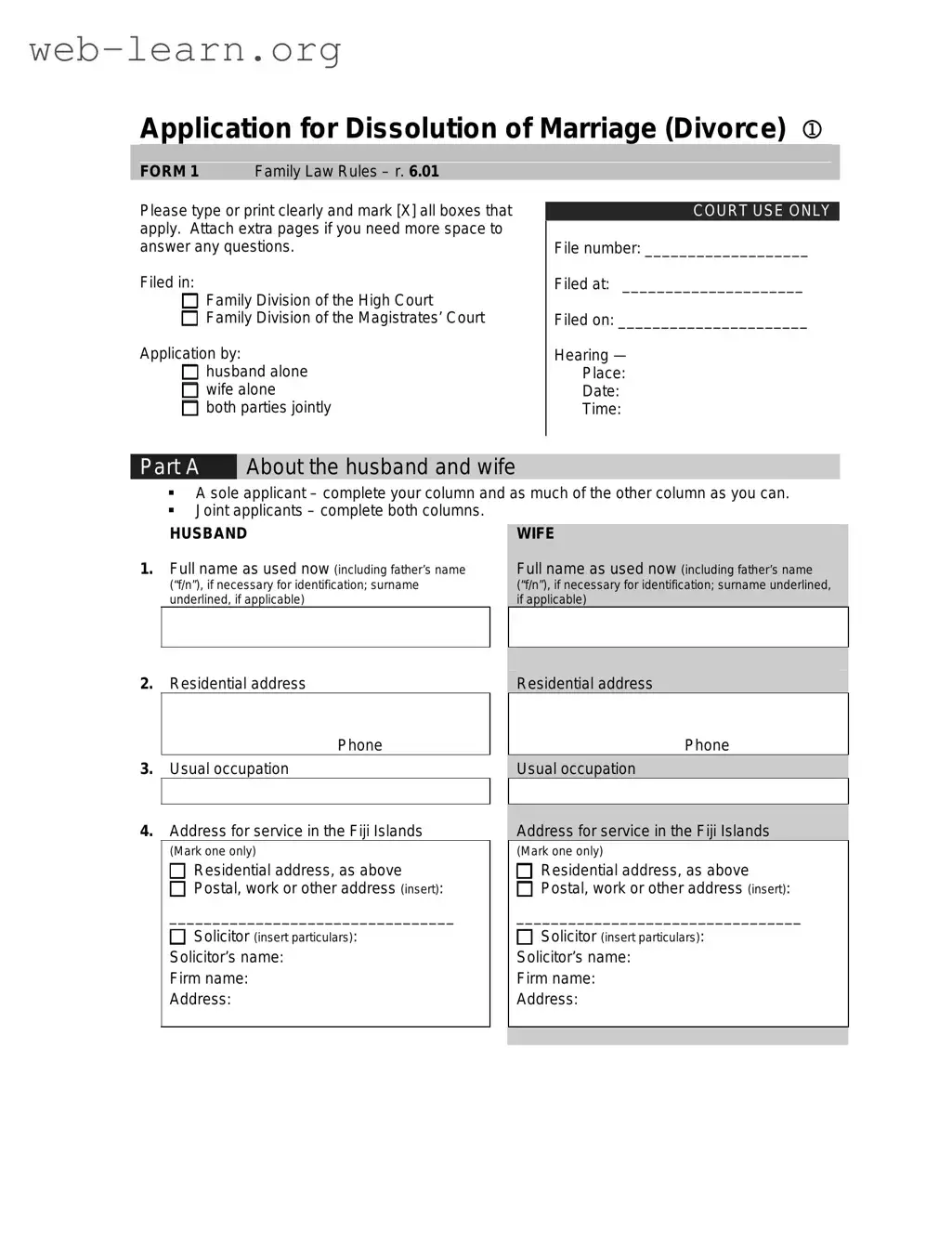
Application for Dissolution of Marriage (Divorce) 1
FORM 1 Family Law Rules – r. 6.01
COURT USE ONLYPlease type or print clearly and mark [X] all boxes that
apply. Attach extra pages if you need more space to
answer any questions.
Filed in:
Family Division of the High Court
Family Division of the Magistrates’ Court
Application by:
husband alone
wife alone
both parties jointly
File number: ___________________
Filed at: _____________________
Filed on: ______________________
Hearing —
Place:
Date:
Time:
Part A About the husband and wife
A sole applicant – complete your column and as much of the other column as you can.
Joint applicants – complete both columns.
1.
HUSBAND
Full name as used now
(including father’s name
(“f/n”), if necessary for identification; surname
underlined, if applicable)
WIFE
Full name as used now (including father’s name
(“f/n”), if necessary for identification; surname underlined,
if applicable)
2.
Residential address
Residential address
Phone
Phone
3.
Usual occupation
Usual occupation
4.
Address for service in the Fiji Islands
(Mark one only)
Residential address, as above
Postal, work or other address
(insert):
_________________________________
Solicitor
(insert particulars):
Solicitor’s name:
Firm name:
Address:
(Mark one only)
Residential address, as above
Postal, work or other address
(insert):
_________________________________
Solicitor
(insert particulars):
Solicitor’s name:
Firm name:
Address:
2
5. Basis of jurisdiction
MARK [x] EVERY BOX THAT APPLIES TO THE HUSBAND AND EVERY BOX THAT APPLIESTO THE WIFE
HUSBAND
WIFE
Fiji Islands citizen
Currently lives and intends to live
permanently in the Fiji Islands
Ordinarily lives in the Fiji Islands and has
done so for 12 months immediately before
filing of this application
Fiji Islands citizen
Currently lives and intends to live
permanently in the Fiji Islands
Ordinarily lives in the Fiji Islands and has
done so for 12 months immediately before
filing of this application
Part B About the marriage
Provide the following information directly from your marriage certificate.
6. On what date, at what place and in which country did you get married?
DAY/ MONTH / YEAR TOWN/CITY/LOCALITY COUNTRY
/ /
7. Names as they appear on the marriage certificate
Husband
Wife
Part C
About the break-down of the marriage and any reconciliation
You must have been separated from your spouse for not less than 12 months before you sign this application and file it with
the Court.
8. When did you separate?
/ /
Day / Month / Year
9. Was the date you wrote at item 8 the date on which you regarded the marriage as over?
Yes
No On what date did you regard the marriage as over?
HUSBAND
WIFE
DAY / MONTH / YEAR DAY / MONTH / YEAR
/ / / /
You should be prepared to provide the Court with information about what happened or what was said on that date to show that
one or both of you intended to end the marriage.
3
10. At any time after you separated, have you and your spouse resumed living together?
No
Yes PROVIDE THE FOLLOWING DETAILS
Day / Month / Year Day / Month / Year
Period
From / / to / / months days
11. Do you think it likely that you will live together again as husband and wife?
No
Yes
12. Have you attempted reconciliation?
No
Yes
BRIEFLY DESCRIBE THE ATTEMPT
Part D About other Court cases and orders
Before the Court can decide your Application for Dissolution of Marriage, it needs to know:
13. Do you have proceedings for an order of nullity?
(Proceedings for dissolution of marriage will not proceed if proceeding for nullity is before the Court — s.33)
No
Yes
14. Are there any ongoing cases in this or any other Court on any other family law matters that
involve any of the parties or any of the children listed on this Form?
No
GO TO ITEM 16
Yes PROVIDE THE FOLLOWING DETAILS
Court name and place
Court file number Next court date
/ /
Names of parties to application
Nature of proceedings
IF THERE IS MORE THAN ONE CASE, PLEASE ATTACH AN EXTRA PAGE, NUMBERING THE NEXT CASE ITEM 14, PAGE 2 AND SO ON.
4
15. Are orders already granted?
No GO TO ITEM 16
Yes EITHER attach a full copy of the order, parenting plan, agreement or undertaking OR set out
details below (attach extra pages if you need extra space, numbering them Item 15, page 2,
and so on)
Attached is/are copy/copies of the following (mark [X] the boxes that apply)
court order undertaking parenting plan agreement
OR
GIVE THE FOLLOWING DETAILS:
Court name and place Court file number Date
/ /
Names of parties
Details of the order / undertaking / agreement / parenting plan
IF THERE IS MORE THAN ONE CASE, PLEASE ATTACH AN EXTRA PAGE, NUMBERING THE NEXT CASE ITEM 15, PAGE 2, AND SO ON.
Part E About the Children under 18
16. Are there any children of the marriage currently under 18?
Include:
Any children of you and your spouse born before the marriage or after separation.
Children adopted by you and your spouse (or either of you with the consent of the other)
Any other child (including a child of neither of you) who was treated as a member of your family
immediately before your final separation.
No
GO TO PART F Yes COMPLETE ITEMS 17 AND 18
17. Give the following details for each child:
Full name M/F Date of birth Relationship to parties
Child 1:
/ /
Child 2:
/ /
Child 3:
/ /
Child 4:
/ /
Child 5:
/ /
Child 6:
/ /
Child 7
/ /
Child 8:
/ /
IF THERE ARE MORE CHILDREN, PLEASE ATTACH AN EXTRA PAGE, NUMBERING IT ITEM 18, PAGE 2.
5
18. The Court needs to determine whether the arrangements for your children are proper in all the
circumstances. To assist the Court to do this, please set out below the arrangements for the children
including details about their home, schooling, health, financial support (including any maintenance
paid for them), their contact with each of their parents and any other matter you consider will assist
the Court.
u ments described in item 18?
ision:
6
19. Do yo propose any changes to the arrange
No
Yes
Please provide details, in relation to each child, of any significant changes that are planned – for
example, changing residence, schooling arrangements or superv
7
Part F Affidavit of applicant(s)
HE DATE YOU SEPARATED.
davit. You must sign it in the presence of a Justice of the Peace, notary
blic or lawyer. The person witnessing the affidavit will fill in the place and date.
oth the husband and wife are to sign the affidavit ONLY if you are applying together. You may do so
fore different persons and at different times or before the same witness on the same occasion. If only one of
u is applying for the divorce, only you are to sign the affidavit. You do not have to ask your spouse.
PLEASE DO NOT COMPLETE THIS PART OF THE FORM UNTIL YOU ARE WITH A PERSON WHO IS
LEGALLY ABLE TO WITNESS YOUR SIGNATURE – PLEASE DO NOT SIGN UNLESS IT IS AT LEAST 12
ONTHS SINCE T
M
You must complete the following affi
pu
B
be
yo
Husband
Wife
I swear*/affirm* that:
I am the*/an* applicant;
I swear*/affirm* that:
I have read this application;
the facts of which I have personal
I have read this application;
the facts of which I have pers
kn
a
kn
I am the*/an* applicant;
ts are true to the best of my
owledge are true; and
ll other facts are true to the best of my
onal
knowledge are true; and
all other fac
owledge, information and belief. knowledge, information and belief.
Signature of husband
Signature of wife
Place Date
Place Date
/ / / /
Before me (signature of witness)
Full name of witness (please print) Full name of witness (please print)
r Oaths Justice of the Peace/Commissioner for Oaths
Notary
Justice of the Peace/Commissioner fo
Notary
Lawyer Lawyer
elete whichever is inapplicable * D
This application was prepared by:
applicant(s)
lawyer for applicant(s)
PRINT LAWYER’S FIRM NAME
Notice of Application — Dissolution of Marriage (Divorce)
Complete this notice if you are applying on your own, then pin the notice to the front
of the copy of the Application for Dissolution of Marriage (Divorce) to be served on
your spouse.
To
(name and address of spouse)
In the attached application your spouse is applying for divorce. The Court has set down the
hearing of this application at the time and place shown on page 1 of the Application for
Dissolution of Marriage (Divorce).
WHAT STEPS YOU NEED TO TAKE AS THE RECIPIENT OF THIS NOTICE
1 You should check the details given by your spouse in the attached application to make
sure that they are correct to the best of your knowledge.
2 You should sign, date and return the attached Acknowledgment of Service (Form 21)
to the person who served the Application for Divorce.
3 If you want the divorce to be granted, you do not have to file any other documents.
4 If you want the divorce to be granted, but you disagree with facts contained in the
application, you may file a Response (Marital Status Proceedings) (Form 4) and
appear in person on the hearing date.
5 If you do not want the divorce to be granted you must complete a Response
(Marital Status Proceedings) (Form 4) asking for the application to be dismissed. You
will need to set out grounds on which you seek the dismissal. You will need to file the
Response with the Court:
— if the application was served in the Fiji Islands, within 28 days after it was served; or
— if it was served overseas, within 42 days of the application being served.
After filing the Response with the Court you must also serve a copy of it on your
spouse. You can obtain instructions on how to serve it from the court registry.
You must come to the hearing. If you do not attend, the Court may determine the
Application for Divorce in your absence.
PROPERTY AND MAINTENANCE
If you have not applied to the Court for orders about property or maintenance, you may do
so by a separate application (Form 9 for applications relating to property only or to both
property and maintenance; Form 5 for applications for maintenance only) within 2 years of
the date the divorce becomes final. After that time you must obtain the permission of the
Court to apply.
Signature of Registry Officer ______________________________Date / /

Form Information

Fact Name Description
Purpose The Application for Divorce form initiates the divorce process in court.
Governing Law Each state has specific laws governing divorce applications. For example, in California, it's governed by the Family Code.
Filing Requirements Typically, you must file the form with the court in the county where either spouse resides.
Information Needed Basic information about both spouses, marriage details, and grounds for divorce are required.
Filing Fees Most states require a filing fee, which varies by jurisdiction.
Response Time The other spouse usually has a set period to respond to the application after it is served.
Amendments If necessary, you can amend the application to correct errors or add information.
Legal Representation While you can file without a lawyer, seeking legal advice is often beneficial for navigating the process.

Detailed Guide for Filling Out Application For Divorce

After gathering all necessary information, you are ready to fill out the Application for Divorce form. Completing this form accurately is essential for moving forward with the divorce process. Below are the steps to guide you through filling out the form.

  1. Begin with your personal information. Enter your full name, address, and contact details in the designated fields.
  2. Provide your spouse's information. Include their full name, address, and contact details as well.
  3. Indicate the date of your marriage. Make sure to include the month, day, and year.
  4. State the date of separation. This should be the date when you and your spouse began living apart.
  5. Specify the grounds for divorce. Choose the appropriate reason based on your situation, such as irreconcilable differences.
  6. List any children from the marriage. Include their names and birth dates, if applicable.
  7. Detail any property or assets that need to be divided. This may include real estate, vehicles, or financial accounts.
  8. Provide any additional information as required by the form. This may involve answering questions about spousal support or other relevant matters.
  9. Review the completed form for accuracy. Ensure all sections are filled out correctly and clearly.
  10. Sign and date the form at the bottom. Your signature confirms that the information provided is true and accurate.

Obtain Answers on Application For Divorce

  1. What is the Application for Divorce form?

    The Application for Divorce form is a legal document that initiates the divorce process. It outlines the reasons for the divorce and provides necessary information about both spouses, including their names, addresses, and any children involved.

  2. Who can file the Application for Divorce?

    Either spouse can file the Application for Divorce. One must meet the residency requirements of the state where the application is filed. Typically, at least one spouse must have lived in the state for a certain period before filing.

  3. What information do I need to provide?

    The form requires various details, including:

    • Full names and addresses of both spouses
    • Date of marriage
    • Reasons for the divorce
    • Information about children, if applicable
    • Financial information, such as income and assets
  4. How do I file the Application for Divorce?

    To file the Application for Divorce, complete the form and submit it to the appropriate court in your jurisdiction. You may be required to pay a filing fee. Check with your local court for specific procedures and fees.

  5. What happens after I file the Application for Divorce?

    After filing, the court will review your application. If everything is in order, a hearing date may be set. You must also serve your spouse with a copy of the application and any related documents.

  6. Can I change my mind after filing?

    Yes, you can withdraw your Application for Divorce at any time before the court finalizes the divorce. However, you must formally notify the court and your spouse of your decision.

  7. What if my spouse does not agree to the divorce?

    If your spouse contests the divorce, the case may proceed to court. The court will then determine the outcome based on the evidence presented. It is advisable to seek legal counsel in such situations.

  8. Do I need a lawyer to file the Application for Divorce?

    While it is not mandatory to have a lawyer, it is highly recommended. A lawyer can help ensure that the application is completed correctly and can provide guidance throughout the divorce process.

  9. How long does the divorce process take?

    The duration of the divorce process varies by state and the complexity of the case. Some divorces can be finalized in a few months, while others may take a year or more, especially if there are disputes over custody or property.

  10. Are there any resources available to help me?

    Yes, many resources are available, including legal aid organizations, online guides, and support groups. Local court websites often provide information and resources for individuals navigating the divorce process.

Common mistakes

Filling out the Application for Divorce form can be a complex process. Many individuals make common mistakes that can lead to delays or complications in their divorce proceedings. Understanding these pitfalls can help ensure a smoother experience.

One frequent mistake is providing incomplete information. Applicants often overlook sections that require detailed responses. Omitting critical details, such as financial information or the names of children, can result in the court rejecting the application or requesting additional information, which prolongs the process.

Another common error involves incorrect or inconsistent information. When individuals do not double-check their entries, discrepancies can arise. For instance, using different spellings for names or varying addresses can create confusion and may require clarification from the court.

Failure to sign the application is another mistake that can cause significant delays. Some individuals may forget to sign the form or neglect to date it properly. Without a signature, the application is considered incomplete, and the court cannot process it.

Additionally, applicants sometimes neglect to review the specific requirements of their jurisdiction. Each state may have different rules regarding the Application for Divorce. Not adhering to local regulations can lead to rejection or unnecessary complications in the filing process.

People also tend to underestimate the importance of providing accurate financial disclosures. Incomplete or misleading financial information can have serious consequences, including potential legal repercussions. Transparency is crucial in divorce proceedings, especially when determining asset division and support obligations.

Finally, many individuals fail to seek assistance when needed. Navigating the divorce process can be overwhelming. Not utilizing available resources, such as legal aid or online guides, can lead to mistakes that might have been easily avoided with proper support.

Documents used along the form

When filing for divorce, several additional forms and documents may be required to support your application. Each of these documents serves a specific purpose and helps ensure that the divorce process goes smoothly. Below is a list of common forms you might encounter along with a brief description of each.

  • Summons: This document notifies your spouse that you are filing for divorce. It includes important information about the case and outlines their rights and obligations.
  • Financial Affidavit: A detailed statement of your financial situation, including income, expenses, assets, and debts. This form helps the court understand your financial needs and responsibilities.
  • Child Custody Agreement: If you have children, this document outlines how custody and visitation will be handled. It addresses the best interests of the children and may include parenting plans.
  • Property Settlement Agreement: This agreement details how marital property and debts will be divided between you and your spouse. It can help avoid disputes and clarify each party's rights.
  • Notice of Appearance: If your spouse hires an attorney, this document informs the court that the attorney is representing them in the case.
  • Certificate of Service: This form confirms that all necessary documents have been properly delivered to your spouse. It is important for maintaining transparency in the legal process.
  • Request for Hearing: If you need to schedule a court hearing for any reason, this form requests that the court set a date for your case to be heard.
  • Final Judgment of Divorce: This document officially concludes the divorce process. It outlines the court's decisions regarding custody, support, and property division.
  • Motion to Modify: If circumstances change after the divorce is finalized, this form requests the court to alter previous orders related to custody, support, or property.

Understanding these documents can help you navigate the divorce process more effectively. Each form plays a crucial role in ensuring that your rights are protected and that the court has all necessary information to make informed decisions.

Similar forms

  • Petition for Dissolution of Marriage: This document initiates the divorce process, similar to the Application for Divorce, by formally requesting the court to end the marriage.
  • Response to Petition: After receiving a divorce petition, this document allows the other spouse to respond, outlining their position on the divorce and any related issues.
  • Financial Affidavit: This form provides a detailed account of each spouse's income, expenses, assets, and debts, which is crucial for determining support and division of property.
  • Child Custody Agreement: This document outlines how parents will share custody and make decisions regarding their children, similar to the Application for Divorce in addressing family matters.
  • Marital Settlement Agreement: This agreement details how assets and debts will be divided and any support arrangements, paralleling the Application for Divorce by resolving key issues.
  • Motion for Temporary Orders: This document requests the court to issue temporary orders regarding custody, support, or property while the divorce is pending, similar in its purpose to the Application for Divorce.
  • Notice of Hearing: This form informs parties of a scheduled court hearing related to the divorce, ensuring that everyone is aware of important dates, much like the Application for Divorce.
  • Summons: This document notifies the other spouse that a divorce action has been filed and outlines their rights and responsibilities, serving a similar function as the Application for Divorce.
  • Affidavit of Service: This form confirms that the divorce papers were delivered to the other spouse, which is essential for the court's jurisdiction, akin to the Application for Divorce.
  • Final Judgment of Divorce: This document finalizes the divorce, detailing the court's decisions on all issues, similar to how the Application for Divorce starts the process of resolving those issues.

Dos and Don'ts

When filling out the Application For Divorce form, it's important to approach the process with care. Here are ten essential do's and don'ts to keep in mind:

  • Do read the instructions carefully before starting.
  • Do provide accurate and truthful information.
  • Do double-check your spelling and grammar.
  • Do keep a copy of the completed form for your records.
  • Do file your application in the correct jurisdiction.
  • Don't leave any sections blank unless instructed.
  • Don't use jargon or unclear language.
  • Don't rush through the form; take your time to ensure accuracy.
  • Don't forget to sign and date the application.
  • Don't submit the form without reviewing it first.

Taking these steps seriously can make a significant difference in your divorce process. Make sure to follow these guidelines to avoid unnecessary complications.

Misconceptions

When it comes to the Application For Divorce form, many misunderstandings can arise. Here are nine common misconceptions that people often have:

  1. Filing for divorce is complicated.

    Many believe that the process is overly complex. In reality, while it can be emotional, the paperwork is often straightforward and manageable.

  2. You need a lawyer to file.

    While having a lawyer can be helpful, it is not mandatory. Individuals can file on their own if they feel comfortable doing so.

  3. Divorce forms are the same in every state.

    Each state has its own specific forms and requirements. It's essential to use the correct forms for your state.

  4. You must prove fault to get a divorce.

    Many think they need to show that one spouse is at fault. However, most states allow for no-fault divorce, which simplifies the process.

  5. Filing for divorce means you will go to court.

    While some cases do end up in court, many divorces are settled outside of court through negotiation or mediation.

  6. You can’t change the form once it’s filed.

    People often think that once a form is submitted, it cannot be altered. In fact, you can amend your application if necessary.

  7. All assets will automatically be split 50/50.

    This is a common belief, but asset division depends on state laws and individual circumstances.

  8. Children always have to choose between parents.

    Some fear that children will be forced to choose sides. Courts prioritize the best interests of the child, focusing on their well-being.

  9. You can’t file for divorce if your spouse disagrees.

    Even if one spouse does not agree, you can still file for divorce. The process can continue without mutual consent.

Understanding these misconceptions can help ease the process and clarify what to expect when filing for divorce.

Key takeaways

Filling out the Application for Divorce form is an important step in the divorce process. Here are some key takeaways to keep in mind:

  • Ensure you have all necessary personal information, including full names, addresses, and dates of birth for both parties.
  • Clearly state the grounds for divorce. Familiarize yourself with the acceptable reasons in your state.
  • Provide accurate details regarding any children involved, including their names and ages.
  • Be prepared to disclose information about marital assets and debts. Transparency is crucial.
  • Double-check for any required signatures. Both parties may need to sign certain sections.
  • Understand the filing fees associated with submitting the application. Fees vary by state.
  • File the application with the appropriate court. Know your local court’s requirements for submission.
  • After filing, keep copies of all documents for your records. This will help in future proceedings.
  • Consider seeking legal advice if you have questions or concerns about the process. Professional guidance can be beneficial.

By following these key points, you can navigate the Application for Divorce process more effectively.