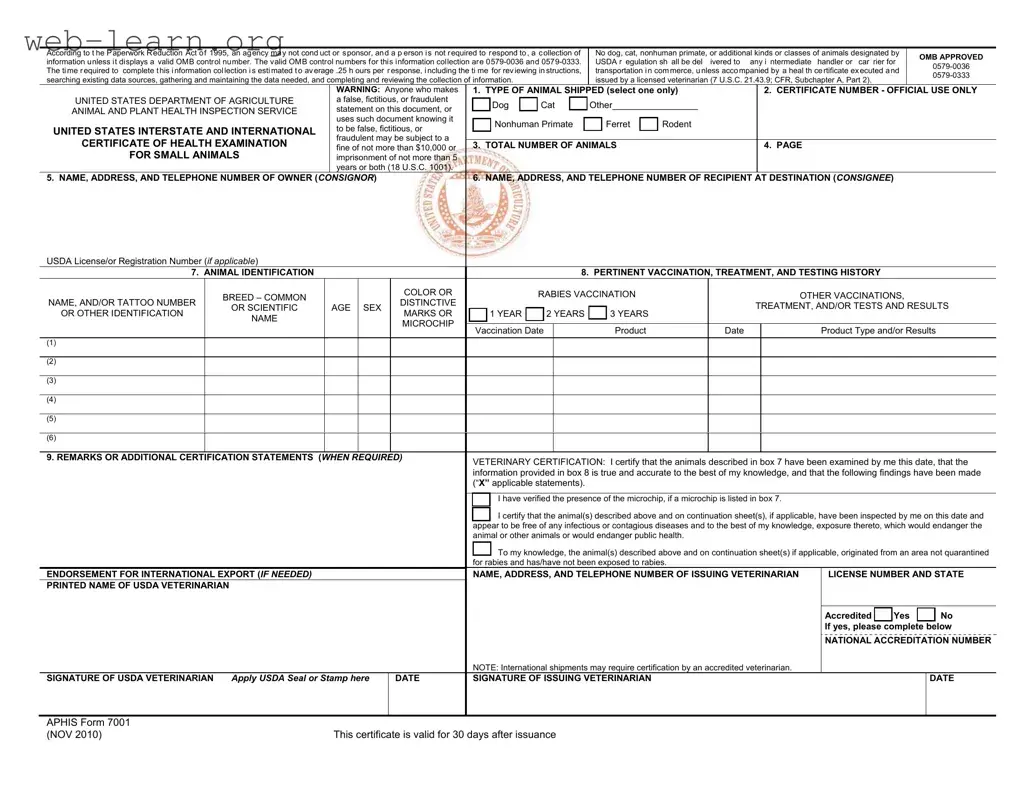
Homepage Blank Aphis 7001 Form
Outline

The Aphis 7001 form plays a crucial role in the transportation of certain animals across state lines and international borders. This certificate, officially titled the United States Interstate and International Certificate of Health Examination, is mandated by the U.S. Department of Agriculture (USDA) and ensures compliance with health regulations. It is specifically designed for various types of animals, including dogs, cats, nonhuman primates, and other species as designated by the USDA. Each form must display a valid OMB control number, which confirms its legitimacy under the Paperwork Reduction Act of 1995. The completion of this form is estimated to take about 15 minutes, encompassing the time needed for reviewing instructions and gathering necessary data. Key sections of the form require information such as the type and number of animals being shipped, details about the owner and recipient, and pertinent health certifications from a licensed veterinarian. These health certifications must affirm that the animals are free from infectious diseases and have received the necessary vaccinations. Additionally, any false statements on the form can lead to severe penalties, including hefty fines or imprisonment. The Aphis 7001 form thus serves not only as a logistical requirement but also as a safeguard for public health and animal welfare during the movement of animals.

Sample - Aphis 7001 Form

According to t he Paperwork Reduction Act of 1995, an agency may not cond uct or sponsor, and a p erson is not required to respond to, a c ollection of
information unless it displays a valid OMB control number. The valid OMB control numbers for this information collection are 0579-0036 and 0579-0333.
The ti me r equired to complete this i nformation col lection i s estimated to av erage .25 h ours per r esponse, i ncluding the ti me for rev iewing in structions,
searching existing data sources, gathering and maintaining the data needed, and completing and reviewing the collection of information.
No dog, cat, nonhuman primate, or additional kinds or classes of animals designated by
USDA r egulation sh all be del ivered to any i ntermediate handler or car rier for
transportation in commerce, u nless acco mpanied by a heal th certificate executed and
issued by a licensed veterinarian (7 U.S.C. 21.43.9; CFR, Subchapter A, Part 2).
OMB APPROVED
0579-0036
0579-0333
UNITED STATES DEPARTMENT OF AGRICULTURE
ANIMAL AND PLANT HEALTH INSPECTION SERVICE
UNITED STATES INTERSTATE AND INTERNATIONAL
CERTIFICATE OF HEALTH EXAMINATION
FOR SMALL ANIMALS
WARNING: Anyone who makes
a false, fictitious, or fraudulent
statement on this document, or
uses such document knowing it
to be false, fictitious, or
fraudulent may be subject to a
fine of not more than $10,000 or
imprisonment of not more than 5
years or both (18 U.S.C. 1001).
1. TYPE OF ANIMAL SHIPPED (select one only)
Dog Cat Other_________________
Nonhuman Primate Ferret Rodent
2. CERTIFICATE NUMBER - OFFICIAL USE ONLY
3. TOTAL NUMBER OF ANIMALS 4. PAGE
5. NAME, ADDRESS, AND TELEPHONE NUMBER OF OWNER (CONSIGNOR)
USDA License/or Registration Number (if applicable)
6. NAME, ADDRESS, AND TELEPHONE NUMBER OF RECIPIENT AT DESTINATION (CONSIGNEE)
7. ANIMAL IDENTIFICATION 8. PERTINENT VACCINATION, TREATMENT, AND TESTING HISTORY
NAME, AND/OR TATTOO NUMBER
OR OTHER IDENTIFICATION
BREED – COMMON
OR SCIENTIFIC
NAME
AGE SEX
COLOR OR
DISTINCTIVE
MARKS OR
MICROCHIP
RABIES VACCINATION
1 YEAR 2 YEARS 3 YEARS
OTHER VACCINATIONS,
TREATMENT, AND/OR TESTS AND RESULTS
Vaccination Date Product Date Product Type and/or Results
(1)
(2)
(3)
(4)
(5)
(6)
9. REMARKS OR ADDITIONAL CERTIFICATION STATEMENTS (WHEN REQUIRED)
VETERINARY CERTIFICATION: I certify that the animals described in box 7 have been examined by me this date, that the
information provided in box 8 is true and accurate to the best of my knowledge, and that the following findings have been made
(“X” applicable statements).
I have verified the presence of the microchip, if a microchip is listed in box 7.
I certify that the animal(s) described above and on continuation sheet(s), if applicable, have been inspected by me on this date and
appear to be free of any infectious or contagious diseases and to the best of my knowledge, exposure thereto, which would endanger the
animal or other animals or would endanger public health.
To my knowledge, the animal(s) described above and on continuation sheet(s) if applicable, originated from an area not quarantined
for rabies and has/have not been exposed to rabies.
ENDORSEMENT FOR INTERNATIONAL EXPORT (IF NEEDED) NAME, ADDRESS, AND TELEPHONE NUMBER OF ISSUING VETERINARIAN
NOTE: International shipments may require certification by an accredited veterinarian.
LICENSE NUMBER AND STATE
PRINTED NAME OF USDA VETERINARIAN
Accredited Yes No
If yes, please complete below
NATIONAL ACCREDITATION NUMBER
SIGNATURE OF USDA VETERINARIAN Apply USDA Seal or Stamp here
DATE
SIGNATURE OF ISSUING VETERINARIAN
DATE
APHIS Form 7001
(NOV 2010) This certificate is valid for 30 days after issuance

Form Information

Fact Name Fact Description
OMB Control Numbers The valid OMB control numbers for the Aphis 7001 form are 0579-0036 and 0579-0333.
Paperwork Reduction Act According to the Paperwork Reduction Act of 1995, responses to this form are not mandatory unless it displays a valid OMB control number.
Completion Time It is estimated that completing this information collection will take an average of 0.25 hours per response.
Animal Types Users must select only one type of animal shipped from options including dog, cat, nonhuman primate, ferret, and rodent.
Health Certificate Requirement Animals must be accompanied by a health certificate executed by a licensed veterinarian unless specified otherwise.
Legal Consequences Providing false information on this form can lead to fines of up to $10,000 or imprisonment for up to 5 years.
Veterinary Certification The issuing veterinarian must certify that the animals have been examined and are free from infectious diseases.
International Export For international shipments, additional certification by an accredited veterinarian may be required.
Validity Period This certificate is valid for 30 days after its issuance date.
USDA Regulations USDA regulations mandate that all relevant documentation must be delivered to any intermediate handler or carrier.

Detailed Guide for Filling Out Aphis 7001

Filling out the APHIS 7001 form is an important step in ensuring that animals are transported safely and in compliance with regulations. This form collects necessary information about the animals being shipped, their health status, and the parties involved in the transaction. Below are the steps to complete the form accurately.

  1. Type of Animal Shipped: Select one option from the list provided: Dog, Cat, Nonhuman Primate, Ferret, Rodent, or Other.
  2. Certificate Number: Leave this section blank as it is for official use only.
  3. Total Number of Animals: Enter the total number of animals being shipped.
  4. Page: Indicate the page number if this is a continuation of a multi-page form.
  5. Name, Address, and Telephone Number of Owner (Consignor): Fill in the complete details of the owner or consignor of the animals.
  6. Name, Address, and Telephone Number of Recipient at Destination (Consignee): Provide the complete details of the recipient or consignee.
  7. USDA License/Registration Number: If applicable, enter the USDA license or registration number here.
  8. Animal Identification: Enter the breed, common name, color, age, sex, and any distinctive marks or identification numbers such as a microchip number.
  9. Pertinent Vaccination, Treatment, and Testing History: Document the rabies vaccination details, other vaccinations, treatments, and testing results for each animal.
  10. Remarks or Additional Certification Statements: Include any additional information or certifications that may be required.
  11. Veterinary Certification: The veterinarian must certify that the animals have been examined and that the provided information is accurate. This includes checking for microchips and confirming the animals are free from infectious diseases.
  12. Endorsement for International Export: If needed, provide the name, address, and telephone number of the issuing veterinarian, along with their license number and state.
  13. Signature of USDA Veterinarian: The USDA veterinarian must sign and date the form, applying the USDA seal or stamp if required.
  14. Signature of Issuing Veterinarian: The issuing veterinarian must also sign and date the form.

Obtain Answers on Aphis 7001

  1. What is the purpose of the APHIS 7001 form?

    The APHIS 7001 form, also known as the United States Interstate and International Certificate of Health Examination for Small Animals, is primarily used to certify the health of certain animals being transported across state lines or internationally. It ensures that the animals meet health standards and are free from infectious or contagious diseases that could pose risks to other animals or public health.

  2. Who is required to complete the APHIS 7001 form?

    Anyone who is shipping animals such as dogs, cats, nonhuman primates, ferrets, or rodents is required to complete the APHIS 7001 form. This includes both individual pet owners and commercial entities. The form must be filled out accurately and completely to avoid any delays or issues during transportation.

  3. What information is needed on the APHIS 7001 form?

    The APHIS 7001 form requires several key pieces of information:

    • Type of animal being shipped
    • Certificate number (for official use)
    • Contact information for both the owner (consignor) and the recipient (consignee)
    • Animal identification details, including breed, age, sex, and any distinctive marks
    • Vaccination and treatment history

    Providing accurate details is crucial for ensuring compliance with health regulations.

  4. What are the consequences of providing false information on the APHIS 7001 form?

    Submitting false or fraudulent information on the APHIS 7001 form can lead to serious legal consequences. Individuals may face fines of up to $10,000 or imprisonment for up to five years, or both. It is essential to ensure that all information provided is truthful and accurate to avoid these penalties.

  5. How long is the APHIS 7001 form valid?

    The APHIS 7001 form is valid for 30 days after it is issued. If the transportation of the animal occurs after this period, a new form must be completed to ensure compliance with health regulations. Timely processing and submission of the form are important to facilitate smooth transportation.

Common mistakes

Completing the APHIS 7001 form can be a straightforward process, but many people make common mistakes that can lead to delays or complications. One frequent error is failing to select the correct type of animal being shipped. It is crucial to choose only one option from the list provided. Selecting multiple types can confuse the processing staff and may result in the form being rejected.

Another mistake involves the certificate number. Many individuals overlook the section labeled "CERTIFICATE NUMBER - OFFICIAL USE ONLY." This area is intended for official use, and leaving it blank can raise questions about the validity of the document.

Incorrectly filling out the owner and recipient information is a prevalent issue. Ensure that the name, address, and telephone number of both the consignor and consignee are accurate and complete. Missing or incorrect information can lead to miscommunication and delays in delivery.

Many people also forget to provide the animal identification details. This section is vital for tracking and verifying the animals being shipped. Omitting this information can result in complications during transportation.

In addition, failing to include pertinent vaccination, treatment, and testing history can be problematic. The form requires specific details about vaccinations and treatments. Incomplete entries can raise concerns about the health status of the animals and may lead to additional scrutiny.

Another common oversight is neglecting the veterinary certification section. The veterinarian must sign and date the form, confirming that the information provided is accurate. Without this certification, the form may not be accepted.

People often misinterpret the requirement for additional remarks or certification statements. If applicable, this section must be filled out completely. Ignoring it can lead to misunderstandings about the shipment's compliance with health regulations.

Additionally, individuals sometimes fail to check the expiration date of the certificate. The APHIS 7001 form is only valid for 30 days after issuance. Submitting an expired certificate can result in significant delays.

Lastly, some individuals overlook the importance of keeping a copy of the completed form. Retaining a copy provides a reference in case any issues arise during the shipping process. This can be invaluable for resolving disputes or clarifying information.

By being aware of these common mistakes, you can help ensure that the APHIS 7001 form is completed accurately and efficiently. Taking the time to review each section carefully can prevent unnecessary complications and facilitate a smoother shipping experience.

Documents used along the form

The APHIS 7001 form is crucial for the transportation of certain animals within the United States. However, it is often accompanied by other forms and documents to ensure compliance with various regulations and to provide necessary health information. Here is a list of some of the key documents that may be used alongside the APHIS 7001 form:

  • Health Certificate: This document, issued by a licensed veterinarian, certifies that the animal has been examined and is free from contagious diseases. It is essential for interstate and international transport.
  • Import Permit: Required for animals entering the United States from other countries, this permit ensures that the animals meet specific health and safety standards set by the USDA.
  • Export Certificate: This certificate is necessary when sending animals out of the United States. It verifies that the animals comply with the health regulations of the destination country.
  • Quarantine Documents: If animals are coming from areas with known disease outbreaks, quarantine documents may be needed to confirm that they have been isolated and monitored for a certain period.
  • Vaccination Records: Detailed records of vaccinations received by the animal provide evidence of immunization against specific diseases, which is often required for transport.
  • Microchip Registration: This document proves that the animal has been microchipped, which is increasingly required for identification and tracking purposes.
  • Transportation Agreement: This agreement outlines the responsibilities and liabilities of the parties involved in the transport of the animal, ensuring that all parties are aware of their obligations.
  • Manifest of Animals: A comprehensive list of all animals being transported, this document is often required by carriers to ensure proper handling and tracking during transport.

Each of these documents plays a vital role in ensuring the safe and legal transportation of animals. Understanding their purpose and requirements can help prevent delays and ensure compliance with health regulations. Proper documentation not only safeguards the animals but also protects public health and the integrity of the transportation process.

Similar forms

  • APHIS Form 7000: Similar to the APHIS 7001, this form is used for the health certification of animals. It also requires information about the type of animal and the veterinary certification process.
  • APHIS Form 7003: This form is used for the transportation of animal products. Like the 7001, it includes details about the sender and recipient, along with health status information.
  • APHIS Form 7004: This form pertains to the importation of animals and animal products. It requires similar health certification and identification details as the 7001.
  • APHIS Form 7005: Used for the exportation of animals, this form shares the requirement for veterinary certification and animal identification, mirroring the APHIS 7001.
  • USDA Veterinary Health Certificate: This document serves as a general health certificate for animals being transported across state lines, similar to the APHIS 7001 in purpose and content.
  • Import Permit: Required for certain animals entering the U.S., this permit includes health information and is similar in its regulatory nature to the APHIS 7001.
  • Export Certificate: This document is needed for animals being sent abroad. It also requires health information and veterinary endorsement, akin to the APHIS 7001.
  • Animal Health Certificate (State-specific): Many states require this document for animals being transported within or into the state, similar to the APHIS 7001 in its health certification requirements.
  • Health Certificate for Livestock: This certificate is used for livestock and requires similar health verification and identification details as the APHIS 7001.

Dos and Don'ts

When filling out the APHIS 7001 form, it's essential to follow specific guidelines to ensure accuracy and compliance. Here’s a list of things to do and avoid:

  • Do read the instructions carefully before starting the form.
  • Do ensure that all animal information is complete and accurate.
  • Do verify the presence of any required health certificates from a licensed veterinarian.
  • Do double-check the OMB control numbers to confirm they are valid.
  • Do sign and date the form in the appropriate sections.
  • Do keep a copy of the completed form for your records.
  • Don't leave any sections blank; incomplete forms may lead to delays.
  • Don't use outdated versions of the form; always use the latest version.
  • Don't provide false or misleading information; this can result in severe penalties.
  • Don't forget to include any additional certifications if required.
  • Don't overlook the importance of legibility; ensure your handwriting is clear.
  • Don't submit the form without reviewing it for errors.

Misconceptions

Misconceptions about the APHIS 7001 form can lead to confusion and potential issues when transporting animals. Here are nine common misunderstandings:

  1. The APHIS 7001 form is only for dogs and cats. Many believe this form is limited to these animals, but it also covers nonhuman primates, ferrets, rodents, and other species.
  2. You don’t need a health certificate for small animals. Some people think that smaller pets don’t require health certificates. However, a health certificate is necessary unless specific exemptions apply.
  3. The form is optional. Many individuals assume that completing the APHIS 7001 form is optional. In reality, it is required for interstate and international transport of certain animals.
  4. Only veterinarians can complete the form. While a licensed veterinarian must certify the health of the animal, the owner or shipper can fill out the form before submitting it to the vet.
  5. Once issued, the certificate is valid indefinitely. The APHIS 7001 form is only valid for 30 days after issuance. After that, a new form must be completed.
  6. All animals need to be microchipped. Not all animals are required to have a microchip. This is only necessary if it is specifically indicated in the documentation.
  7. It’s acceptable to falsify information on the form. Some may think that minor inaccuracies are harmless, but providing false information can lead to severe penalties, including fines and imprisonment.
  8. The APHIS 7001 form is the only requirement for transporting animals. In addition to this form, other regulations and requirements may apply depending on the destination and type of animal.
  9. Once the form is completed, it doesn’t need to be reviewed. Many people believe that after filling out the form, no further review is necessary. However, it’s essential to double-check all information for accuracy before submission.

Understanding these misconceptions can help ensure compliance with regulations and facilitate smoother transportation of animals.

Key takeaways

Here are key takeaways for filling out and using the APHIS 7001 form:

  • OMB Control Numbers: Ensure the form displays a valid OMB control number (0579-0036 or 0579-0333) as required by the Paperwork Reduction Act of 1995.
  • Time Estimate: Completing the form is estimated to take about 15 minutes, including reviewing instructions and gathering necessary data.
  • Animal Type: Select only one type of animal being shipped from the options provided (e.g., dog, cat, nonhuman primate).
  • Certificate Number: Leave the certificate number section blank for official use only.
  • Owner and Recipient Information: Clearly fill in the name, address, and telephone number of both the owner (consignor) and the recipient (consignee).
  • Animal Identification: Provide detailed information about the animals, including breed, age, sex, and any distinctive marks.
  • Vaccination History: Include pertinent vaccination, treatment, and testing history for each animal, ensuring accuracy in dates and results.
  • Veterinary Certification: The veterinarian must certify the health of the animals and confirm that all information provided is accurate.
  • Validity: Remember that the APHIS 7001 certificate is valid for only 30 days after issuance, so plan accordingly.