Homepage Blank Alabama Vehicle POA MVT 5-13 (Rev 09-19) Form
Outline

The Alabama Vehicle Power of Attorney (POA) MVT 5-13 (Rev 09-19) form serves as an important document for vehicle owners in Alabama who wish to designate another individual to act on their behalf regarding vehicle-related matters. This form is particularly useful when the owner cannot be present for transactions such as titling, registration, or the sale of a vehicle. It allows the appointed agent to perform specific actions, ensuring that the owner's interests are represented. The form requires essential information such as the owner's name, the agent's name, and details about the vehicle in question, including its identification number. Additionally, it includes a section for the owner's signature, which must be notarized to validate the authority granted. Understanding the nuances of this form is crucial for both vehicle owners and their appointed agents to ensure compliance with Alabama's vehicle laws and regulations.
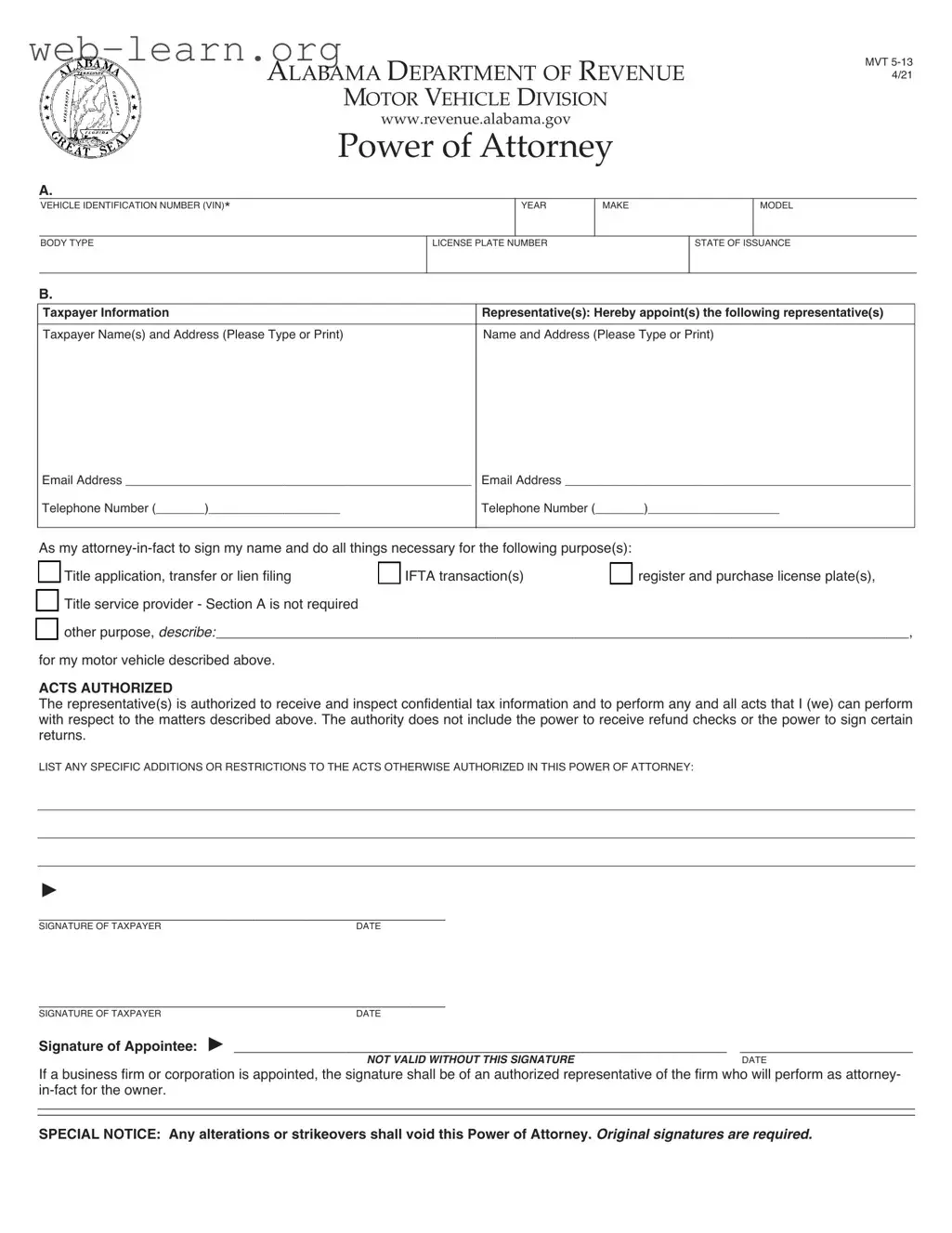
Sample - Alabama Vehicle POA MVT 5-13 (Rev 09-19) Form

ALABAMA DEPARTMENT OF REVENUE
MOTOR VEHICLE DIVISION
www.revenue.alabama.gov
Power of Attorney
MVT 5-13
4/21
As my attorney-in-fact to sign my name and do all things necessary for the following purpose(s):
6
Title application, transfer or lien filing
6
IFTA transaction(s)
6
register and purchase license plate(s),
6
Title service provider - Section A is not required
6
other purpose, describe:_________________________________________________________________________________________,
for my motor vehicle described above.
V
_______________________________________________
SIGNATURE OF TAXPAYER DATE
_______________________________________________
SIGNATURE OF TAXPAYER DATE
Signature of Appointee: V _________________________________________________________ ____________________
NOT VALID WITHOUT THIS SIGNATURE DATE
If a business firm or corporation is appointed, the signature shall be of an authorized representative of the firm who will perform as attorney-
in-fact for the owner.
SPECIAL NOTICE: Any alterations or strikeovers shall void this Power of Attorney. Original signatures are required.
ACTS AUTHORIZED
The representative(s) is authorized to receive and inspect confidential tax information and to perform any and all acts that I (we) can perform
with respect to the matters described above. The authority does not include the power to receive refund checks or the power to sign certain
returns.
LIST ANY SPECIFIC ADDITIONS OR RESTRICTIONS TO THE ACTS OTHERWISE AUTHORIZED IN THIS POWER OF ATTORNEY:
Taxpayer Information Representative(s): Hereby appoint(s) the following representative(s)
Taxpayer Name(s) and Address (Please Type or Print) Name and Address (Please Type or Print)
Email Address __________________________________________________
Telephone Number (_______)___________________
Email Address __________________________________________________
Telephone Number (_______)___________________
VEHICLE IDENTIFICATION NUMBER (VIN)
*
YEAR MAKE MODEL
BODY TYPE LICENSE PLATE NUMBER STATE OF ISSUANCE
B.
A.

Form Information

Fact Name Description
Purpose The Alabama Vehicle POA MVT 5-13 (Rev 09-19) form is used to grant someone the authority to act on behalf of a vehicle owner in matters related to the vehicle, such as registration and title transfers.
Governing Law This form is governed by the Alabama Code, specifically Title 32, Chapter 8, which outlines the laws regarding motor vehicles and their registration.
Validity The form must be signed by the vehicle owner and may need to be notarized to ensure its validity and to prevent fraud.
Usage Individuals can use this form when they are unable to personally attend to vehicle-related tasks, allowing a designated agent to handle these responsibilities on their behalf.

Detailed Guide for Filling Out Alabama Vehicle POA MVT 5-13 (Rev 09-19)

Once you have the Alabama Vehicle POA MVT 5-13 form in front of you, it’s time to fill it out carefully. Make sure you have all the necessary information ready. This will help ensure a smooth process as you complete the form.

  1. Begin by entering the date at the top of the form.
  2. Fill in your name as the principal. This is the person granting power of attorney.
  3. Provide your address, including city, state, and zip code.
  4. Write your phone number for contact purposes.
  5. Identify the agent to whom you are granting power of attorney. This is the person who will act on your behalf.
  6. Include the agent’s address, city, state, and zip code.
  7. Clearly describe the vehicle involved. Include the make, model, year, and Vehicle Identification Number (VIN).
  8. Sign and date the form at the designated area. Your signature confirms your intention.
  9. Have the form notarized if required. This adds an extra layer of validity.

After completing the form, ensure all information is accurate. You may need to submit it to the appropriate authority or keep it for your records, depending on your situation.

Obtain Answers on Alabama Vehicle POA MVT 5-13 (Rev 09-19)

  1. What is the Alabama Vehicle POA MVT 5-13 (Rev 09-19) form?

    The Alabama Vehicle POA (Power of Attorney) MVT 5-13 form allows an individual to authorize another person to act on their behalf in matters related to vehicle registration and titling. This form is particularly useful when the vehicle owner cannot be present to complete necessary transactions, such as transferring ownership or registering a vehicle.

  2. Who can use the POA form?

    Any vehicle owner in Alabama can use the POA form. This includes individuals who may be unable to attend to vehicle-related matters due to various reasons, such as being out of state, having health issues, or simply needing assistance. The designated agent must be someone the vehicle owner trusts to handle these responsibilities.

  3. How do I complete the form?

    To complete the Alabama Vehicle POA MVT 5-13 form, follow these steps:

    • Provide your personal information as the vehicle owner, including your name, address, and contact details.
    • Clearly identify the agent you are designating by including their name and contact information.
    • Specify the powers you are granting to your agent, such as transferring title or registering the vehicle.
    • Sign and date the form to validate it.
  4. Is the form legally binding?

    Yes, once properly completed and signed, the Alabama Vehicle POA MVT 5-13 form is legally binding. It gives the designated agent the authority to act on behalf of the vehicle owner in specified matters. However, it is important to ensure that the form is filled out accurately to avoid any potential disputes or issues.

  5. Do I need to have the form notarized?

    While notarization is not always required for the Alabama Vehicle POA MVT 5-13 form, it is recommended. Having the form notarized adds an extra layer of legitimacy and can help prevent any challenges regarding the authenticity of the signatures. Check with local authorities or the Department of Revenue for specific requirements.

  6. Where do I submit the completed form?

    The completed Alabama Vehicle POA MVT 5-13 form should be submitted to the appropriate local Department of Revenue office or the office handling vehicle registrations in your area. It may also be necessary to present the form when conducting transactions related to the vehicle, such as transferring ownership.

  7. Can I revoke the Power of Attorney?

    Yes, the vehicle owner has the right to revoke the Power of Attorney at any time. To do this, a written notice should be provided to the designated agent and any relevant authorities. It is advisable to keep a copy of the revocation for personal records to avoid any confusion in the future.

Common mistakes

Filling out the Alabama Vehicle Power of Attorney (POA) MVT 5-13 form can be a straightforward process, but several common mistakes may hinder its effectiveness. Understanding these pitfalls can help ensure that the form is completed accurately and efficiently.

One frequent error is failing to provide complete information about the vehicle. The form requires details such as the Vehicle Identification Number (VIN), make, model, and year. Omitting any of this information can lead to delays or complications in processing the POA.

Another mistake involves not properly identifying the principal and the agent. Both parties must be clearly named, along with their respective addresses. Inaccuracies or missing information can create confusion and may invalidate the authority granted by the POA.

Many individuals neglect to sign the form. A signature is crucial, as it confirms the principal's intent to grant power of attorney. Without this signature, the form holds no legal weight, rendering it ineffective.

Additionally, some people fail to date the form. A date is important for establishing when the authority takes effect. Without a date, there may be questions about the validity of the POA, especially if disputes arise later.

Another common oversight is not having the form notarized, when required. While notarization may not be necessary in all cases, it adds an extra layer of authenticity and can help prevent challenges to the authority granted.

Finally, individuals sometimes do not keep a copy of the completed form for their records. Retaining a copy is essential for both the principal and the agent, as it serves as proof of the authority granted and can be referenced in future transactions or discussions.

Documents used along the form

When dealing with vehicle transactions in Alabama, several forms and documents often accompany the Alabama Vehicle POA MVT 5-13 (Rev 09-19) form. Understanding these documents is crucial for ensuring a smooth process. Below are some commonly used forms that may be required.

  • Alabama Title Application (MVT 1): This form is used to apply for a new title for a vehicle. It provides essential information about the vehicle, including its identification number and the owner's details.
  • Bill of Sale: This document serves as proof of the sale of a vehicle. It includes information about the buyer and seller, the vehicle's details, and the sale price. A bill of sale is important for establishing ownership transfer.
  • Odometer Disclosure Statement: This form is required when transferring ownership of a vehicle. It records the vehicle's odometer reading at the time of sale, ensuring transparency and preventing fraud.
  • Application for Duplicate Title (MVT 4): If a vehicle title is lost or damaged, this form is used to request a duplicate title. It is essential for maintaining clear ownership records.

Having these documents ready can help streamline the vehicle registration or transfer process. Always ensure that you have the correct forms filled out to avoid delays or complications.

Similar forms

The Alabama Vehicle POA MVT 5-13 (Rev 09-19) form is a specific document that allows individuals to grant power of attorney for vehicle-related matters. There are several other documents that serve similar purposes in various contexts. Here’s a look at seven of them:

  • General Power of Attorney: This document gives someone the authority to act on your behalf in a wide range of legal and financial matters, not limited to vehicle transactions.
  • Limited Power of Attorney: Similar to the general version, but it restricts the agent's powers to specific tasks, such as selling a car or handling a particular transaction.
  • Vehicle Title Transfer Form: This form is used to officially transfer ownership of a vehicle from one person to another, often requiring signatures from both parties.
  • Bill of Sale: A document that records the sale of a vehicle, including details like the sale price and vehicle identification number (VIN). It serves as proof of the transaction.
  • Authorization for Release of Information: This form allows a third party to access certain information about a vehicle, which can be necessary for title transfers or registrations.
  • Vehicle Registration Application: When registering a vehicle, this application is needed to provide the necessary details to the Department of Motor Vehicles (DMV).
  • Affidavit of Heirship: In cases where a vehicle owner has passed away, this document can help establish the rightful heir to the vehicle, allowing for the transfer of ownership.

Each of these documents plays a crucial role in vehicle transactions and legal authority, ensuring that processes are carried out smoothly and legally.

Dos and Don'ts

When filling out the Alabama Vehicle POA MVT 5-13 (Rev 09-19) form, it is important to follow specific guidelines to ensure accuracy and compliance. Below is a list of things you should and shouldn't do:

  • Do read the entire form carefully before starting.
  • Do provide accurate information for all required fields.
  • Do use black or blue ink to complete the form.
  • Do sign and date the form where indicated.
  • Do keep a copy of the completed form for your records.
  • Don't leave any required fields blank.
  • Don't use correction fluid or tape on the form.
  • Don't submit the form without verifying all information is correct.
  • Don't forget to check for any additional documents that may be needed.
  • Don't rush through the process; take your time to ensure accuracy.

Misconceptions

Understanding the Alabama Vehicle POA MVT 5-13 (Rev 09-19) form can be challenging due to several misconceptions. Here are six common misunderstandings about this form:

  • It's only for selling a vehicle. Many believe this form is solely for transferring ownership during a sale. However, it can also be used for various purposes, such as registering a vehicle or handling other transactions on behalf of the owner.
  • Only a lawyer can complete it. Some think that legal assistance is required to fill out the form. In reality, individuals can complete it themselves, as long as they provide the necessary information accurately.
  • It must be notarized. While notarization can add an extra layer of validation, it is not always required for the form to be valid. Check local regulations to confirm if notarization is necessary for your specific situation.
  • It can only be used for one-time transactions. This form can be utilized for multiple transactions, not just a single event. As long as the power of attorney is valid, it can be used repeatedly for different purposes.
  • Anyone can be designated as an agent. There is a misconception that any person can act as an agent. The agent must be a trusted individual, and it is advisable to choose someone who is responsible and capable of handling the tasks assigned.
  • It expires immediately after use. Some believe that the power of attorney becomes void after a single use. In fact, the authority granted can remain in effect until the owner revokes it or until a specified expiration date is reached, if applicable.

Clarifying these misconceptions can help individuals use the Alabama Vehicle POA MVT 5-13 (Rev 09-19) form effectively and confidently.

Key takeaways

When filling out and using the Alabama Vehicle POA MVT 5-13 (Rev 09-19) form, several key points should be considered to ensure proper completion and use of the document.

  • The form serves as a Power of Attorney, allowing one individual to act on behalf of another in matters related to vehicle transactions.
  • It is important to accurately complete all sections of the form, including the names and addresses of both the principal and the agent.
  • Signatures from both parties are required to validate the document; ensure that the principal’s signature is notarized.
  • The form must be dated to indicate when the authority is granted.
  • Keep a copy of the completed form for personal records after submission.
  • Review any specific requirements from the Alabama Department of Revenue or local DMV offices regarding the use of the form.
  • Utilize the form for various vehicle-related tasks, such as title transfers or registration renewals, to streamline the process.