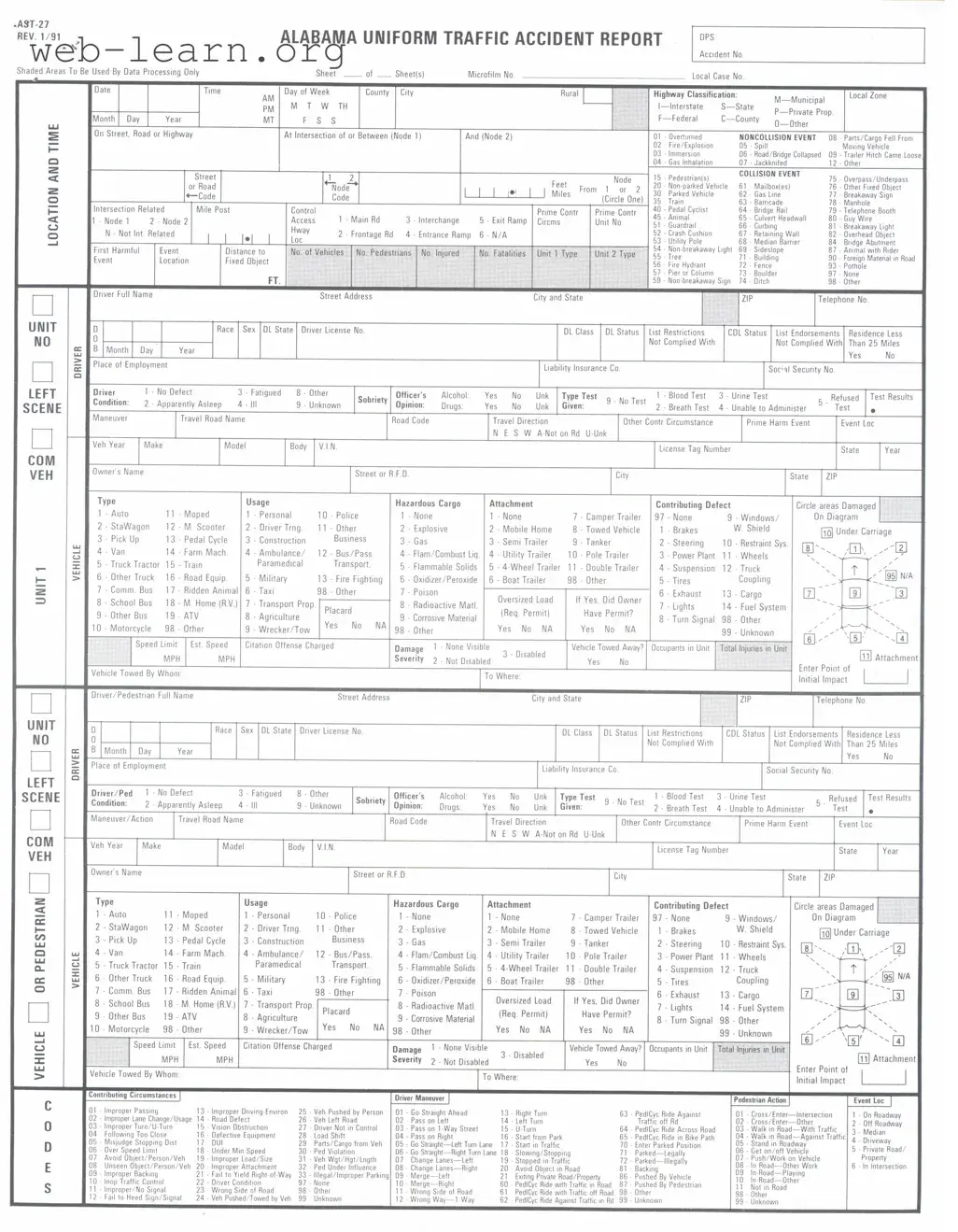
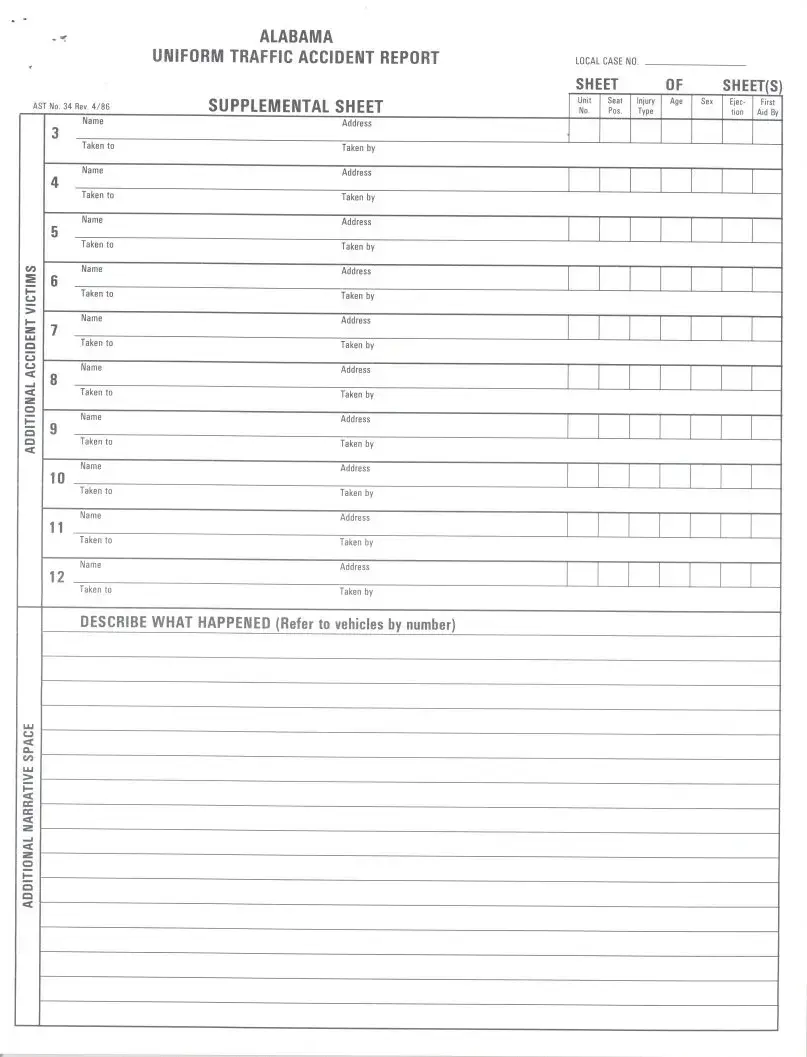
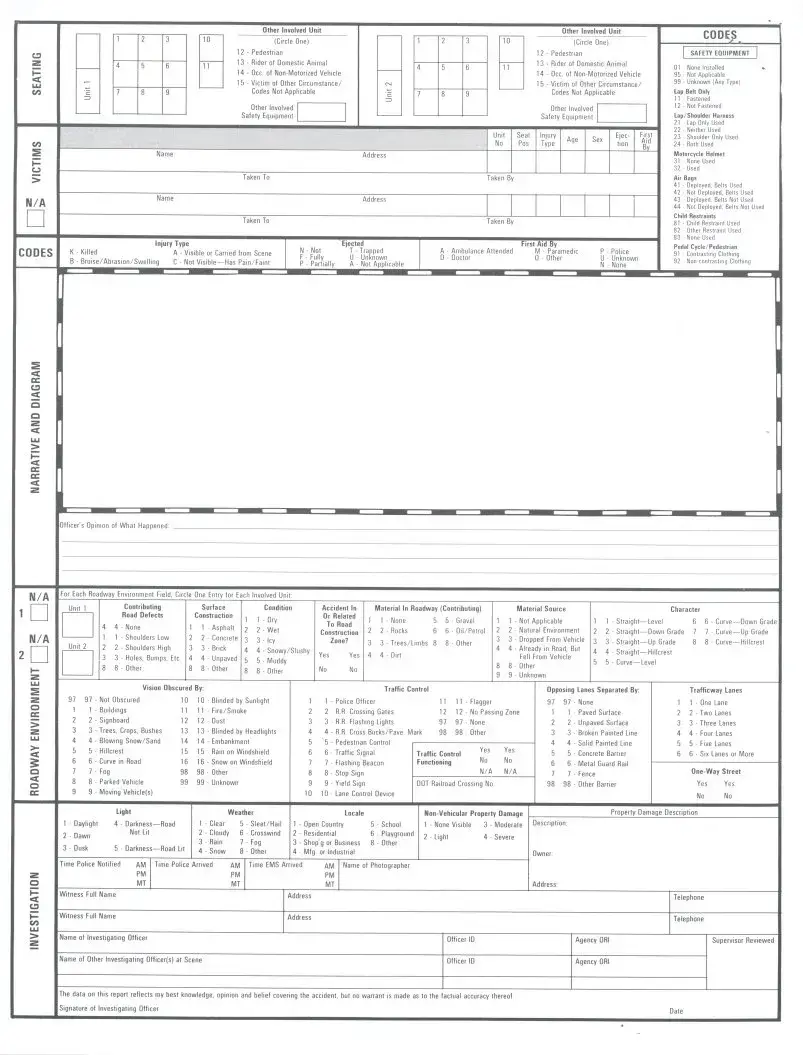
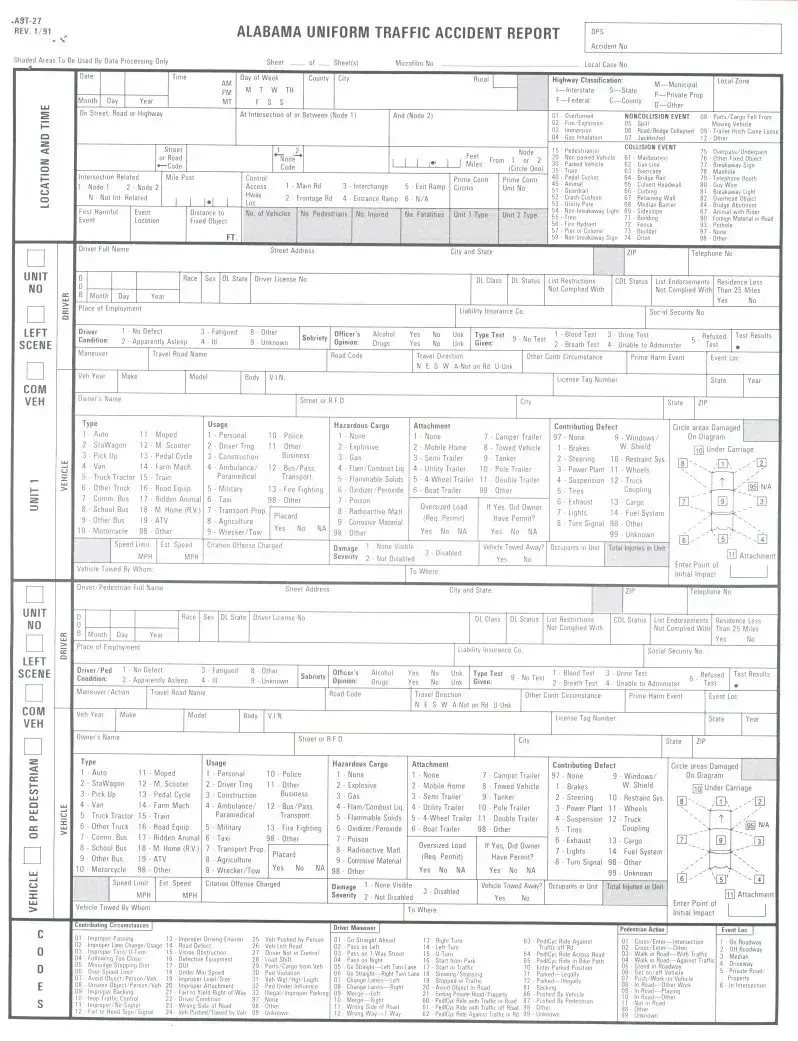
The Alabama Uniform Traffic Report form is a crucial document used by law enforcement to record details of traffic accidents across the state. This form captures essential information such as the date, time, and location of the incident, as well as the vehicles and individuals involved. It includes sections for identifying the type of accident, whether it was a collision or a non-collision event, and details about any injuries or fatalities that occurred. The report also documents environmental conditions, contributing factors, and the actions of the drivers at the time of the accident. Officers are required to fill out this form accurately to ensure that all relevant data is collected for analysis and future reference. Additionally, the form contains fields for witness information and the investigating officer’s observations, which are vital for understanding the circumstances surrounding the accident. Proper completion of the Alabama Uniform Traffic Report is essential for law enforcement, insurance companies, and legal proceedings, making it a key component in the management of traffic safety and accident reporting in Alabama.


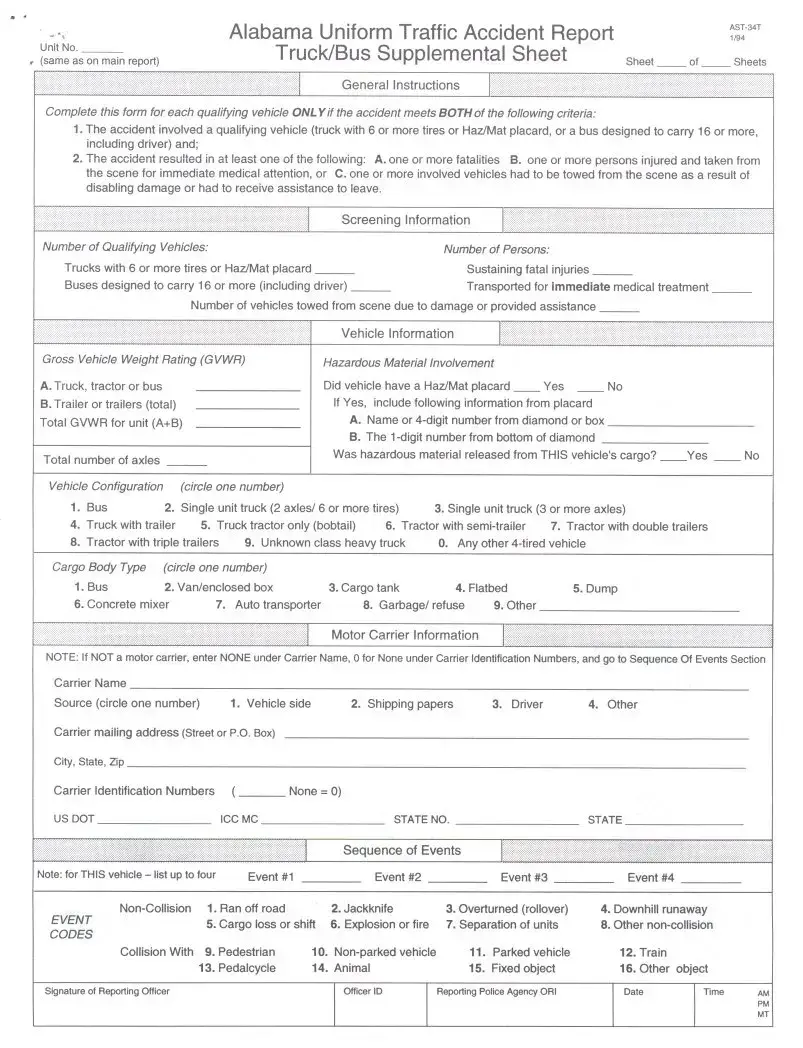
| Fact Name | Details |
|---|---|
| Form Title | Alabama Uniform Traffic Accident Report |
| Governing Law | Code of Alabama, Title 32, Chapter 10 |
| Form Version | AST-27 REV. 1/91 |
| Data Processing Areas | Shaded areas are reserved for data processing only. |
| Date Format | Requires entry of month, day, and year. |
| Accident Number | Each report includes a unique DPS Accident Number. |
| Event Types | Includes collision and non-collision events. |
| Driver Information | Requires full name, address, and driver's license details. |
| Signature Requirement | The investigating officer must sign the report, affirming accuracy. |
Filling out the Alabama Uniform Traffic Report form is an important step in documenting a traffic incident. This report collects essential details about the accident, including involved parties and circumstances. Follow the steps below to ensure you complete the form accurately.
Once the form is completed, it will be submitted to the appropriate authorities for processing. This will help in documenting the incident and may assist in any further investigations or claims related to the accident.
What is the Alabama Uniform Traffic Report (AUTR) form?
The Alabama Uniform Traffic Report (AUTR) form is a standardized document used by law enforcement to record details of traffic accidents that occur within the state. This form captures essential information such as the date, time, location, and circumstances of the accident, along with data about the vehicles and individuals involved.
Who is required to fill out the AUTR form?
Typically, police officers who respond to the scene of a traffic accident are responsible for completing the AUTR form. This includes documenting the facts of the incident, gathering witness statements, and collecting information from the involved parties. The form must be filled out accurately to ensure proper reporting and analysis.
What information is collected on the AUTR form?
The AUTR form collects a wide range of information, including:
How does the AUTR form help in traffic accident analysis?
The information collected on the AUTR form is invaluable for traffic accident analysis. It helps law enforcement agencies, policymakers, and researchers identify trends in traffic accidents, assess the effectiveness of safety measures, and develop strategies to improve road safety. By analyzing this data, communities can work towards reducing the occurrence of accidents and enhancing public safety.
What happens to the completed AUTR form?
Once completed, the AUTR form is submitted to the appropriate law enforcement agency. The data is then entered into a centralized database for further analysis. This ensures that the information is accessible for future reference, statistical analysis, and reporting purposes.
Can individuals obtain a copy of the AUTR form?
Yes, individuals involved in a traffic accident can request a copy of the AUTR form. This can typically be done through the law enforcement agency that investigated the accident. There may be a process for obtaining the report, which could include filling out a request form and possibly paying a small fee.
Are there penalties for not completing the AUTR form?
Failure to complete the AUTR form when required can lead to penalties for the officer involved, as it is a mandated procedure in Alabama. Additionally, incomplete or inaccurate reporting can hinder investigations and may result in legal complications for those involved in the accident.
Is there a deadline for submitting the AUTR form?
Yes, the AUTR form must be submitted within a specific timeframe after the accident occurs. Typically, law enforcement agencies are required to file the report within a few days of the incident. Timely submission is crucial for maintaining accurate records and ensuring that all relevant data is captured for analysis.
Completing the Alabama Uniform Traffic Report form accurately is essential for documenting traffic incidents. However, individuals often make several common mistakes that can lead to complications. One frequent error is failing to provide the correct date. The form requires precise information regarding the month, day, and year of the incident. Omitting or miswriting this information can create confusion and delay in processing the report.
Another mistake is neglecting to specify the exact location of the accident. While the form provides spaces for detailing the street, road, or highway, some individuals may leave this section incomplete. This omission can hinder the ability of law enforcement and insurance companies to follow up on the incident effectively.
Inaccurate reporting of the time of the accident is also a common issue. The form asks for both the time of day and whether it occurred in the AM or PM. Misreporting this detail can lead to discrepancies in witness statements and other evidence. Furthermore, individuals sometimes forget to indicate the day of the week, which can provide helpful context for investigators.
Another area where errors frequently occur is in the section concerning the type of collision event. Some individuals may not fully understand the categories listed, leading to incorrect selections. This can affect the classification of the accident and the subsequent investigation.
Additionally, failing to document all involved parties accurately is a significant oversight. The report requires detailed information about each driver, including their names, addresses, and license details. Incomplete or incorrect entries can complicate the claims process and lead to disputes later on.
Individuals often overlook the importance of providing complete information about injuries. The form requests data on the number of injured parties and fatalities. Inaccurate reporting can skew statistical data and affect the assessment of the incident's severity.
Moreover, neglecting to indicate whether any citations were issued can lead to misunderstandings. This section is crucial for determining liability and can influence insurance claims. Failing to address this can result in delays or disputes regarding fault.
Finally, individuals sometimes do not sign or date the report properly. The signature of the investigating officer is vital for the document's validity. Without it, the report may not hold up in legal proceedings or insurance claims. Ensuring all sections are complete and accurate is essential for a smooth resolution following a traffic incident.
The Alabama Uniform Traffic Report (AUTR) is a critical document used to record details about traffic accidents in the state. Alongside this form, several other documents often accompany it to provide a comprehensive understanding of the incident. Below is a brief description of five such documents that are commonly utilized in conjunction with the AUTR.
These documents collectively support the investigation and resolution of traffic accidents. They provide a clearer picture of the incident, ensuring that all parties involved receive fair treatment under the law. Understanding these forms can help individuals navigate the aftermath of a traffic incident more effectively.
The Alabama Uniform Traffic Report form serves as a crucial document in documenting traffic accidents. Several other documents share similarities with this report, primarily in their purpose and structure. Below is a list of nine similar documents, each highlighting how they relate to the Alabama Uniform Traffic Report.
Understanding these documents can enhance awareness of the information needed in the event of an accident and streamline the process of reporting and resolving related issues.
When filling out the Alabama Uniform Traffic Report form, attention to detail is crucial. This document serves as an official record of a traffic incident and can have significant implications. Below is a list of ten important dos and don’ts to consider during the completion of this form.
By following these guidelines, you can help ensure that the Alabama Uniform Traffic Report is filled out correctly and serves its intended purpose effectively.
Misconceptions about the Alabama Uniform Traffic Report form can lead to confusion and mistakes. Here are ten common misconceptions explained:
Understanding these misconceptions can help ensure that the Alabama Uniform Traffic Report is filled out correctly and used effectively.
Accurately fill out the Alabama Uniform Traffic Report form to ensure all necessary information is documented. This includes details about the accident, vehicles involved, and individuals present.
Provide clear and precise descriptions of the accident events. Use specific codes for collision and non-collision events to categorize the nature of the incident effectively.
Ensure that all contact information for drivers, witnesses, and involved parties is complete. This includes names, addresses, phone numbers, and insurance details.
Document the location of the accident accurately, including street names, mile markers, and any relevant landmarks. This information is crucial for investigations.
Include details about vehicle conditions and any contributing factors, such as weather or road conditions. This helps in understanding the circumstances surrounding the accident.
Review the form for accuracy and completeness before submission. Incomplete or incorrect information can delay processing and affect legal proceedings.