Homepage Blank Alabama Uniform Incident Report Form
Outline

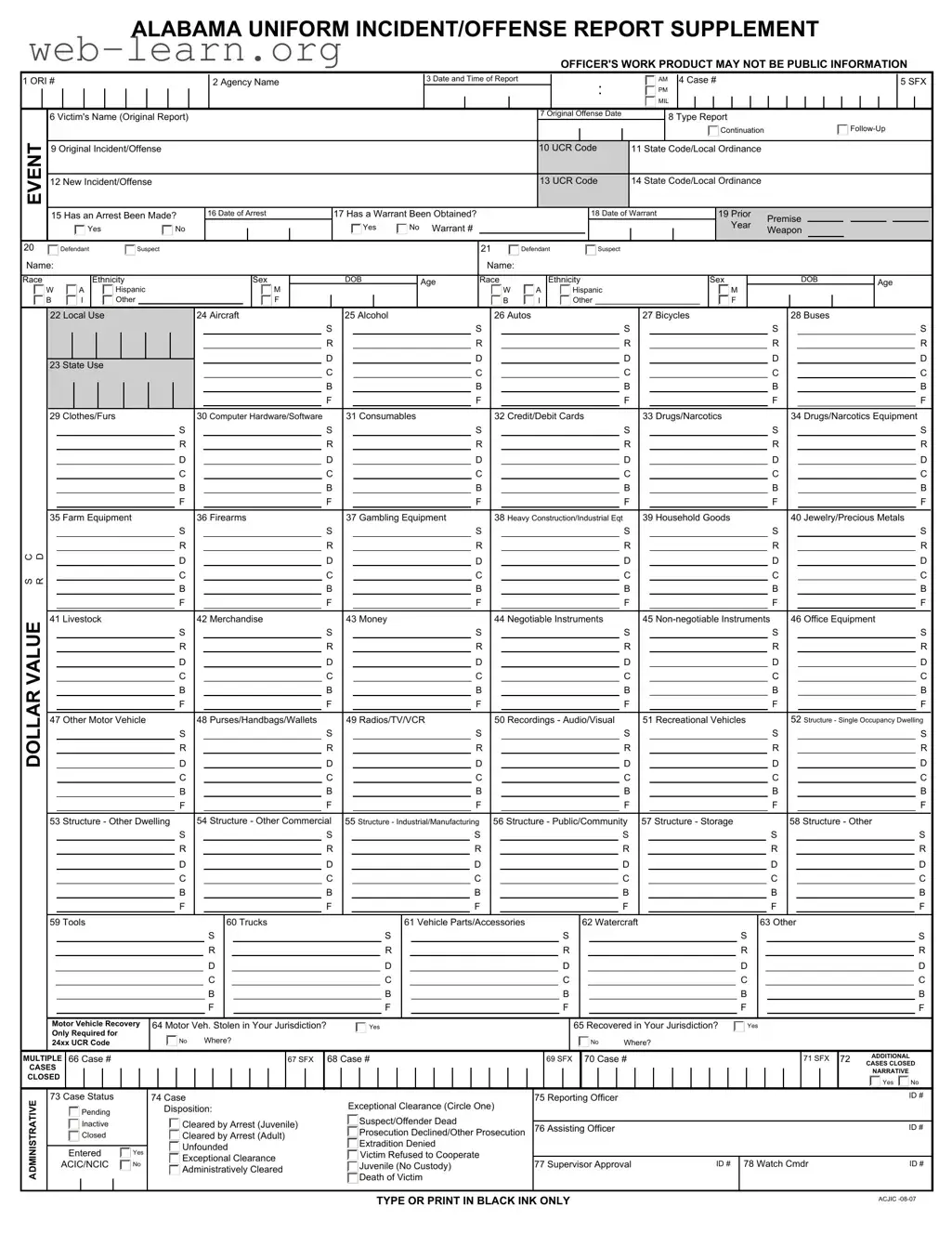
The Alabama Uniform Incident Report form serves as a crucial tool for law enforcement agencies across the state, providing a standardized method for documenting incidents and offenses. This form is designed to capture essential information about various incidents, including the case number, agency name, and details of the original offense. It includes sections for reporting the status of the case, whether an arrest has been made, and if any warrants have been obtained. Each entry requires specific details, such as the names and demographics of victims and suspects, as well as the nature of the offense and any property involved. The form also allows for the inclusion of a narrative, where officers can provide a comprehensive account of the incident. Additionally, it emphasizes the importance of confidentiality, noting that an officer's work product is not public information. Given the form's extensive nature, it plays a vital role in ensuring that law enforcement can effectively communicate and track incidents, ultimately contributing to public safety and accountability.

Sample - Alabama Uniform Incident Report Form

OFFICER'S WORK PRODUCT MAY NOT BE PUBLIC INFORMATION
ALABAMA UNIFORM INCIDENT/OFFENSE REPORT SUPPLEMENT
EVENT
DOLLAR VALUE
66 Case #
67 SFX
69 SFX
68 Case #
71 SFX
70 Case #
72
ADDITIONAL
CASES CLOSED
NARRATIVE
77 Supervisor Approval
78 Watch Cmdr
ID #
ID #
ACJIC -08-07
ADMINISTRATIVE
MULTIPLE
CASES
CLOSED
S C
R D
76 Assisting Officer
75 Reporting Officer
ID #
ID #
73 Case Status
Entered
ACIC/NCIC
Yes
No
Pending
Inactive
Closed
74 Case
Disposition:
1 ORI #
3 Date and Time of Report
:
AM
PM
MIL
4 Case #
2 Agency Name
5 SFX
11 State Code/Local Ordinance
14 State Code/Local Ordinance
13 UCR Code
9 Original Incident/Offense
12 New Incident/Offense
6 Victim's Name (Original Report)
10 UCR Code
8 Type Report
Continuation
Follow-Up
7 Original Offense Date
15 Has an Arrest Been Made?
16 Date of Arrest
No
Yes
No
Yes
17 Has a Warrant Been Obtained?
Warrant #
18 Date of Warrant
DOB
19 Prior
Year
Premise
Weapon
20
Name:
Defendant
Suspect
21
Suspect
Defendant
Name:
Age
Race
Sex
I
A
B
W
F
Motor Vehicle Recovery
Only Required for
24xx UCR Code
64 Motor Veh. Stolen in Your Jurisdiction?
65 Recovered in Your Jurisdiction?
No
Yes
Where?
Yes
Where?
No
47 Other Motor Vehicle
S
R
D
C
B
F
24 Aircraft
C
D
R
S
B
F
25 Alcohol
C
D
R
S
B
F
26 Autos
C
D
R
S
B
F
27 Bicycles
C
D
R
S
B
F
32 Credit/Debit Cards
C
D
R
S
B
F
31 Consumables
C
D
R
S
B
F
30 Computer Hardware/Software
C
D
R
S
B
F
29 Clothes/Furs
C
D
R
S
B
F
35 Farm Equipment
C
D
R
S
B
F
36 Firearms
C
D
R
S
B
F
37 Gambling Equipment
C
D
R
S
B
F
38 Heavy Construction/Industrial Eqt
C
D
R
S
B
F
28 Buses
C
D
R
S
B
F
33 Drugs/Narcotics
C
D
R
S
B
F
34 Drugs/Narcotics Equipment
C
D
R
S
B
F
40 Jewelry/Precious Metals
C
D
R
S
B
F
39 Household Goods
C
D
R
S
B
F
46 Office Equipment
C
D
R
S
B
F
45 Non-negotiable Instruments
C
D
R
S
B
F
44 Negotiable Instruments
C
D
R
S
B
F
43 Money
C
D
R
S
B
F
42 Merchandise
C
D
R
S
B
F
41 Livestock
C
D
R
S
B
F
48 Purses/Handbags/Wallets
C
D
R
S
B
F
49 Radios/TV/VCR
C
D
R
S
B
F
50 Recordings - Audio/Visual
C
D
R
S
B
F
51 Recreational Vehicles
C
D
R
S
B
F
52 Structure - Single Occupancy Dwelling
C
D
R
S
B
F
23 State Use
22 Local Use
F
B
C
D
R
S
53 Structure - Other Dwelling
F
B
C
D
R
S
54 Structure - Other Commercial
F
B
C
D
R
S
55 Structure - Industrial/Manufacturing
F
B
C
D
R
S
56 Structure - Public/Community
F
B
C
D
R
S
57 Structure - Storage
F
B
C
D
R
S
58 Structure - Other
F
B
C
D
R
S
63 Other
S
R
D
C
B
F
62 Watercraft
S
R
D
C
B
F
61 Vehicle Parts/Accessories
S
R
D
C
B
F
60 Trucks
S
R
D
C
B
F
59 Tools
TYPE OR PRINT IN BLACK INK ONLY
Exceptional Clearance (Circle One)
Suspect/Offender Dead
Prosecution Declined/Other Prosecution
Extradition Denied
Victim Refused to Cooperate
Juvenile (No Custody)
Death of Victim
Cleared by Arrest (Juvenile)
Cleared by Arrest (Adult)
Unfounded
Exceptional Clearance
Administratively Cleared
Ethnicity
M
Other
Hispanic
Age
M
F
Sex
Other
Hispanic
Ethnicity
I
A
B
Race
W
DOB
ADDITIONAL INCIDENT/OFFENSE
NARRATIVE CONTINUED
OFFICER'S WORK PRODUCT MAY NOT BE PUBLIC INFORMATION
NARRATIVE
TYPE OR PRINT IN BLACK INK ONLY
Continued on Additional Supplement
81 SFX
80 Case #
79 Date and Time of Report
AM
PM
MIL
:
NARRATIVE
NARRATIVE
82 Type Report: Continuation Follow-up
ACJIC -06-06

Form Information

Fact Name Details
Purpose of the Form The Alabama Uniform Incident Report form is used to document incidents and offenses reported to law enforcement agencies across the state.
Governing Law This form is governed by Alabama Code § 41-9-620, which outlines the requirements for law enforcement reporting.
Confidentiality Clause The form states that the officer's work product may not be public information, ensuring the privacy of the involved parties.
Case Status Options Each report allows for various case status options, including Pending, Inactive, and Closed, to accurately reflect the status of the incident.
Incident Types Different types of incidents can be reported, such as theft, assault, or drug-related offenses, allowing for comprehensive data collection.
Victim Information The form requires detailed victim information, including the victim's name, age, and any relevant demographics, to assist in investigations.
Suspect Information Law enforcement must provide suspect details, including name, race, sex, and age, to facilitate identification and apprehension.
Property Recovery The form includes sections to indicate whether stolen property was recovered and where, which aids in tracking crime trends.
Exceptional Clearance Circumstances Specific circumstances for exceptional clearance are detailed, such as the death of a victim or the refusal of prosecution, to clarify case outcomes.

Detailed Guide for Filling Out Alabama Uniform Incident Report

Completing the Alabama Uniform Incident Report form is a crucial step in documenting an incident. This form must be filled out accurately to ensure that all necessary information is captured. Following these steps will help you complete the form correctly and efficiently.

  1. Begin by entering the Case Number in the designated field.
  2. Fill in the Agency Name at the top of the form.
  3. Provide the Date and Time of Report using the appropriate format.
  4. Indicate the Original Incident/Offense and New Incident/Offense if applicable.
  5. Complete the section for Victim's Name and Original Offense Date.
  6. Specify the Type of Report by selecting either "Continuation" or "Follow-Up."
  7. Indicate if an Arrest Has Been Made and provide the Date of Arrest if applicable.
  8. Check whether a Warrant Has Been Obtained and fill in the Warrant Number if relevant.
  9. Provide details about the Defendant/Suspect, including their name, race, sex, and age.
  10. Document the Case Status by selecting the appropriate option: Entered ACIC/NCIC, Pending, Inactive, or Closed.
  11. Fill in the Case Disposition and indicate if there are any additional cases closed.
  12. Complete the Narrative section, describing the incident in detail.
  13. Finally, ensure that the form is signed by the Reporting Officer and the Supervisor for approval.

Once the form is completed, submit it to the appropriate authority as required. Timeliness in submitting this report is essential for proper documentation and follow-up actions.

Obtain Answers on Alabama Uniform Incident Report

  1. What is the Alabama Uniform Incident Report form?

    The Alabama Uniform Incident Report form is a standardized document used by law enforcement agencies throughout Alabama to report incidents and offenses. This form collects essential details about the event, including the nature of the incident, involved parties, and any actions taken by law enforcement. It ensures that all relevant information is documented consistently, facilitating better data management and analysis.

  2. Who is required to fill out this form?

    Typically, police officers or designated personnel from law enforcement agencies are responsible for completing the Alabama Uniform Incident Report form. The reporting officer must provide accurate and thorough information about the incident, including witness statements and any evidence collected. Supervisors may also review and approve the report before it is finalized.

  3. What information is included in the report?

    The report includes various sections that capture critical details such as:

    • Case number and agency name
    • Date and time of the incident
    • Victim and suspect information
    • Description of the offense
    • Details of any arrests made
    • Property involved, including stolen and recovered items

    All entries must be filled out accurately to provide a clear account of the incident.

  4. Is the information on the form public?

    No, the officer's work product, which includes the information on the Alabama Uniform Incident Report form, is not public information. This means that the details contained within the report are generally confidential and may only be accessed by authorized personnel or through specific legal channels.

  5. What should be done if an error is found in the report?

    If an error is identified in the Alabama Uniform Incident Report, it is crucial to correct it as soon as possible. The reporting officer should submit a correction or an addendum to the original report, clearly stating the changes that need to be made. Proper documentation of any amendments ensures that the record remains accurate and up-to-date.

  6. How is the information from this report used?

    The data collected from the Alabama Uniform Incident Report form serves multiple purposes. Law enforcement agencies utilize it for crime analysis, resource allocation, and strategic planning. Additionally, the information contributes to statewide crime statistics, which help inform public policy and community safety initiatives. Accurate reporting is vital for understanding crime trends and enhancing law enforcement practices.

Common mistakes

Filling out the Alabama Uniform Incident Report form requires careful attention to detail. One common mistake is neglecting to provide complete information in the narrative section. This section is crucial for understanding the context of the incident. Officers often rush through this part, leading to vague or incomplete descriptions that can hinder investigations.

Another frequent error involves the case status selection. Officers may forget to indicate whether the case is active, inactive, or closed. This omission can create confusion for other law enforcement personnel who rely on this information for follow-up actions.

Inaccuracies in the victim’s information also occur often. Officers may enter incorrect names or fail to include essential details such as the victim's age or race. This can complicate victim assistance efforts and affect the overall quality of the report.

Many officers overlook the importance of documenting whether an arrest has been made. Failing to check "Yes" or "No" in this section can lead to miscommunication about the status of the investigation. Furthermore, not providing the date of arrest when applicable can create additional complications.

Improperly filling out the section for property recovery is another common mistake. Officers sometimes forget to indicate whether the stolen property was recovered and, if so, where. This information is vital for tracking stolen items and can aid in the resolution of cases.

Additionally, officers may neglect to provide a proper case number or use an incorrect format. This can lead to difficulties in locating the report later. Each report must have a unique identifier to ensure that it can be easily referenced in the future.

Finally, many officers fail to obtain the necessary supervisor approval. This step is essential for validating the report and ensuring that all procedures have been followed correctly. Without this approval, the report may lack credibility and could face challenges in legal proceedings.

Documents used along the form

The Alabama Uniform Incident Report form is a crucial document for law enforcement agencies in Alabama. However, it is often accompanied by several other forms and documents that provide additional context and information. Here’s a list of commonly used documents alongside the incident report.

  • Supplemental Incident Report: This document allows officers to add more details or updates to an original incident report. It is useful for ongoing investigations where new information becomes available.
  • Witness Statements: These are written accounts from individuals who witnessed the incident. They help establish facts and provide different perspectives on the event.
  • Victim Statement Form: This form collects information directly from the victim about the incident. It can include details about the crime, the impact on the victim, and any injuries sustained.
  • Arrest Report: If an arrest is made, this report details the circumstances surrounding the arrest, including the suspect's information and the charges filed against them.
  • Evidence Collection Log: This document tracks the collection and handling of evidence related to the incident. It ensures that all evidence is accounted for and properly documented.
  • Property Receipt: When property is seized as evidence, this receipt records what was taken, ensuring that it is returned to the rightful owner or properly disposed of after the case concludes.
  • Crime Scene Report: This report documents the condition of the crime scene at the time of the officer's arrival. It includes photographs, sketches, and descriptions of physical evidence.
  • Case Disposition Report: After the investigation, this report summarizes the findings and the outcome of the case, indicating whether it was closed, charges were filed, or other actions were taken.

Each of these documents plays a vital role in the investigation and prosecution process. They ensure that all aspects of an incident are thoroughly documented and provide a comprehensive view of the case for law enforcement and judicial purposes.

Similar forms

The Alabama Uniform Incident Report form serves as a crucial document in law enforcement, capturing essential details about incidents and offenses. Several other documents share similarities with this form, each playing a role in reporting and documenting various situations. Below are six documents that are comparable to the Alabama Uniform Incident Report form:

  • Police Report: This document outlines the details of an incident, including witness statements, evidence collected, and the actions taken by law enforcement. Like the Alabama form, it serves to provide a comprehensive account of events for future reference.
  • Incident Report: Often used in various organizations, this report details specific incidents within a workplace or public setting. Similar to the Alabama form, it focuses on the facts of the incident, including involved parties and outcomes.
  • Accident Report: Typically used by insurance companies and law enforcement, this report details the circumstances surrounding an accident. It parallels the Alabama form by documenting key information such as involved vehicles, damages, and any injuries sustained.
  • Arrest Report: This document records the details surrounding an arrest, including the suspect's information and the charges filed. Like the Alabama form, it is essential for legal proceedings and provides a clear account of the circumstances leading to the arrest.
  • Field Interview Report: Used by officers to document interactions with individuals during investigations, this report captures observations and statements. It shares similarities with the Alabama form in that it serves to record important information that may aid in ongoing investigations.
  • Crime Report: This report is generated to summarize criminal activity within a specific area or time frame. It is similar to the Alabama form in its goal to provide a structured overview of incidents for analysis and prevention strategies.

Dos and Don'ts

When filling out the Alabama Uniform Incident Report form, it's essential to follow certain guidelines to ensure accuracy and compliance. Here’s a list of things you should and shouldn't do:

  • Do use black ink to fill out the form. This ensures that all information is clear and legible.
  • Don't leave any required fields blank. Incomplete information can lead to delays or issues with processing the report.
  • Do provide detailed descriptions in the narrative section. Clear narratives help convey the context and specifics of the incident.
  • Don't include personal opinions or assumptions in the report. Stick to the facts to maintain professionalism and objectivity.
  • Do double-check the case number and other identifiers for accuracy. Errors can complicate the case tracking process.
  • Don't use abbreviations or jargon that may not be universally understood. Clarity is key.
  • Do ensure that all signatures are present where required. This includes supervisor approvals and officer signatures.
  • Don't forget to indicate whether an arrest has been made or if a warrant has been obtained. This information is crucial for legal follow-up.
  • Do keep a copy of the completed report for your records. Having a reference can be helpful in future proceedings.

Misconceptions

Misconceptions about the Alabama Uniform Incident Report form can lead to confusion for both law enforcement and the public. Here are seven common misunderstandings:

  • All information on the report is public. Many people believe that once a report is filed, it becomes public information. However, the officer's work product may not be accessible to the public.
  • Only serious crimes require a report. Some individuals think that only major offenses necessitate an incident report. In reality, any incident that involves law enforcement can warrant a report, regardless of severity.
  • The report is only for the police. While the primary purpose of the report is for law enforcement, it can also serve as documentation for insurance claims, legal proceedings, and other purposes.
  • Filing a report guarantees an arrest. People often assume that once a report is filed, an arrest will follow. This is not always the case, as investigations may not lead to an arrest for various reasons.
  • All reports are completed immediately. Many think that reports are filled out and submitted right after an incident. In practice, it can take time to gather all necessary information before a report is finalized.
  • Victims have no input in the report. Some believe that victims cannot influence the content of the report. In fact, victims can provide vital information and context that law enforcement may include in the report.
  • Once filed, the report cannot be changed. There is a misconception that a report is permanent once submitted. In reality, corrections can be made if errors are identified after the report is filed.

Understanding these misconceptions can help clarify the purpose and process of the Alabama Uniform Incident Report form, fostering better communication between law enforcement and the community.

Key takeaways

  • Filling out the Alabama Uniform Incident Report form requires careful attention to detail. Ensure that all fields are completed accurately to provide a clear picture of the incident.

  • Use black ink only when filling out the form. This ensures that the information is legible and can be easily processed.

  • Be aware that the officer's work product is not public information. This means that sensitive details may remain confidential, protecting the privacy of those involved.

  • When reporting multiple cases, be sure to indicate this clearly on the form. This helps in tracking and managing related incidents effectively.

  • The form includes sections for various types of property, such as vehicles, firearms, and electronics. Specify the type of property involved to ensure accurate categorization.

  • Indicate whether an arrest has been made and if a warrant has been obtained. This information is crucial for law enforcement follow-up and legal proceedings.

  • Pay attention to the narrative section. This is your opportunity to provide a detailed account of the incident, which can be vital for investigations.

  • Finally, supervisor approval is required on the form. Make sure to obtain the necessary signatures to validate the report.