The Alabama Transfer-on-Death Deed form serves as a valuable tool for individuals looking to simplify the transfer of property upon their passing. This legal instrument allows property owners to designate one or more beneficiaries who will automatically receive the property without the need for probate. By filling out this form, individuals can ensure that their real estate assets are transferred directly to their chosen heirs, providing a seamless transition and potentially saving time and money for loved ones. It’s important to understand that this deed only takes effect after the property owner’s death, meaning that the owner retains full control over the property during their lifetime. Additionally, the form must be properly executed and recorded to be valid, highlighting the importance of following the necessary steps to avoid complications later on. Understanding the nuances of the Transfer-on-Death Deed can empower property owners in Alabama to make informed decisions about their estate planning, ensuring their wishes are honored while also benefiting their beneficiaries.
Alabama Transfer-on-Death Deed Template
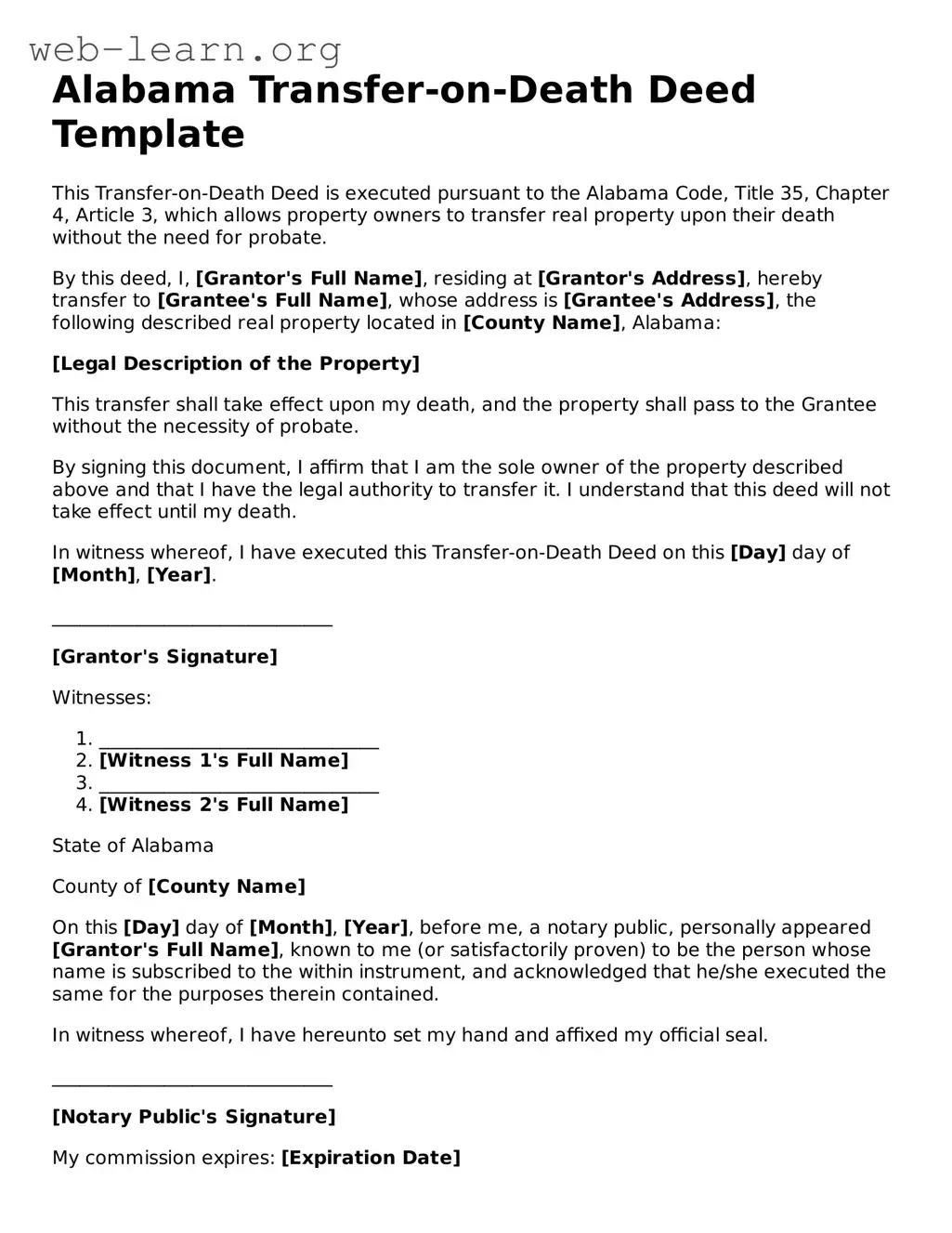
This Transfer-on-Death Deed is executed pursuant to the Alabama Code, Title 35, Chapter 4, Article 3, which allows property owners to transfer real property upon their death without the need for probate.
By this deed, I, [Grantor's Full Name], residing at [Grantor's Address], hereby transfer to [Grantee's Full Name], whose address is [Grantee's Address], the following described real property located in [County Name], Alabama:
[Legal Description of the Property]
This transfer shall take effect upon my death, and the property shall pass to the Grantee without the necessity of probate.
By signing this document, I affirm that I am the sole owner of the property described above and that I have the legal authority to transfer it. I understand that this deed will not take effect until my death.
In witness whereof, I have executed this Transfer-on-Death Deed on this [Day] day of [Month], [Year].
______________________________
[Grantor's Signature]
Witnesses:
State of Alabama
County of [County Name]
On this [Day] day of [Month], [Year], before me, a notary public, personally appeared [Grantor's Full Name], known to me (or satisfactorily proven) to be the person whose name is subscribed to the within instrument, and acknowledged that he/she executed the same for the purposes therein contained.
In witness whereof, I have hereunto set my hand and affixed my official seal.
______________________________
[Notary Public's Signature]
My commission expires: [Expiration Date]
| Fact Name | Details |
|---|---|
| Definition | An Alabama Transfer-on-Death Deed allows property owners to transfer real estate to beneficiaries upon their death without going through probate. |
| Governing Law | The Alabama Transfer-on-Death Deed is governed by Alabama Code § 35-4-191 through § 35-4-198. |
| Eligibility | Any individual who owns real property in Alabama can create a Transfer-on-Death Deed. |
| Beneficiary Designation | Property owners can name one or more beneficiaries in the deed, who will inherit the property upon the owner’s death. |
| Revocation | Transfer-on-Death Deeds can be revoked or changed at any time before the owner's death, as long as the owner follows proper procedures. |
| Filing Requirements | The deed must be signed by the property owner and recorded with the county probate court to be effective. |
| Effect on Taxes | Creating a Transfer-on-Death Deed does not trigger gift taxes or affect property taxes until the transfer occurs after death. |
| Limitations | Transfer-on-Death Deeds cannot be used for certain types of property, such as jointly owned property or property subject to a mortgage. |
Once you have obtained the Alabama Transfer-on-Death Deed form, you are ready to begin the process of filling it out. It is important to ensure that all information is accurate and complete, as this document will play a crucial role in the transfer of property upon your passing. Below are the steps to guide you through the completion of the form.
After completing these steps, it is advisable to keep a copy of the recorded deed for your records. Inform your designated beneficiary or beneficiaries about the deed to ensure they understand the arrangement. This transparency can help avoid confusion and potential disputes in the future.
What is a Transfer-on-Death Deed?
A Transfer-on-Death Deed (TOD Deed) is a legal document that allows a property owner to transfer their real estate to a designated beneficiary upon their death. This deed does not take effect until the owner passes away, meaning the owner retains full control of the property during their lifetime.
Who can use a Transfer-on-Death Deed in Alabama?
Any individual who owns real property in Alabama can create a Transfer-on-Death Deed. This includes homeowners and property investors. However, the property must be solely owned by the individual, as joint ownership may require different considerations.
What are the benefits of using a Transfer-on-Death Deed?
There are several advantages to using a TOD Deed:
How do I create a Transfer-on-Death Deed?
To create a TOD Deed, the property owner must fill out the appropriate form, including details about the property and the designated beneficiary. It is essential to sign the deed in the presence of a notary public. After signing, the deed must be recorded with the county probate court where the property is located to be effective.
Can I change or revoke a Transfer-on-Death Deed after it is created?
Yes, the property owner can change or revoke the TOD Deed at any time before their death. To do this, the owner must create a new deed or a formal revocation document, which also needs to be recorded with the county probate court.
What happens if the beneficiary dies before the property owner?
If the designated beneficiary passes away before the property owner, the TOD Deed will typically become void. It is advisable to name an alternate beneficiary to ensure the property still transfers as intended.
Are there any limitations on the property that can be transferred using a TOD Deed?
Yes, certain types of property may not be eligible for a TOD Deed. For instance, properties held in a trust or properties subject to a mortgage may have specific requirements. It's best to consult with a legal professional to understand any limitations that may apply.
Is there a cost associated with creating a Transfer-on-Death Deed?
While there may be costs for legal assistance or notary services, the primary expense will be the recording fee charged by the county probate court. This fee can vary by location, so it's wise to check with the local court for specific amounts.
Filling out the Alabama Transfer-on-Death Deed form can be a straightforward process, but many people encounter pitfalls that can complicate their intentions. One common mistake is failing to provide accurate information about the property. It's crucial to include the correct legal description of the property being transferred. Omitting this detail or using vague descriptions can lead to disputes or even invalidate the deed.
Another frequent error involves not properly identifying the beneficiaries. Each beneficiary's full name and, if applicable, their relationship to the property owner should be clearly stated. Incomplete or incorrect names can create confusion and potentially result in legal challenges down the line.
Some individuals neglect to sign the deed in the presence of a notary. Alabama law requires that the Transfer-on-Death Deed be notarized to be legally binding. Skipping this step can render the document ineffective, leaving the property in limbo and not fulfilling the owner’s wishes.
Additionally, failing to record the deed with the local probate court is a significant oversight. After completing the form, it must be filed with the appropriate county office. Without this crucial step, the deed may not be recognized, and the intended transfer may not occur.
People also sometimes overlook the importance of updating the deed after major life events, such as marriage, divorce, or the death of a beneficiary. Changes in circumstances can affect the validity of the deed or the distribution of the property, so it is essential to revisit and revise the document as needed.
Another common mistake is not consulting with a legal professional. While the form might seem simple, the implications of a Transfer-on-Death Deed can be complex. Seeking advice ensures that all legal requirements are met and that the deed reflects the owner's true intentions.
Some individuals fail to communicate their plans to the beneficiaries. Not informing those who are named in the deed can lead to confusion and conflict among family members. Open dialogue about the intentions behind the deed can help prevent misunderstandings and ensure a smoother transition.
Moreover, neglecting to consider tax implications can be a costly oversight. While the Transfer-on-Death Deed allows for the transfer of property outside of probate, it does not exempt the estate from potential tax liabilities. Understanding these financial aspects is vital for effective estate planning.
Finally, many people do not take the time to review the completed deed before submission. Mistakes can easily slip through the cracks, and a careful review can catch errors that might otherwise complicate the transfer process. Taking the time to ensure accuracy can save significant headaches later on.
When considering the Alabama Transfer-on-Death Deed, it's essential to be aware of other forms and documents that may be necessary for a smooth property transfer. These documents help clarify intentions, ensure compliance with state laws, and facilitate the transition of ownership. Here’s a list of commonly used forms in conjunction with the Transfer-on-Death Deed:
Understanding these documents can help ensure that your estate planning is comprehensive and effective. Each form plays a crucial role in the overall process of property transfer and can help prevent disputes among heirs.
The Transfer-on-Death Deed (TOD) form is a valuable estate planning tool that allows property owners to designate beneficiaries who will receive their property upon their death. It shares similarities with several other legal documents. Below are six documents that are comparable to the TOD form, along with an explanation of how they are alike:
When filling out the Alabama Transfer-on-Death Deed form, there are important considerations to keep in mind. This deed allows individuals to transfer property to beneficiaries upon their death without the need for probate. Here is a list of things you should and shouldn't do during this process.
Many people have misunderstandings about the Alabama Transfer-on-Death Deed form. Here are some common misconceptions:
While a Transfer-on-Death Deed allows for the direct transfer of property, it does not replace the need for a will. A will can address other important matters, such as personal belongings and guardianship of children.
This form can benefit anyone who owns property and wishes to simplify the transfer process. It is not limited to those with significant assets.
A Transfer-on-Death Deed allows property to pass outside of probate, meaning court approval is not necessary for the transfer to occur.
While it is possible to revoke a Transfer-on-Death Deed, the process must be done correctly. Simply deciding to change your mind does not automatically invalidate the deed.
This deed is limited to real property, such as land and buildings. Personal property, like vehicles or bank accounts, is not covered by this deed.
It is possible to have multiple Transfer-on-Death Deeds for a single property, but only the most recent one will be effective. Older deeds will be revoked automatically.
Filling out and using the Alabama Transfer-on-Death Deed form can be a straightforward process if you understand the key aspects involved. Here are some important takeaways:
Understanding these key points can help ensure a smooth process when utilizing the Transfer-on-Death Deed in Alabama.
How to Avoid Probate in Illinois - This deed does not affect the owner's ability to sell or mortgage the property during their lifetime.
Where Can I Get a Tod Form - Using this deed can simplify estate planning and reduce family disputes.
Transfer on Death Deed Florida Form - Beneficiaries do not have any rights to the property until the owner's death.