Homepage Blank Alabama Sm 1 Form
Outline

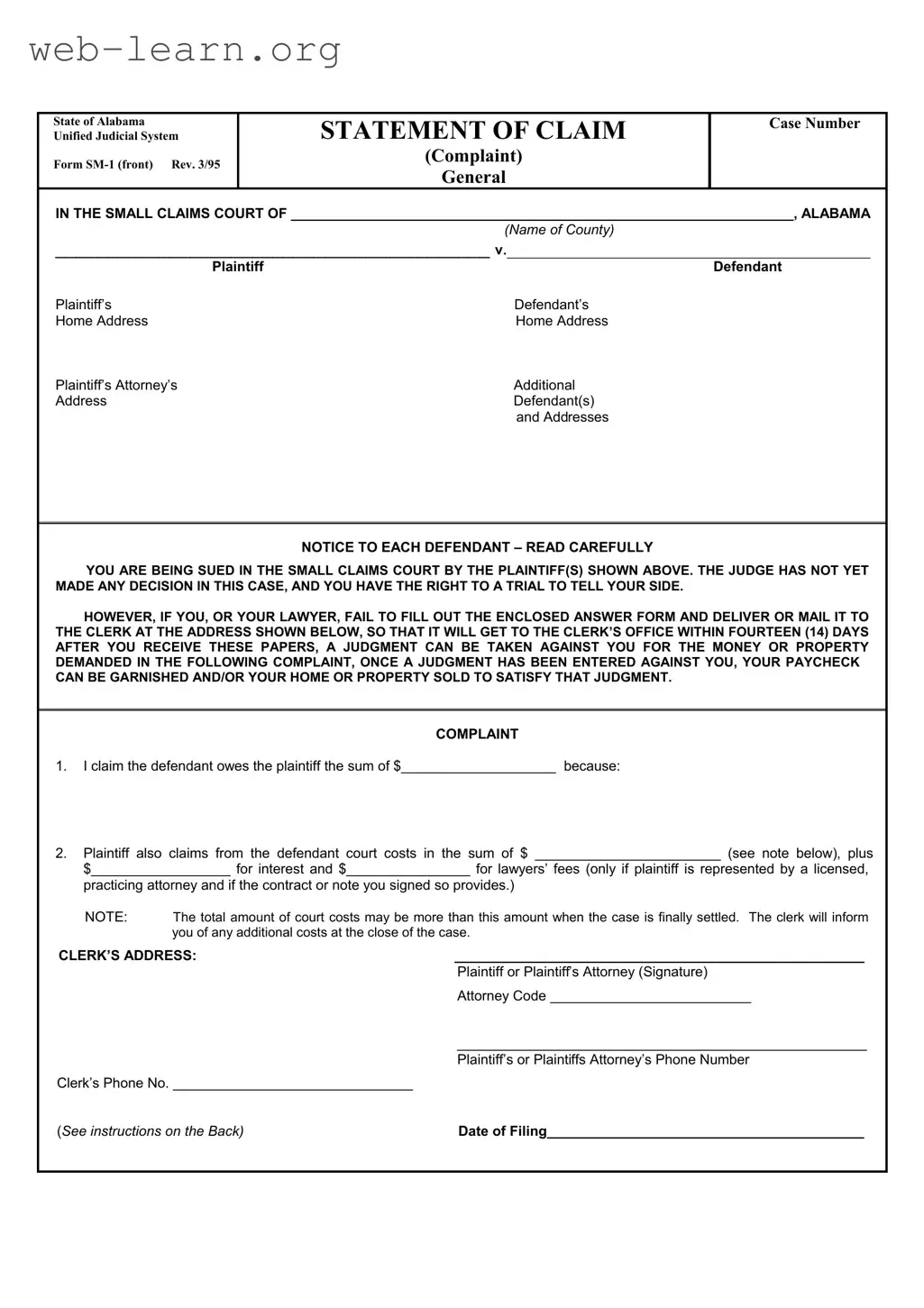
The Alabama Sm 1 form, also known as the Statement of Claim, serves as a crucial document in the Small Claims Court system. This form is designed for individuals who wish to initiate a legal action against another party, commonly referred to as the defendant. It outlines the plaintiff's claims, including the amount owed and the reasons for the claim. The form requires specific information, such as the names and addresses of both the plaintiff and defendant, as well as any legal representation involved. Importantly, the Sm 1 form includes a notice to the defendant, informing them of their right to a trial and the potential consequences of failing to respond within the specified timeframe. Additionally, it details the process for filing the claim, serving the defendant, and what to expect during the court proceedings. Understanding this form is essential for anyone seeking to resolve a dispute through the Small Claims Court in Alabama.


Sample - Alabama Sm 1 Form

State of Alabama
Unified Judicial System
Form SM-1 (front) Rev. 3/95
STATEMENT OF CLAIM
(Complaint)
General
Case Number
IN THE SMALL CLAIMS COURT OF _________________________________________________________________, ALABAMA
(Name of County)
__________________________________________ v._______________________________________
Plaintiff Defendant
Plaintiff’s Defendant’s
Home Address Home Address
Plaintiff’s Attorney’s Additional
Address Defendant(s)
and Addresses
NOTICE TO EACH DEFENDANT – READ CAREFULLY
YOU ARE BEING SUED IN THE SMALL CLAIMS COURT BY THE PLAINTIFF(S) SHOWN ABOVE. THE JUDGE HAS NOT YET
MADE ANY DECISION IN THIS CASE, AND YOU HAVE THE RIGHT TO A TRIAL TO TELL YOUR SIDE.
HOWEVER, IF YOU, OR YOUR LAWYER, FAIL TO FILL OUT THE ENCLOSED ANSWER FORM AND DELIVER OR MAIL IT TO
THE
CLERK AT THE ADDRESS SHOWN BELOW, SO THAT IT WILL GET TO THE CLERK’S OFFICE WITHIN FOURTEEN (14) DAYS
AFTER YOU RECEIVE THESE PAPERS, A JUDGMENT CAN BE TAKEN AGAINST YOU FOR THE MONEY OR PROPERTY
DEMANDED IN THE FOLLOWING COMPLAINT, ONCE A JUDGMENT HAS BEEN ENTERED AGAINST YOU, YOUR PAYCHECK
CAN BE GARNISHED AND/OR YOUR HOME OR PROPERTY SOLD TO SATISFY THAT JUDGMENT.
COMPLAINT
1. I claim the defendant owes the plaintiff the sum of $____________________ because:
2. Plaintiff also claims from the defendant court costs in the sum of $ ________________________ (see note below), plus
$__________________ for interest and $________________ for law
yers’ fees (only if plaintiff is represented by a licensed,
practicing attorney and if the contract or note you signed so provides.)
NOTE: The total amount of court costs may be more than this amount when the case is finally settled. The clerk will inform
you of any additional costs at the close of the case.
CLERK’S ADDRESS: _____________________________________________________
Plaintiff or Plaintiff’s Attorney
(Signature)
Attorney
Code __________________________
_____________________________________________________
Plaintiff’s or Plaintiffs Attorney
’s Phone Number
Clerk’s Phone No. _______________________________
(See instructions on the Back) Date of Filing_________________________________________
Form SM-1 (back) Rev. 3/95
INSTRUCTIONS TO THE PLAINTIFF’S
This is your case, and if you are acting as your own lawyer, you are responsible in seeing that your claim is successfully presented
at each stage of the procedure until it is concluded.
1. You must complete one of these forms for each defendant you wish to sue. Each defendant must be described by his/her
correct legal name and address (not a post office box). Be as brief as possible but include every important name, date
and place
2. To start your case you must file the completed form wi
th the clerk assigned to Small Claims cases. The clerk will stamp
a copy for you to show that the case has been filed and will insert the number of the case on the front of this form.
3. You are responsible for seeing that each defendant receives a copy of this form. If you haven’t heard from anyone about
the case in about fourteen days, then check with the clerk’s office, to make sure that each defendant has been served.
4. If any of the defendants ask for a trial you will be notified of the place, the date, and the time. You must be present or your
case will be dismissed. You may take a judgment by default fourteen (14) days after the defendant has received a copy
of this form, if the defendant fails to file his/her Answer.
5. You are responsible to see to the enforcement of any judgment that is awarded to y
ou. It is not the responsibility of the
court or the clerk to collect the judgment for you.
ANY TIME YOU CONTACT THE CLERK ABOUT THIS CASE YOU MUST REFER T
O THE CASE NUMBER ON THE FRONT.
INSTRUCTIONS TO SHERIFF OR PROCESS SERVER
To Any Sheriff or Any Person Authorized by Rule 4.1(b)(1) or 4.1(b)(2) of the Alabama Rules of Civil Procedure to Effect Service in
the State of Alabama.
You are hereby commanded to serve this summons and a copy of
the Statement of Claim in
this action upon the defendant(s)
named __________________________________________________________________________________________________
________________________________________________________________________________________________________
and make proper return to this court.
Date ________________________ _____________________________________ By__________
Clerk
RETURN ON SERVICE:
Served on defendant(s) named _______________________________________________________________________________
________________________________________________________________________________________________________
by delivering a copy
of the Summons and Statement of Claim to him/her in ____________________________________________
County, Alabama, on (Date) ______________________________________________________________________,
____________________________________________________
Process Server Signature
____________________________________________________
Title of Process Server
This service by certified mail of this Summons and Statement of Claim is initiated upon the request of _______________________
______________________________ pursuant to Rule 4.1.(c) of the Alabama Rules of Civil Procedure.
Date Requested ___________________________________ Date Mailed __________________________________________
Return Receipt Date _______________________________ ______________________________ By
___________________
Clerk

Form Information

Fact Name Fact Description
Form Purpose The Alabama SM-1 form is used to initiate a small claims case in the state of Alabama.
Governing Law This form is governed by the Alabama Rules of Civil Procedure, specifically Rule 4.1.
Defendant's Rights Defendants have the right to a trial and must respond within 14 days to avoid a default judgment.
Filing Process To start a case, the completed SM-1 form must be filed with the clerk assigned to Small Claims cases.
Cost Recovery Plaintiffs can claim court costs, interest, and attorney fees if represented, as part of their complaint.

Detailed Guide for Filling Out Alabama Sm 1

Filling out the Alabama SM-1 form requires careful attention to detail. This form initiates a small claims case and must be completed accurately to ensure proper processing. After completing the form, it will need to be filed with the appropriate court clerk.

  1. Begin by entering the name of the county where you are filing the claim in the designated space.
  2. In the section labeled "Plaintiff," provide your name and home address. If you have an attorney, include their name and additional address as well.
  3. Next, fill in the name of the defendant and their home address. Ensure that you use the correct legal name and address, avoiding post office boxes.
  4. In the "Complaint" section, state the amount you claim the defendant owes you. Write this amount clearly in the space provided.
  5. Also, indicate any court costs you are claiming from the defendant. Fill in the amount of interest and any attorney's fees, if applicable.
  6. Sign the form where indicated. If you are represented by an attorney, they should sign it as well and include their attorney code.
  7. Provide your phone number and the phone number of the clerk's office in the appropriate spaces.
  8. Finally, write the date of filing at the bottom of the form.

Obtain Answers on Alabama Sm 1

  1. What is the purpose of the Alabama Sm 1 form?

    The Alabama Sm 1 form is used to initiate a small claims case in the Small Claims Court of Alabama. This form allows a plaintiff to formally state their claim against a defendant. It includes details such as the amount owed, reasons for the claim, and the addresses of both parties involved. By filing this form, the plaintiff seeks a resolution to their dispute through the court system.

  2. How do I fill out the Alabama Sm 1 form correctly?

    To fill out the Alabama Sm 1 form, you need to provide accurate information for each section. Start with the names and addresses of both the plaintiff and defendant. Clearly state the amount owed and the reasons for the claim. It is essential to ensure that all information is correct and complete, as this will help in the processing of your case. If you are unsure about any part, consider seeking assistance to avoid mistakes.

  3. What happens after I file the Alabama Sm 1 form?

    Once you file the Alabama Sm 1 form with the clerk of the Small Claims Court, the clerk will stamp a copy for your records. You must then ensure that each defendant receives a copy of the form. If the defendants do not respond within fourteen days, you may be able to obtain a judgment by default. If they do respond and request a trial, you will be notified of the date, time, and location of the hearing.

  4. What if the defendant does not respond to the claim?

    If the defendant does not respond within the fourteen-day period, you can request a judgment by default. This means that the court may grant your claim without a trial, as the defendant failed to contest it. However, it is crucial to follow the correct procedures to ensure that the judgment is valid and enforceable.

  5. Am I responsible for collecting the judgment awarded to me?

    Yes, once a judgment is awarded in your favor, you are responsible for enforcing it. The court does not collect the judgment for you. You may need to take additional steps, such as garnishing wages or placing liens on property, to collect the amount owed. It is important to understand your responsibilities in this process to ensure you receive what you are owed.

Common mistakes

Filling out the Alabama SM-1 form can be a straightforward process, but many people make common mistakes that can complicate their claims. Understanding these pitfalls can save time and prevent frustration.

One frequent error is failing to provide the correct legal names and addresses for each defendant. It’s essential to use the full legal name, as nicknames or incomplete names can lead to delays or even dismissal of the case. Additionally, using a post office box instead of a physical address can also be problematic, as the court requires a verifiable location for service of process.

Another mistake involves not completing the form for each defendant. If you are suing multiple parties, each one requires a separate SM-1 form. Omitting this step can result in confusion and may hinder your ability to pursue your claims effectively.

Some individuals overlook the importance of signing the form. A signature is not just a formality; it signifies that the information provided is accurate and that you are officially initiating the claim. Without a signature, the form may be rejected by the court.

Additionally, people often forget to include all relevant financial details in the complaint section. The form requires you to specify the amount owed, court costs, interest, and any attorney fees. Leaving any of these sections blank can result in a lack of clarity about your claim and could weaken your case.

It’s also important to remember that you must ensure each defendant receives a copy of the form. Some claimants assume that filing with the court is enough, but it is your responsibility to serve the defendants. Failing to do so can lead to complications down the line, especially if a defendant contests the case.

Lastly, many people neglect to keep a copy of the filed form for their own records. Having this documentation is crucial for tracking the progress of your case and for reference in any future communications with the court. This oversight can lead to confusion and miscommunication.

Documents used along the form

The Alabama Sm 1 form serves as a foundational document in small claims court proceedings. It initiates the legal process by outlining the plaintiff's claims against the defendant. However, several other forms and documents often accompany this form to facilitate various aspects of the case. Below is a list of these related documents, each described briefly.

  • Answer Form: This document is completed by the defendant in response to the claims made in the Sm 1 form. It allows the defendant to present their side of the story, dispute the allegations, and provide any defenses they may have. Timely submission of this form is crucial, as failure to do so may result in a default judgment against the defendant.
  • Summons: The summons is a legal document that notifies the defendant that they are being sued. It includes essential information such as the case number, the court's name, and instructions on how to respond. This document is typically served alongside the Sm 1 form to ensure the defendant is aware of the legal action being taken against them.
  • Proof of Service: This document verifies that the defendant has been officially served with the Sm 1 form and summons. It is completed by the process server and includes details about how and when the documents were delivered. This proof is important for the court to confirm that the defendant has received notice of the lawsuit.
  • Judgment Form: If the case proceeds to a conclusion, a judgment form may be used to record the court's decision. This document outlines the outcome of the case, including any monetary awards or other remedies granted to the plaintiff. It serves as the official record of the court's ruling and may be used for enforcement purposes.

These documents collectively contribute to the small claims process, ensuring that both parties have the opportunity to present their cases and that the court can render a fair decision. Understanding these forms and their functions is essential for anyone involved in small claims litigation in Alabama.

Similar forms

The Alabama SM 1 form is similar to several other legal documents used in small claims and civil court processes. Here are five documents that share similarities with the SM 1 form:

  • Notice of Claim: This document informs a defendant about a claim against them. Like the SM 1 form, it outlines the plaintiff's allegations and the amount owed. Both require accurate identification of parties involved.
  • Summons: A summons notifies a defendant of a legal action and requires their response. Similar to the SM 1 form, it includes deadlines for responses and warns of consequences for failing to respond.
  • Answer Form: This is the defendant's response to the plaintiff's claims. It parallels the SM 1 form by addressing the same parties and case details, allowing the defendant to present their side of the story.
  • Judgment Form: After a court decision, this document outlines the judgment details. It shares similarities with the SM 1 form in that it specifies amounts owed and parties involved, but it reflects the outcome rather than initiating the claim.
  • Request for Default Judgment: This document is filed when a defendant fails to respond. It is similar to the SM 1 form because it references the original claim and requests a judgment based on the lack of response.

Dos and Don'ts

When filling out the Alabama Sm 1 form, it’s essential to approach the task with care. Here are some key do's and don'ts to ensure your submission is accurate and effective.

  • Do provide the correct legal names and addresses for all defendants.
  • Do file the completed form with the appropriate clerk for Small Claims cases.
  • Do keep a copy of the filed form for your records.
  • Do ensure that you include all relevant details, such as the amount owed and any applicable fees.
  • Do check with the clerk’s office if you haven’t heard back in fourteen days.
  • Don't use a post office box for the defendant’s address; a physical address is required.
  • Don't forget to sign the form before submission.
  • Don't assume the court will enforce the judgment for you; follow up as needed.
  • Don't neglect to refer to the case number when contacting the clerk.
  • Don't leave out any important names, dates, or places that support your claim.

Following these guidelines will help ensure that your claim is presented effectively and can lead to a successful resolution.

Misconceptions

Understanding the Alabama Sm 1 form can be challenging, and several misconceptions often arise. Here is a list of eight common misunderstandings:

  • The form is only for small amounts of money. Many people believe that the Sm 1 form is limited to small claims. However, it can be used for various monetary disputes, not just minor amounts.
  • You need a lawyer to file the form. While legal representation can be beneficial, individuals can file the Sm 1 form on their own without an attorney. It is designed for self-representation.
  • Once filed, the case is automatically resolved. Filing the form does not guarantee a resolution. A trial may still be necessary, and both parties must present their cases before a judgment is made.
  • The plaintiff must prove their case immediately. The initial filing does not require the plaintiff to present all evidence at once. The trial is the stage for presenting evidence and arguments.
  • Defendants have unlimited time to respond. Defendants must respond within fourteen days of receiving the Sm 1 form. Failure to do so may result in a default judgment against them.
  • The court collects the judgment for you. After a judgment is awarded, it is the plaintiff's responsibility to enforce it. The court does not handle the collection process.
  • All claims are heard in the same location. The case must be filed in the appropriate county where the defendant resides or where the dispute occurred. Different counties may have different procedures.
  • The form is the same for every case. Each case may require specific information tailored to the unique circumstances. Plaintiffs must ensure all relevant details are accurately included.

These misconceptions can lead to confusion and hinder the process of filing a claim. Understanding the facts about the Alabama Sm 1 form is essential for anyone involved in a small claims dispute.

Key takeaways

When dealing with the Alabama Sm 1 form, it’s crucial to understand its significance and the steps involved in filling it out correctly. Here are some key takeaways to guide you through the process:

  • Complete for Each Defendant: You must fill out a separate Sm 1 form for every defendant you intend to sue. Ensure that you provide their correct legal name and address, avoiding post office boxes.
  • Filing Process: After completing the form, file it with the Small Claims court clerk. The clerk will stamp your copy to confirm that your case has been officially filed, and they will assign a case number.
  • Serving the Defendants: It’s your responsibility to ensure that each defendant receives a copy of the Sm 1 form. If you do not hear from them within fourteen days, follow up with the clerk’s office to verify that service has been completed.
  • Trial Notification: If any defendant requests a trial, you will be informed of the details regarding the time and place. Attendance is mandatory; failure to appear may result in your case being dismissed.
  • Enforcement of Judgment: If you win your case, it is up to you to enforce the judgment. The court or clerk will not collect the awarded amount on your behalf.

Understanding these points will help you navigate the process smoothly and ensure that your claim is presented effectively in court.