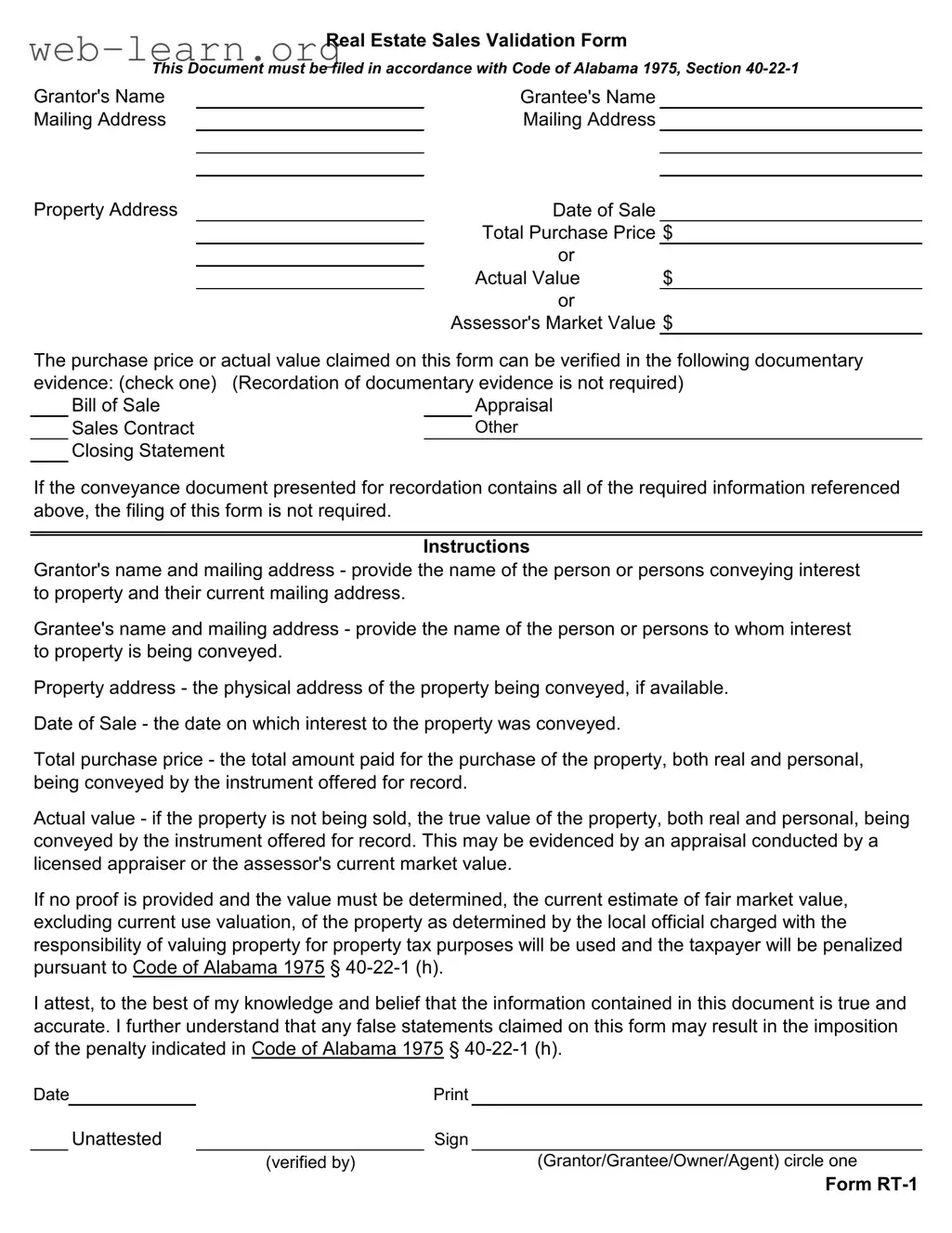
When navigating the complexities of real estate transactions in Alabama, the Alabama Rt 1 form plays a crucial role in ensuring compliance with state regulations. This form is essential for documenting the sale of property, capturing key details such as the names and addresses of both the grantor and grantee, as well as the property address and date of sale. One of the most significant aspects of the Rt 1 form is its requirement to disclose the total purchase price or actual value of the property, which can be substantiated through various forms of documentary evidence, including bills of sale or appraisals. Importantly, if the conveyance document already includes all necessary information, the filing of this form may not be required, streamlining the process for all parties involved. However, it’s vital to remember that any inaccuracies or omissions can lead to penalties under Alabama law, emphasizing the importance of accuracy and honesty in the information provided. By understanding the nuances of the Alabama Rt 1 form, individuals can better navigate their real estate transactions with confidence and clarity.

| Fact Name | Details |
|---|---|
| Governing Law | This form is governed by the Code of Alabama 1975, Section 40-22-1. |
| Purpose | The form is used to validate real estate sales in Alabama. |
| Required Information | It requires details such as the grantor's and grantee's names, mailing addresses, property address, date of sale, and total purchase price. |
| Documentary Evidence | Documentary evidence can include a bill of sale, appraisal, sales contract, or closing statement. |
| Filing Requirement | If the conveyance document has all required information, filing this form is not necessary. |
| Penalties | False statements on the form may result in penalties as outlined in the governing law. |
Filling out the Alabama Rt 1 form is an important step in the real estate transaction process. This form requires specific information about the parties involved and the property being sold. Completing it accurately is crucial to ensure compliance with state regulations.
After completing the form, ensure that all information is correct before submitting it to the appropriate authorities. Any discrepancies could lead to penalties or delays in processing your real estate transaction.
What is the Alabama Rt 1 form?
The Alabama Rt 1 form, also known as the Real Estate Sales Validation Form, is a document required by the state of Alabama. It must be filed in accordance with Code of Alabama 1975, Section 40-22-1. This form provides essential information about the sale of real estate, including details about the grantor, grantee, property address, date of sale, and the total purchase price.
Who needs to file the Alabama Rt 1 form?
The form must be filed by the grantor, or the person conveying interest in the property. If the conveyance document contains all required information, the filing of this form is not necessary. However, it is important to check if your situation requires it.
What information is required on the form?
The Alabama Rt 1 form requires the following information:
What types of documentary evidence can be provided?
You can verify the claimed purchase price or actual value with one of the following types of documentary evidence:
Recordation of this evidence is not required, but it must be available if needed.
What happens if I do not file the form when required?
If you fail to file the Alabama Rt 1 form when necessary, the local official responsible for property valuation will determine the fair market value of the property. This value will exclude current use valuation and may result in penalties as outlined in Code of Alabama 1975 § 40-22-1 (h).
Can I provide an estimated value if I do not have an appraisal?
Yes, if you do not have an appraisal, you can provide an estimate of the fair market value. However, this estimate must be based on the current market conditions and should be substantiated by local officials if needed.
What are the consequences of providing false information on the form?
Providing false statements on the Alabama Rt 1 form can lead to serious consequences. You may face penalties as indicated in Code of Alabama 1975 § 40-22-1 (h). It is crucial to ensure that all information is accurate and truthful.
Is there a specific format for signing the form?
Yes, the form requires you to attest to the accuracy of the information provided. You must sign and date the form, and indicate whether you are the grantor, grantee, owner, or agent. This verification adds credibility to the information submitted.
Where should I submit the Alabama Rt 1 form?
The completed Alabama Rt 1 form should be submitted to the appropriate county office where the property is located. This may be the county probate court or another designated office responsible for property records. Be sure to check with local authorities for specific submission guidelines.
Can I get assistance with filling out the form?
If you need help completing the Alabama Rt 1 form, you may seek assistance from a real estate professional, attorney, or a knowledgeable friend. Local county offices may also provide guidance on the information required and the filing process.
Filling out the Alabama Rt 1 form can be straightforward, but many people make common mistakes that can lead to delays or complications. One frequent error is leaving out the grantor's name. This section must include the full name of the person or entity conveying interest in the property. Without this information, the form may be rejected or require additional clarification.
Another mistake is not providing the correct grantee's name. The grantee is the individual or entity receiving the property. If the name is misspelled or incomplete, it can create issues during the property transfer process. Always double-check the spelling and ensure that it matches official documents.
People often forget to include the mailing addresses for both the grantor and grantee. This information is crucial for communication and record-keeping. Without accurate addresses, it may be difficult for the parties involved to receive important notices or documents related to the property.
When it comes to the property address, some individuals fail to provide a complete or accurate location. This can lead to confusion and may delay the processing of the form. It’s important to include the full physical address, including street number, street name, city, and zip code, if available.
Another common oversight is miscalculating the total purchase price or actual value of the property. This figure must reflect the correct amount paid or the assessed market value. If this information is inaccurate, it could result in penalties or complications in the transaction. Always verify the numbers before submission.
Lastly, people sometimes neglect to check the box indicating the type of documentary evidence provided. This step is important, even though recordation of evidence is not required. Indicating the correct type of documentation can help clarify the value of the property and support the information provided on the form.
When engaging in real estate transactions in Alabama, several forms and documents may accompany the Alabama Rt 1 form. Understanding these documents is crucial for ensuring compliance and protecting your interests. Below is a list of commonly used forms and documents in conjunction with the Rt 1 form.
Each of these documents plays a vital role in the real estate transaction process. Ensuring that all necessary forms are completed accurately and submitted in a timely manner can help prevent legal issues and facilitate a smooth transfer of property ownership.
The Alabama Rt 1 form, known as the Real Estate Sales Validation Form, serves a specific purpose in real estate transactions. Several other documents share similarities with this form in terms of function and information required. Below are four documents that are comparable to the Alabama Rt 1 form:
When filling out the Alabama Rt 1 form, attention to detail is crucial. Here’s a list of things you should and shouldn’t do to ensure your submission is accurate and compliant.
Following these guidelines will help streamline the process and minimize potential issues. Always remember that the integrity of the information you provide is paramount. Good luck with your filing!
This is incorrect. The form is required for all real estate transactions, regardless of whether the property is residential, commercial, or industrial.
Actually, if the conveyance document already contains all the required information, the filing of this form is not necessary. This can save time and effort in certain situations.
Both the grantor (seller) and grantee (buyer) must provide their information on the form. This ensures that both parties are recognized in the transaction.
This is not true. The total purchase price reflects what was paid, while the actual value can be determined by an appraisal or the assessor's market value, which may differ.
In fact, providing false information can lead to penalties. The law clearly states that inaccuracies may result in consequences, emphasizing the importance of honesty when filling out the form.
This is misleading. The form should be filed in accordance with the timeline set forth in the Alabama Code, which generally requires it to be submitted at the time of recordation.
While you must indicate how the purchase price or actual value is verified, recordation of the documentary evidence itself is not required. You simply need to check the appropriate option on the form.
While the form does play a role in tax assessments, it also serves to officially document the transfer of property ownership, making it important for legal purposes beyond taxation.