In the realm of financial transactions, the Alabama Promissory Note serves as a crucial instrument that outlines the terms of a loan agreement between a borrower and a lender. This legally binding document encapsulates essential details, including the principal amount borrowed, the interest rate, and the repayment schedule. It also specifies the consequences of default, providing clarity and protection for both parties involved. By clearly stating the obligations of the borrower and the rights of the lender, the Promissory Note helps to minimize misunderstandings and disputes. Additionally, it may include provisions for prepayment and late fees, which are vital for managing the loan effectively. Understanding the nuances of this form is imperative for anyone engaged in lending or borrowing in Alabama, as it not only facilitates smoother transactions but also reinforces the importance of clear communication in financial dealings.
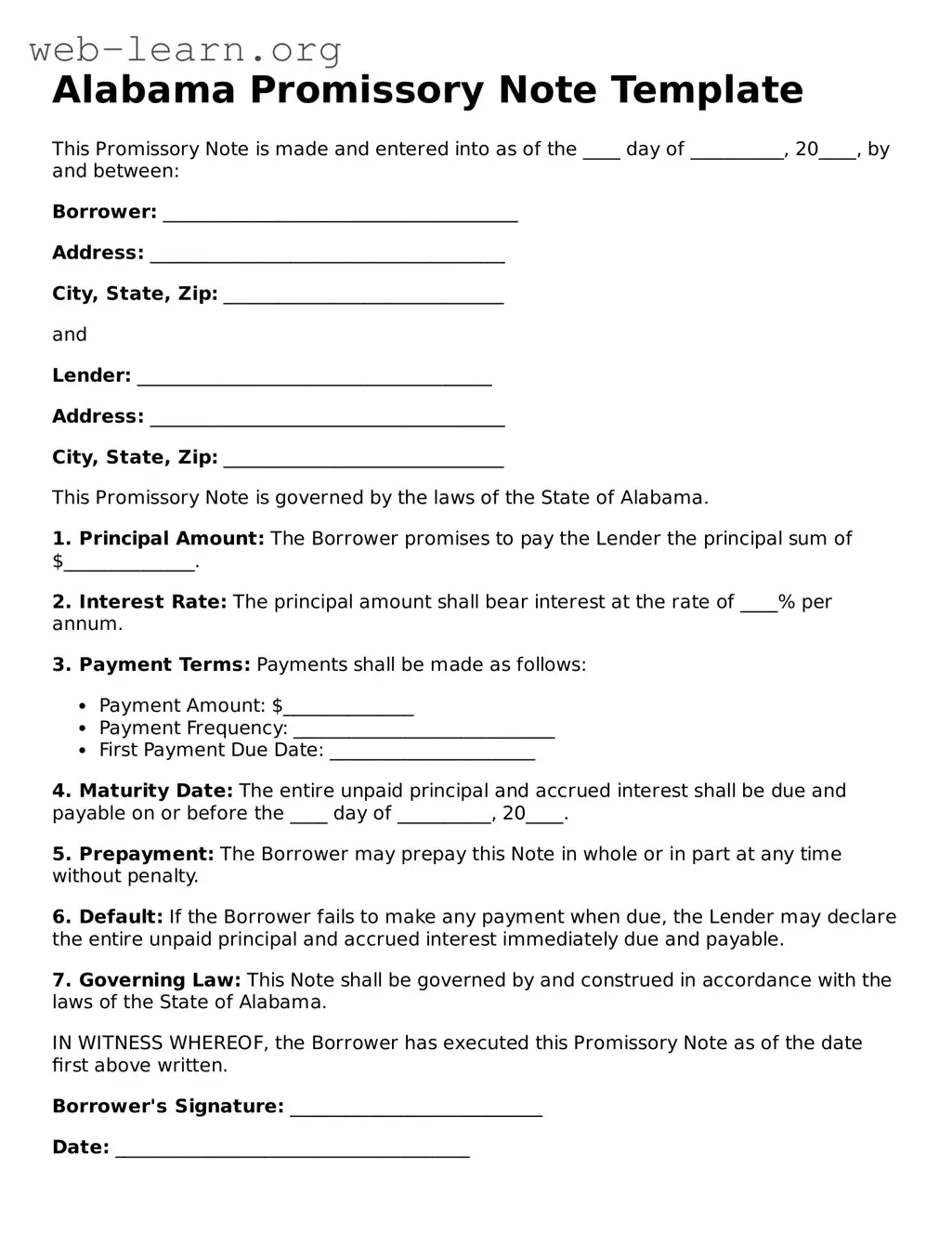
Alabama Promissory Note Template
This Promissory Note is made and entered into as of the ____ day of __________, 20____, by and between:
Borrower: ______________________________________
Address: ______________________________________
City, State, Zip: ______________________________
and
Lender: ______________________________________
Address: ______________________________________
City, State, Zip: ______________________________
This Promissory Note is governed by the laws of the State of Alabama.
1. Principal Amount: The Borrower promises to pay the Lender the principal sum of $______________.
2. Interest Rate: The principal amount shall bear interest at the rate of ____% per annum.
3. Payment Terms: Payments shall be made as follows:
4. Maturity Date: The entire unpaid principal and accrued interest shall be due and payable on or before the ____ day of __________, 20____.
5. Prepayment: The Borrower may prepay this Note in whole or in part at any time without penalty.
6. Default: If the Borrower fails to make any payment when due, the Lender may declare the entire unpaid principal and accrued interest immediately due and payable.
7. Governing Law: This Note shall be governed by and construed in accordance with the laws of the State of Alabama.
IN WITNESS WHEREOF, the Borrower has executed this Promissory Note as of the date first above written.
Borrower's Signature: ___________________________
Date: ______________________________________
Lender's Signature: ___________________________
Date: ______________________________________
| Fact Name | Description |
|---|---|
| Definition | A promissory note is a written promise to pay a specified amount of money to a designated person at a certain time. |
| Governing Law | In Alabama, the Uniform Commercial Code (UCC) governs promissory notes, specifically UCC Article 3. |
| Essential Elements | A valid promissory note must include the principal amount, interest rate, payment schedule, and signatures of the parties involved. |
| Types of Notes | Promissory notes can be secured or unsecured. A secured note is backed by collateral, while an unsecured note is not. |
| Interest Rates | Alabama law does not set a maximum interest rate for promissory notes, but usury laws apply to prevent excessively high rates. |
| Enforceability | To be enforceable in court, a promissory note must be clear and unambiguous in its terms. |
| Transferability | Promissory notes can be transferred to another party through endorsement, making them negotiable instruments. |
| Default Consequences | If the borrower defaults, the lender has the right to pursue legal action to recover the owed amount. |
| Statute of Limitations | In Alabama, the statute of limitations for enforcing a promissory note is six years from the date of default. |
Once you have the Alabama Promissory Note form in hand, you will need to fill it out carefully to ensure all necessary information is included. This document will require specific details about the loan agreement between the borrower and the lender.
A promissory note is a legal document that outlines a promise by one party to pay a specific amount of money to another party under agreed-upon terms. In Alabama, this document serves as a formal agreement between a borrower and a lender, detailing the amount borrowed, the interest rate, repayment schedule, and any collateral involved.
For a promissory note to be valid in Alabama, it must include several key elements:
Yes, a promissory note is legally binding in Alabama, provided it meets the necessary legal requirements. Both parties must agree to the terms, and the document must be signed. If the borrower fails to repay the loan as outlined, the lender has the right to take legal action to recover the owed amount.
Yes, a promissory note can be modified after it is signed, but both parties must agree to the changes. It is advisable to document any modifications in writing and have both parties sign the amended agreement to ensure clarity and enforceability.
If the borrower defaults on the promissory note, the lender can take several actions. These may include:
It is essential for both parties to understand the consequences of defaulting and to communicate openly to avoid escalation.
Filling out the Alabama Promissory Note form can be straightforward, but many people make common mistakes that can lead to issues down the line. One frequent error is failing to include all necessary parties. Both the borrower and the lender must be clearly identified. If one party is missing, it can create confusion and potentially invalidate the agreement.
Another common mistake is not specifying the loan amount clearly. The amount should be written in both numerical and written form. For example, if the loan is for $5,000, it should be stated as "Five Thousand Dollars ($5,000)." Omitting this detail can lead to misunderstandings about how much is owed.
People often overlook the importance of the interest rate. Some individuals either forget to include it or write it incorrectly. The interest rate affects the total amount owed over time. It is essential to ensure that this detail is accurate and clearly stated in the document.
Additionally, borrowers sometimes neglect to include the repayment terms. The form should specify how and when payments will be made. Whether it is a monthly payment plan or a lump sum at the end of the term, clarity is key. Without this information, the lender may face difficulties in enforcing the agreement.
Another mistake involves not signing the document. Both parties must sign the Promissory Note to make it legally binding. Failing to do so can render the agreement unenforceable. It's important to ensure that all required signatures are present before finalizing the document.
Some individuals also forget to date the form. The date is critical as it establishes when the agreement takes effect. Without a date, it may be challenging to determine the timeline for payments and other obligations.
Lastly, not keeping copies of the signed Promissory Note can lead to problems later. Both the borrower and lender should retain a copy for their records. This ensures that both parties have access to the terms of the agreement if any disputes arise in the future.
When dealing with a promissory note in Alabama, there are several other documents and forms that can be essential for a complete understanding of the transaction. Each of these documents serves a specific purpose and can help clarify the terms and obligations involved. Below is a list of commonly used forms that accompany a promissory note.
Understanding these documents can greatly assist both borrowers and lenders in navigating the complexities of financing. Each form plays a critical role in ensuring that all parties are aware of their rights and responsibilities throughout the loan process.
When filling out the Alabama Promissory Note form, it's crucial to follow certain guidelines to ensure that the document is valid and enforceable. Here are seven things you should and shouldn't do:
Following these guidelines will help ensure that your Alabama Promissory Note is completed correctly and can be enforced if necessary.
Understanding the Alabama Promissory Note form is important for anyone involved in lending or borrowing money. However, several misconceptions can lead to confusion. Here are six common misconceptions:
These misconceptions can lead to misunderstandings about the use and function of promissory notes in Alabama. Clarity on these points can help individuals navigate their financial agreements more effectively.
When filling out and using the Alabama Promissory Note form, keep these key takeaways in mind:
These points are essential for ensuring that the promissory note is valid and enforceable in Alabama.
Online Promissory Note - It is a common tool used in peer-to-peer lending arrangements.
Promissory Note Template Illinois - They can serve as a foundation for building future financial relationships.
Promissory Note Friendly Loan Agreement Format - Promissory notes can be secured or unsecured, depending on whether collateral is involved.