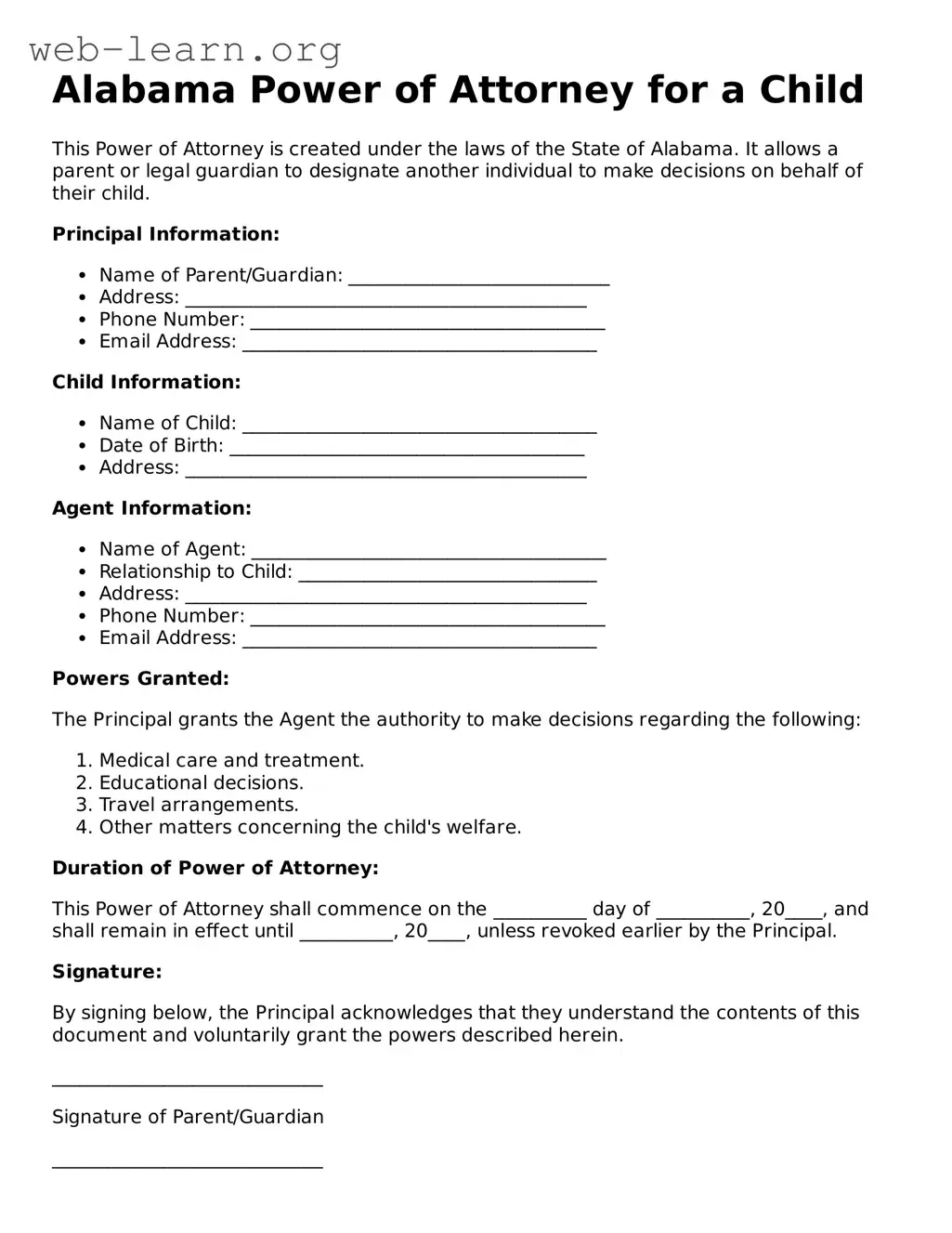
The Alabama Power of Attorney for a Child form serves as a vital legal tool for parents or guardians seeking to grant temporary authority over a child to another trusted individual. This document allows the designated agent to make decisions regarding the child’s welfare, including education, healthcare, and other day-to-day matters, ensuring that the child’s needs are met in the absence of the parent or guardian. It is particularly useful in situations such as travel, extended family visits, or when a parent is unable to care for the child due to work commitments or emergencies. By completing this form, parents can specify the duration of the authority granted, which can be tailored to fit specific circumstances. Additionally, the form requires signatures from both the parent or guardian and the agent, reinforcing the legitimacy of the arrangement. Understanding the implications and responsibilities that come with this power is essential for all parties involved, ensuring that the child's best interests remain a priority. Furthermore, the Alabama Power of Attorney for a Child form is designed to be straightforward, making it accessible for families to navigate the legal landscape with confidence.
Alabama Power of Attorney for a Child
This Power of Attorney is created under the laws of the State of Alabama. It allows a parent or legal guardian to designate another individual to make decisions on behalf of their child.
Principal Information:
Child Information:
Agent Information:
Powers Granted:
The Principal grants the Agent the authority to make decisions regarding the following:
Duration of Power of Attorney:
This Power of Attorney shall commence on the __________ day of __________, 20____, and shall remain in effect until __________, 20____, unless revoked earlier by the Principal.
Signature:
By signing below, the Principal acknowledges that they understand the contents of this document and voluntarily grant the powers described herein.
_____________________________
Signature of Parent/Guardian
_____________________________
Date
Witness Information:
Witnesses are required to sign below:
Notary Public:
State of Alabama
County of ______________________
Subscribed and sworn to before me this ______ day of __________, 20____.
_____________________________
Notary Public Signature
My Commission Expires: _______________
| Fact Name | Description |
|---|---|
| Purpose | The Alabama Power of Attorney for a Child form allows a parent or legal guardian to designate another adult to make decisions on behalf of their child. |
| Governing Law | This form is governed by Alabama Code § 26-1-1 through § 26-1-4, which outlines the legal framework for powers of attorney for minors. |
| Duration | The authority granted through this form can be temporary or permanent, depending on the specific needs outlined by the parent or guardian. |
| Revocation | The parent or guardian can revoke the power of attorney at any time, provided they notify the designated adult and follow the proper procedures. |
| Signature Requirement | The form must be signed by the parent or legal guardian in the presence of a notary public to ensure its validity. |
To complete the Alabama Power of Attorney for a Child form, gather the necessary information and ensure you understand the details required. This form allows a designated individual to make decisions regarding the care and welfare of a child in the absence of the parent or legal guardian.
After completing the form, keep a copy for your records and provide copies to the individual receiving power of attorney. Ensure that all parties understand their roles and responsibilities as outlined in the document.
What is a Power of Attorney for a Child in Alabama?
A Power of Attorney for a Child in Alabama is a legal document that allows a parent or guardian to grant another adult the authority to make decisions on behalf of their child. This can include medical, educational, and general welfare decisions. The designated adult can be a relative, family friend, or any trusted individual.
Why would I need a Power of Attorney for my child?
There are several reasons why you might need this document. For instance, if you are traveling, working long hours, or unable to care for your child temporarily, granting power of attorney ensures that your child’s needs are met. It allows the designated person to act in your absence, ensuring your child receives necessary care and support.
How long does the Power of Attorney for a Child last?
The duration of the Power of Attorney can vary. It can be set for a specific period, such as a few months, or it can remain in effect until revoked by the parent or guardian. Always specify the duration in the document to avoid confusion.
Do I need to have the Power of Attorney notarized?
Yes, in Alabama, the Power of Attorney for a Child must be notarized to be valid. This adds a layer of authenticity to the document and ensures that all parties understand the implications of the authority being granted.
Can I revoke the Power of Attorney once it is established?
Yes, you can revoke the Power of Attorney at any time. To do this, you must provide written notice to the person you designated as the attorney-in-fact and any relevant institutions, such as schools or medical facilities. It is advisable to document the revocation formally.
What decisions can the designated person make?
The person you designate can make a variety of decisions on behalf of your child. These may include:
However, the specific powers granted should be clearly outlined in the document.
Is there a specific form I need to use?
While there is no state-mandated form for a Power of Attorney for a Child, it is essential to use a document that meets Alabama's legal requirements. Many legal service providers offer templates that can be customized to your needs. Ensure that the form you choose includes all necessary elements for validity.
What should I do if I have more questions?
If you have more questions about the Power of Attorney for a Child, consider consulting with a legal professional. They can provide guidance tailored to your specific situation and ensure that you understand all aspects of the document.
Filling out the Alabama Power of Attorney for a Child form can be straightforward, but many people stumble along the way. One common mistake is not understanding the purpose of the document. This form grants someone else the authority to make decisions for your child. If you don’t clarify this, you might end up giving away more power than intended.
Another frequent error is failing to specify the duration of the power of attorney. The form should clearly state how long the arrangement will last. Without this detail, the authority may seem open-ended, leading to confusion or misuse.
People often overlook the need for signatures. Both the parent or guardian and the designated agent must sign the document. Neglecting this step can render the form invalid. Always double-check that all necessary signatures are in place.
Inaccurate or incomplete information is another pitfall. When filling out the form, ensure that all names, addresses, and contact details are correct. A simple typo can create problems later on, especially if you need to contact the designated agent.
Many forget to include a witness or notary, if required. In Alabama, having a witness can strengthen the validity of the document. Skipping this step might lead to challenges in the future.
People also sometimes fail to provide clear instructions about the powers granted. If you want the agent to handle specific matters, like medical decisions or educational choices, make sure to outline these clearly. Ambiguity can lead to misunderstandings.
Another mistake is not reviewing the form after completion. It’s wise to read through the entire document before submitting it. This final check can catch errors or omissions that might have been missed initially.
Finally, neglecting to keep copies of the completed form is a common oversight. Always retain a copy for your records and provide one to the designated agent. This ensures everyone involved is on the same page and can refer back to the document if needed.
When preparing a Power of Attorney for a Child in Alabama, several additional documents may be necessary to ensure comprehensive legal authority and protection for the child. Below is a list of commonly used forms and documents that complement the Power of Attorney for a Child.
These documents work together to provide clarity and security for both the child and the designated caregiver. It is important to gather and prepare these forms to ensure that all legal bases are covered.
When filling out the Alabama Power of Attorney for a Child form, it's essential to approach the process with care. Here are five important things to keep in mind:
Following these guidelines will help you navigate the process smoothly and ensure that the power of attorney is properly established.
Many people have misunderstandings about the Alabama Power of Attorney for a Child form. Here are ten common misconceptions, along with clarifications to help clear things up.
Understanding these misconceptions can help parents make informed decisions regarding their child's care and ensure they have the necessary legal tools in place.
Filling out and using the Alabama Power of Attorney for a Child form is an important step for parents or guardians who need to grant authority to another adult for the care of their child. Here are some key takeaways to consider:
Power of Attorney in Louisiana - It is essential to communicate the purpose of the Power of Attorney to the child.
What Is Power of Attorney for a Child - Empower a trusted adult to make informed decisions about your child's education and health care.
Temporary Poa for Child - Parents can consult with a lawyer if they have questions about the form.