Homepage Blank Alabama Mvt 5 13 Form
Outline

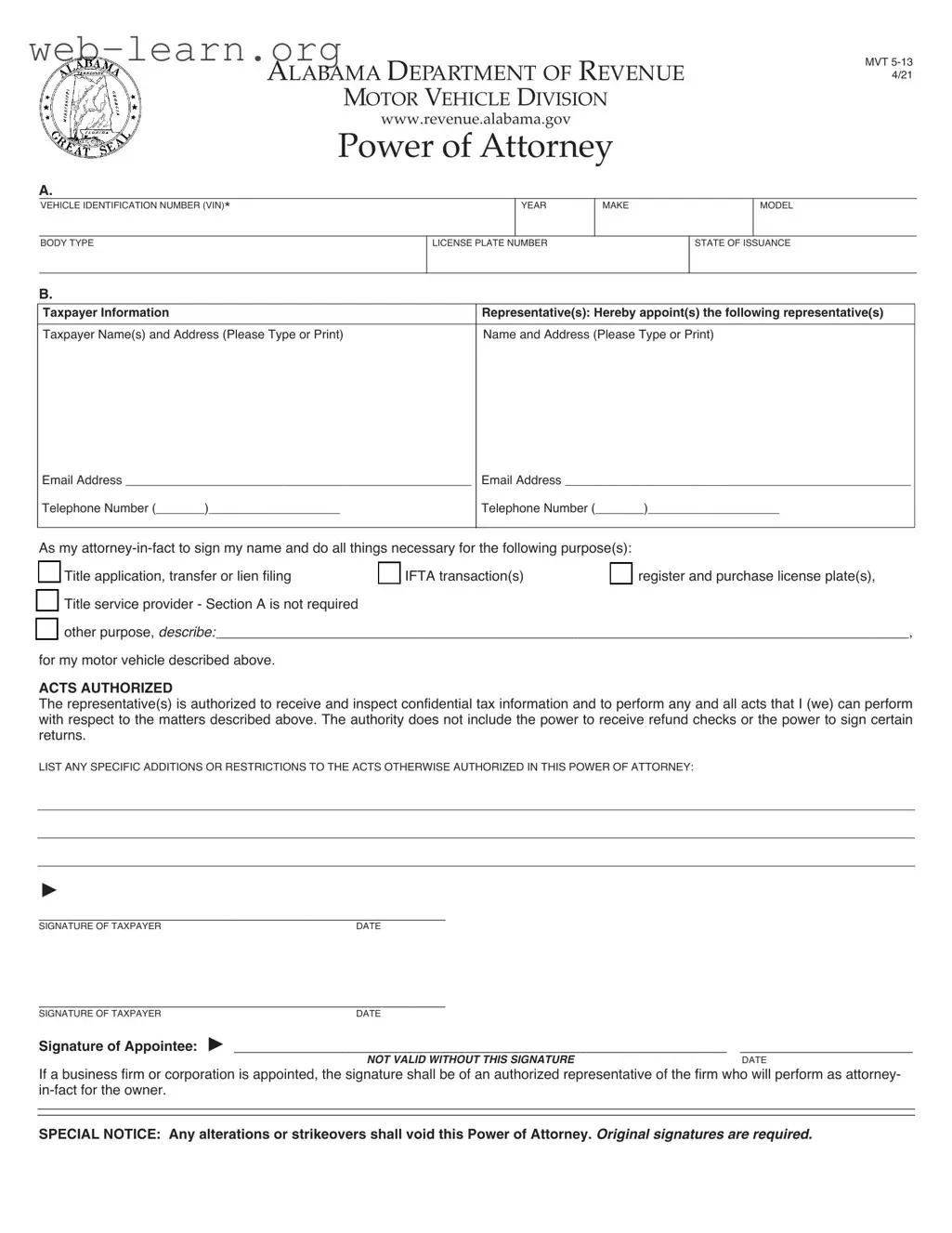
The Alabama MVT 5-13 form serves as a crucial document within the state's Motor Vehicle Division, facilitating a variety of transactions related to motor vehicles. This form is primarily designed to grant power of attorney to a representative, allowing them to act on behalf of the taxpayer in specific matters. These matters may include applying for a title, transferring ownership, filing liens, and registering or purchasing license plates. The form requires essential information such as the vehicle identification number (VIN), the year, make, and model of the vehicle, as well as the taxpayer's details, including their name, address, and contact information. Additionally, it outlines the acts that the appointed representative is authorized to perform, which can encompass receiving and inspecting confidential tax information. However, it is important to note that the authority granted does not extend to receiving refund checks or signing certain returns. The form also provides space for any specific additions or restrictions to the powers being granted, ensuring that the taxpayer can tailor the scope of authority as needed. To validate the document, original signatures from both the taxpayer and the appointee are required, emphasizing the importance of authenticity in this legal process.
Sample - Alabama Mvt 5 13 Form

ALABAMA DEPARTMENT OF REVENUE
MOTOR VEHICLE DIVISION
www.revenue.alabama.gov
Power of Attorney
MVT 5-13
4/21
As my attorney-in-fact to sign my name and do all things necessary for the following purpose(s):
6
Title application, transfer or lien filing
6
IFTA transaction(s)
6
register and purchase license plate(s),
6
Title service provider - Section A is not required
6
other purpose, describe:_________________________________________________________________________________________,
for my motor vehicle described above.
V
_______________________________________________
SIGNATURE OF TAXPAYER DATE
_______________________________________________
SIGNATURE OF TAXPAYER DATE
Signature of Appointee: V _________________________________________________________ ____________________
NOT VALID WITHOUT THIS SIGNATURE DATE
If a business firm or corporation is appointed, the signature shall be of an authorized representative of the firm who will perform as attorney-
in-fact for the owner.
SPECIAL NOTICE: Any alterations or strikeovers shall void this Power of Attorney. Original signatures are required.
ACTS AUTHORIZED
The representative(s) is authorized to receive and inspect confidential tax information and to perform any and all acts that I (we) can perform
with respect to the matters described above. The authority does not include the power to receive refund checks or the power to sign certain
returns.
LIST ANY SPECIFIC ADDITIONS OR RESTRICTIONS TO THE ACTS OTHERWISE AUTHORIZED IN THIS POWER OF ATTORNEY:
Taxpayer Information Representative(s): Hereby appoint(s) the following representative(s)
Taxpayer Name(s) and Address (Please Type or Print) Name and Address (Please Type or Print)
Email Address __________________________________________________
Telephone Number (_______)___________________
Email Address __________________________________________________
Telephone Number (_______)___________________
VEHICLE IDENTIFICATION NUMBER (VIN)
*
YEAR MAKE MODEL
BODY TYPE LICENSE PLATE NUMBER STATE OF ISSUANCE
B.
A.

Form Information

Fact Name Details
Form Title Power of Attorney MVT 5-13
Governing Body Alabama Department of Revenue
Purpose To authorize a representative to act on behalf of the taxpayer for various motor vehicle-related tasks.
Vehicle Information Requires details such as VIN, year, make, model, body type, and license plate number.
Taxpayer Information Includes fields for the taxpayer's name, address, email, and telephone number.
Acts Authorized Allows the representative to inspect tax information and perform acts related to title applications, IFTA transactions, and more.
Restrictions Does not grant authority to receive refund checks or sign certain returns.
Signature Requirement Original signatures are required from the taxpayer and the appointed representative.
Validity Notice Any alterations or strikeovers will void the Power of Attorney.

Detailed Guide for Filling Out Alabama Mvt 5 13

Completing the Alabama MVT 5 13 form involves providing specific information about the vehicle and the taxpayer, as well as designating a representative to act on behalf of the taxpayer. Following these steps will help ensure that the form is filled out correctly.

  1. Locate the section labeled "A. VEHICLE IDENTIFICATION NUMBER (VIN)". Fill in the VIN, year, make, model, body type, license plate number, and state of issuance of the vehicle.
  2. Proceed to section "B. Taxpayer Information". Here, input the name and address of the taxpayer. Ensure that this information is typed or printed clearly.
  3. Provide the email address of the taxpayer. Include a telephone number for contact purposes.
  4. In the same section, designate the representative(s) by typing or printing their name and address. Include their email address and telephone number as well.
  5. Specify the purpose for which the representative is being appointed. Check the appropriate boxes for title application, IFTA transactions, license plate registration, or other purposes. If selecting "other", describe the purpose in the provided space.
  6. List any specific additions or restrictions to the acts authorized in the Power of Attorney, if applicable.
  7. Sign and date the form in the designated area for the taxpayer. If there are multiple taxpayers, ensure that each one signs and dates the form.
  8. If applicable, the appointee must also sign and date the form. This signature is necessary for the form to be valid.

Once the form is completed, it is important to review it for accuracy. Any alterations or strikeovers may void the Power of Attorney, so care should be taken to ensure that all information is correct and clearly presented. Original signatures are required for the form to be valid.

Obtain Answers on Alabama Mvt 5 13

  1. What is the purpose of the Alabama MVT 5 13 form?

    The Alabama MVT 5 13 form serves as a Power of Attorney specifically for motor vehicle-related transactions. By completing this form, a taxpayer appoints a representative to act on their behalf for various purposes, including title applications, lien filings, and the registration or purchase of license plates. The form ensures that the appointed representative can perform necessary actions while adhering to the legal requirements set forth by the Alabama Department of Revenue.

  2. Who can be appointed as a representative using this form?

    Any individual or business entity can be appointed as a representative on the Alabama MVT 5 13 form. It is essential that the person or entity designated has the authority and capability to act on behalf of the taxpayer. If a business firm or corporation is appointed, an authorized representative of that firm must sign the form to validate the appointment.

  3. What specific actions can the appointed representative perform?

    The representative is authorized to perform a variety of actions related to the taxpayer's motor vehicle, including:

    • Filing title applications
    • Transferring titles or filing liens
    • Conducting International Fuel Tax Agreement (IFTA) transactions
    • Registering and purchasing license plates
    • Other specified purposes, as indicated by the taxpayer

    However, it is important to note that the representative does not have the authority to receive refund checks or sign certain tax returns.

  4. Are there any restrictions or additional instructions that can be included in the form?

    Yes, the taxpayer can specify any restrictions or additional instructions in the designated section of the form. This allows for tailored authority, ensuring that the representative's powers align with the taxpayer's preferences and requirements.

  5. What are the requirements for the form to be valid?

    For the Alabama MVT 5 13 form to be considered valid, it must be signed by the taxpayer, and original signatures are required. Additionally, any alterations or strikeovers on the form will void the Power of Attorney. The signature of the appointed representative is also necessary, along with the date of signing, to complete the appointment process.

Common mistakes

Filling out the Alabama MVT 5 13 form can be a straightforward process, but many individuals make common mistakes that can lead to delays or complications. One of the most frequent errors is failing to provide complete vehicle information. The form requires specific details such as the Vehicle Identification Number (VIN), year, make, model, body type, and license plate number. Omitting any of these elements can render the application incomplete and may necessitate resubmission.

Another common mistake is not clearly printing or typing the taxpayer's name and address. Legibility is crucial. If the information is difficult to read, it can lead to misunderstandings or miscommunications. It is advisable to double-check this section to ensure that all details are clear and accurate.

Many people also overlook the importance of providing accurate contact information. This includes telephone numbers and email addresses. If the Alabama Department of Revenue needs to reach out for clarification or additional information, having the correct contact details is essential. Missing or incorrect information can slow down the process significantly.

In addition, individuals often fail to specify the purpose of the power of attorney clearly. The form allows for multiple purposes, such as title application or registration. If the purpose is not clearly marked or described, it can lead to confusion about the authority granted to the representative. This oversight can complicate the execution of necessary tasks related to the vehicle.

Another mistake is neglecting to include any specific additions or restrictions to the acts authorized. If there are particular limitations or additional instructions, they should be clearly stated. Failing to do so can result in the representative acting beyond the intended scope of authority, which may lead to legal complications.

Some individuals forget that the form is not valid without original signatures. Many might assume that a photocopy or electronic signature is acceptable, but this is not the case. Original signatures are required to ensure the authenticity of the document, so it is crucial to sign in the designated areas.

Lastly, making alterations or strikeovers on the form can void the power of attorney. It is important to fill out the form accurately from the beginning. If mistakes occur, it is better to start over with a new form rather than attempting to correct errors on the original. This practice helps maintain the integrity of the document and avoids potential issues down the line.

Documents used along the form

The Alabama MVT 5-13 form is a Power of Attorney used primarily for motor vehicle transactions. When completing this form, several other documents may be necessary to facilitate various processes related to vehicle registration, title transfers, and more. Below is a list of related forms that often accompany the MVT 5-13, each serving a distinct purpose.

  • Application for Certificate of Title: This document is required when applying for a new title for a vehicle. It provides essential information about the vehicle and its ownership history.
  • Bill of Sale: A bill of sale serves as proof of the transaction between the buyer and seller. It includes details about the vehicle, sale price, and the parties involved.
  • Vehicle Registration Application: This form is necessary for registering a vehicle with the state. It typically requires information about the vehicle and the owner.
  • Notice of Lien: If there is a loan on the vehicle, this document must be filed to notify the state of the lender's interest in the vehicle until the loan is paid off.
  • IFTA Application: For those involved in interstate trucking, the International Fuel Tax Agreement (IFTA) application is essential for fuel tax reporting across state lines.
  • Power of Attorney for Vehicle Transactions: Similar to the MVT 5-13, this document allows an individual to designate someone else to act on their behalf specifically for vehicle-related matters.
  • Title Transfer Form: When ownership of a vehicle changes, this form is used to officially transfer the title from the seller to the buyer.

Understanding these documents and their purposes can streamline the process of vehicle transactions in Alabama. Each form plays a vital role in ensuring compliance with state regulations and protecting the interests of all parties involved.

Similar forms

The Alabama Mvt 5 13 form serves a specific purpose in granting power of attorney for motor vehicle-related transactions. Several other documents share similarities in function and intent. Here are five such documents:

  • General Power of Attorney: This document allows an individual to appoint someone else to manage their financial and legal affairs. Like the Mvt 5 13, it grants authority to act on behalf of the principal, but it is broader in scope, covering all financial matters rather than just vehicle-related issues.
  • Limited Power of Attorney: Similar to the Mvt 5 13, a limited power of attorney restricts the agent's authority to specific tasks. This could include handling a particular transaction or decision, making it comparable in terms of its focused purpose.
  • Vehicle Title Transfer Form: This form is used to officially transfer ownership of a vehicle from one party to another. While it does not grant power of attorney, it is closely related to the Mvt 5 13 in facilitating vehicle transactions.
  • IRS Form 2848 (Power of Attorney and Declaration of Representative): This form allows taxpayers to authorize someone to represent them before the IRS. Like the Mvt 5 13, it involves granting authority for specific purposes, though it pertains to tax matters rather than motor vehicle transactions.
  • Authorization to Release Information Form: This document allows an individual to authorize a third party to access their personal information. It shares the common theme of granting access and authority, similar to how the Mvt 5 13 allows representatives to act on behalf of the taxpayer regarding vehicle matters.

Dos and Don'ts

When filling out the Alabama MVT 5 13 form, it is important to follow specific guidelines to ensure that the document is completed correctly. Here is a list of things you should and shouldn't do:

  • Do provide accurate and complete information for the Vehicle Identification Number (VIN), year, make, model, and body type.
  • Do clearly print or type all names and addresses to avoid any confusion.
  • Do include valid email addresses and telephone numbers for effective communication.
  • Do specify the purpose for which you are granting power of attorney, such as title application or registration.
  • Do ensure that all signatures are original; electronic signatures may not be accepted.
  • Don't alter or strike over any part of the form, as this will void the power of attorney.
  • Don't leave any required fields blank; incomplete forms may lead to delays.
  • Don't forget to include any specific additions or restrictions to the acts authorized.
  • Don't use abbreviations or informal language that could lead to misunderstandings.
  • Don't assume that a representative can receive refund checks; this power is not included.

Misconceptions

Misconceptions about the Alabama Mvt 5 13 form can lead to confusion and mistakes. Here are nine common misunderstandings:

  • It can be used for any vehicle transaction. The Mvt 5 13 form is specifically for certain actions, such as title applications, transfers, and lien filings. It does not cover all vehicle-related transactions.
  • Anyone can sign the form. Only the taxpayer or an authorized representative can sign. If a business is involved, an authorized representative must sign on behalf of the firm.
  • Power of attorney is unlimited. The authority granted in this form is specific. It does not include the power to receive refund checks or sign certain returns.
  • The form does not need to be notarized. While notarization is not explicitly required, original signatures are mandatory for the form to be valid.
  • All sections must be completed. Section A is not required if the purpose is related to title service providers. This can lead to a simpler process for some users.
  • It can be altered after signing. Any alterations or strikeovers will void the Power of Attorney. This means it must be filled out correctly the first time.
  • Email addresses are optional. Providing email addresses is important for communication purposes. It is recommended to include them for better contact.
  • There are no restrictions on acts authorized. Taxpayers can list specific additions or restrictions to the acts authorized. This provides flexibility based on individual needs.
  • It is only for personal use. The Mvt 5 13 form can be used by businesses as well. Corporations and firms can appoint representatives to act on their behalf.

Understanding these misconceptions is essential for effectively using the Alabama Mvt 5 13 form. Accurate completion ensures that the intended actions can be carried out without issues.

Key takeaways

The Alabama MVT 5 13 form is used to grant power of attorney for motor vehicle-related matters. Below are key takeaways regarding the form:

  • The form requires detailed vehicle information, including the Vehicle Identification Number (VIN), year, make, model, and license plate number.
  • Taxpayer information must be clearly provided, including names, addresses, email addresses, and telephone numbers of both the taxpayer and the appointed representative(s).
  • Specific purposes for granting power of attorney must be indicated, such as title application, IFTA transactions, and license plate registration.
  • Authorized representatives can access confidential tax information but cannot receive refund checks or sign certain tax returns.
  • Any alterations to the form will void the power of attorney, and original signatures from all parties are required for validity.