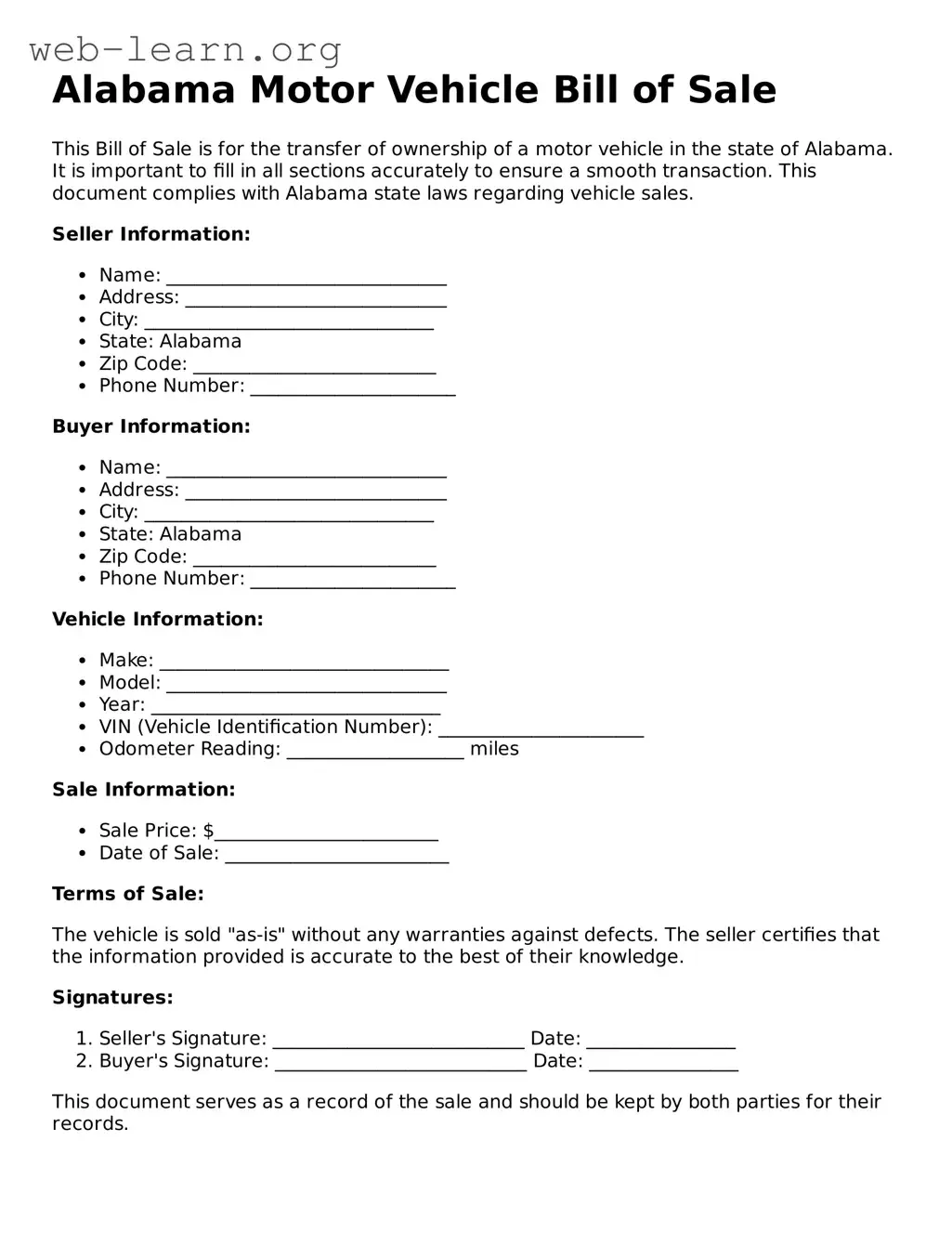
The Alabama Motor Vehicle Bill of Sale form serves as a crucial document in the transfer of ownership for motor vehicles within the state. This form captures essential details about the transaction, including the names and addresses of both the seller and the buyer, as well as the vehicle's identification number (VIN), make, model, and year. It also specifies the sale price and the date of the transaction, providing a clear record for both parties. This document not only protects the interests of the buyer and seller but also aids in the registration process with the Alabama Department of Revenue. Additionally, the form can include information about any liens on the vehicle, ensuring that the buyer is fully aware of any outstanding financial obligations. Properly completing this form is vital, as it lays the groundwork for a smooth transfer of ownership and helps prevent potential disputes in the future.
Alabama Motor Vehicle Bill of Sale
This Bill of Sale is for the transfer of ownership of a motor vehicle in the state of Alabama. It is important to fill in all sections accurately to ensure a smooth transaction. This document complies with Alabama state laws regarding vehicle sales.
Seller Information:
Buyer Information:
Vehicle Information:
Sale Information:
Terms of Sale:
The vehicle is sold "as-is" without any warranties against defects. The seller certifies that the information provided is accurate to the best of their knowledge.
Signatures:
This document serves as a record of the sale and should be kept by both parties for their records.
| Fact Name | Details |
|---|---|
| Purpose | The Alabama Motor Vehicle Bill of Sale form serves as a legal document to record the sale of a vehicle between a buyer and a seller. |
| Governing Law | This form is governed by Alabama state law, specifically the Alabama Code Title 32, Chapter 8. |
| Required Information | The form requires details such as the vehicle's make, model, year, VIN, and the sale price. |
| Signatures | Both the buyer and seller must sign the document to validate the transaction. |
| Date of Sale | The date of the transaction must be clearly indicated on the form. |
| Notarization | While notarization is not mandatory, it is recommended to enhance the document's credibility. |
| Transfer of Ownership | The Bill of Sale acts as proof of ownership transfer, which is essential for the buyer to register the vehicle. |
| Tax Implications | Sales tax may apply based on the sale price, and the buyer is responsible for paying this tax during registration. |
| Record Keeping | Both parties should retain a copy of the Bill of Sale for their records and future reference. |
| Availability | The form can typically be obtained online or at local DMV offices in Alabama. |
Filling out the Alabama Motor Vehicle Bill of Sale form is a straightforward process. Once completed, you can use this document to finalize the sale of a vehicle, ensuring both parties have a clear record of the transaction.
What is a Motor Vehicle Bill of Sale in Alabama?
A Motor Vehicle Bill of Sale is a legal document that records the sale of a vehicle between a buyer and a seller. This form provides proof of the transaction and details such as the vehicle's identification number (VIN), make, model, year, and the sale price. It is essential for both parties to keep a copy for their records.
Is a Bill of Sale required in Alabama?
While a Bill of Sale is not legally required for every vehicle sale in Alabama, it is highly recommended. This document serves as a receipt and can help resolve disputes regarding the transaction. Additionally, it may be required when registering the vehicle with the Alabama Department of Revenue.
What information is needed to complete the Bill of Sale?
To complete the Bill of Sale, you will need the following information:
Can I create my own Bill of Sale?
Yes, you can create your own Bill of Sale as long as it includes all the necessary information. However, using a standard form can ensure that you do not miss any important details. Various templates are available online for your convenience.
Do I need to have the Bill of Sale notarized?
Notarization is not required for a Bill of Sale in Alabama. However, having the document notarized can add an extra layer of protection and verification for both parties involved in the transaction.
What should I do after completing the Bill of Sale?
After completing the Bill of Sale, both the buyer and seller should sign the document. Each party should retain a copy for their records. The buyer will need this document when registering the vehicle with the state. It is also advisable to notify the local Department of Motor Vehicles (DMV) about the sale.
How does the Bill of Sale affect vehicle registration?
The Bill of Sale is an important document when registering a vehicle in Alabama. It serves as proof of ownership and the sale price, which may affect taxes. The buyer will need to present the Bill of Sale when applying for a title and registration with the DMV.
What if there are issues after the sale?
If issues arise after the sale, such as disputes over the vehicle's condition or ownership, the Bill of Sale can serve as a key piece of evidence. It is crucial to keep the document safe and refer to it if any disputes occur. In some cases, legal advice may be necessary to resolve the matter.
When filling out the Alabama Motor Vehicle Bill of Sale form, individuals often make several common mistakes that can lead to confusion or legal issues down the line. Understanding these pitfalls can help ensure a smoother transaction. One frequent error is failing to provide complete and accurate information about the vehicle. This includes details like the Vehicle Identification Number (VIN), make, model, and year. Omitting any of these can create problems when registering the vehicle or transferring ownership.
Another mistake involves not including the correct names of the buyer and seller. It’s essential that both parties’ names are written clearly and match the names on their identification documents. If there are discrepancies, it could complicate the ownership transfer. Additionally, using nicknames or abbreviations can lead to misunderstandings, so it’s best to stick to formal names.
Many people also overlook the importance of signing the form. Both the buyer and the seller must sign the document for it to be valid. A signature serves as an acknowledgment of the transaction and the terms agreed upon. Without signatures, the form lacks legal weight, which could lead to disputes later on.
Another common oversight is not including the date of the sale. This detail is crucial as it establishes when the transaction took place. Without a date, it may be challenging to resolve any disputes regarding the timing of ownership transfer or any associated responsibilities.
People sometimes forget to include the sale price of the vehicle. This figure is not only important for the transaction itself but also for tax purposes. The Alabama Department of Revenue requires accurate reporting of the sale price to assess taxes appropriately. Leaving this blank can lead to complications when filing taxes or registering the vehicle.
Additionally, individuals may neglect to provide information about any liens on the vehicle. If there is a loan or any other financial obligation attached to the vehicle, this must be disclosed. Failing to mention existing liens can result in legal repercussions for the seller and financial issues for the buyer.
Another mistake is not keeping a copy of the completed Bill of Sale. It’s essential for both parties to retain a copy for their records. This document serves as proof of the transaction and can be critical if any disputes arise later. Without a copy, individuals may find themselves without a record of the sale.
Finally, some people do not seek assistance when needed. If there’s any uncertainty about how to fill out the form correctly, it’s wise to consult with a professional or refer to official resources. Taking the time to ensure everything is filled out properly can save a lot of trouble in the future.
The Alabama Motor Vehicle Bill of Sale form serves as a crucial document in the transfer of ownership for vehicles. However, several other forms and documents are commonly used alongside it to ensure a smooth transaction and compliance with state regulations. Below is a list of these documents, each playing a vital role in the process.
Utilizing these documents alongside the Alabama Motor Vehicle Bill of Sale can help facilitate a legal and efficient transfer of vehicle ownership. Each form plays a specific role in ensuring that all parties are protected and that the transaction adheres to state laws.
When filling out the Alabama Motor Vehicle Bill of Sale form, it is important to follow certain guidelines to ensure accuracy and legality. Here are some recommendations:
Many people have misunderstandings about the Alabama Motor Vehicle Bill of Sale form. Here are some common misconceptions and clarifications to help clear things up:
Some believe that a Bill of Sale is optional. However, it is a crucial document that provides proof of the transaction between the buyer and seller.
While both documents are important, a Bill of Sale does not transfer ownership on its own. You must also complete a title transfer to officially change ownership.
Both the buyer and the seller should sign the Bill of Sale to ensure that both parties agree to the terms of the sale.
This is not true. A Bill of Sale can be used for both new and used vehicles to document the sale.
While you can draft your own, it’s important to follow Alabama’s guidelines to ensure the document is valid and includes all necessary information.
Even in private sales, having a Bill of Sale is important for legal protection and to establish ownership.
In Alabama, notarization is not mandatory for a Bill of Sale, but it can add an extra layer of security and authenticity.
Each state has its own requirements and forms. It’s best to use the specific Alabama Bill of Sale form to avoid complications.
When filling out and using the Alabama Motor Vehicle Bill of Sale form, keep these key points in mind:
Idaho Bill of Sale Pdf - It is advisable to keep a copy of the Bill of Sale for future reference.
Dmv Forms Colorado - In some cases, the Bill of Sale can also serve as a temporary title until the official title is transferred.
Car Bill of Sale Printable - Can be tailored to meet specific needs of the transaction.
Arkansas Dmv Online - For added security, both parties may want to exchange identification at the time of signing the Bill of Sale.